
A Kirschner wire (K-wire) is a thin, sharp-pointed orthopedic wire — typically 0.9 ถึง 2.5 mm in diameter in 304V or 316LVM stainless steel, with trocar, diamond or bayonet tip designs — used for fracture fixation, skeletal traction and temporary alignment in hand, foot, pediatric and trauma surgery. In the implant-and-instrument supply chain, “straightening a K-wire” means two different things, and this page is about the manufacturing one: producing and holding wire straightness on the finishing line, in straighten-and-cut cells, and during revalidation of finished goods. (The clinical act of bending a K-wire intraoperatively is a surgical technique, not an industrial process, and is outside our scope.)
A K-wire straightening solution has to answer five questions before machine selection:
- Is the process straightening coiled raw wire before cutting, or correcting cut wire blanks as a finishing/revalidation step?
- What straightness specification applies — and is it defined as chord deviation over a length, free-state bow on a surface plate, or curvature over a gauge length?
- Which material condition applies (อบอ่อน, work-hardened, or a temper that must not be altered) and what surface state (bright, passivated)?
- Which correction route preserves tip geometry, surface finish and mechanical properties — roll straightening in the unwind line, rotary straightening, or selective point-press for blanks?
- How will released straightness, tip condition, surface quality and freedom from kinks be verified under medical-device documentation?

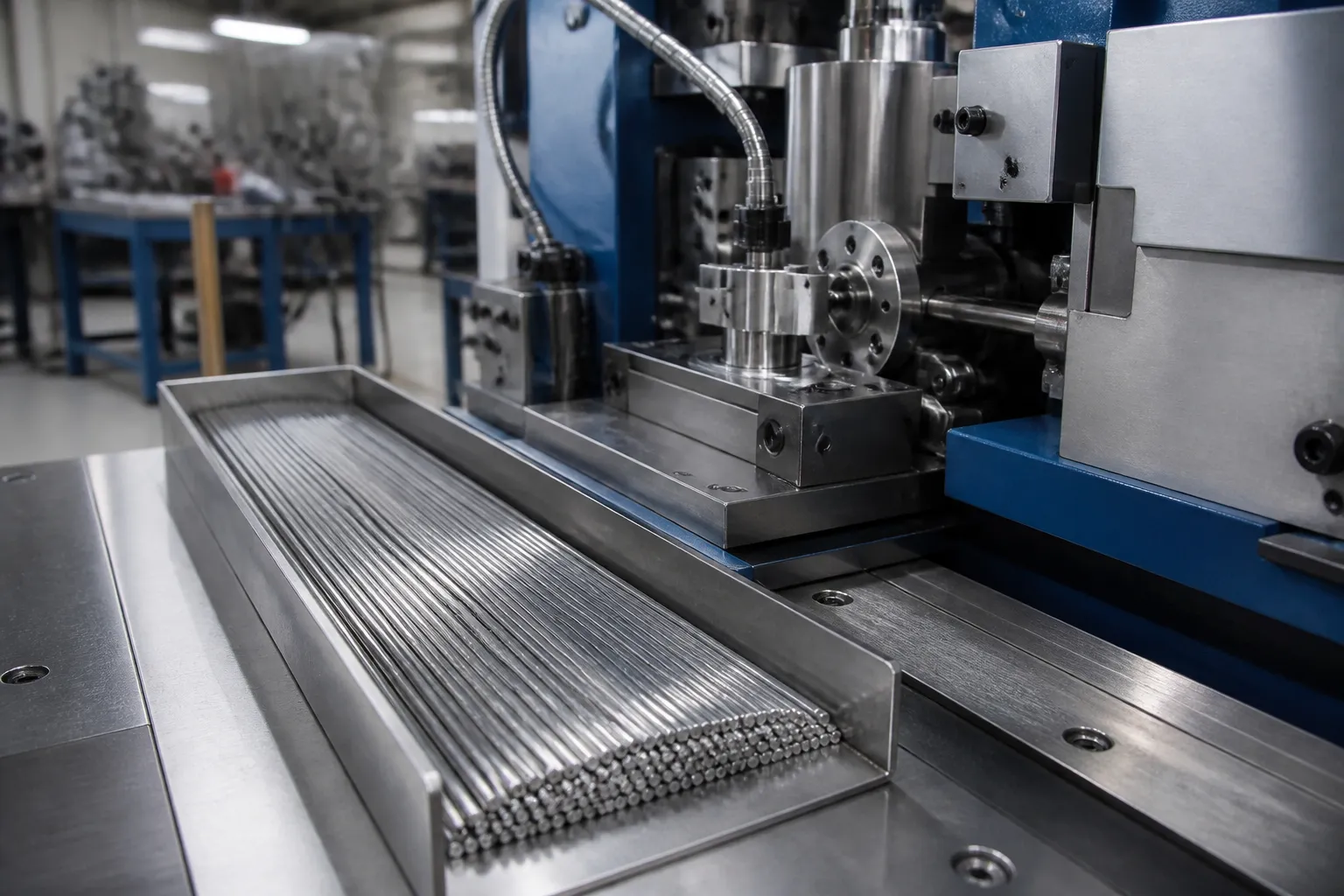
*Representative workshop photograph. Actual wire dimensions, materials and acceptance limits follow the device specification and a validated process study.*
Two Straightening Worlds on One Results Page
ผลลัพธ์ DataForSEO สำหรับ k-wire straightening mix hospital patient-leaflets about K-wire fixation surgery, AO surgical technique references, orthopedic instrument catalogs for wire benders, and general wire-straightening machine vendors. Nothing currently addresses the OEM question: how a K-wire manufacturer holds a straightness spec on fine stainless wire at production rate under medical quality systems. The engineering content for that question exists in fine-wire and cut-to-length practice — the choice between roll and rotary methods summarized in roll vs rotary wire straightening and the fine-wire process overview in fine stainless steel wire straightening and cutting.
| Process Location | เกิดอะไรขึ้น | Engineering Concern |
|---|---|---|
| Payoff and straighten-and-cut line | Coiled 304V/316LVM wire is uncoiled, straightened through roll or rotary tooling, and cut to length | Residual curvature from the coil; kink-free feeding; length and end-condition control |
| Blank finishing (grinding tips, threading) | Cut blanks get trocar/diamond tips; some get threading or flats | Handling straightness; no re-coiling of finished blanks |
| การตรวจสอบขั้นสุดท้าย / revalidation | Finished wires checked against straightness spec; occasional NOK disposition | Measurement definition; released-state verification; documentation |
| Point-repair of blanks | Selective correction of individual bowed blanks | Gentle point-press with soft tooling; tip and surface protection; limited correction count |
Define “Straight” Before Measuring Anything
Fine-wire straightness is one of the most commonly under-specified characteristics in device drawings. Three definitions circulate, and they are not interchangeable:
- chord deviation over length — maximum gap between the wire and a straight line (or a precision straightedge/surface plate) over a stated length, e.g. millimeters per 300 มม;
- free-state bow — the wire lying untouched on a flat plate under gravity, which mixes true curvature with gravity droop for very fine wires;
- curvature over a gauge length — local bend severity, which is what matters for kink detection.
The specification should also state the measurement condition: supported or free, rotation allowed or fixed, and at what point along the wire (tips excluded or included). A wire can pass a chord spec and still carry a short local kink near the tip that a surgeon will feel immediately. The same measurement-definition discipline discussed for tubes in loaded vs released straightness measurement applies: final acceptance must follow release, not the constrained in-process reading.

Material and Process Considerations
Raw Wire Condition
Coiled wire carries residual curvature from winding. The straighten-and-cut line removes it mechanically — without heat, without changing the temper the device designer specified. The line must be validated so that the process does not over-work the wire surface or introduce new residual stress that relaxes later into a visible bow in the sterile package.
Springback and Work Hardening
Austenitic stainless spring wire springs back strongly and work-hardens further with each correction cycle. For production the answer is a stable, validated line setting; for point repair the answer is small incremental corrections with a documented maximum count per blank — repeated press-and-check on the same wire is both a quality and a process-validation problem. The compensation logic is the same as in การชดเชยสปริงกลับของการยืดเพลา, scaled to fine wire.
Surface and Tip Protection
K-wire function depends on a bright, defect-free surface and a sharp, correctly formed tip. All straightening tooling contacting the wire — rolls, คำแนะนำ, anvils, supports — must be engineered so that no scratches, die marks or burnish bands are introduced, following the contact-stress discipline of surface-protection tooling in straightening. Tips never contact tooling at all. The same protection-first thinking used for medical mandrel straightening applies to finished-wire handling.

Choosing the Route: Line Straightening vs Blank Correction
| วิธี | Best Fit | การควบคุมหลัก | อย่าคาดเดา |
|---|---|---|---|
| Roll straightening in the payoff line | Continuous production from coil | Roll set geometry, ระยะห่าง, ความเร็ว, tension | One setting fits all diameters or tempers |
| Rotary straightening | Round wire needing uniform residual-stress relief | Rotary angle, ความเร็ว, feed rate | It improves tips or cut-end quality — it does not touch them |
| Point-press on individual blanks | Revalidation and NOK rework of cut blanks | Force ceiling, soft tooling, จำนวนการแก้ไข | It is a substitute for a validated line — it is a disposition tool |
| Rejection | Kinks, ข้อบกพร่องที่พื้นผิว, tip damage, over-corrected blanks | Defined disposition rules | Every bowed blank is reworkable |
Closed-Loop Process (Finishing and Revalidation)
- Identify the wire: โลหะผสม, อารมณ์, เส้นผ่านศูนย์กลาง, tip style, drawing/spec revision, lot.
- Inspect incoming blanks or line output: พื้นผิว, tips, cut ends, visible kinks.
- Qualify measurement: specified definition, วัด, supported state, repeatability on a golden sample.
- Map straightness by section over the specified length; flag local curvature separately from global bow.
- Classify deviations: coil-memory bow (line tuning), หงิกงอในท้องถิ่น (usually reject), tip-area bend (disposition per rules).
- Correct only approved cases: line adjustment for bow trends, gentle point-press with soft tooling for individual blanks within the correction-count limit.
- ปล่อย, allow stabilization, then remeasure under the acceptance condition.
- Verify surface and tip condition after any handling.
- Record measurements, การตั้งค่า, counts and disposition for lot traceability.
Acceptance and Validation Gates
- straightness per the specified definition, measured released, on a qualified gauge with a golden-sample correlation;
- no local kinks above the curvature limit, checked separately from global bow;
- สภาพพื้นผิว: no new scratches, die marks or burnish bands;
- tip geometry and sharpness unchanged;
- correction count per blank within the validated maximum;
- measurement system qualified (repeatability on fine wire is nontrivial — apply the discipline of เกจ อาร์&R สำหรับการยืดเส้นตรง);
- disposition rules for NOK defined before production, following ขีดจำกัดการเรียงลำดับและการทำงานซ้ำของ NOK.
Common Pitfalls in K-Wire Straightening
- An under-defined straightness spec. “Straight” without a definition, a length basis and a measurement state is unenforceable: suppliers and QA measure different things and both pass. Fix the definition first; machines come second.
- Conflating global bow with a local kink. A chord-deviation measurement can pass a wire that carries a short sharp kink near the tip — the defect a surgeon notices first. Kink detection is a separate curvature check.
- One line setting for every diameter and temper. Residual curvature, springback and work-hardening response all change with wire diameter and temper. Each combination needs its own validated setting; interpolated settings are a bet, not a process.
- Accepting in-line readings as final. The constrained wire inside the straightener reads flat. Residual stress relaxes after cutting and during storage; acceptance follows release, after a defined stabilization interval, on a sample of cut blanks.
- Rework without a count limit. Point-pressing a bowed blank repeatedly cold-works the same zone; the wire stiffens, then fails handling or fatigue checks in ways nobody connects to straightening. Cap and record corrections per blank.
- Tooling marks on bright wire. Worn rolls or guides leave circumferential marks or burnish bands that pass a caliper and fail a surface inspection under magnification. Tooling condition is part of the validated process state.
- Packaging that re-bends the product. A perfectly straight wire stored curved in its tray is curved when opened. Package configuration belongs in the straightness validation scope, not just sterilization validation.
ข้อมูลที่จำเป็นสำหรับข้อเสนอทางเทคนิค
- wire specification: alloy and grade (เช่น, 304วี, 316LVM), อารมณ์, diameter range;
- tip designs (trocar, diamond, bayonet) and how tips are produced;
- straightness specification with its exact definition, length basis and measurement state;
- kink/curvature limit if specified separately;
- cut lengths and length tolerances;
- line rate (เมตร/นาที) and shift pattern for production lines, or daily blank volumes for revalidation cells;
- surface finish and passivation requirements;
- measurement method in use today and its known weaknesses;
- stabilization and packaging constraints;
- quality-system documentation requirements (IQ/OQ/PQ expectations, การตรวจสอบย้อนกลับ, lot records);
- NOK disposition rules in force;
- representative wire samples for trials.
คำถามที่พบบ่อย
Can finished K-wires be straightened if they bow in stock?
Sometimes, within a validated rework window: gentle point-press correction with soft tooling, a documented maximum correction count, and full re-inspection of straightness, surface and tip. A kinked or surface-damaged wire is rejected, not reworked.
Why do wires that passed inspection bow later in the package?
Usually residual stress relaxing after straightening, or packaging/handling that stores the wire bent. The countermeasures are a line validated for stress relief stability, released-state acceptance after a defined stabilization interval, and package validation that does not impose curvature.
Does straightening change the wire’s mechanical properties?
Mechanical straightening is cold work. In production the line is validated so the delivered temper meets specification; in rework, the correction count is capped so the work-hardening contribution stays inside the validated envelope. Neither is a free-for-all bending operation.
How is straightness actually measured on sub-millimeter wire?
Typically as chord deviation over a stated length on a qualified straightedge or surface plate, or with non-contact sensors in the line, with the measurement condition defined and a golden sample controlling method repeatability. The spec must define the state (free vs supported) because gravity affects very fine wires.
Build the Solution Around the Specification
We develop K-wire and fine medical wire straightening solutions around the actual specification, alloy and temper, line rate and documentation requirements. Related processes: the medical wire hub on our medical device solutions pages, ที่ small-diameter medical drill straightening solution, และ medical mandrel straightening solution.
Send the wire specification (โลหะผสม, อารมณ์, เส้นผ่านศูนย์กลาง, tip design), the straightness definition and acceptance method, line rate and cut-length requirements, and representative samples. จากนั้นเราสามารถกำหนดกลยุทธ์การวัดผลได้, straightening route, tooling map and traceable acceptance plan for your K-wire application.