
ในอุตสาหกรรมการผลิตสปริง, การดัดด้วยสลักเกลียวยาวหลังจากการอบชุบถือเป็นปัญหาสากล. แบบดั้งเดิม “การตอกด้วยมือ” ไม่เพียงแต่ไม่มีประสิทธิภาพเท่านั้น แต่ยังไม่สามารถรับประกันความแม่นยำที่สม่ำเสมออีกด้วย. บทความนี้แบ่งปันความเชี่ยวชาญ โซลูชันการยืดโบลต์อัตโนมัติ: demonstrating a reported client case in which automation took an 8-person manual line to one operator supervising four machines, with straightness held within 0.1 mm on the client’s acceptance records.
What is the Bolt?
โบลท์เป็นตัวยึดพื้นฐานสำหรับเครื่องจักร, การก่อสร้าง, และอุตสาหกรรมยานยนต์. ชิ้นงานทั่วไปสำหรับโซลูชันนี้คือสลักเกลียวยาวที่มีความแข็งแรงสูง: 15เส้นผ่านศูนย์กลางมม, 340ความยาวมม.
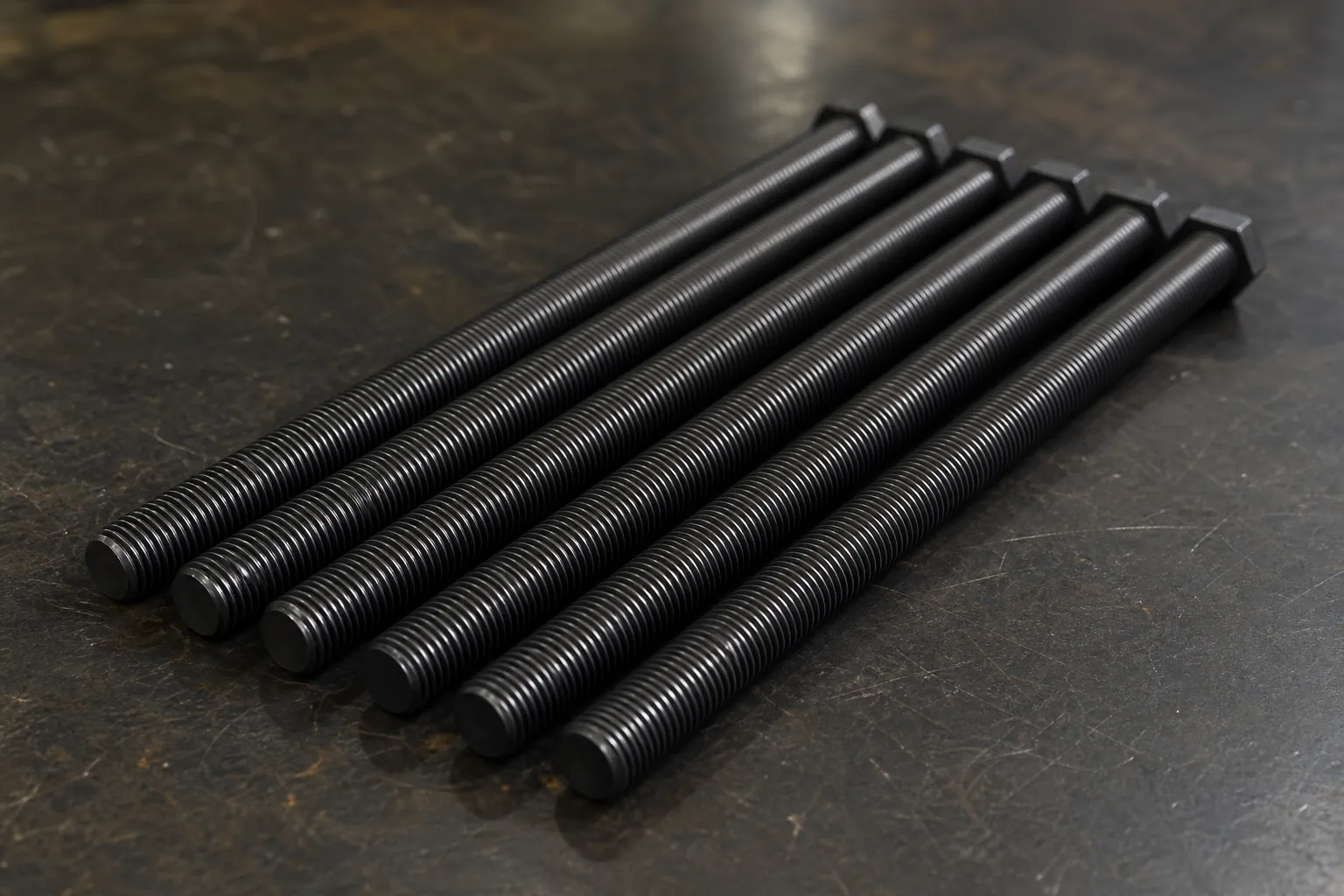
ลักษณะโครงสร้างและความท้าทาย
- อัตราส่วน L/D สูง: ความยาว 340 มม. ทำให้โบลต์มีความไวสูงต่อการโค้งงอเริ่มต้นที่ 0.5 มม – 1.5มม. หลังการให้ความร้อน.
- ข้อกำหนดที่แม่นยำ: The client required straightness within 0.2 มม; the case acceptance records were held under 0.1 มม.
- ข้อกำหนดการป้องกัน: กระบวนการยืดผมต้องรับประกันความเสียหายเป็นศูนย์ต่อความแม่นยำของเกลียวและคุณภาพพื้นผิว.
Why Heat Treatment Bends Long Bolts in the First Place
Understanding the distortion source is what makes a correction process defensible instead of decorative. During quenching, a long fastener cools unevenly: the section cools at different rates depending on orientation in the basket or fixture, agitation contact, and local mass differences between the plain shank, the threaded length and the head. Each cooling path wants to contract by a different amount, and the resulting locked-in stresses bend the part when it relaxes. The effect scales with length — which is why short bolts leave heat treatment usable while long ones of the same grade systematically arrive bent. Thread rolling and machining before treatment add their own stress history, and any straightening performed at the heat treater counts as prior deformation for everything done afterward.
Two practical consequences follow. อันดับแรก, incoming inspection on long heat-treated bolts is not optional paperwork — the bend magnitude and pattern arriving at the straightening station determine both the correction plan and any supplier conversation, and the interaction of prior deformation with correction response is the reason reverse-loading behavior matters, as covered under Bauschinger effect ในการยืดผม. ที่สอง, process decisions upstream — how parts are racked or basketed through quench, whether stress relief is applied — change the distribution the straightening station sees, and are usually the cheapest place to reduce total correction work.
Reading the Bend Before Correcting It
Long fasteners arrive with a small vocabulary of bend patterns, and naming the pattern is the first step of an efficient correction loop. A single-arc bow — one gentle curve, maximum near the middle — is the most common heat-treatment signature and the most straightforward to correct with supports positioned around the peak. An S-shaped double bend has two opposite peaks, usually reflecting two constraint points during quench, and demands two coordinated corrections rather than one big press at the largest reading. A local kink near the head or the thread runout concentrates distortion where section stiffness changes, and behaves differently from a distributed bow. ในที่สุด, twist about the axis occasionally accompanies bending on parts with asymmetric features. Each pattern requires its own measurement map and correction sequence, which is why an automatic station that scans the full length and builds the map before pressing — rather than chasing the single worst reading — converges in fewer strokes. The measuring-and-correcting loop behind this is described for automatic shaft straightening generally, and for the long-bolt family specifically in the กระบวนการยืดโบลต์ยาวอัตโนมัติ.
เหตุใดการยืดโบลท์จึงต้องเคลื่อนตัวออกห่างจาก “การตอกด้วยมือ”
กระบวนการแบบดั้งเดิมเทียบกับ. โซลูชั่นอัตโนมัติ
The figures below are this client’s reported baseline and post-commissioning values, not a universal benchmark for every fastener line.
| จุดปวด | การตอกด้วยมือ / กดด้วยตนเอง | โซลูชันการยืดผมอัตโนมัติ |
| ความต้องการแรงงาน | 8 workers per shift (manual baseline, reported case) | 1 ตัวดำเนินการสำหรับ 4 เครื่องจักร (reported case) |
| ความตรง | 0.2 – 0.5 mm spread (reported manual baseline) | ≤ 0.1 มม (client acceptance records) |
| รอบเวลา | 120 – 180 ชิ้น/ชิ้น (reported manual baseline) | 10 – 15 ชิ้น/ชิ้น (reported case) |
| ค่าใช้จ่ายโดยรวม | High labor cost per corrected part | Manpower reduced from 8 operators to 1 supervising 4 เครื่องจักร (reported case) |
ผังกระบวนการยืดโบลต์แบบอัตโนมัติ
โซลูชันนี้ครอบคลุมกระบวนการอัตโนมัติแบบวงปิดตั้งแต่การป้อนไปจนถึงการคัดแยก, ตรวจสอบให้แน่ใจว่าสลักเกลียวทุกตัวตรงตามข้อกำหนดการจัดส่งที่มีมาตรฐานสูง.
คำอธิบายกระบวนการหลัก
- การให้อาหารอัตโนมัติ: สลักเกลียวที่โค้งงอจะถูกป้อนโดยอัตโนมัติจากฮอปเปอร์ไปยังสถานียืดผม โดยปราศจากการแทรกแซงของมนุษย์.
- การวัดแบบไดนามิก: เซ็นเซอร์ความแม่นยำสูงจะสแกนชิ้นงานที่หมุนแบบเรียลไทม์, จับจุดโค้งงอสูงสุดตลอดความยาวได้อย่างแม่นยำ.
- การกดเซอร์โว: ระบบอัจฉริยะจะคำนวณสปริงกลับโดยอัตโนมัติตามวัสดุ (เหล็กกล้าคาร์บอน / โลหะผสมเหล็ก), และเซอร์โวแรมใช้แรงกดที่แม่นยำสำหรับการแก้ไขรอบเดียว.
- การเรียงลำดับอัตโนมัติ: สลักเกลียวที่ผ่านการรับรองไปยังขั้นตอนต่อไป, while non-conforming parts are automatically isolated before they leave the machine.

เครื่องยืดโบลท์ UBJ-80
เครื่องหนีบผมนี้เหมาะอย่างยิ่งสำหรับชิ้นส่วนที่ผ่านการอบชุบด้วยความร้อน (เช่น, ส่วนประกอบเครื่องปั๊ม/สำนักงาน, ชิ้นส่วนรถยนต์/รถจักรยานยนต์, เครื่องมือ, สกรู) และบาร์ (เหล็ก, ทองแดง, อลูมิเนียม, สแตนเลส, โลหะผสมไทเทเนียม) ความยาว 60–600 มม & เส้นผ่านศูนย์กลาง φ3–φ25มม. ช่วยเพิ่มทั้งความแม่นยำและคุณภาพของผลิตภัณฑ์.
ความท้าทายและแนวทางแก้ไขในการยืดแกนกลางลำตัวให้ตรง
ท้าทาย 1: Manning and the Reported “1 ผู้ประกอบการสำหรับ 4 เครื่องจักร” Case
คำอธิบายปัญหา: Manual hammering and press correction depend on operator skill, stamina and shift discipline, so manning levels stay high and results vary from operator to operator.
สารละลาย:
โซลูชันของเรานำไปใช้งาน ระบบอัตโนมัติแบบวงปิดเต็มรูปแบบ. ตรรกะการดำเนินการนั้นง่ายมาก, พร้อมสูตรในตัวสำหรับสเปคโบลท์ต่างๆ. พนักงานมาตรฐานจำเป็นต้องเติมถังบรรจุเป็นระยะเท่านั้น; ส่วนที่เหลือ—การวัด, ยืดผม, และการตรวจสอบ—ได้รับการจัดการโดยอัตโนมัติโดยเครื่องจักร. ซึ่งจะช่วยแก้ปัญหาการขาดแคลนแรงงานและกำจัดการตกหล่นที่เกิดจากความเหนื่อยล้า.
ท้าทาย 2: รับประกันความสม่ำเสมอภายในความแม่นยำ 0.1 มม
คำอธิบายปัญหา: เมื่อสายฟ้าถูกกระแทก, การกระจายความเครียดภายในไม่สม่ำเสมอ, มักนำไปสู่การแก้ไขมากเกินไปในพื้นที่ที่มีการแปล.
สารละลาย:
โซลูชันนี้ใช้ก ระบบควบคุมเซอร์โวแบบกำหนดพารามิเตอร์ได้ครบถ้วน. ต่างจากการตัดสินของมนุษย์ที่คลุมเครือ, เซ็นเซอร์ตรวจจับส่วนโค้งตามแนวแกนของสลักเกลียวด้วยความแม่นยำระดับไมครอน. ผ่านอัลกอริธึมเซอร์โวแบบหลายขั้นตอน, ระบบสามารถเอาชนะสปริงด้านหลังยืดหยุ่นของ S45C หรือเหล็กโลหะผสมได้อย่างแม่นยำ, locking final straightness within the 0.1 mm window achieved on this client’s qualified recipe.
How Thread and Head Zones Are Protected During Correction
Thread protection is a contact-zone engineering problem, and the principles are the same ones that govern surface-protection tooling across straightening applications. The correction force and the reaction forces both need somewhere to live, and on a long bolt the plain shank is the region designed to carry load, while the threaded length and the under-head fillet are the regions most easily damaged. A protection concept therefore has three parts: place supports on the shank at controlled span positions around the bend peak; direct press contact onto the shank through tooling that conforms to the section instead of touching thread crests; and keep every edge that could contact the workpiece generously radiused so load spreads instead of concentrating. Cleanliness belongs in the same sentence — debris trapped between press tooling and a thread flank is a scratch generator, and on plated or coated bolts the coating class defines how much contact the finish can tolerate at all.
The validation side is equally concrete. A thread-protection claim is proven by inspection agreed before the trial — thread gauges still running, flank condition reviewed under the method the quality function specifies — together with the released-state straightness result, on representative parts, after repeat setups. Protection and geometry are accepted together or not at all.
What an Acceptance Criteria Package Should Contain
A bolt straightening process is only as good as the acceptance definition it answers to, and a complete one answers five questions in writing. What characteristic governs — straightness of the axis, measured how: on centers, on supports, หมุน, in what condition, since a reading under restraint is not a released result, ต่อ การฝึกปฏิบัติการวัดแบบโหลดเทียบกับแบบปล่อย. What the limit is, and where it applies — full length or specified spans. What else must survive the process — thread fit, การตกแต่งพื้นผิว, การเคลือบ, head markings. How conformity is sampled — every part through an automatic gauge, or a sampling plan with defined reaction to a failure. And what happens to nonconforming parts — rework limits, segregation and disposition authority, following the NOK sorting and rework-limit framework. Buyers comparing straightening suppliers are well advised to ask for exactly this package; the ability to produce it says more about a supplier than any single machine specification.
กรณีการผลิต: ตัวเลือกที่สี่ของลูกค้าชาวอินเดีย
ความเป็นมาของลูกค้า
ซัพพลายเออร์อุปกรณ์ยึดที่มีชื่อเสียงของอินเดียซึ่งจัดหาส่วนประกอบให้กับแบรนด์เครื่องจักรก่อสร้างระดับโลก.
ผลการดำเนินงาน
- สั่งซ้ำ: โดยพิจารณาจากผลงานที่โดดเด่นของสามหน่วยแรก, ลูกค้าเพิ่งซื้อของมา 4เครื่องนั้น.
- Operator Consolidation: The client reported one operator managing all 4 machines after commissioning, with a substantial increase in output per operator.
- เกณฑ์มาตรฐานคุณภาพ: The client’s records report straightness moving from 0.2 mm down to under 0.1 mm after commissioning.
คำถามที่พบบ่อย
- ถาม: แกนยืดผมจะทำให้เกลียวโบลต์เสียหายหรือไม่?
- เลขที่. เราได้ออกแบบ ไม่ติดต่อ, แม่พิมพ์ป้องกันเบาะ สำหรับการยืดสลักเกลียวโดยเฉพาะ. บล็อกกดเข้ากับความโค้งของสลักเกลียวได้อย่างสมบูรณ์แบบ, รับประกันการกระจายแรงที่สม่ำเสมอและหลีกเลี่ยงการเยื้องพื้นผิว.
- ถาม: อุปกรณ์สามารถรวมเข้ากับระบบ MES ของโรงงานของเราได้หรือไม่?
- ใช่. ระบบควบคุมของเรามีอินเทอร์เฟซข้อมูลมาตรฐานเพื่อบันทึกและส่งออกข้อมูลการยืดตรงแบบเรียลไทม์สำหรับสลักเกลียวทุกตัว, ตรงตามข้อกำหนดการตรวจสอบย้อนกลับที่ทันสมัย.
Additional Process Questions
Why do bolts from the same heat-treatment lot arrive with different bend patterns?
Because each part’s position in the basket or rack gave it a different cooling path. Quench distortion is sensitive to orientation, local mass and agitation contact, so even identical bolts leave treatment with different locked-in stress patterns. Mapping incoming parts rather than assuming a uniform error is the practical answer, and it is why scanning-based stations build a per-part correction plan.
How many correction passes does a long bolt need?
It depends on the pattern, not a fixed number. A single-arc bow typically converges in one planned press; an S-bend needs two coordinated corrections; local kinks near section changes respond differently again. The governing rule is a rework limit set before production — parts that stop responding are routed to review, not pressed repeatedly, because each additional plastic cycle consumes fatigue life and changes the material’s response.
Should straightening come before or after thread rolling?
The route belongs to the fastener process engineer, but the trade-off is explicit: correcting before thread rolling lets subsequent operations work from a straight blank, while correcting after heat treatment with finished threads demands the contact-zone protection described above. Whichever route is chosen, the acceptance package must define what state the straightness limit applies to, and the correction validation must be run on parts carrying that state.
สรุป
สำหรับโรงงาน Fastener ที่มีประสิทธิภาพและคุณภาพสูง, หนึ่ง โซลูชันการยืดโบลต์อัตโนมัติ เป็นเส้นทางสำคัญในการเพิ่มขีดความสามารถในการแข่งขัน. Whether the target is lower manning or 0.1 mm delivery precision, the figures in this article are one client’s reported case; your own results depend on the bolt family, incoming distortion and acceptance definition.
Moving from manual bolt correction toward automation? ที่ manual vs automatic selection logic และ กรณี ROI สำหรับการยืดผมอัตโนมัติ เป็นขั้นตอนต่อไปตามธรรมชาติ.
หากคุณกำลังประสบปัญหาด้านการจัดการแรงงานหรือปัญหาคอขวดที่มีความแม่นยำ, รู้สึกอิสระที่จะ ติดต่อเรา สำหรับข้อเสนอทางเทคนิคที่กำหนดเอง.