
Trong ngành sản xuất dây buộc, uốn cong các bu lông dài sau khi xử lý nhiệt là một vấn đề phổ biến. Truyền thống “đập bằng tay” không chỉ không hiệu quả mà còn không đảm bảo độ chính xác nhất quán. Bài viết này chia sẻ một chuyên ngành Giải pháp nắn thẳng bu lông tự động: demonstrating a reported client case in which automation took an 8-person manual line to one operator supervising four machines, with straightness held within 0.1 mm on the client’s acceptance records.
What is the Bolt?
Bu lông là ốc vít nền tảng cho máy móc, sự thi công, và ngành công nghiệp ô tô. Phôi điển hình cho giải pháp này là bu lông dài có độ bền cao: 15đường kính mm, 340chiều dài mm.
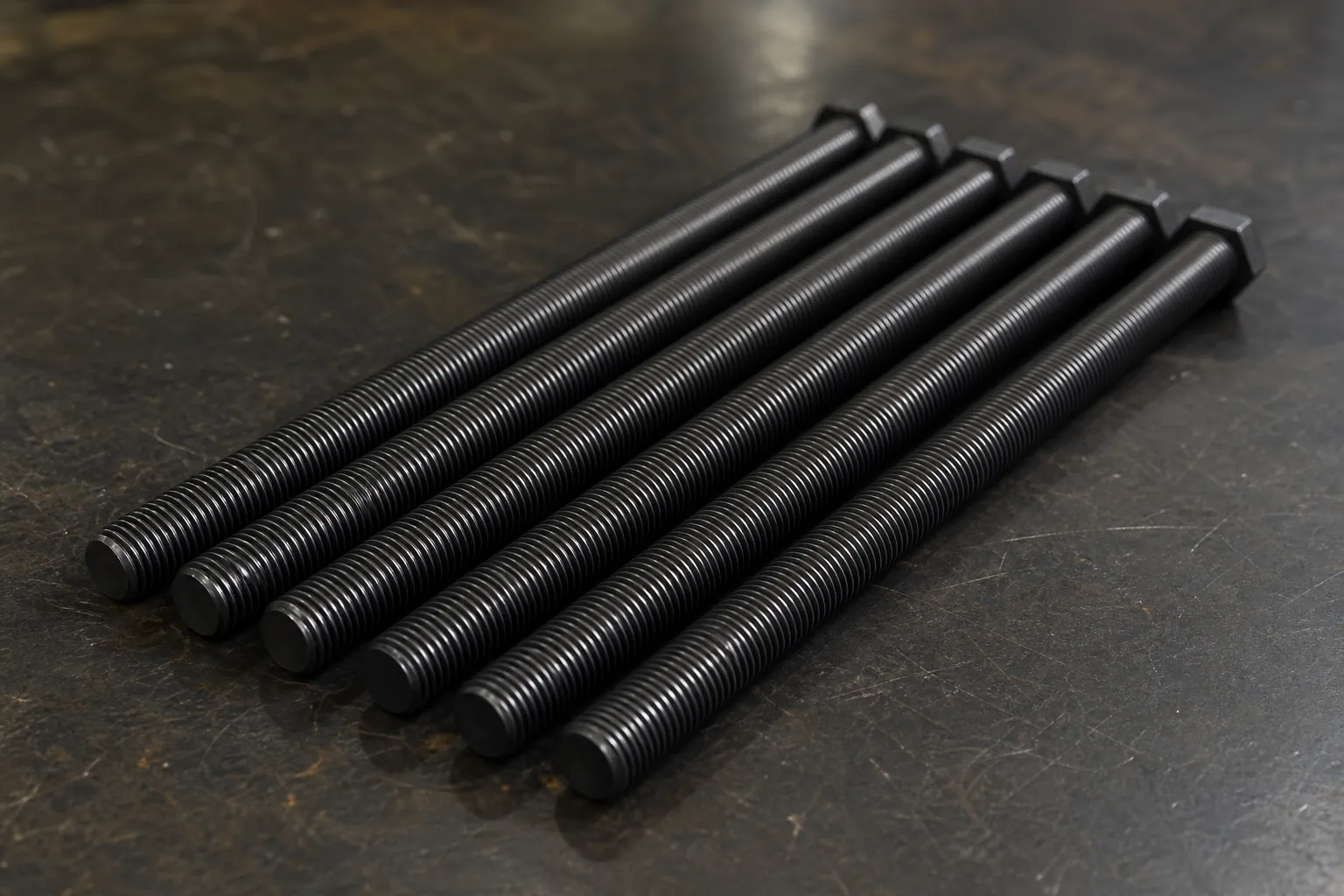
Đặc điểm cấu trúc và thách thức
- Tỷ lệ L/D cao: Chiều dài 340mm khiến bu-lông rất dễ bị uốn cong ban đầu 0,5mm – 1.5mm sau khi xử lý nhiệt.
- Yêu cầu về độ chính xác: The client required straightness within 0.2 mm; the case acceptance records were held under 0.1 mm.
- Yêu cầu bảo vệ: Quá trình làm thẳng phải đảm bảo không làm hỏng độ chính xác của ren và chất lượng bề mặt.
Why Heat Treatment Bends Long Bolts in the First Place
Understanding the distortion source is what makes a correction process defensible instead of decorative. During quenching, a long fastener cools unevenly: the section cools at different rates depending on orientation in the basket or fixture, agitation contact, and local mass differences between the plain shank, the threaded length and the head. Each cooling path wants to contract by a different amount, and the resulting locked-in stresses bend the part when it relaxes. The effect scales with length — which is why short bolts leave heat treatment usable while long ones of the same grade systematically arrive bent. Thread rolling and machining before treatment add their own stress history, and any straightening performed at the heat treater counts as prior deformation for everything done afterward.
Two practical consequences follow. Đầu tiên, incoming inspection on long heat-treated bolts is not optional paperwork — the bend magnitude and pattern arriving at the straightening station determine both the correction plan and any supplier conversation, and the interaction of prior deformation with correction response is the reason reverse-loading behavior matters, as covered under hiệu ứng Bauschinger trong việc làm thẳng. Thứ hai, process decisions upstream — how parts are racked or basketed through quench, whether stress relief is applied — change the distribution the straightening station sees, and are usually the cheapest place to reduce total correction work.
Reading the Bend Before Correcting It
Long fasteners arrive with a small vocabulary of bend patterns, and naming the pattern is the first step of an efficient correction loop. A single-arc bow — one gentle curve, maximum near the middle — is the most common heat-treatment signature and the most straightforward to correct with supports positioned around the peak. An S-shaped double bend has two opposite peaks, usually reflecting two constraint points during quench, and demands two coordinated corrections rather than one big press at the largest reading. A local kink near the head or the thread runout concentrates distortion where section stiffness changes, and behaves differently from a distributed bow. Cuối cùng, twist about the axis occasionally accompanies bending on parts with asymmetric features. Each pattern requires its own measurement map and correction sequence, which is why an automatic station that scans the full length and builds the map before pressing — rather than chasing the single worst reading — converges in fewer strokes. The measuring-and-correcting loop behind this is described for automatic shaft straightening generally, and for the long-bolt family specifically in the automatic long bolt straightening process.
Tại sao việc làm thẳng bu lông phải tránh xa “Búa thủ công”
Quy trình truyền thống vs. Giải pháp tự động
The figures below are this client’s reported baseline and post-commissioning values, not a universal benchmark for every fastener line.
| Điểm đau | Búa thủ công / Bấm thủ công | Giải pháp làm thẳng tự động |
| Yêu cầu lao động | 8 workers per shift (manual baseline, reported case) | 1 toán tử cho 4 máy móc (reported case) |
| Độ thẳng | 0.2 – 0.5 mm spread (reported manual baseline) | ≤ 0,1mm (client acceptance records) |
| Thời gian chu kỳ | 120 – 180 s/mảnh (reported manual baseline) | 10 – 15 s/mảnh (reported case) |
| Tổng chi phí | High labor cost per corrected part | Manpower reduced from 8 operators to 1 supervising 4 máy móc (reported case) |
Quy trình làm thẳng bu lông tự động
Giải pháp này bao gồm toàn bộ quy trình tự động khép kín từ cấp liệu đến phân loại, đảm bảo mọi bu lông đều đáp ứng yêu cầu giao hàng tiêu chuẩn cao.
Mô tả quy trình cốt lõi
- Tự động cho ăn: Bu lông uốn cong được tự động đưa từ phễu vào trạm làm thẳng mà không cần sự can thiệp của con người.
- Đo động: Cảm biến có độ chính xác cao quét phôi quay trong thời gian thực, nắm bắt chính xác điểm uốn tối đa trên toàn bộ chiều dài.
- ép servo: Hệ thống thông minh tự động tính toán độ đàn hồi dựa trên vật liệu (thép cacbon/thép hợp kim), và ram servo áp dụng áp suất chính xác để hiệu chỉnh một lần.
- Tự động sắp xếp: Bu lông đủ tiêu chuẩn tiến tới giai đoạn tiếp theo, while non-conforming parts are automatically isolated before they leave the machine.

Máy nắn bu lông UBJ-80
Máy ép tóc này lý tưởng cho các bộ phận đã hoàn thiện được xử lý nhiệt (ví dụ., linh kiện máy dập/văn phòng, phụ tùng ô tô/xe máy, công cụ, ốc vít) và quán bar (thép, đồng, nhôm, thép không gỉ, hợp kim titan) có chiều dài 60–600mm & đường kính φ3–φ25mm. Nó tăng cường cả độ chính xác và chất lượng sản phẩm.
Những thách thức và giải pháp làm thẳng cốt lõi
Thử thách 1: Manning and the Reported “1 Toán tử cho 4 Máy móc” Case
Mô tả vấn đề: Manual hammering and press correction depend on operator skill, stamina and shift discipline, so manning levels stay high and results vary from operator to operator.
Giải pháp:
Giải pháp của chúng tôi thực hiện tự động hóa vòng kín hoàn toàn. Logic hoạt động cực kỳ đơn giản, với các công thức tích hợp sẵn cho các thông số kỹ thuật bu lông khác nhau. Một công nhân tiêu chuẩn chỉ cần đổ đầy phễu định kỳ; phần còn lại—đo lường, làm thẳng, và kiểm tra—được xử lý tự động bởi máy. Điều này giải quyết tình trạng thiếu lao động và loại bỏ sự sụt giảm độ chính xác do mệt mỏi.
Thử thách 2: Đảm bảo tính nhất quán trong phạm vi chính xác 0,1mm
Mô tả vấn đề: Khi bu lông bị búa đập, sự phân bố ứng suất bên trong trở nên không đồng đều, thường dẫn đến sự điều chỉnh quá mức ở các khu vực cục bộ.
Giải pháp:
Giải pháp sử dụng một hệ thống điều khiển servo được tham số hóa đầy đủ. Không giống như sự phán xét mơ hồ của con người, cảm biến phát hiện đường cong trục của bu lông với độ chính xác ở mức micron. Thông qua các thuật toán servo nhiều bước, hệ thống khắc phục chính xác lò xo đàn hồi của S45C hoặc thép hợp kim, locking final straightness within the 0.1 mm window achieved on this client’s qualified recipe.
How Thread and Head Zones Are Protected During Correction
Thread protection is a contact-zone engineering problem, and the principles are the same ones that govern surface-protection tooling across straightening applications. The correction force and the reaction forces both need somewhere to live, and on a long bolt the plain shank is the region designed to carry load, while the threaded length and the under-head fillet are the regions most easily damaged. A protection concept therefore has three parts: place supports on the shank at controlled span positions around the bend peak; direct press contact onto the shank through tooling that conforms to the section instead of touching thread crests; and keep every edge that could contact the workpiece generously radiused so load spreads instead of concentrating. Cleanliness belongs in the same sentence — debris trapped between press tooling and a thread flank is a scratch generator, and on plated or coated bolts the coating class defines how much contact the finish can tolerate at all.
The validation side is equally concrete. A thread-protection claim is proven by inspection agreed before the trial — thread gauges still running, flank condition reviewed under the method the quality function specifies — together with the released-state straightness result, on representative parts, after repeat setups. Protection and geometry are accepted together or not at all.
What an Acceptance Criteria Package Should Contain
A bolt straightening process is only as good as the acceptance definition it answers to, and a complete one answers five questions in writing. What characteristic governs — straightness of the axis, measured how: on centers, on supports, quay, in what condition, since a reading under restraint is not a released result, mỗi loaded versus released measurement practice. What the limit is, and where it applies — full length or specified spans. What else must survive the process — thread fit, bề mặt hoàn thiện, lớp phủ, head markings. How conformity is sampled — every part through an automatic gauge, or a sampling plan with defined reaction to a failure. And what happens to nonconforming parts — rework limits, segregation and disposition authority, following the NOK sorting and rework-limit framework. Buyers comparing straightening suppliers are well advised to ask for exactly this package; the ability to produce it says more about a supplier than any single machine specification.
Trường hợp sản xuất: Lựa chọn thứ tư của khách hàng Ấn Độ
Bối cảnh khách hàng
Nhà cung cấp ốc vít nổi tiếng của Ấn Độ cung cấp linh kiện cho các thương hiệu máy móc xây dựng toàn cầu.
Kết quả thực hiện
- Lặp lại đơn hàng: Dựa trên thành tích nổi bật của 3 đơn vị đầu tiên, khách hàng gần đây đã mua 4cái máy.
- Operator Consolidation: The client reported one operator managing all 4 machines after commissioning, with a substantial increase in output per operator.
- Điểm chuẩn chất lượng: The client’s records report straightness moving from 0.2 mm down to under 0.1 mm after commissioning.
Câu hỏi thường gặp
- Q: Ram thẳng có làm hỏng ren bu lông không?
- KHÔNG. Chúng tôi đã thiết kế không liên lạc, khuôn bảo vệ có đệm đặc biệt để làm thẳng bu lông. Các khối ép khớp với độ cong của bu lông một cách hoàn hảo, đảm bảo phân bố lực đều và tránh vết lõm bề mặt.
- Q: Thiết bị có thể tích hợp vào hệ thống MES của nhà máy chúng tôi không?
- Đúng. Hệ thống điều khiển của chúng tôi có các giao diện dữ liệu tiêu chuẩn để ghi và xuất dữ liệu làm thẳng theo thời gian thực cho mỗi bu lông, đáp ứng yêu cầu truy xuất nguồn gốc hiện đại.
Additional Process Questions
Why do bolts from the same heat-treatment lot arrive with different bend patterns?
Because each part’s position in the basket or rack gave it a different cooling path. Quench distortion is sensitive to orientation, local mass and agitation contact, so even identical bolts leave treatment with different locked-in stress patterns. Mapping incoming parts rather than assuming a uniform error is the practical answer, and it is why scanning-based stations build a per-part correction plan.
How many correction passes does a long bolt need?
It depends on the pattern, not a fixed number. A single-arc bow typically converges in one planned press; an S-bend needs two coordinated corrections; local kinks near section changes respond differently again. The governing rule is a rework limit set before production — parts that stop responding are routed to review, not pressed repeatedly, because each additional plastic cycle consumes fatigue life and changes the material’s response.
Should straightening come before or after thread rolling?
The route belongs to the fastener process engineer, but the trade-off is explicit: correcting before thread rolling lets subsequent operations work from a straight blank, while correcting after heat treatment with finished threads demands the contact-zone protection described above. Whichever route is chosen, the acceptance package must define what state the straightness limit applies to, and the correction validation must be run on parts carrying that state.
Bản tóm tắt
Dành cho các nhà máy sản xuất dây buộc theo đuổi hiệu quả và chất lượng cao, MỘT Giải pháp nắn thẳng bu lông tự động là con đường thiết yếu để tăng khả năng cạnh tranh. Whether the target is lower manning or 0.1 mm delivery precision, the figures in this article are one client’s reported case; your own results depend on the bolt family, incoming distortion and acceptance definition.
Moving from manual bolt correction toward automation? Các logic lựa chọn thủ công và tự động và Hộp ROI để làm thẳng tự động là những bước tiếp theo tự nhiên.
Nếu bạn đang phải đối mặt với các vấn đề về quản lý lao động hoặc tắc nghẽn về độ chính xác, cảm thấy tự do Liên hệ chúng tôi cho một đề xuất kỹ thuật tùy chỉnh.