
У промисловості виробництва кріпильних виробів, згинання довгих болтів після термообробки є універсальною больовою точкою. Традиційний “ручне забивання” є не тільки неефективним, але й не може гарантувати незмінну точність. Ця стаття ділиться спеціалізованим Автоматизоване рішення для правки болтів: demonstrating a reported client case in which automation took an 8-person manual line to one operator supervising four machines, with straightness held within 0.1 mm on the client’s acceptance records.
What is the Bolt?
Болти є фундаментальними кріпильними елементами для механізмів, будівництво, і автомобільної промисловості. Типовою заготовкою для цього рішення є високоміцний довгий болт: 15діаметр мм, 340довжина мм.
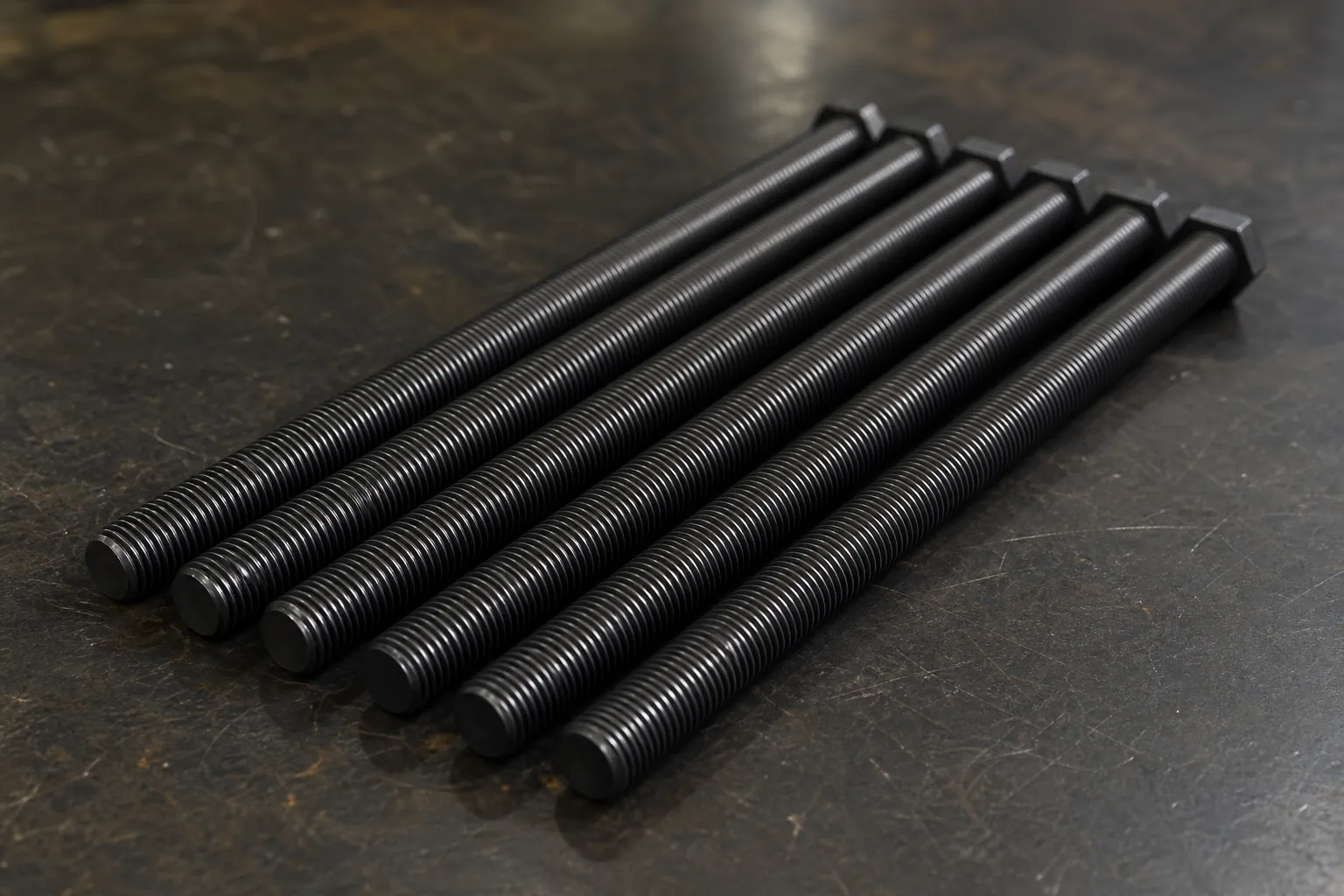
Конструктивні особливості та проблеми
- Високе співвідношення L/D: Довжина 340 мм робить болт дуже чутливим до початкового вигину на 0,5 мм – 1.5мм після термообробки.
- Вимоги до точності: The client required straightness within 0.2 мм; the case acceptance records were held under 0.1 мм.
- Вимоги до захисту: Процес випрямлення повинен забезпечувати нульове пошкодження точності різьби та якості поверхні.
Why Heat Treatment Bends Long Bolts in the First Place
Understanding the distortion source is what makes a correction process defensible instead of decorative. During quenching, a long fastener cools unevenly: the section cools at different rates depending on orientation in the basket or fixture, agitation contact, and local mass differences between the plain shank, the threaded length and the head. Each cooling path wants to contract by a different amount, and the resulting locked-in stresses bend the part when it relaxes. The effect scales with length — which is why short bolts leave heat treatment usable while long ones of the same grade systematically arrive bent. Thread rolling and machining before treatment add their own stress history, and any straightening performed at the heat treater counts as prior deformation for everything done afterward.
Two practical consequences follow. перше, incoming inspection on long heat-treated bolts is not optional paperwork — the bend magnitude and pattern arriving at the straightening station determine both the correction plan and any supplier conversation, and the interaction of prior deformation with correction response is the reason reverse-loading behavior matters, as covered under ефект Баушингера при випрямленні. друге, process decisions upstream — how parts are racked or basketed through quench, whether stress relief is applied — change the distribution the straightening station sees, and are usually the cheapest place to reduce total correction work.
Reading the Bend Before Correcting It
Long fasteners arrive with a small vocabulary of bend patterns, and naming the pattern is the first step of an efficient correction loop. A single-arc bow — one gentle curve, maximum near the middle — is the most common heat-treatment signature and the most straightforward to correct with supports positioned around the peak. An S-shaped double bend has two opposite peaks, usually reflecting two constraint points during quench, and demands two coordinated corrections rather than one big press at the largest reading. A local kink near the head or the thread runout concentrates distortion where section stiffness changes, and behaves differently from a distributed bow. Нарешті, twist about the axis occasionally accompanies bending on parts with asymmetric features. Each pattern requires its own measurement map and correction sequence, which is why an automatic station that scans the full length and builds the map before pressing — rather than chasing the single worst reading — converges in fewer strokes. The measuring-and-correcting loop behind this is described for automatic shaft straightening generally, and for the long-bolt family specifically in the automatic long bolt straightening process.
Чому необхідно відмовитися від випрямлення болтів “Ручне забивання”
Традиційний процес проти. Автоматизоване рішення
The figures below are this client’s reported baseline and post-commissioning values, not a universal benchmark for every fastener line.
| Точка болю | Ручне забивання / Ручна преса | Автоматизоване рішення для випрямлення |
| Вимоги до робочої сили | 8 workers per shift (manual baseline, reported case) | 1 оператор для 4 машини (reported case) |
| прямолінійність | 0.2 – 0.5 mm spread (reported manual baseline) | ≤ 0,1 мм (client acceptance records) |
| Час циклу | 120 – 180 п/шт (reported manual baseline) | 10 – 15 п/шт (reported case) |
| Загальна вартість | High labor cost per corrected part | Manpower reduced from 8 operators to 1 supervising 4 машини (reported case) |
Автоматизований процес правки болтів
Це рішення охоплює повністю замкнутий автоматизований процес від подачі до сортування, гарантуючи, що кожен болт відповідає високим стандартам доставки.
Опис основних процесів
- Автоматичне годування: Зігнуті болти автоматично подаються з бункера на станцію правки без втручання людини.
- Динамічне вимірювання: Високоточні датчики сканують обертову заготовку в режимі реального часу, точне фіксування максимальної точки згину по всій довжині.
- Сервонатискання: Розумна система автоматично розраховує пружність на основі матеріалу (вуглецева сталь/легована сталь), а сервопривід застосовує точний тиск для корекції за один прохід.
- Автосортування: Кваліфіковані болти переходять до наступного етапу, while non-conforming parts are automatically isolated before they leave the machine.

Машина для правки болтів UBJ-80
Цей випрямляч ідеально підходить для термічно оброблених готових деталей (напр., компоненти для штампування/офісної машини, авто/мото запчастини, інструменти, гвинти) і бари (сталь, мідь, алюміній, нержавіюча сталь, титановий сплав) довжиною 60-600 мм & діаметр φ3–φ25 мм. Це підвищує як точність, так і якість продукції.
Основні проблеми випрямлення та рішення
Виклик 1: Manning and the Reported “1 Оператор для 4 Машини” Case
Опис проблеми: Manual hammering and press correction depend on operator skill, stamina and shift discipline, so manning levels stay high and results vary from operator to operator.
Рішення:
Наше рішення реалізує повна автоматизація замкнутого циклу. Логіка роботи надзвичайно проста, із вбудованими рецептами для різних характеристик болтів. Стандартному працівнику потрібно лише періодично наповнювати бункер; решта—вимір, випрямлення, та перевірка — виконується машиною автоматично. Це вирішує нестачу робочої сили та усуває падіння точності, спричинені втомою.
Виклик 2: Гарантія консистенції з точністю до 0,1 мм
Опис проблеми: Коли болт піддається ударам молотка, розподіл внутрішніх напруг стає нерівномірним, часто призводить до надмірної корекції в локалізованих областях.
Рішення:
Рішення використовує a повністю параметризована сервосистема керування. На відміну від туманного людського судження, датчики визначають осьову криву болта з мікронною точністю. За допомогою багатокрокових серво алгоритмів, система точно долає пружну пружину S45C або легованої сталі, locking final straightness within the 0.1 mm window achieved on this client’s qualified recipe.
How Thread and Head Zones Are Protected During Correction
Thread protection is a contact-zone engineering problem, and the principles are the same ones that govern surface-protection tooling across straightening applications. The correction force and the reaction forces both need somewhere to live, and on a long bolt the plain shank is the region designed to carry load, while the threaded length and the under-head fillet are the regions most easily damaged. A protection concept therefore has three parts: place supports on the shank at controlled span positions around the bend peak; direct press contact onto the shank through tooling that conforms to the section instead of touching thread crests; and keep every edge that could contact the workpiece generously radiused so load spreads instead of concentrating. Cleanliness belongs in the same sentence — debris trapped between press tooling and a thread flank is a scratch generator, and on plated or coated bolts the coating class defines how much contact the finish can tolerate at all.
The validation side is equally concrete. A thread-protection claim is proven by inspection agreed before the trial — thread gauges still running, flank condition reviewed under the method the quality function specifies — together with the released-state straightness result, on representative parts, after repeat setups. Protection and geometry are accepted together or not at all.
What an Acceptance Criteria Package Should Contain
A bolt straightening process is only as good as the acceptance definition it answers to, and a complete one answers five questions in writing. What characteristic governs — straightness of the axis, measured how: on centers, on supports, обертовий, in what condition, since a reading under restraint is not a released result, пер loaded versus released measurement practice. What the limit is, and where it applies — full length or specified spans. What else must survive the process — thread fit, обробка поверхні, покриття, head markings. How conformity is sampled — every part through an automatic gauge, or a sampling plan with defined reaction to a failure. And what happens to nonconforming parts — rework limits, segregation and disposition authority, following the NOK sorting and rework-limit framework. Buyers comparing straightening suppliers are well advised to ask for exactly this package; the ability to produce it says more about a supplier than any single machine specification.
Виготовлення корпусу: Четвертий вибір індійського клієнта
Довідкова інформація клієнта
Відомий індійський постачальник кріплень, що постачає компоненти для світових брендів будівельної техніки.
Результати впровадження
- Повторні замовлення: На основі видатної продуктивності перших трьох агрегатів, клієнт нещодавно придбав їх 4го автомата.
- Operator Consolidation: The client reported one operator managing all 4 machines after commissioning, with a substantial increase in output per operator.
- Еталон якості: The client’s records report straightness moving from 0.2 mm down to under 0.1 mm after commissioning.
поширені запитання
- Q: Чи не пошкодить виправний шток різьбу болта?
- немає. Ми спроектували безконтактний, м'які захисні форми спеціально для випрямлення болтів. Прес-блоки ідеально відповідають кривизні болта, забезпечення рівномірного розподілу сили та уникнення вм’ятин на поверхні.
- Q: Чи можна обладнання інтегрувати в систему MES нашого заводу?
- так. Наша система керування має стандартні інтерфейси даних для запису та експорту даних правки в реальному часі для кожного болта, відповідність сучасним вимогам простежуваності.
Additional Process Questions
Why do bolts from the same heat-treatment lot arrive with different bend patterns?
Because each part’s position in the basket or rack gave it a different cooling path. Quench distortion is sensitive to orientation, local mass and agitation contact, so even identical bolts leave treatment with different locked-in stress patterns. Mapping incoming parts rather than assuming a uniform error is the practical answer, and it is why scanning-based stations build a per-part correction plan.
How many correction passes does a long bolt need?
It depends on the pattern, not a fixed number. A single-arc bow typically converges in one planned press; an S-bend needs two coordinated corrections; local kinks near section changes respond differently again. The governing rule is a rework limit set before production — parts that stop responding are routed to review, not pressed repeatedly, because each additional plastic cycle consumes fatigue life and changes the material’s response.
Should straightening come before or after thread rolling?
The route belongs to the fastener process engineer, but the trade-off is explicit: correcting before thread rolling lets subsequent operations work from a straight blank, while correcting after heat treatment with finished threads demands the contact-zone protection described above. Whichever route is chosen, the acceptance package must define what state the straightness limit applies to, and the correction validation must be run on parts carrying that state.
Резюме
Для фабрик кріпильних виробів, які прагнуть високої ефективності та якості, ан Автоматизоване рішення для правки болтів є основним шляхом до підвищення конкурентоспроможності. Whether the target is lower manning or 0.1 mm delivery precision, the figures in this article are one client’s reported case; your own results depend on the bolt family, incoming distortion and acceptance definition.
Moving from manual bolt correction toward automation? The manual vs automatic selection logic і Корпус ROI для автоматичного випрямлення are the natural next steps.
Якщо ви зіткнулися з проблемами організації праці або вузькими місцями точності, не соромтеся Зв'яжіться з нами для індивідуальної технічної пропозиції.