
Borunun ovalliği ve merkez çizgisinin düzlüğü farklı geometrik koşullardır. Ovallik bir kesitin şekliyle ilgilidir; merkez çizgisi düzlüğü, borunun uzunluğu boyunca izlediği yol ile ilgilidir. Bir tüp kabul edilebilir merkez çizgisi geometrisine sahip olabilir ancak bir istasyonda yuvarlak olmayabilir, veya merkez çizgisi uzun bir açıklık boyunca yaylanırken ölçülen her bölümde yuvarlak olabilir. Bu koşulları tek bir “doğruluk” değeri olarak ele almak, yanlış süreç kararına yol açabilir.
Bu kılavuz bir ölçüm ve kabul çerçevesidir. StraighteningTech tüp serisi olduğunu iddia etmez, duvar yeteneği, ölçer, sensör, tolerans veya onaylanmış düzeltme süreci. Nihai gereksinimler kontrollü çizimden gelmelidir, referans yöntemi ve temsili örnekler.

*Mühendislik konsept illüstrasyonu. Tüp doğrultma işlemi bağlamını tasvir ediyor, belirli bir tüp ailesinin veya duvar durumunun işlenebileceğinin kanıtı değildir.*
Her Bir Özelliği Ölçmeden Önce Tanımlayın
Ovallik istasyon başına bir özelliktir: Ölçülen her kesitin kendi değeri vardır, ve on iki istasyonda incelenen bir tüpün farklı olabilen on iki ovallik değeri vardır.. Merkez çizgisinin düzgünlüğü tam uzunluklu bir özelliktir: bu kesitlerin ardışık merkezlerinin izlediği yoldan türetilir. Bu iki özellik yalnızca farklı kusurları tanımlamakla kalmaz; ölçüm zincirinin farklı seviyelerinde de yaşarlar., ve yüksek seviye düşük olandan hesaplanır.
Bu bağımlılık gizli bağlantıdır. Bir merkez çizgisi doğrudan ölçülmez; hesaplandı, istasyon istasyon, asla tam olarak yuvarlak olmayan bölümlerden. Ölçülen bir kesiti tek bir merkez noktasına (iki çapın ortalaması) dönüştüren kural hangisi olursa olsun, a least-squares circle center, a minimum-zone circle center, or the center a two-point gauge happens to report — becomes part of the straightness definition. Two inspection methods can therefore disagree about the centerline of the same physical tube while each is internally consistent, because they embedded different center-finding rules.
The acceptance documents should state, for each characteristic: the formula (diameter-based ovality, radial-deviation-based ovality, or a full form tolerance), the center-finding rule feeding the centerline calculation, and the station set over which each value applies. A single “straightness OK” record that does not say which rules produced it is not transferable between supplier and customer gauges.
Uygun Desteklerle Kesit ve Boyuna Geometriyi Ölçün
Destek pozisyonları görünen merkez hattını sarkma yoluyla etkileyebilir; kenetleme ince duvarlı bir bölümü etkileyebilir; prob teması yüzey veya duvar tepkisini etkileyebilir. Bu nedenle prosedür, her bir karakteristik için koşulları tanımlamalı ve gerektiğinde kontrolleri tekrarlamalı/yeniden yerleştirmelidir..
| Ölçüm kontrolü | Neden önemli? |
|---|---|
| Kesit istasyonu ve yönlendirme | Ovallik uzunluk boyunca ve çevre çevresinde değişiklik gösterebilir |
| Boyuna açıklık ve destekler | Merkez çizgisi okumaları yerçekimi ve fikstür efektlerini içerebilir |
| Veri ve bitiş koşulu | Sonucun amaçlanan işlevle ilgili olup olmadığını belirler |
| İletişim veya optik yöntem | Farklı yüzey tanıtabilir, erişim ve belirsizlik sınırları |
| Serbest bırakılma durumu | Geçici kısıtlamanın son geometri olarak raporlanmasını önler |
Support Spacing Filters the Centerline Signal
On a measured span, destekler merkez çizgisi okuması için mekanik bir filtre görevi görür: Destek aralığından daha kısa bir dalga boyuna sahip bükülme içeriği, sertleştirilmiş bölümler tarafından kısmen bastırılır, daha uzun dalga boylu yay okumaya geçerken. Bu nedenle aynı tüp, her iki okuma da yanlış olmadan, kısa bir fikstür açıklığında uzun olana göre farklı yay raporlayabilir. Destek açıklığı bir kurulum kolaylığı değildir; düzlük tanımının bir parçasıdır, ve eşleşmelidir, veya açıkça ilişkilendirilebilir, müşteri göstergesinin kullandığı aralık.
İstasyon aralığı örnekleme alanında benzer bir rol oynar. Geniş aralıklı istasyonlar merkez hattı yolunu yetersiz örnekliyor ve istasyonlar arasındaki yerel kıvrımı kaçırabiliyor; çok yoğun istasyonlar yüzey ve duvar kalınlığı değişimini hesaplanan eksene karıştırmaya başlar. The sampling plan should state where stations sit — not only how many — because the informative stations are the support points, the clamping points, the tube ends and the neighborhoods of expected bend peaks.
On thin-wall tubes the supports carry a second, unwanted effect: support reaction can ovalize the section locally, so the ovality measured at a support station includes a measurement-induced contribution. Comparing readings at supported stations against readings taken just outside the support influence is a cheap check for this; where the difference is significant, the ovality acceptance must be evaluated at defined free stations. For the loaded-versus-released distinction in final acceptance, Görmek Yüklü ve serbest bırakılmış doğrusallık ölçümü.
Bir Hatayı Düzeltmeyin ve Diğerinin Çözüldüğünü Varsayın
Yayı azaltmayı amaçlayan bir düzeltme işlemi ovalliği veya duvar durumunu değiştirebilir. Kesit formunu iyileştirmeyi amaçlayan bir süreç merkez hattının düzgünlüğünü sağlayamayabilir. Örnek plan hangi geometrinin kontrol edildiğini tanımlamalıdır, hangi ikincil özellikler kontrol edilir, Temasa izin verildiğinde ve bağımsız bir sürecin gerekli olduğu durumlarda.
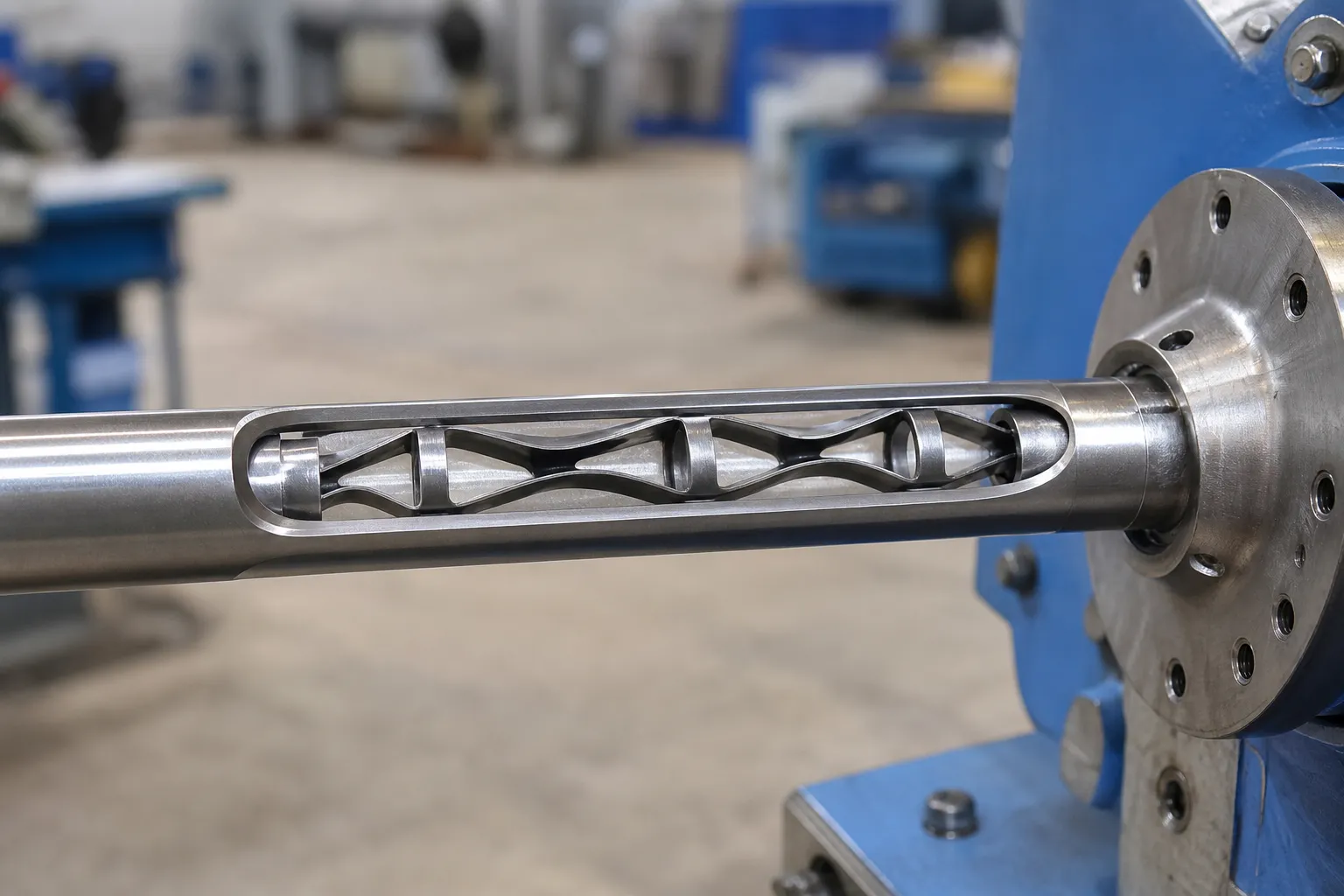
*Mühendislik konsept illüstrasyonu. Aday mühendislik sorusu olarak dahili desteği sunar; iç takımların standart olduğu veya her tüp için uygun olduğu iddiası değildir.*
Yuvarlak olmayan içi boş profiller için, see square and rectangular tube straightening. İçi boş dönen parçalar için, Görmek ince duvarlı içi boş mil doğrultma.
Separate the Two Signals Before Accepting Either Reading
The two characteristics contaminate each other's measurements in specific, diagnosable ways. In a rotating single-probe trace at one station, the radial signal contains at least the local form error of the section and the offset of the section center from the rotation axis. Ovality-dominated form error appears primarily as a second harmonic — the trace repeats twice per revolution, with the ovality major axis setting the phase. A center offset appears as a first harmonic — one bump per revolution. Within a single trace the two are separable in principle, but the first harmonic itself is ambiguous: a genuine bend and a seating or chucking offset produce the same single-station signature. The discriminators live outside the single trace. Across stations, a bend changes amplitude with longitudinal position and follows the bend plane, while a seating offset keeps a constant amplitude and a phase locked to the rotation axis. That multi-station logic, together with the harmonic fingerprints of lobing and datum effects, is developed in Dönen ölçümde yuvarlaklık ve bükülme.
The contamination also runs the other way. A probe scanned along the tube reads the local surface, eksen değil: a tube that is straight on its centerline but drifting in ovality orientation along its length produces a lengthwise trace that looks like bow. A practical two-scan check costs little: scan the length in one direction, then in the orthogonal direction — by rotating the tube ninety degrees against the same probe, or by using a second probe at right angles. Compare the two traces. A centerline bow decomposes into the two directions as projections of one vector: the two traces are similar in shape and same in sign, each a scaled copy of the other. Section form does the opposite: where the ovality major axis lies in the first scan direction it lies across it in the second, so a peak in one trace corresponds to a valley in the other. Traces that are same-shape-same-sign nominate a bend; traces that are opposite-sign at particular stations nominate form and wall variation. Only the first category should go to a correction decision.
Wall-thickness eccentricity adds a third layer on drawn or rolled tube: the outside surface and the bore are not concentric, so a centerline computed from outside-diameter measurements and one computed from bore measurements will not coincide. İkisi de yanlış değil; farklı fonksiyonel sorulara cevap veriyorlar. Kabulü hangisi yönetiyorsa, parçanın montajındaki işlevine ve çizimine uymalıdır., hangi ölçü mevcut olursa olsun, onu tanımlar. Düzeltme sırasındaki ince duvar davranışının kendi arıza modları vardır, kapsanan ince duvarlı borunun çökmeden düzleştirilmesi.
Müşteri Ölçer Korelasyon Planı Oluşturun
Denemede temsili normal ve en kötü durum tüpleri kullanılmalıdır, her iki özellik için ham okumalar, mutabık kalınan destek ve yayın koşulları, kurulumu tekrarla, yüzey/duvar kontrolleri, ve müşteri göstergesiyle karşılaştırma. Kayıt, okumanın bir makine proses değeri olup olmadığını belirtmelidir, bir müşteri kabul değeri veya ilişkili bir sonuç.
Kullanmak makine göstergesi ile müşteri göstergesi korelasyonu Ve numune testinin doğrultulması ve kabulü kanıt paketini tanımlamak için.
İki Ayrı Kabul Zinciri Çalıştırın, Bir Değil
Çünkü tanımlar, destekler ve arıza modları farklıdır, ovallik ve merkez çizgisi düzlüğünün her birinin çizim dilinden imzalı kayda kadar kendi zincirine ihtiyacı vardır. Her ikisini de tek bir jenerikte daraltmak “geometri tamam” aşağıdaki her bağlantıyı belirsiz bırakıyor:
| Zincir bağlantısı | Ovallik zinciri | Merkez hattı zinciri |
|---|---|---|
| Karakteristik ve formül | Hangi sapma kuralı, istasyon başına uygulanır | Hangi aralık geçerlidir, and which center-finding rule feeds the path |
| Referans yöntemi | Section measurement at defined stations | Lengthwise scan or rotating trace on defined supports |
| Support and release | Free stations distinguished from supported stations | Span defined; sag and clamping effects addressed or correlated |
| Sampling | Station positions fixed by the specification, rahatlıktan değil | Station spacing short enough to resolve the shortest expected bend |
| Ölçme yeteneği | Repeatability proven against within-part form variation | Repeatability proven against part-to-part and setup variation |
| Korelasyon | Machine gauge vs customer gauge on the same sections | Machine gauge vs customer gauge on the same span and supports |
| Kayıt | Per-station values with rule and station identity | Path result with support span and filtering stated |
Each link is a place the chain silently breaks. Belirtilmemiş bir formül iki gösterge yapar' karşılaştırılamaz sayılar. Makinede tanımlanan ancak müşteride tanımlanmayan bir destek koşulu, her korelasyon girişiminde sistematik bir dengeleme oluşturur. Belirtilmemiş bir istasyon seti, kararın operatörün ölçüm yaptığı yere bağlı olmasına neden olur. Kanıtlanmamış ölçüm yeteneği, ölçüm gürültüsünü belirgin süreç sapmasına dönüştürür, düzeltme döngüsünün daha sonra takip ettiği. Bu rakamlardan herhangi birine güvenmeden önce ölçüm sisteminin doğrulanması, R ölçer&Çizgileri düzeltmek için R.
SSS
Bir tüp düz ama yuvarlak olmayabilir mi??
Evet. Merkez çizgisi düzlüğü ve ovallik farklı koşullardır ve ayrı ölçüm gerektirir. Uygulamada ikisi aynı muayene kaydına aittir ancak farklı karakteristik numaraları altındadır, her biri kendi formülüne sahip, istasyon seti ve gösterge korelasyonu.
Yuvarlak bir kesit borunun uzunluğu boyunca düz olduğunu kanıtlar mı??
HAYIR. Bir tüp ölçülen kesitlerde yuvarlak olabilir ancak merkez çizgisi yay veya taramaya sahip olabilir. Uzunlamasına tarama eksen yerine yüzeyi okur, yani yukarıdaki ortogonal iki taramalı karşılaştırma, form etkilerini doğrusallık kararının dışında tutan şeydir.
Bir düzeltme süreci her iki sonucu da garanti edebilir mi??
İş parçasına özel doğrulama olmadan olmaz. Süreç, çizimin gerektirdiği her özelliği ölçmeli ve doğrulamalıdır.. In particular, a process validated for bow says nothing about its effect on section form at contacts, supports and free stations — those need their own before-and-after readings.
How can we tell whether a straightness reading is contaminated by ovality?
Repeat the lengthwise scan in the orthogonal direction and compare the traces. Same shape and same sign across the two scans is the signature of a centerline bow; opposite sign at particular stations points to section form or wall variation. Rotating single-station traces add a second test: a bend changes amplitude between stations, while a seating offset does not.
Does ovality need to be measured at every cross-section?
Only the specification can answer that. Kabul planının garanti etmesi gereken şey, istasyon setinin önceden sabitlenmiş olmasıdır - genellikle destekler dahil, kelepçeler, uçlar ve viraj zirvelerinin komşuları; dolayısıyla karar, operatörün nerede kontrol ettiğine bağlı değildir.

*Mühendislik konsept illüstrasyonu.*