
Petrol matkap borusu düzleştirme çözümleri
Petrol sondaj borusu petrol sondajı için temel ekipmandır, ve düzlüğü ve eş eksenliliği sondaj verimliliğini ve güvenliğini doğrudan etkiler. Doğrultma çözümümüz, her türlü petrol sondaj borusunun düzleştirme doğruluğunun ve eş eksenliliğinin API standartlarının gereksinimlerini karşıladığından emin olmak için yüksek hassasiyetli lazer ölçüm sistemiyle donatılmış büyük ölçekli akıllı doğrultma ekipmanını benimser., Bu, sondaj aletlerinin kullanım ömrünü ve delme verimliliğini önemli ölçüde artırır.
Petrol Sondaj Borusu Uygulaması

Standart Sondaj Borusu
Standart sondaj borusu, petrol sondajında en yaygın kullanılan sondaj aracıdır ve sondaj verimliliğini artırmak için mükemmel eşeksenlilik ve düzlük sağlaması gerekir..
Başvuru:
- API Standart Sondaj Borusu
- derin kuyu sondaj çubuğu
- Yönlü Kuyu Sondaj Direği
- Yatay Kuyu Sondaj Direği
Teknik parametreler:
- Eş eksenlilik: ≤0,08 mm/m
- Doğruluk: ≤0,2 mm/m
- Yuvarlaklık: ≤0,1 mm
- Üretim verimliliği: 15-20 adet/saat
Özel Sondaj Borusu
Özel jeolojik koşullarda ve karmaşık çalışma ortamlarında özel sondaj boruları kullanılır, daha yüksek malzeme özellikleri ve işleme hassasiyeti gerektiren.
Başvuru:
- ultra derin kuyu sondajı
- Kükürt içeren O-kuyusu
- Yüksek basınçlı kuyu sondajı
- Sert zemin delme
Teknik parametreler:
- Eş eksenlilik: ≤0,05 mm/m
- Doğruluk: ≤0,15 mm/m
- Yuvarlaklık: ≤0,1 mm
- Üretim verimliliği: 10-15 adet/saat

Takım Bağlantısı Bükümleri ve Tüm Boru Doğrultma
Sondaj borusunun her iki ucundaki takım bağlantıları sürtünme kaynaklıdır, API bağlantılarını taşıyan kalın duvarlı dövme bölümler - zaten sağlam olan bir montajın en sert kısmı. Pratikte neredeyse hiçbir zaman tek başlarına eğilmezler: Muayene bayrakları bir takım ekleminde tükendiğinde veya büküldüğünde, gerçek eğrilik genellikle kaynak geçişinin yakınındaki boru gövdesinde veya gövde-bağlantı arayüzünde bulunur, ve düzeltme, bağlantılar yerindeyken tüm boru üzerinde gerçekleştirilir. Bu nedenle atölye anlamında bir takım ekleminin düzleştirilmesi, tüm borunun düzleştirilmesi anlamına gelir, eklemlerde ölçülür.
Bu ölçüm noktası önemlidir. Bağlantıda düzleştirilmiş bir sondaj borusu kabul edilir: bağlantı dişi ekseni ile boru gövdesi ekseni arasındaki salgı, dizide geçerli olan şeydir, dolayısıyla muayene verisi, basın vücudun metrelerce uzağında hareket ettiği durumlarda bile eklemdir. Düzeltme rotası, makalemizde açıklanan baskıya karşı rulo mantığını takip eder. Presle düzleştirme vs silindirle doğrultma karşılaştırmak, herhangi bir temastan önce takılan diş koruyucuları ve boru uzunluğu alışkanlıkları yerine ölçülen bükülme haritasından belirlenen destek aralığı ile.
Sıra hikayenin diğer yarısıdır. Petrol sahası denetim yüklenicileri, düzeltmenin önce geldiği yenileme akışlarını anlatıyor, temizlemeden önce ve ardından duvar kalınlığı, sürüklenme ve çatlak araştırmaları — bu denetimlerin anlamlı sonuçlar vermesi için geometrinin onarılması gerekir (Sondaj borusu yenileme sağlayıcılarından rapor edilen servis sırası açıklamaları). Borunun altındaki daha ağır BHA üyeleri için, kuvvet sınıfında düzeltme mantığı artıyor: bizimkine bakın matkap yaka düzeltme Ve ağır sondaj borusu doğrultma geçiş bölgesi ve yaka aileleri için sayfalar.
İki pratik kural, takım bağlantısıyla ilgili düzeltmeleri beladan uzak tutar. Birinci, her şeyden önce bağlantıları koruyun: iplik koruyucuları ölçüm ve presleme sırasında açık kalır, ve destek yok, Rulo veya kelepçe her zaman bir omuza dayanır, dişli veya döner omuzlu conta yüzeyi — bağlantı, borunun en değerli ve en az tamir edilebilir özelliğidir. Saniye, sürtünme kaynağı bölgesini kendi muayene öğesi olarak ele alın: kaynağın yakınında yoğunlaşan bir bükme, herhangi bir pres döngüsünden önce geçiş alanının çatlak incelemesini tetiklemelidir, çünkü bu bölge hem kaynak artık gerilimlerini hem de servis bükülmesini yoğunlaştıran kesit değişikliğini taşır. Doğruluk kontrolünden geçen ancak hasarlı bir bağlantıya veya denetlenmemiş bir kaynak anomalisine sahip olan bir boru yenilenmemiştir; yalnızca reddedilmesi daha zor hale getirilmiştir.
Twisted Pipe Is Not Bent Pipe — the Twist-Off Judgment
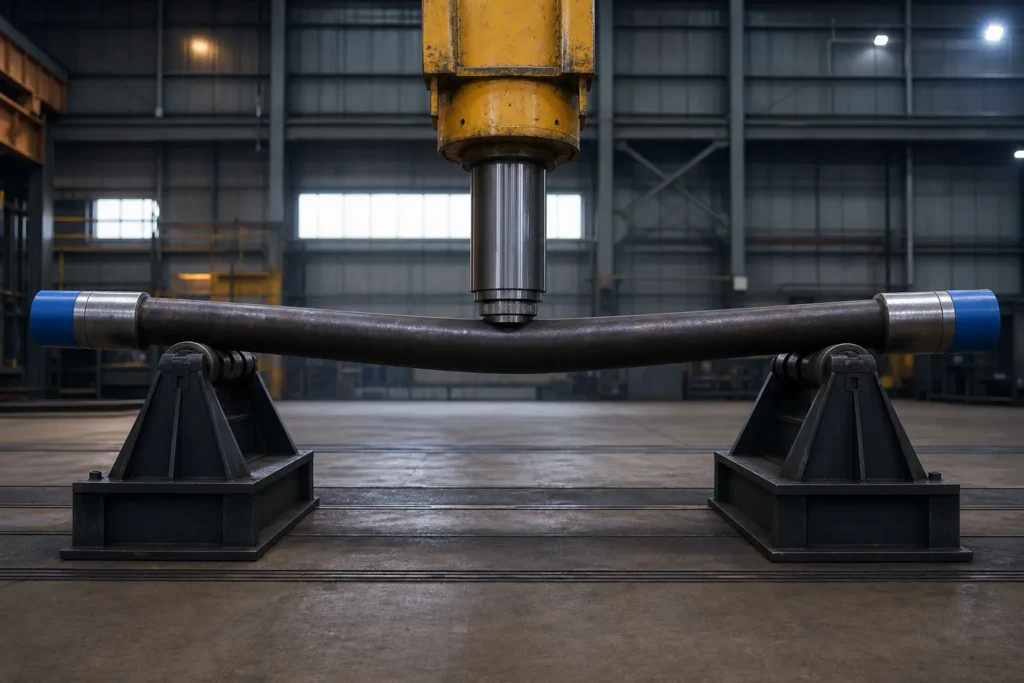
Drill pipe accumulates two different kinds of geometric damage, and only one of them belongs on a press. A bükülmek is deviation in a single plane — the tube reads straight from two perpendicular viewpoints and curved from the others. A büküm is permanent angular displacement around the pipe’s own axis: scribe a longitudinal line down a twisted joint and the line rotates as it travels — one cross-section has permanently rotated against its neighbors. The distinction matters because the two conditions come from different events and leave different damage behind.
Permanent twist is usually an accident record: twist-off events, where the string’s stored torsional energy releases at parting and winds the pipe beyond yield, plus stuck-pipe back-offs and the sustained torque of directional work. By the time the twist is visible, the affected length has already been loaded past yield in torsion — a metallurgical fact, not a geometry problem: no press cycle unwinds it, and rotating the section back cold would add a second plastic episode on top of the first.
This is why press straightening, as a process, declines the job. A straightening press superimposes controlled single-plane bending; twist correction would instead require controlled torque about the axis across the twisted length — a different machine and loading mode — while the yield history that produced the twist remains in the steel either way. The judgment that does apply runs:
- Quantify the twist first. Mark or measure the angular reference along the joint — how many degrees over what length — before any decision, the same measure-first discipline that governs bending.
- Treat visible permanent twist as a material flag. It marks a length that has already yielded once in service — a condition for the inspection standard to evaluate, not a shape to correct.
- Check the connections specifically. A joint that took twist concentrates consequences at the rotary shouldered connections, where make-up reference and shoulder sealing are compromised independently of the body — damage that routes to re-machining or replacement decisions, basına değil.
- Route the verdict to the inspection standard. Whether a twisted joint is downgraded, restricted or condemned is decided under the governing inspection practice for drill stem elements — the framework mapped in our API straightness standards overview — not in the shop.
The practical consequence for reconditioning flow: twist is screened out at incoming inspection, before the joint is ever scheduled for press time. That sequencing — classify, then correct only what classification releases — is the organizing principle of our drill pipe reconditioning workflow article. A shop that discovers twist after straightening has wasted press time on a joint that was never a candidate.
One borderline case deserves honesty: a joint can carry both a bend and a mild residual twist, and the bend alone is legitimately correctable. Correct only what measurement defines — plane-by-plane bend correction to the connection-axis datum, with the twist documented and routed to the inspection decision — never “improved” by pressing harder in a diagonal plane.
The RSC Thread Axis Is the Straightness Datum
Ask where straightness is measured on a drill pipe joint and the wrong answer is the most common one: the outside surface of the tube. A chalk line along the OD can read straight while the joint still runs out in the string, and a joint with a visible body bow can run true — because the pipe’s functional axis is not its skin. It is the axis established by the rotary shouldered connections at both ends. The RSC thread axis is the datum the string actually rotates about, and every straightening measurement that matters is taken against it.
The reasoning is mechanical. Hizmette, the joint’s position in the drill string is defined entirely by its two connections: shoulders seat, threads engage, and the next joint’s axis continues from the connection axis, not from the mid-body OD. What the rig experiences as “crooked pipe” is eccentricity between those connection axes and the tube between them. A body-straightening pass judged on surface lines can leave that eccentricity untouched — the tube looks better and the string vibrates exactly as before.
Measurement practice follows the datum:
- Simulate the thread axis at both ends. Thread-mounted arbors, expanding mandrels or precision centering in the connection bore stand in for the axis the threads define, and runout is read off the tube body against that simulated axis.
- Or invert the reference. With the joint supported on the connection datum surfaces, body runout is measured directly along the tube — support geometry substitutes for arbors when they are not available, at some cost in setup rigor.
- Read at defined stations, not at the worst-looking spot. A runout profile along the body — the multipoint logic described in our multipoint shaft measurement article — is what turns “it looks straight” into a number the certification can carry.
The connection-inspection world already maintains a mature gauge ecosystem for RSC geometry — thread single-element and gauging practice for taper, lead and form — and straightening acceptance should be understood as one branch of that same connection-defined metrology. The gauges certify the connection; the runout check certifies the body against the connection’s axis; together they answer the only question the string asks: does this joint run true about the axis its threads define?
On the press, the datum has two operational consequences. Supports and press points are chosen so the correction acts on the body without ever loading a connection, and the post-correction verification is taken on the connection-axis datum before the joint is released — shop-floor acceptance and string-level acceptance stay the same measurement, as outlined for tubular repair work in our drill pipe reconditioning workflow. A straightening record that shows body runout measured to the RSC axis is the one a recertification file can defend; anything measured to a surface line is geometry documentation, not acceptance.
Petrol Sondaj Borusu Doğrultma Çözümü Proses Videosu
Petrol Sondaj Borusu Doğrultma Makinası İçin Ürün Özellikleri
- Test doğruluğunu sağlamak için, Test fikstürlerini oluştururken ve işlerken yüksek hassasiyetli bir yer değiştirme sensörü kullanın.
- Hizalama doğruluğunu artırmak için yüksek hassasiyetli konum kontrollü yükleme sistemi ile donatılmıştır.
- Düzleştirme prosesinin süresini kısaltmak için çeşitli bileşenleri koordine etmek ve yönetmek.
- Ekipman bakımını kolaylaştırmak için mükemmel anormal durum alarmı bilgileri.
- İşleme bilgilerini saklamak için 16g hafıza kartına sahiptir, Ana bilgisayarla ayrılmış iletişim bağlantısı.
- Hızlı değişim takımları ve fikstürleri, parametreli ayarlama ve değiştirme, otomatik araç kurulumu.


