
De beslissing om een richtmachine achteraf aan te passen of te vervangen moet op bewijsmateriaal zijn gebaseerd, not on the machine's age alone. Een ouder mechanisch platform is wellicht nog geschikt voor een gerichte upgrade; een nieuwere machine kan nog steeds slecht passen als hij wordt gemeten, veiligheid, handling- of data-architectuur kan de huidige werkstuk- en acceptatievereiste niet ondersteunen. The decision must also separate a machine condition finding from the availability of a supplier's retrofit service.
Deze gids is een neutraal kopersraamwerk. Er wordt niet beweerd dat StraighteningTech retrofits aanbiedt, conversies, reserveonderdelen, controleert upgrades of een specifieke servicereactie. Deze scopes moeten afzonderlijk worden bevestigd.

*Techniek concept illustratie. Het toont een kandidaat-celarchitectuur, geen beoordeling van een bestaande machine of een belofte dat er een upgrade beschikbaar is.*
Begin met het huidige werkstuk en de acceptatievereiste
Voordat u de machine inspecteert, de huidige en geplande werkstukfamilies bevriezen, datums tekenen, geometrische kenmerken, meetmethode, beschermde contactzones, productmix, omgaan met behoeften, traceerbaarheidsverwachtingen en veiligheidsverplichtingen. Een retrofit waarbij de verkeerde procesarchitectuur behouden blijft, zal een mismatch in capaciteiten niet oplossen.
Gebruik schacht, selectie van buis- en profielrichters om het doelproces te definiëren voordat opties worden vergeleken.
Beoordeel mechanisch, Veiligheid en gereedschapsconditie
Een beoordeling moet de toestand van het frame documenteren, gidsen, ondersteunt, rollen of persinterfaces, armaturen, bewaken, controles, elektrische toestand, onderhoudsgemak en de beschikbaarheid van kritische onderdelen. Het moet ook identificeren wat niet kan worden geverifieerd zonder een gekwalificeerde inspectie.
| Beoordelingsgebied | Vraagje ombouwen | Vervangingsvraag |
|---|---|---|
| Mechanische structuur | Kan het het doelkrachtpad en het werkstuk veilig ondersteunen?? | Is er een nieuwe architectuur nodig voor het proces? |
| Gereedschappen en steunen | Kunnen armaturen/contactzones worden gevalideerd voor de doelfamilie?? | Heeft de nieuwe oplossing een andere werkstukopspanning nodig?? |
| Veiligheid | Kunnen de vereiste bewakings- en veiligheidsfuncties worden geverifieerd? | Vereist de doeltaak een andere veiligheidsarchitectuur?? |
| Reserveonderdelen en onderhoudbaarheid | Zijn kritische componenten gedurende de beoogde levensduur te ondersteunen?? | Leidt veroudering tot onaanvaardbare operationele risico's?? |
When a Retrofit Is Defensible — and When It Is Not
A retrofit earns consideration when four conditions hold at once: the mechanical structure is demonstrably sound for the target force path; the target workpiece families stay within the load and geometry envelope the structure was built for; the measurement architecture — sensors, datum repetition, settings handling — can either be added or correlated to the reference method; and a supplier has confirmed in writing the scope that will actually be performed. Lose any one of the four and the retrofit discussion is spending engineering time on a route that cannot close.
The clearest non-starters are architectural. When the product mix is moving toward a different correction architecture — a different force path, a different support concept, a different measurement principle than the frame and tooling can carry — no component-level upgrade changes that. The same applies when obsolescence has reached the safety layer: guarding and safety functions built around withdrawn components are a revalidation project of their own, and stacking that on top of a process upgrade rarely survives an honest risk review. Eindelijk, when frame condition cannot be verified without a qualified inspection, the retrofit quote is priced against unknowns — commission the inspection first, or treat the machine's remaining life as unproven.
Evalueer de compatibiliteit van metingen en regelingen
Het retrofitbesluit gaat niet alleen over het vervangen van een controller. De machine moet de juiste eigenschap op het juiste nulpunt meten, herhaal de vereiste ondersteunings-/positioneringsconditie, beheer instellingen of recepten waar relevant, registreer de noodzakelijke gegevens en routeer uitzonderingen veilig.
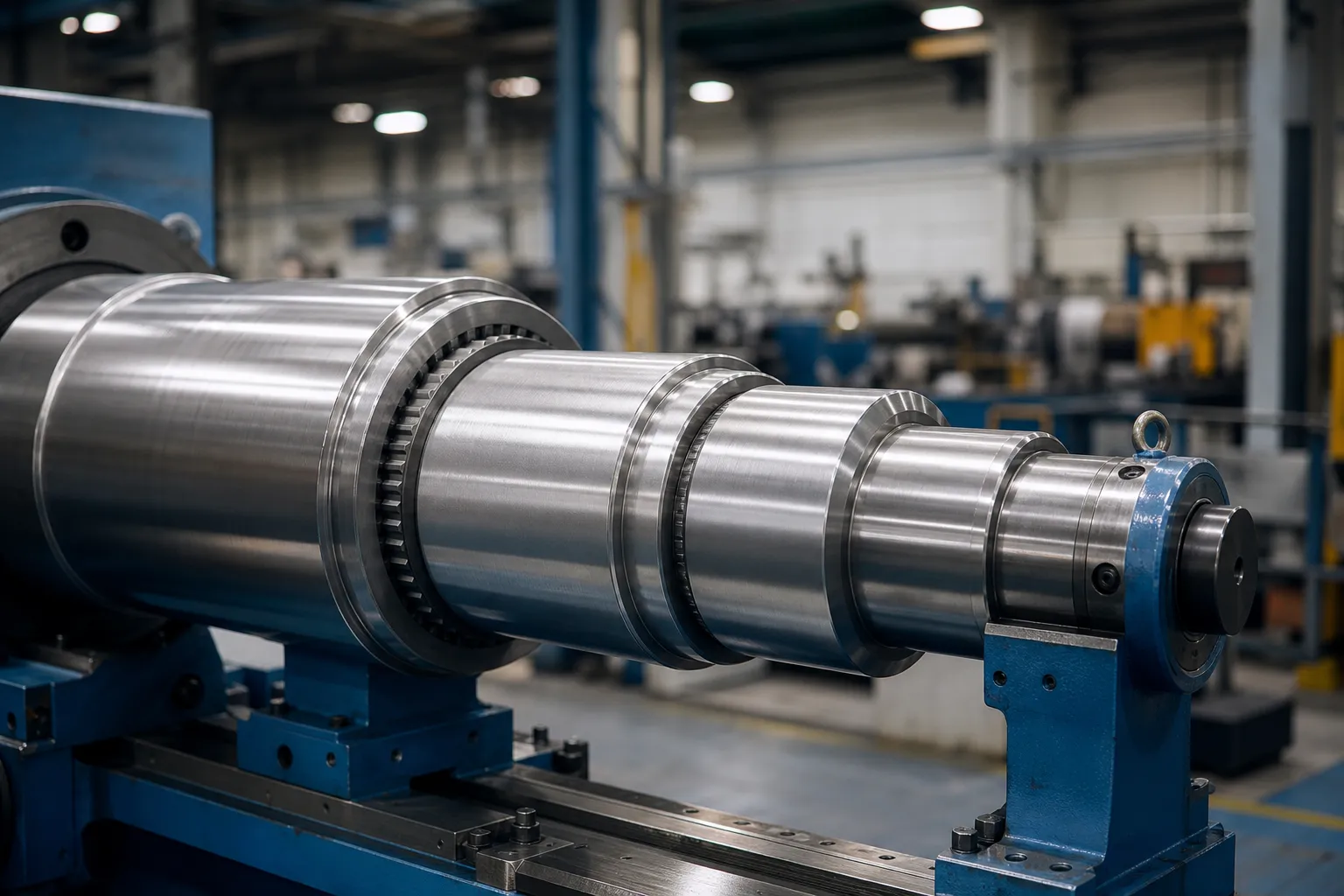
*Techniek concept illustratie. Het toont een beoordeling van een doelprocesselectie, geen beoordeling dat een bestaande machine kan worden geüpgraded naar elke kandidaat-architectuur.*

*Techniek concept illustratie. Het benadrukt de noodzaak om de geometrie na vrijgave te verifiëren; er staat niet dat een bestaande machine kan worden omgebouwd tot een gesloten-lussysteem.*
Controleer de correlatie van de meters, sensorconditie, gegevensintegriteit, toegangscontrole, verandermanagement en de relatie tussen meetwaarden en de klantreferentiemethodiek. Een nieuw scherm brengt op zichzelf geen geldige correctielus tot stand.
A Five-Gate Verification Path
The decision becomes tractable when it is run as a sequence of gates, each with a defined pass condition and a defined action when it fails. De volgorde is belangrijk: every later gate is cheaper to evaluate once the earlier ones have closed.
Hek 1 — Requirement
Doorgang: workpiece families, revisies van tekeningen, de datum, characteristics and the customer acceptance method are frozen in writing. Fail action: stop. Neither a retrofit nor a replacement can be specified against a moving target, and any quote received at this stage is a guess.
Hek 2 — Mechanical
Doorgang: documented evidence that frame, gidsen, supports and force path carry the target family — including the findings that require a qualified inspection. Fail action: vervangen, repurpose the machine to a lighter family, or close the gap with the inspection before any further spending.
Hek 3 — Measurement
Doorgang: the machine measures the specified characteristic on the specified datum, repeats the support and positioning condition, manages settings or recipes where relevant, and can be correlated to the customer gauge. Fail action: scope the measurement retrofit explicitly as its own engineering and validation package, or route the decision to replacement.
Hek 4 — Demonstration
Doorgang: the proposed configuration is demonstrated on representative parts through to released-state results and customer-gauge correlation. Fail action: treat the proposal as unproven. A retrofit that cannot be demonstrated before commitment is a bet placed with production as the stake.
Hek 5 — Economics
Doorgang: both routes are compared on total evaluated cost — engineering, installatie, stilstand, revalidatie, opleiding, spares for the intended life, contingency for failure — using the buyer's own baseline. Fail action: if the comparison cannot be made honestly, the deciding factor is risk posture, not price, and that is a management decision to make explicitly.
Vergelijk downtime, Risico en revalidatie
Voor beide routes is een technisch plan nodig, installatie, veiligheidsbeoordeling, inbedrijfstelling, monster testen, training en documentatie voor operators. Een vergelijking moet de waarschijnlijke downtime-perioden omvatten, blootstelling aan reserveonderdelen, impact van de omschakeling, kwalificatie inspanning, productieonvoorziene omstandigheden en de kosten van een onsuccesvol resultaat. Do not use an average payback or “faster ROI” claim without the buyer's own baseline data.
Cost Items Both Quotes Must State
Most retrofit-versus-replace comparisons fail not on the numbers but on what the numbers omit. The table lists the items a comparable pair of quotes has to carry:
| Cost item | Where it hides in retrofit quotes | Where it hides in replacement quotes |
|---|---|---|
| Engineering and qualification | Marked “included” with no validation scope | Assumed to be in the machine price with no FAT/SAT scope |
| Installation and downtime | Scheduled around production informally | Window underestimated where foundations or utilities change |
| Safety review and commissioning | Omitted when controls are touched | Bundled invisibly into startup support |
| Gauge correlation study | Postponed until after startup | Postponed until after startup |
| Operator training | Limited to the new component | Limited to the first shift |
| Documentation and traceability update | Legacy records not migrated | Templates delivered without the buyer's data model |
| Spares for the intended life | Old-platform parts assumed available | First-generation components on a new platform |
| Production contingency during ramp | Coverage during validation runs undefined | Coverage during the learning curve undefined |
| Cost of an unsuccessful outcome | Rarely defined at all | Rarely defined at all |
| Existing machine disposal or residual value | Ignored | Ignored |
Two of these deserve emphasis because they are almost always missing: the correlation study and the cost of failure. Without a gauge correlation there is no common acceptance language between the machine and the customer, and every later dispute is unresolvable. Without a defined failure outcome — re-run, external processing, scrap allowance, rollback — the comparison silently assigns zero cost to the riskier route.
Maak van monstervalidatie de beslissingspoort
De voorkeursroute moet het doelproces demonstreren met representatieve onderdelen: datum zitplaatsen, herhaalbaarheid van metingen, correctie reactie, resultaat in vrijgegeven toestand, oppervlakte conditie, afhandeling, uitzonderingsrouting en klant-metercorrelatie. Als het bewijsmateriaal niet veilig kan worden afgesloten op het bestaande platform, vervanging of een andere procesarchitectuur kan de beter verdedigbare route zijn.
Voor de validatiestructuur, zien rechttrekken monstertest en acceptatie and machine gauge versus customer gauge correlation.
Risks a Retrofit Trial Must Retire
A retrofit validation is not a demonstration that the machine moves; it is the retirement of specific failure modes, each with its own test:
- Correction-response risk — springback drifting with material state or batch. Test with representative parts from more than one material lot, recording the stroke-versus-result relationship; how that relationship moves between lots is the process's real signature. The underlying mechanism is covered in het Bauschinger-effect bij het rechttrekken.
- Released-state risk — in-machine readings diverging from final geometry once the part is released. Test by independent remeasurement after release, on supports defined in the acceptance plan. The distinction is developed in geladen versus vrijgegeven rechtheidsmeting.
- Setup-repeatability risk — the corrected result depending on who sets up the part. Test by repeating full setups with the datum deliberately reseated, comparing results before any capability claim. The statistical framing is in maat R&R voor het rechttrekken van lijnen.
- Exception-routing risk — a rejected or mid-cycle-interrupted part following an undefined path. Test by injecting faults deliberately, including an interrupted cycle, and verifying what happens to the part in the machine and how the event is recorded. Disposition rules for rejected parts are covered in NOK sorteer- en herbewerkingslimieten.
Red Flags in Any Proposal
- No representative-part demonstration is offered, or one is promised only after commitment.
- ROI or payback is asserted without asking for the buyer's own baseline data.
- The scope is written in conditional language — “can be considered”, “possible upgrade” — leaving the binding scope undefined.
- A controller or screen upgrade is presented as proof of straightening capability.
- No failure path is defined: nothing about what happens if the agreed result is not met.
Vragen die u moet stellen vóór een retrofit- of vervangingsvoorstel
- Welke werkstukfamilie en tekeningrevisie bepalen de eis?
- Met welke meet- en acceptatiemethode moet de oplossing overeenkomen?
- Welke mechanisch, veiligheid, controle- en reserveonderdelenbevindingen worden gedocumenteerd?
- What configuration changes are actually within the supplier's confirmed service scope?
- Welke validatiemonsters, meetgegevens en vrijgavecriteria zullen het succes bepalen?
- Wat gebeurt er als het bestaande platform niet aan het afgesproken resultaat kan voldoen??
Veelgestelde vragen
Is retrofit altijd goedkoper dan vervanging?
Nee. Kosten zijn afhankelijk van de staat, domein, veiligheid, veroudering, geldigmaking, downtime en het doelproces. It must be evaluated with the buyer's own data. The defensible comparison is total evaluated cost — engineering, stilstand, revalidatie, spares over the intended life and a priced failure path — not the number on the upgrade quote.
Kan een controllerupgrade het rechttrekkende vermogen bewijzen??
Nee. Meting, gegeven, gereedschap, steun, correctiereactie en acceptatie vereisen nog steeds validatie. What a controller changes is data handling and interface; the characteristic and the correction response still have to be demonstrated on parts, which is what Gates 3 En 4 above are for.
Betekent dit artikel dat StraighteningTech een retrofitservice aanbiedt??
Nee. Beschikbaarheid en reikwijdte van de service moeten afzonderlijk worden bevestigd vóór enige commerciële verbintenis. The five-gate path above works the same way regardless of which supplier or route is eventually selected.
What should we do if a retrofit cannot be demonstrated with our parts before commitment?
Treat the demonstration gate as failed. Either phase the commitment so that a paid engineering study on your parts precedes the full scope, route the work to a proven process in the interim, or move the decision to replacement. What should not happen is accepting the retrofit on price while carrying the full validation risk in production.