
בתעשיית ייצור מחברים, כיפוף בברגים ארוכים לאחר טיפול בחום הוא נקודת כאב אוניברסלית. מָסוֹרתִי “פטיש ידני” הוא לא רק לא יעיל אלא גם לא מבטיח דיוק עקבי. מאמר זה חולק מומחה פתרון יישור בריח אוטומטי: demonstrating a reported client case in which automation took an 8-person manual line to one operator supervising four machines, with straightness held within 0.1 mm on the client’s acceptance records.
What is the Bolt?
ברגים הם מחברים בסיסיים למכונות, בְּנִיָה, ותעשיות הרכב. חומר העבודה האופייני לפתרון זה הוא בורג ארוך בעל חוזק גבוה: 15קוטר מ"מ, 340אורך מ"מ.
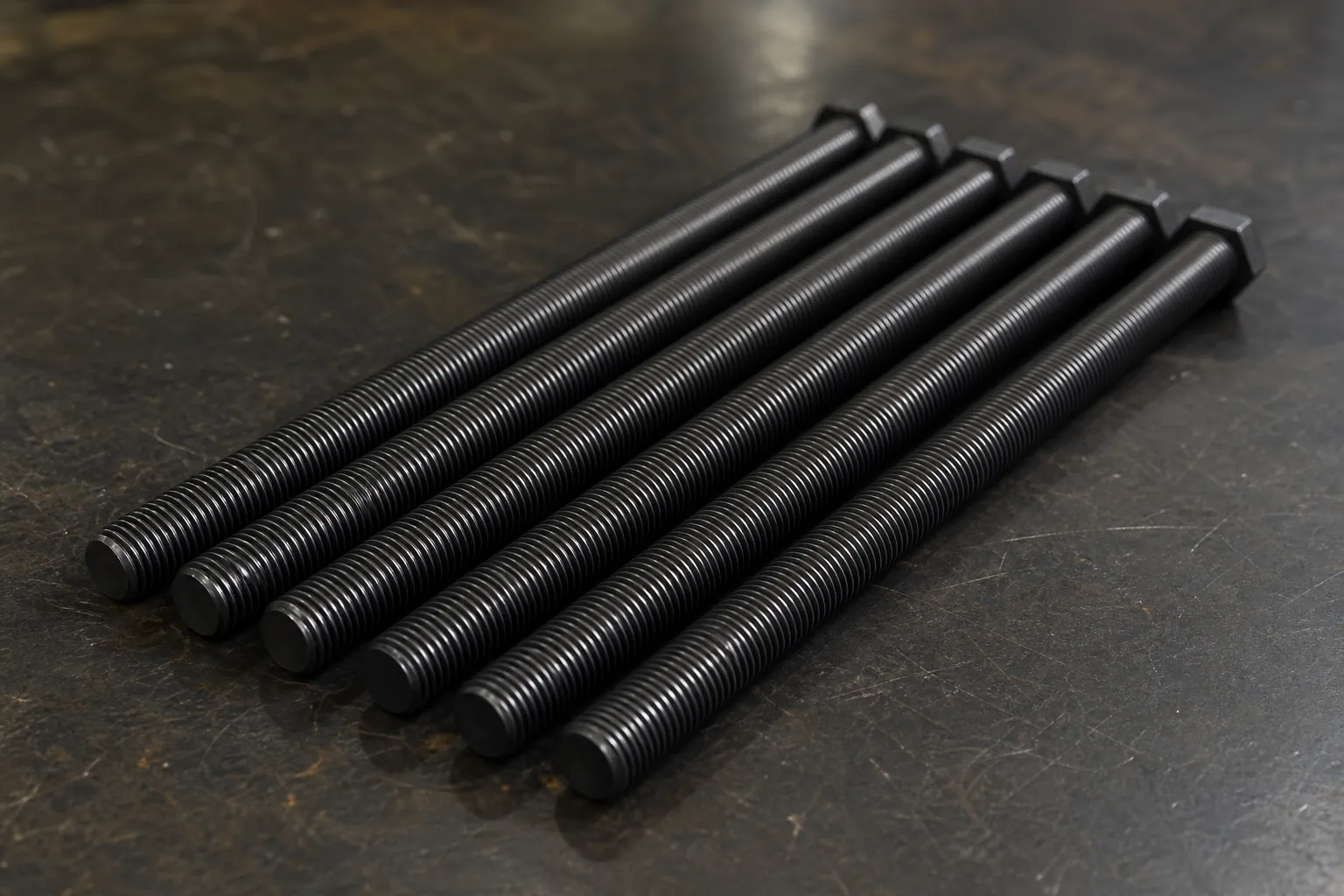
תכונות ואתגרים מבניים
- High L/D Ratio: אורך 340 מ"מ הופך את הבריח לרגיש מאוד לכיפוף ראשוני של 0.5 מ"מ – 1.5mm after heat treatment.
- Precision Requirements: The client required straightness within 0.2 מ"מ; the case acceptance records were held under 0.1 מ"מ.
- Protection Requirements: תהליך היישור חייב להבטיח אפס נזק לדיוק החוט ולאיכות פני השטח.
Why Heat Treatment Bends Long Bolts in the First Place
Understanding the distortion source is what makes a correction process defensible instead of decorative. During quenching, a long fastener cools unevenly: the section cools at different rates depending on orientation in the basket or fixture, agitation contact, and local mass differences between the plain shank, the threaded length and the head. Each cooling path wants to contract by a different amount, and the resulting locked-in stresses bend the part when it relaxes. The effect scales with length — which is why short bolts leave heat treatment usable while long ones of the same grade systematically arrive bent. Thread rolling and machining before treatment add their own stress history, and any straightening performed at the heat treater counts as prior deformation for everything done afterward.
Two practical consequences follow. רֵאשִׁית, incoming inspection on long heat-treated bolts is not optional paperwork — the bend magnitude and pattern arriving at the straightening station determine both the correction plan and any supplier conversation, and the interaction of prior deformation with correction response is the reason reverse-loading behavior matters, as covered under אפקט באושינגר בהחלקה. שְׁנִיָה, process decisions upstream — how parts are racked or basketed through quench, whether stress relief is applied — change the distribution the straightening station sees, and are usually the cheapest place to reduce total correction work.
Reading the Bend Before Correcting It
Long fasteners arrive with a small vocabulary of bend patterns, and naming the pattern is the first step of an efficient correction loop. A single-arc bow — one gentle curve, maximum near the middle — is the most common heat-treatment signature and the most straightforward to correct with supports positioned around the peak. An S-shaped double bend has two opposite peaks, usually reflecting two constraint points during quench, and demands two coordinated corrections rather than one big press at the largest reading. A local kink near the head or the thread runout concentrates distortion where section stiffness changes, and behaves differently from a distributed bow. לְבָסוֹף, twist about the axis occasionally accompanies bending on parts with asymmetric features. Each pattern requires its own measurement map and correction sequence, which is why an automatic station that scans the full length and builds the map before pressing — rather than chasing the single worst reading — converges in fewer strokes. The measuring-and-correcting loop behind this is described for automatic shaft straightening generally, and for the long-bolt family specifically in the automatic long bolt straightening process.
מדוע יישור בריח חייב להתרחק “Manual Hammering”
תהליך מסורתי לעומת. פתרון אוטומטי
The figures below are this client’s reported baseline and post-commissioning values, not a universal benchmark for every fastener line.
| נקודת כאב | Manual Hammering / Manual Press | פתרון יישור אוטומטי |
| דרישת עבודה | 8 workers per shift (manual baseline, reported case) | 1 מפעיל עבור 4 מכונות (reported case) |
| יוֹשֶׁר | 0.2 – 0.5 mm spread (reported manual baseline) | ≤ 0.1 מ"מ (client acceptance records) |
| זמן מחזור | 120 – 180 s/חתיכה (reported manual baseline) | 10 – 15 s/חתיכה (reported case) |
| עלות כוללת | High labor cost per corrected part | Manpower reduced from 8 operators to 1 supervising 4 מכונות (reported case) |
זרימת תהליך יישור בריח אוטומטי
פתרון זה מכסה תהליך אוטומטי מלא בלולאה סגורה מהאכלה ועד למיון, להבטיח שכל בורג עומד בדרישות אספקה בסטנדרט גבוה.
תיאורי תהליכי ליבה
- הזנה אוטומטית: ברגים מכופפים מוזנים אוטומטית מהופר לתחנת היישור ללא התערבות אנושית.
- מדידה דינמית: חיישנים בעלי דיוק גבוה סורקים את חומר העבודה המסתובב בזמן אמת, לכידת במדויק את נקודת הכיפוף המקסימלית לכל האורך.
- לחיצת סרוו: המערכת החכמה מחשבת קפיצה לאחור אוטומטית על סמך החומר (פלדת פחמן/פלדת סגסוגת), וכבש הסרוו מפעיל לחץ מדויק לתיקון מעבר יחיד.
- מיון אוטומטי: ברגים מוסמכים ממשיכים לשלב הבא, while non-conforming parts are automatically isolated before they leave the machine.

מכונת יישור בריח UBJ-80
מחליק זה אידיאלי עבור חלקים מוגמרים שעברו טיפול בחום (לְמָשָׁל, הטבעה/רכיבי מכונות משרדיות, חלקי רכב/אופנוע, כלים, ברגים) וברים (פְּלָדָה, נְחוֹשֶׁת, אֲלוּמִינְיוּם, פלדת אל - חלד, סגסוגת טיטניום) באורך 60-600 מ"מ & קוטר φ3–φ25 מ"מ. זה מגביר גם את הדיוק וגם את איכות המוצר.
אתגרים ופתרונות יישור ליבה
אֶתגָר 1: Manning and the Reported “1 Operator for 4 מכונות” Case
תיאור הבעיה: Manual hammering and press correction depend on operator skill, stamina and shift discipline, so manning levels stay high and results vary from operator to operator.
פִּתָרוֹן:
הפתרון שלנו מיישם אוטומציה מלאה בלולאה סגורה. היגיון הפעולה פשוט ביותר, עם מתכונים מובנים למפרטי בריח שונים. עובד רגיל צריך רק למלא מחדש את המיכל מדי פעם; השאר - מדידה, יִשׁוּר, ובדיקה - מטופלת אוטומטית על ידי המכונה. זה פותר מחסור בכוח אדם ומבטל נפילות דיוק שנגרמות מעייפות.
אֶתגָר 2: מבטיח עקביות בתוך 0.1 מ"מ דיוק
תיאור הבעיה: כאשר בורג נתון למכות פטיש, חלוקת המתח הפנימי הופכת לא אחידה, לעתים קרובות מוביל לתיקון יתר באזורים מקומיים.
פִּתָרוֹן:
הפתרון משתמש ב-a מערכת בקרת סרוו עם פרמטר מלא. בניגוד לשיפוט אנושי מעורפל, חיישנים מזהים את העקומה הצירית של הבורג עם דיוק ברמת המיקרון. באמצעות אלגוריתמי סרוו מרובי שלבים, המערכת מתגברת במדויק על הקפיצה האחורית האלסטית של פלדות S45C או סגסוגת, locking final straightness within the 0.1 mm window achieved on this client’s qualified recipe.
How Thread and Head Zones Are Protected During Correction
Thread protection is a contact-zone engineering problem, and the principles are the same ones that govern surface-protection tooling across straightening applications. The correction force and the reaction forces both need somewhere to live, and on a long bolt the plain shank is the region designed to carry load, while the threaded length and the under-head fillet are the regions most easily damaged. A protection concept therefore has three parts: place supports on the shank at controlled span positions around the bend peak; direct press contact onto the shank through tooling that conforms to the section instead of touching thread crests; and keep every edge that could contact the workpiece generously radiused so load spreads instead of concentrating. Cleanliness belongs in the same sentence — debris trapped between press tooling and a thread flank is a scratch generator, and on plated or coated bolts the coating class defines how much contact the finish can tolerate at all.
The validation side is equally concrete. A thread-protection claim is proven by inspection agreed before the trial — thread gauges still running, flank condition reviewed under the method the quality function specifies — together with the released-state straightness result, on representative parts, after repeat setups. Protection and geometry are accepted together or not at all.
What an Acceptance Criteria Package Should Contain
A bolt straightening process is only as good as the acceptance definition it answers to, and a complete one answers five questions in writing. What characteristic governs — straightness of the axis, measured how: on centers, on supports, מסתובב, in what condition, since a reading under restraint is not a released result, לְכָל loaded versus released measurement practice. What the limit is, and where it applies — full length or specified spans. What else must survive the process — thread fit, גימור פני השטח, שִׁכבָה, head markings. How conformity is sampled — every part through an automatic gauge, or a sampling plan with defined reaction to a failure. And what happens to nonconforming parts — rework limits, segregation and disposition authority, following the NOK sorting and rework-limit framework. Buyers comparing straightening suppliers are well advised to ask for exactly this package; the ability to produce it says more about a supplier than any single machine specification.
מארז ייצור: הבחירה הרביעית של הלקוח ההודי
רקע לקוח
ספק מחברים הודי ידוע המספק רכיבים למותגי מכונות בנייה עולמיים.
תוצאות יישום
- הזמנות חוזרות: מבוסס על הביצועים המצטיינים של שלוש היחידות הראשונות, הלקוח רכש לאחרונה את שלהם 4המכונה.
- Operator Consolidation: The client reported one operator managing all 4 machines after commissioning, with a substantial increase in output per operator.
- Benchmark איכות: The client’s records report straightness moving from 0.2 mm down to under 0.1 mm after commissioning.
שאלות נפוצות
- ש: האם כבש היישור יפגע בהברגות הברגים?
- לֹא. עיצבנו ללא מגע, תבניות הגנה מרופדות במיוחד ליישור בריח. קוביות העיתונות תואמות את העקמומיות של הבריח בצורה מושלמת, הבטחת חלוקת כוח אחידה והימנעות משקעים משטחים.
- ש: האם הציוד יכול להשתלב במערכת MES של המפעל שלנו?
- כֵּן. מערכת הבקרה שלנו כוללת ממשקי נתונים סטנדרטיים כדי להקליט ולייצא נתוני יישור בזמן אמת עבור כל בורג, עומד בדרישות העקיבות המודרניות.
Additional Process Questions
Why do bolts from the same heat-treatment lot arrive with different bend patterns?
Because each part’s position in the basket or rack gave it a different cooling path. Quench distortion is sensitive to orientation, local mass and agitation contact, so even identical bolts leave treatment with different locked-in stress patterns. Mapping incoming parts rather than assuming a uniform error is the practical answer, and it is why scanning-based stations build a per-part correction plan.
How many correction passes does a long bolt need?
It depends on the pattern, not a fixed number. A single-arc bow typically converges in one planned press; an S-bend needs two coordinated corrections; local kinks near section changes respond differently again. The governing rule is a rework limit set before production — parts that stop responding are routed to review, not pressed repeatedly, because each additional plastic cycle consumes fatigue life and changes the material’s response.
Should straightening come before or after thread rolling?
The route belongs to the fastener process engineer, but the trade-off is explicit: correcting before thread rolling lets subsequent operations work from a straight blank, while correcting after heat treatment with finished threads demands the contact-zone protection described above. Whichever route is chosen, the acceptance package must define what state the straightness limit applies to, and the correction validation must be run on parts carrying that state.
תַקצִיר
למפעלי מחברים הרודפים אחר יעילות ואיכות גבוהה, an פתרון יישור בריח אוטומטי הוא הדרך החיונית להגברת התחרותיות. Whether the target is lower manning or 0.1 mm delivery precision, the figures in this article are one client’s reported case; your own results depend on the bolt family, incoming distortion and acceptance definition.
Moving from manual bolt correction toward automation? ה manual vs automatic selection logic ואת מארז ROI ליישור אוטומטי are the natural next steps.
אם אתה מתמודד עם בעיות ניהול עבודה או צווארי בקבוק מדויקים, תרגיש חופשי צור קשר להצעה טכנית מותאמת אישית.