
Two shafts from the same drawing, cut from bars that arrived the same week, pressed on the same machine by the same recipe, can end the cycle differently: one lands inside tolerance and the other still shows a residual bow. Operators see this every day and answer it the honest way — a second, slightly deeper press on the odd part. That workaround hides a process signal. Springback in straightening is not a constant. It is a distributed output that moves with material lot, گرمی کے علاج کا بیچ, prior process history and measurement conditions.
This page is about the variation itself: how to see it, separate its sources, and govern it statistically across a run instead of chasing it part by part. It is a companion to two related pages rather than a repetition: the per-part math that converts a measured bend into a press stroke is covered in شافٹ سیدھا کرنے میں springback معاوضہ, and the material mechanism that makes a second press behave differently from the first is covered in the Bauschinger effect in straightening.
A practical springback variation program answers five questions before anyone touches a correction coefficient:
- Is the scatter you see true process variation, or is part of it measurement noise?
- Which input is moving — material lot, گرمی کا علاج, upstream stress state, or the setup itself?
- How much of the correction recipe should stay fixed, and how much should be allowed to adapt?
- What statistical evidence justifies a coefficient change instead of a manual override?
- How do you verify that tighter variation control actually improved the line, rather than just feeling better?
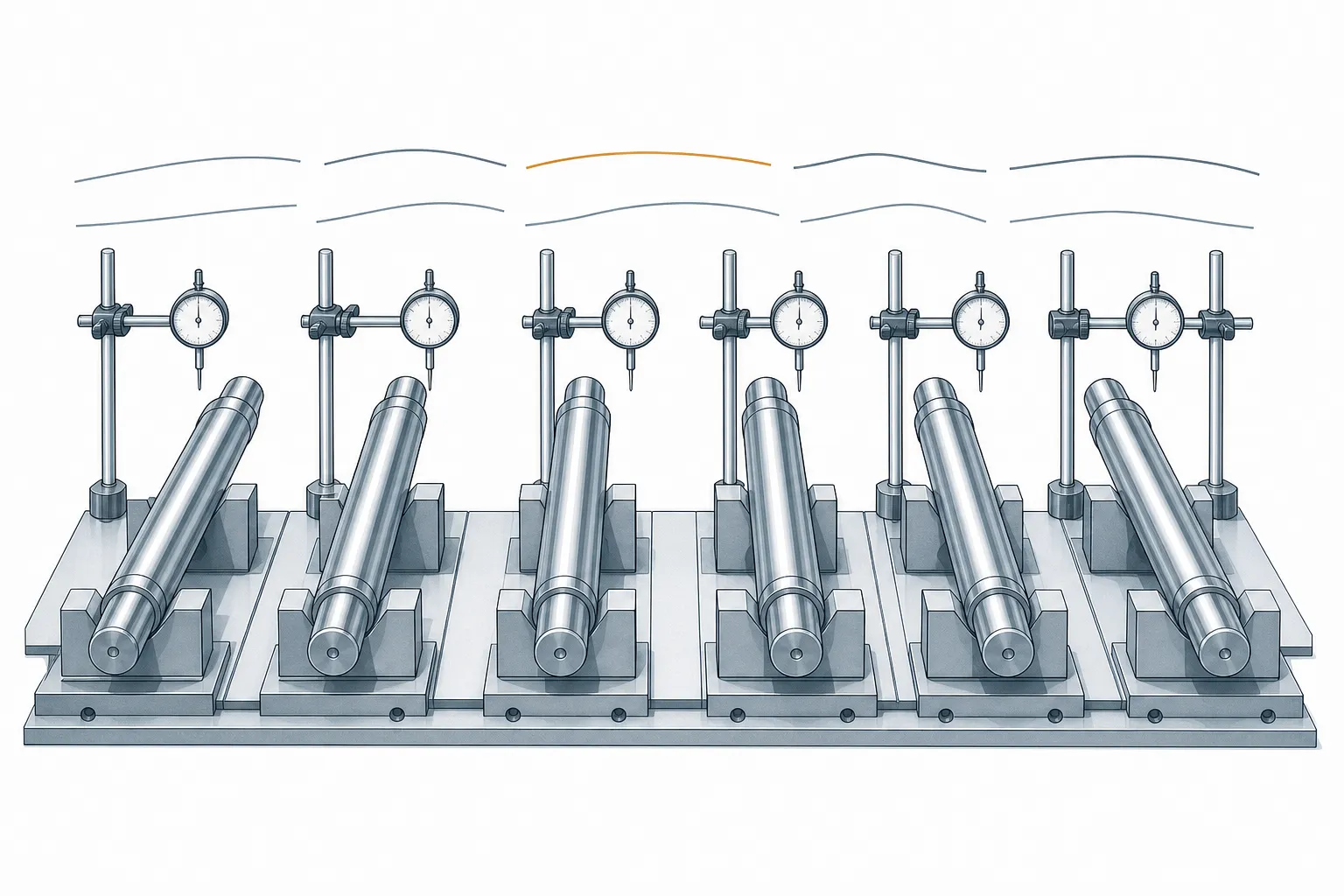
*انجینئرنگ تصور کی مثال: a batch of shafts measured under identical support conditions, plotted as a family of residual-bow curves. یہ گاہک کی سائٹ کی تصویر نہیں ہے۔. Actual distributions require your own measurement data.*
What the Search Results Miss About Springback Variation
Most published material on springback variation belongs to sheet-metal forming. The visible results for the topic are dominated by advanced high-strength steel forming guidelines, V-bending studies and roll-forming end-flare articles. One frequently cited forming paper states the core problem plainly: variation of springback prevents the direct application of springback prediction and compensation techniques. That conclusion transfers exactly to shaft lines, but almost nothing in those results addresses a press or roller straightening line for rotationally symmetric parts, where the same property scatter shows up as press-depth scatter, part after part, shift after shift.
The consequence for a straightening operation is concrete. A compensation model tuned on Monday’s samples is only as good as the stability of everything upstream of the press. Treating springback variation as a machine problem, when it is mostly an incoming-material problem, leads to the wrong investment.
سب سے پہلے, Separate Variation From Its Impostors
Before any statistical treatment, three impostors must be ruled out, because they imitate springback variation in the daily report:
| Observed Symptom | More Likely Cause | Quick Check |
|---|---|---|
| Identical parts corrected on repeat presses land differently | True springback or strength scatter across lots | Group results by heat number; look for between-group separation |
| The same part re-measured gives different bend maps | Measurement system, not the process | Run a gage study before blaming the machine; دیکھیں گیج آر&لائنوں کو سیدھا کرنے کے لیے R |
| TIR drifts slowly across a shift with no lot change | Thermal growth of part, supports or gauges | Log temperature with each measurement; compare warm-up vs steady state |
A second family of impostors comes from the geometry itself. Local form error can masquerade as axis displacement in a rotating measurement, and a part measured loaded in a fixture does not necessarily read the same as a part measured released on centers. Both effects are covered in detail in roundness vs bend in rotating measurement اور loaded vs released straightness measurement. Until those two are under control, springback variation analysis is built on sand.

The Five Source Families of Springback Variation
Once impostors are excluded, genuine springback variation in a straightening line traces back to a small number of source families:
| Source Family | What Moves | How It Shows Up at the Press |
|---|---|---|
| Material lot | Yield strength and elastic modulus within the ordered grade | Same stroke, less correction on stronger lots |
| ہیٹ ٹریٹمنٹ بیچ | Hardness and residual stress state after hardening or tempering | Batch-wise shifts in required press depth; occasional erratic parts |
| Geometry within tolerance | قطر, دیوار, section transitions, length-to-diameter ratio | Stiffness differences that a single recipe does not serve equally |
| Prior process history | Machining and grinding residual stresses; earlier straightening passes elsewhere | Asymmetric recovery; parts that spring back toward an old shape |
| Setup and environment | سپورٹ سپیسنگ, tool condition, part temperature | Slow drift within a shift that no material change explains |
The first two families dominate most industrial cases. Published forming literature treats elastic-modulus variation as a first-class input to springback prediction, and the same logic applies to bars: within a purchased grade, the usable spread of yield behavior between heats is wide enough to shift the correction recipe. That is why a variation program starts in the warehouse, not at the press.
Build the Evidence Chain Before Touching Coefficients
A disciplined line keeps a short chain of evidence that connects every measured part to its inputs:
- material certificates with heat numbers, linked to part serials or at minimum to run dates;
- incoming hardness or sample-destructive checks by lot, where the drawing allows;
- the process stage of each run — as-forged, after rough turning, after hardening, پیسنے کے بعد;
- the straightening recipe in force, with its coefficient set and version;
- full bend maps before and after correction, not only pass/fail flags.
With that chain in place, a scatter plot of required correction versus heat number becomes possible, and the answer to “why does the same bend need different correction” usually becomes visible in an afternoon. Without it, every investigation restarts from zero.
Random Scatter or Systematic Drift? The Split That Decides the Response
Not all variation deserves the same response, and overreacting is as costly as ignoring:
- Random within-lot scatter is absorbed by closed-loop measurement and correction on each part. The correct response is a machine that measures, computes and presses per piece — the architecture described in خودکار شافٹ سیدھا کیسے کام کرتا ہے۔.
- Systematic between-lot shifts call for a re-baselined coefficient set, validated on a sample of the new lot before volume release.
- Slow drift within a shift points at setup or temperature, and is fixed at the fixture, not in software.
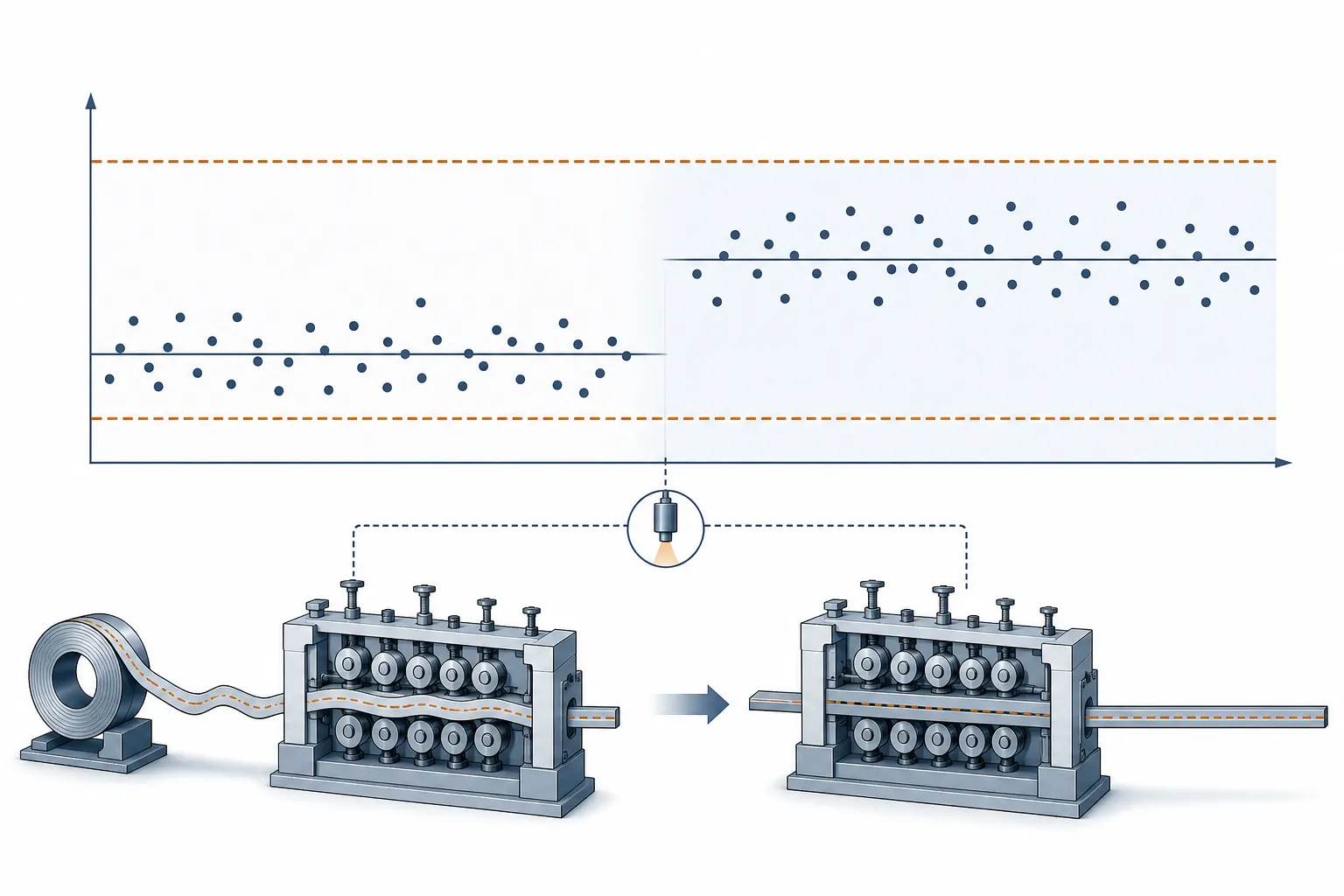
Control charts on the correction actually applied per part are the cheapest instrument for this split. A stable cloud around a moving level is random scatter plus lot shifts; a ramp is drift; a step is a lot change or a setup change. Run rules borrowed from statistical process control keep operators from reacting to single points.
Governing the Machine Side Without Overcorrecting
On the machine side, three practices keep variation management safe:
- Adaptive coefficients with limits. Let the control update its springback estimate from recent parts, but bound the adjustment per lot so a single abnormal part cannot drag the recipe.
- Documented overrides. Manual deeper presses are sometimes necessary, but they belong in the record, tied to the part serial, so the statistics stay honest.
- A hard stop before over-pressing. When a part needs repeated correction cycles to converge, stop and investigate rather than pressing harder each time. Repeated plastic cycles change the material response itself, and the crack risk grows quietly; the reasoning is the same as in خودکار سیدھا کرنے کے دوران شگاف کا پتہ لگانا.
The Closed Loop, End to End
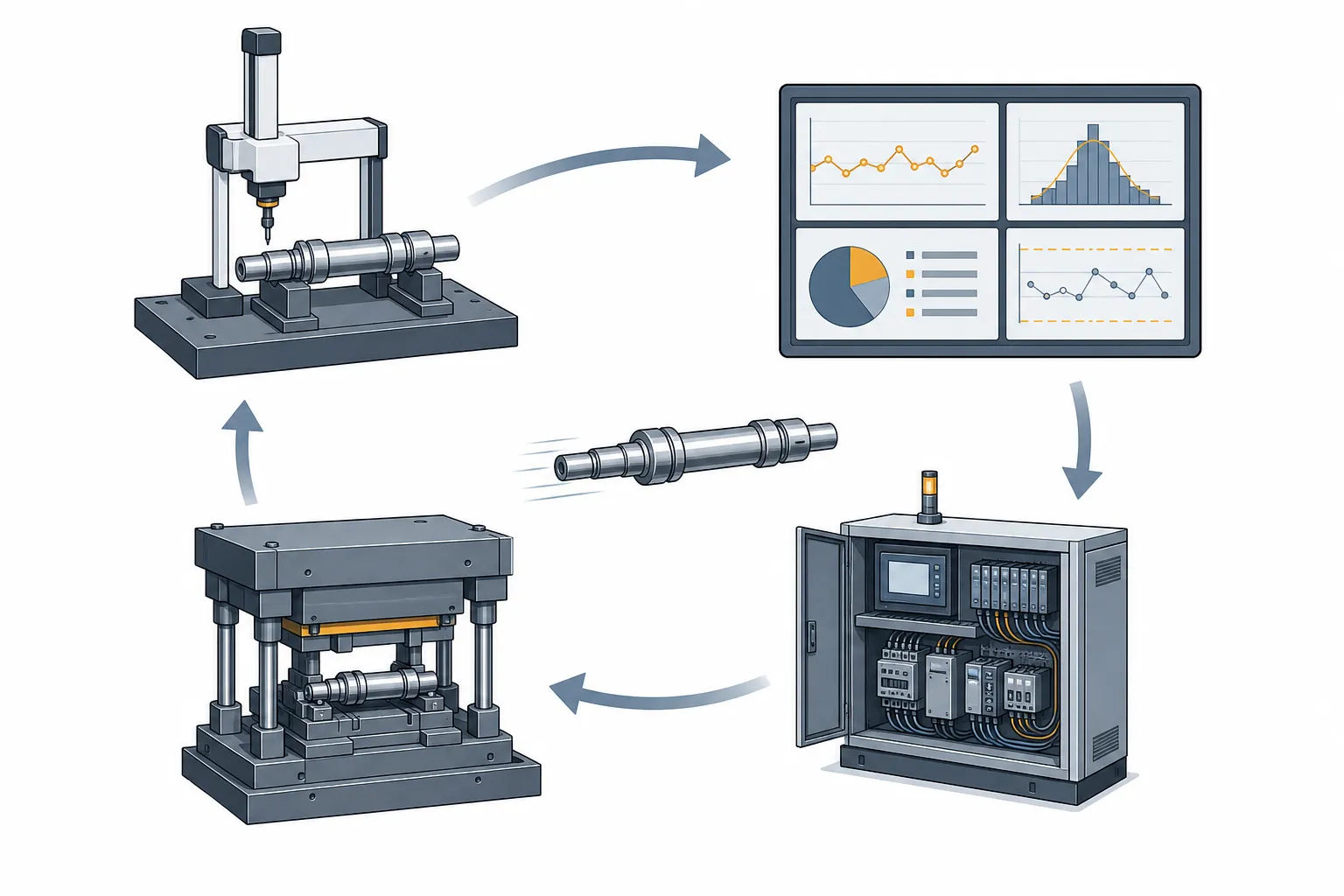
The full variation-governance loop for a production line reads as follows:
- measure every part in, on a qualified setup, logging the bend map;
- group results by heat number, batch and shift;
- apply run rules to separate random scatter, lot steps and drift;
- when a lot step is confirmed, re-baseline coefficients on a sample of that lot;
- verify the first parts after any change before releasing volume;
- file the change with its evidence, so the next investigation starts from data.
Common Failure Patterns
- Tuning compensation on the average of a mixed-lot sample, then wondering why half the parts miss.
- Switching material supplier or bar source without re-running a straightening sample trial on the new lot.
- Treating measurement noise as process drift because no gage study exists to bound the noise.
- Chasing lot shifts with manual presses while the coefficient set stays months out of date.
- Keeping no version history of learned coefficients, so nobody can say which recipe produced last month’s good run.
What to Put on the Table With Your Machine Supplier
If springback variation is determining your rework rate, bring the following to a technical discussion:
- part drawing, material grade and the heat numbers involved in the problem period;
- hardness results by lot, جہاں دستیاب ہے;
- the process stage at straightening and the sequence before it;
- bend maps of incoming and corrected parts, ideally fifty or more per suspect lot;
- the recipe and coefficient version in force, with any manual overrides logged;
- the acceptance criterion — tolerance on runout or straightness, and where it is measured;
- measurement setup description, including supports, centers and temperature conditions;
- representative samples from at least two different lots for trial.
اکثر پوچھے گئے سوالات
Why does the same shaft design need different correction from lot to lot?
Because springback follows the material, not the drawing. Yield strength and elastic modulus vary between heats within the same ordered grade, and heat treatment adds batch-to-batch differences. The correction recipe that fits one lot under- or over-corrects the next.
How much springback variation is normal?
کوئی یونیورسل نمبر نہیں ہے۔, and quoting one would be misleading. The useful figure is your own: the spread of required correction across recent lots, measured on a qualified setup. That baseline is what tells you when a new lot is abnormal.
Should the straightening machine adapt automatically?
Per-part closed-loop correction handles random within-lot scatter well. Between-lot shifts still deserve a deliberate re-baselining on samples, because an adaptive system that silently absorbs a lot change also hides the material signal from you.
How often should straightening sample trials be repeated?
At minimum with every new heat lot or heat-treatment batch, and after any change in upstream process, supplier or stock condition. Within a stable lot, per-part measurement replaces the need for repeated trials.
Can springback variation be eliminated?
نہیں. It can be measured, bounded and compensated. Eliminating the variation would require eliminating material scatter itself. The engineering goal is a line that corrects despite the scatter and raises an alarm when the scatter exceeds what the recipe was validated for.
Is deeper pressing a legitimate response to under-correction?
As a one-off on a verified part, sometimes. As a habit, no. Repeated or excessive pressing changes the material response through cyclic effects and raises crack risk on hard parts. The right response to systematic under-correction is a coefficient update with evidence, not a stronger arm.
Govern the Distribution, Not the Single Part
We treat springback variation as a measurable production property: linked to heats and batches, separated from measurement noise, governed through bounded adaptation and verified on samples at every lot change. The machine architecture — full measurement, per-part correction calculation, logged overrides — follows from that discipline rather than from any generic shaft recipe.
ڈرائنگ بھیجیں۔, material and heat-treatment condition, bend maps from the problem lots, the recipe history and your acceptance criteria. We can then review the variation picture with you and define the measurement strategy, correction envelope and re-baselining rules for your specific parts.
Related: the per-part compensation math is covered in شافٹ سیدھا کرنے میں springback معاوضہ, and the material mechanism behind changing response in the Bauschinger effect in straightening.