
Heavy weight drill pipe (HWDP) is the transition member of a drill string: thicker in wall and heavier per joint than standard drill pipe, yet slimmer and more flexible than the drill collars below it. Each joint typically carries integral upset connections and a long center upset that acts as a wear pad, absorbing hole drag so the tube body does not. That geometry is exactly what makes HWDP straightening its own process: the machine sees string-pipe dimensions, but the force and fixturing demands of a much heavier section — and the correction zones must dodge the very features that make the part valuable.
Five questions frame any heavy weight drill pipe straightening solution:
- Are you straightening new OEM joints after heat treatment and machining, or used joints flowing through an inspection-and-repair program?
- What is the tube OD range, wall configuration and overall joint length, and does the mix include spiral or plain center upsets?
- Where does the bend sit — along the tube body, at the upset-to-tube transition, or at the connections?
- What press force does the thick wall actually require, and which spans are no-press zones (center upset/wear pad, upsets, tool joints)?
- Which straightness and connection-runout criteria will accept the finished joint, measured how and by whom?
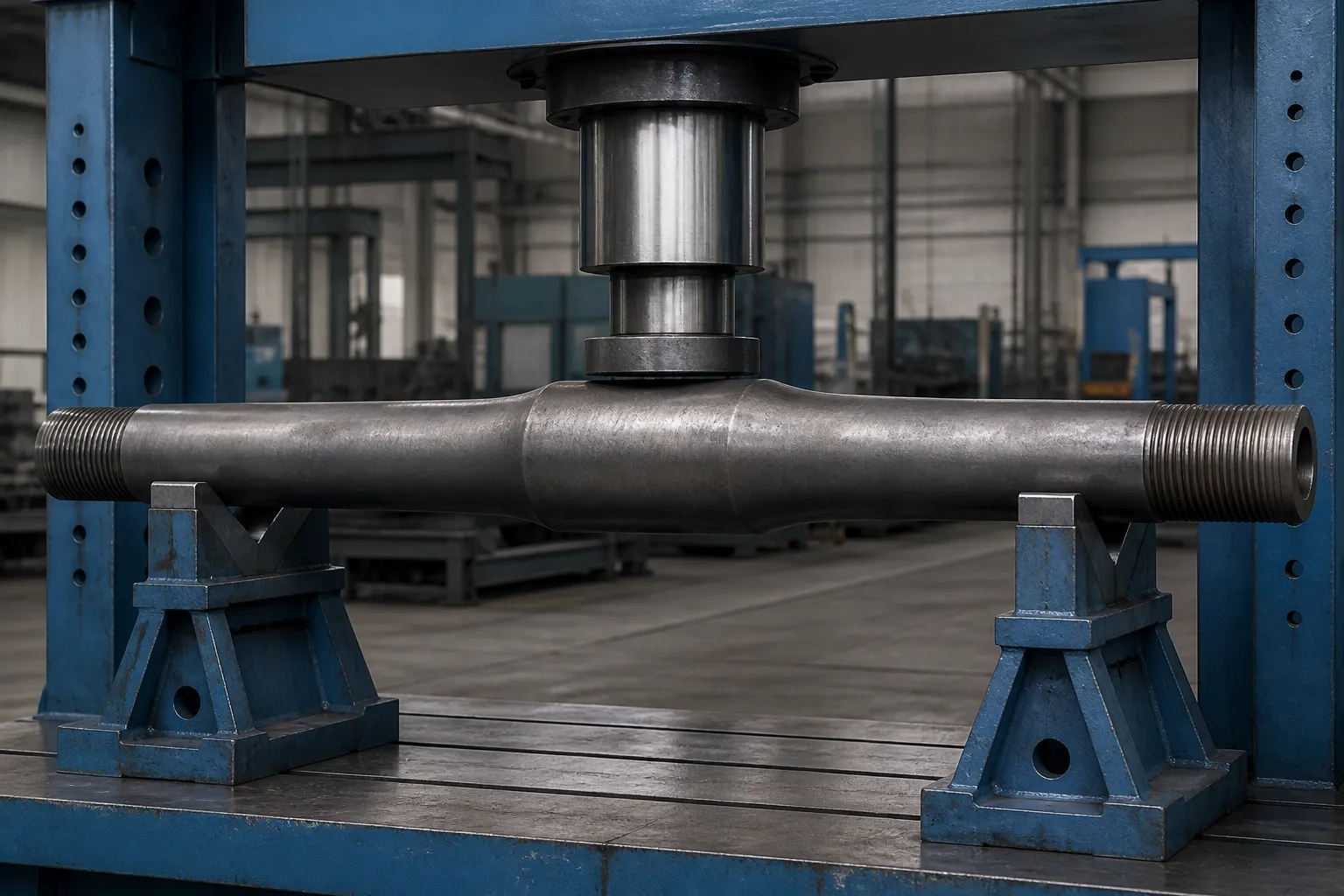
*انجینئرنگ تصور کی مثال: an HWDP joint supported for controlled press correction. یہ گاہک کی سائٹ کی تصویر نہیں ہے۔. Force levels, support positions and acceptance limits must be established against the governing standard edition and representative samples.*
What the Search Results Already Tell You
The results page for heavy weight drill pipe straightening is unusually well-defined: a purpose-built hydraulic pipe straightener rated for tubulars roughly 2″ to 8″ OD sits near the top, followed by a dense block of oilfield service companies describing hydraulic gag-press straightening of tubing, ڈرل پائپ, HWDP and drill collars in portable and in-house configurations, plus inspection contractors that bundle straightening into premium-connection requalification work. Related searches skew toward equipment (“drill pipe straightening machine”, “for sale”, “used”) — this is a machinery purchase keyword as much as a service keyword, and both OEM lines and inspection yards are buying.
Placing HWDP in the Tubular Family
| جزو | فنکشن | Geometry That Matters to Straightening |
|---|---|---|
| ڈرل پائپ | Main string body | پتلی دیوار, friction-welded tool joints; لچکدار, moderate force — see oil drill pipe straightening |
| HWDP | Stiffness transition above the BHA; adds weight while flexing more than a collar | Heavy wall + integral connections + center upset/wear pad that must never take the ram |
| Drill collar | Bit weight and BHA stiffness | Near-solid section, highest force, spiral-groove protection — our drill collar straightening article covers this family |
| Tubing & سانچے | Production conduit | پتلی دیوار, ovality-driven — see oil tubing and casing straightening |
HWDP manufacturing falls under the API specification governing rotary drill stem elements (API Spec 7-1 territory — the current addenda explicitly cover heavy weight drill pipe used in bottom-hole assemblies), while standard drill pipe body requirements live in the drill pipe specification (5DP lineage). For artificial-lift rods on the production side, دیکھیں sucker rod straightening — a different loading world again.
Why HWDP Bends Differently
In a directional or deviated well, the HWDP span is the fatigue hinge of the string: it cycles between the flexible pipe above and the rigid BHA below, absorbing bending stress each revolution. Published manufacturer guidance describes the center upset as the sacrificial wear surface that takes hole-wall contact — which means used joints arrive with the center section wall-worn and sometimes burred, while bends concentrate at the upset-to-body transitions and near the connections where section stiffness steps. Straightening therefore cannot be a single mid-span press: the bend map along the joint decides where supports and force go, and the transitions need short-span control rather than a full-body bow press.
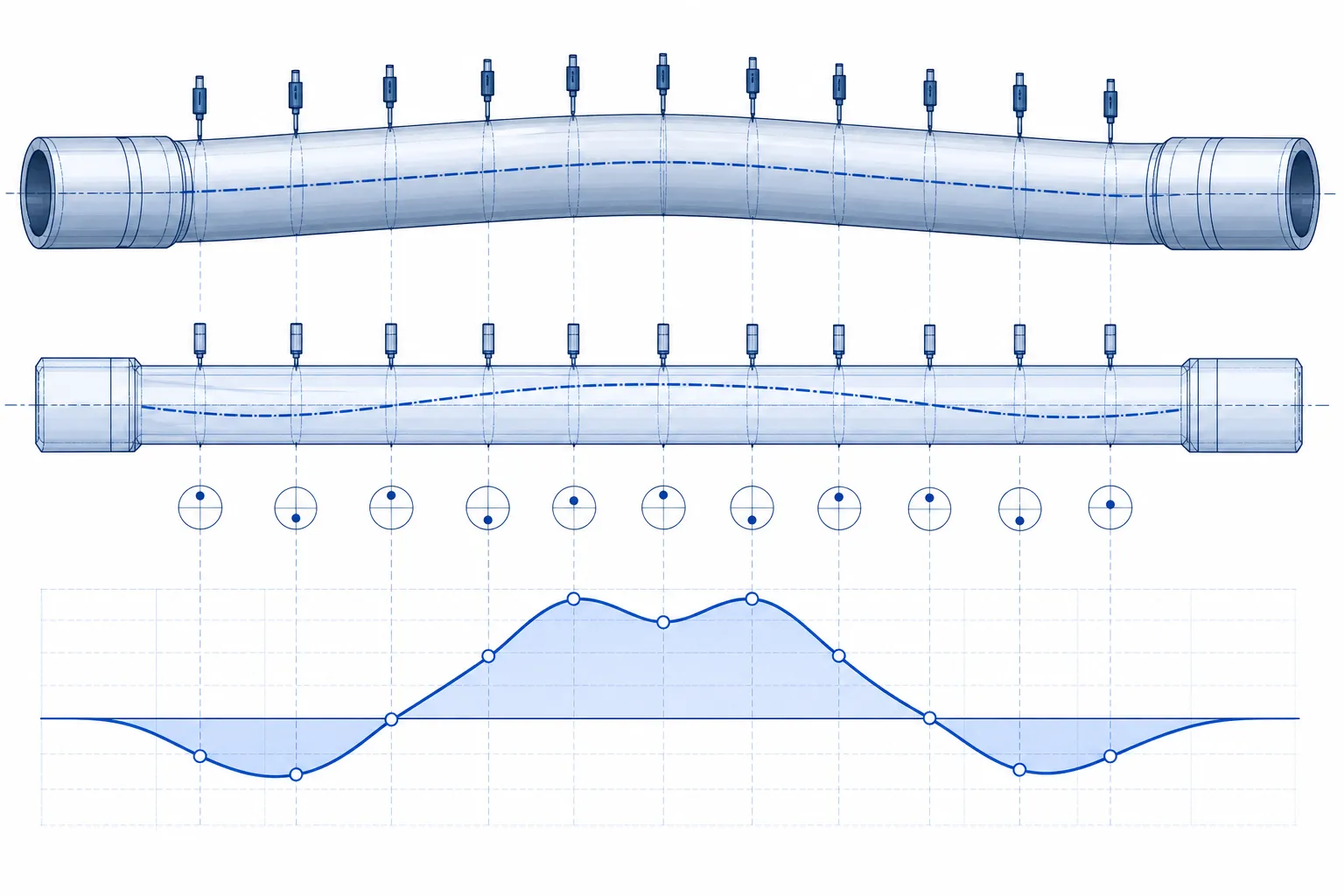
پیمائش: Map Before Press
Screening practice inherited from drill-pipe shops uses a straightedge or taut wire on the tube body; it is fast but blind to connection coaxiality and to curvature at the upsets. For machine-driven correction, rotate the joint on roller or V-block supports and record radial deviation at multiple stations, clock-referenced so the press operator knows the high-point direction at each station. The measurement logic — separating centerline bend from ovality and surface effects, and choosing datums that reflect how the part will actually be used — follows the same principles we detail in سیدھا پن بمقابلہ رن آؤٹ بمقابلہ TIR اور multipoint LVDT shaft measurement, scaled up to oilfield lengths.
Process Route and Force Class
HWDP is press-straightened, not roll-straightened: the wall is far too heavy for economical rotary-tool correction, and the surface finish on the body and upset must be preserved. Service operators describe portable and stationary hydraulic gag presses covering common oilfield tubular ranges (published equipment descriptions span roughly 2-3/8″ to 6-5/8″ OD across tubing, ڈرل پائپ, HWDP and collars, with ram capacities reported in the 60-ton class). The mechanics of gag-press correction — support span, increment size, springback management — are the same discipline we compare in press vs roller straightening اور springback معاوضہ; the HWDP delta is that a wall two to three times heavier than standard drill pipe needs proportionally more controlled force per correction step, and the fixturing must index to the upset geometry.
Thick-wall sections also spring back more per unit of press travel, so the loop presses in smaller increments and re-measures more often than thin-wall tube work. If your mix includes joints fresh from heat treatment, read our گرمی کے علاج کے بعد سیدھا کرنا notes first — HWDP machining sequences interleave correction with stress-relief steps, and pressing order matters to final geometry stability.
Deviation Classes and Protection Zones
| انحراف | Typical Cause | Posture |
|---|---|---|
| Body bow between upsets | سنبھالنا, storage on short supports | Mid-span press program, standard springback loop |
| Bend at upset-to-tube transition | Section-step stress concentration, cyclic service | Short-span pressing; engineering review of fatigue history first |
| Connection-area bend | Make-up and torque events, shoulder damage | Press with thread protection; verify connection runout afterwards |
| Worn/burred center upset with body bow | Hole-wall contact in deviated sections | Straighten on tube-body datums; route wear assessment separately — pressing the pad destroys it |
| Bow plus transverse indication | Fatigue cracking initiation | سیدھا کرنے والا کیس نہیں۔; NDT disposition precedes any correction |
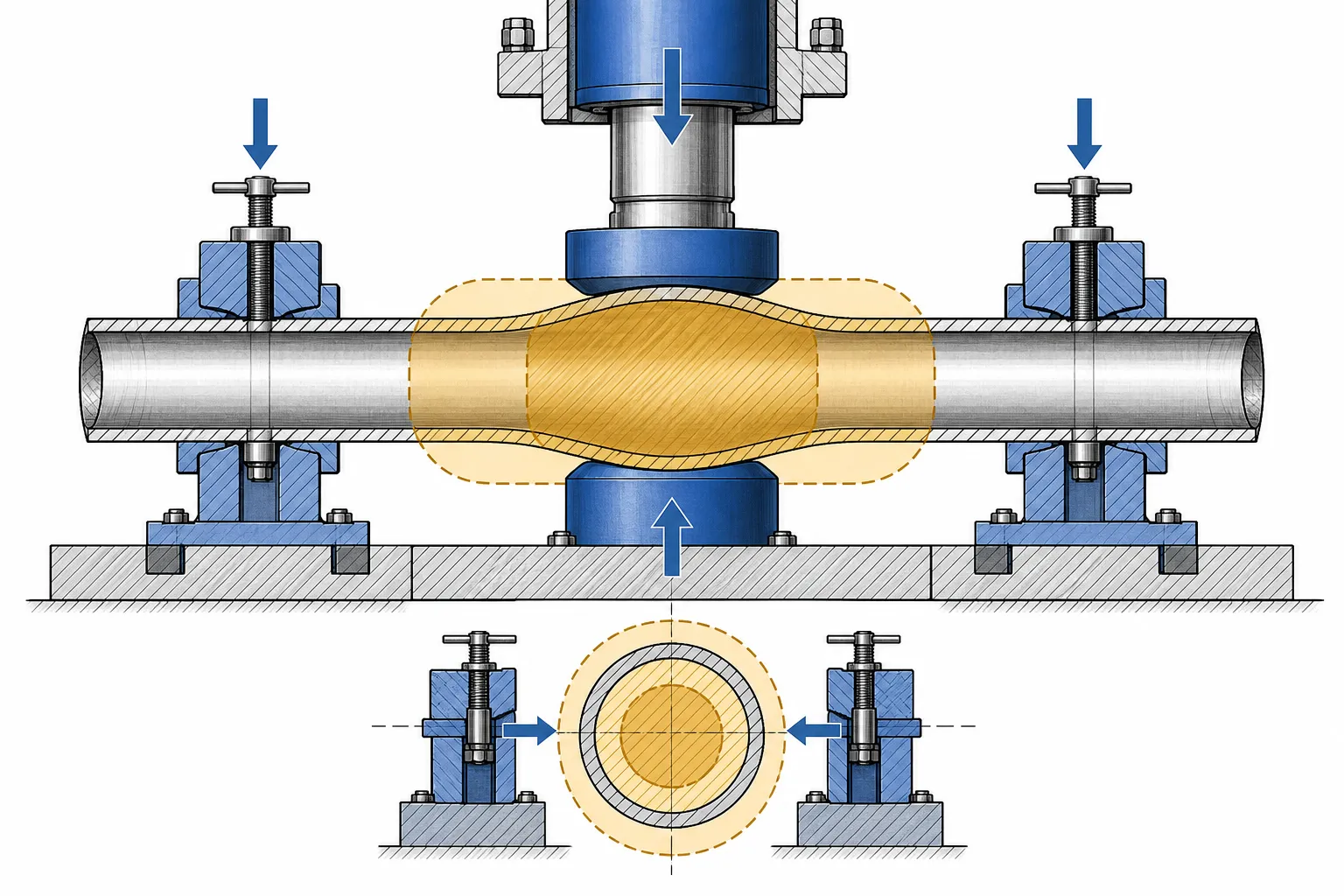
Three protection rules are HWDP-specific. سب سے پہلے, the ram never lands on the center upset or wear pad — it is the joint’s wear allowance and its OD is a functional dimension. دوسرا, supports do not sit inside the upset transitions, where local stresses would bruise the section change. تیسرا, connections stay capped or protected during handling and pressing; a nicked thread turns a good correction job into a scrap event. These rules generalize the surface-protection tooling discipline we describe for precision shaft work, applied at oilfield scale.
Closed Loop and Documentation
Production-grade HWDP straightening runs the same closed loop as other fatigue-critical components: map, press in sized increments, re-measure on identical datums, iterate to band, then re-verify after settling. In inspection-shop flow, the corrected joint should re-enter the inspection sequence (body wall, connection area, ختم) before release, because pressing can move paint-band and wear-mapping references used later in the yard. For machine acceptance projects, our سیدھا کرنے والی مشین FAT چیک لسٹ براہ راست لاگو ہوتا ہے: bring your worst realistic joints, not idealized samples, and prove the loop end to end with your gauges.
OEM and reconditioning loops also differ in rhythm, and the cell should be laid out for whichever dominates your volume. A manufacturing line sees green joints in a known pre-machining state, so correction stations can sit inline with short, predictable cycle targets and the machine program repeats. An inspection yard sees the opposite: mixed grades, mixed damage, joints arriving dirty with unknown history, so the value concentrates in measurement versatility — quick bend mapping on variable lengths, generous handling clearances, and correction records tied to joint serials for traceability back into the owner’s inventory system. One physical press can serve both duties; the fixture inventory, handling method and data handling usually cannot, and that is where projects are won or lost.

Common Mistakes in HWDP Straightening Projects
- Sizing the press from drill-pipe experience — HWDP force demand scales with wall, not with OD, and undersized machines stall mid-program.
- Fixture sets designed around plain tube, so every upset joint needs manual shimming and the center pad still gets marked.
- Accepting joints on body straightness alone while connection-to-body runout — what actually matters to BHA assembly — is never measured.
- No correction-count logging; rework loops quietly consume fatigue life joint by joint.
- Buying on price for occasional collar-grade work and discovering the frame, daylight and handling were never meant for mixed HWDP/collar duty.
RFQ Data That Gets a Real Answer
Bring these to any equipment or cell discussion: OD and wall range across your joint mix; joint lengths and weights including connections made up; upset style (سادہ, spiral) and pad length; steel grades and typical hardness; inbound bend statistics if you have them; acceptance straightness band and connection-runout requirement with the governing standard; target cycle time and annual volume; hall constraints (کرین, bay length, floor). A supplier who does not ask for sample joints after receiving that data is guessing — for this part family, a measured run on representative bent HWDP is the only honest machine specification.
اکثر پوچھے گئے سوالات
Is HWDP straightening the same machine work as drill pipe straightening?
The route is the same hydraulic gag-press logic, but not the same machine sizing: the heavy wall and integral upset put HWDP force requirements far above string pipe of equal OD, and fixtures must avoid the center pad. Machines and service rigs marketed for “tubing through drill collars” cover the range with changeable tooling — verify HWDP specifically, with samples.
Can the center upset be pressed?
نہیں. The upset is the designed wear surface and a functional OD; pressing on it both marks it and changes its geometry. Correction is applied on tube-body spans with supports indexed clear of the upset transitions.
How straight does HWDP need to be?
Acceptance belongs to the applicable API drill-stem specifications and the operator’s in-service classification limits — always the current edition, never a web-stated number. What the machine contract must state is your measured band, the measurement method, and where the datum sits relative to upsets and connections.
Portable press or fixed cell?
Portable gag presses make sense for field-side and low-volume recovery; fixed cells with rotating measurement, logged corrections and settling re-checks pay off in inspection yards and OEM lines. The decision framework is the one in our دستی بمقابلہ خودکار سیدھا کرنا comparison, weighted by joint value and throughput.
Summary and Next Step
Heavy weight drill pipe straightening is string-pipe logistics with collar-grade force and one extra rule — the center upset is untouchable. Get the family boundaries set, the bend mapped station by station, the press sized by wall not OD, and the loop closed with settling re-measurement and connection-runout checks. Send your joint mix, acceptance bands and one representative bent joint, and we will scope the machine and fixturing around measured results rather than catalog assumptions. For adjacent families, see our pages on drill collar straightening اور heat-treated rock drill rod straightening.