
Keputusan untuk memasang semula atau menggantikan mesin pelurus hendaklah berdasarkan bukti, not on the machine's age alone. Platform mekanikal yang lebih lama mungkin masih sesuai untuk peningkatan yang disasarkan; mesin yang lebih baru mungkin masih kurang sesuai jika ukurannya, keselamatan, pengendalian atau seni bina data tidak dapat menyokong bahan kerja semasa dan keperluan penerimaan. The decision must also separate a machine condition finding from the availability of a supplier's retrofit service.
Panduan ini ialah rangka kerja pembeli neutral. Ia tidak mendakwa bahawa StraighteningTech menawarkan pengubahsuaian, penukaran, alat ganti, mengawal peningkatan atau tindak balas perkhidmatan tertentu. Skop tersebut mesti disahkan secara berasingan.

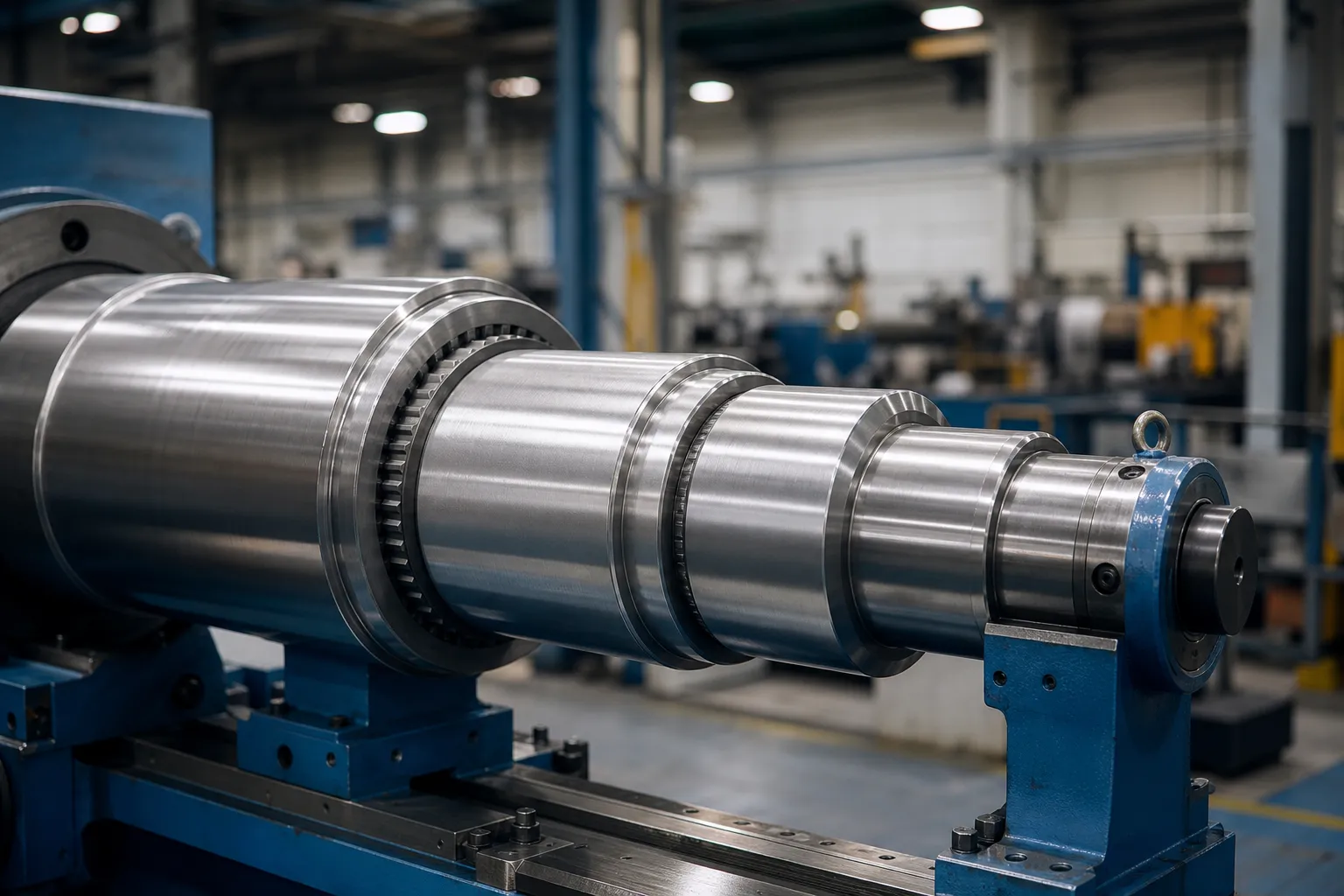
*Ilustrasi konsep kejuruteraan. Ia menunjukkan seni bina sel calon, bukan penilaian mesin sedia ada atau janji bahawa peningkatan tersedia.*
Mulakan Dengan Bahan Kerja Semasa dan Keperluan Penerimaan
Sebelum memeriksa mesin, membekukan keluarga bahan kerja semasa dan terancang, melukis tarikh, ciri geometri, kaedah pengukuran, zon hubungan terlindung, campuran produk, mengendalikan keperluan, jangkaan kebolehkesanan dan kewajipan keselamatan. Pengubahsuaian yang mengekalkan seni bina proses yang salah tidak akan menyelesaikan ketidakpadanan keupayaan.
guna aci, pemilihan pelurus tiub dan profil untuk menentukan proses sasaran sebelum membandingkan pilihan.
Menilai Mekanikal, Keadaan Keselamatan dan Perkakas
Penilaian hendaklah mendokumenkan keadaan rangka, panduan, menyokong, penggelek atau antara muka tekan, lekapan, menjaga, kawalan, keadaan elektrik, kebolehkhidmatan dan ketersediaan bahagian kritikal. Ia juga harus mengenal pasti perkara yang tidak boleh disahkan tanpa pemeriksaan yang berkelayakan.
| Bidang penilaian | Perbaikan semula soalan | Soalan penggantian |
|---|---|---|
| Struktur mekanikal | Bolehkah ia menyokong laluan daya sasaran dan bahan kerja dengan selamat? | Adakah seni bina baharu diperlukan untuk proses tersebut? |
| Perkakas dan sokongan | Bolehkah lekapan/zon kenalan disahkan untuk keluarga sasaran? | Adakah penyelesaian baharu memerlukan pegangan kerja yang berbeza? |
| Keselamatan | Bolehkah fungsi pengawalan dan keselamatan yang diperlukan disahkan? | Adakah tugas sasaran memerlukan seni bina keselamatan yang berbeza? |
| Alat ganti dan kebolehselenggaraan | Adakah komponen kritikal boleh disokong untuk hayat yang dimaksudkan? | Adakah keusangan mewujudkan risiko operasi yang tidak boleh diterima? |
When a Retrofit Is Defensible — and When It Is Not
A retrofit earns consideration when four conditions hold at once: the mechanical structure is demonstrably sound for the target force path; the target workpiece families stay within the load and geometry envelope the structure was built for; the measurement architecture — sensors, datum repetition, settings handling — can either be added or correlated to the reference method; and a supplier has confirmed in writing the scope that will actually be performed. Lose any one of the four and the retrofit discussion is spending engineering time on a route that cannot close.
The clearest non-starters are architectural. When the product mix is moving toward a different correction architecture — a different force path, a different support concept, a different measurement principle than the frame and tooling can carry — no component-level upgrade changes that. The same applies when obsolescence has reached the safety layer: guarding and safety functions built around withdrawn components are a revalidation project of their own, and stacking that on top of a process upgrade rarely survives an honest risk review. Akhirnya, when frame condition cannot be verified without a qualified inspection, the retrofit quote is priced against unknowns — commission the inspection first, or treat the machine's remaining life as unproven.
Nilaikan Keserasian Pengukuran dan Kawalan
Keputusan pengubahsuaian bukan sahaja tentang menggantikan pengawal. Mesin mesti mengukur ciri yang betul pada datum yang betul, ulangi keadaan sokongan/kedudukan yang diperlukan, mengurus tetapan atau resipi jika berkaitan, merekodkan data yang diperlukan dan pengecualian laluan dengan selamat.
*Ilustrasi konsep kejuruteraan. Ia menggambarkan semakan pemilihan proses sasaran, bukan penilaian bahawa mesin sedia ada boleh dinaik taraf kepada setiap seni bina calon.*

*Ilustrasi konsep kejuruteraan. Ia menekankan keperluan untuk mengesahkan geometri selepas dikeluarkan; ia tidak menyatakan bahawa mana-mana mesin sedia ada boleh ditukar kepada sistem gelung tertutup.*
Semak korelasi tolok, keadaan sensor, integriti data, kawalan capaian, pengurusan perubahan dan hubungan antara nilai yang diukur dan kaedah rujukan pelanggan. Skrin baharu tidak dengan sendirinya mewujudkan gelung pembetulan yang sah.
A Five-Gate Verification Path
The decision becomes tractable when it is run as a sequence of gates, each with a defined pass condition and a defined action when it fails. Perintah itu penting: every later gate is cheaper to evaluate once the earlier ones have closed.
Gerbang 1 — Requirement
lulus: workpiece families, semakan lukisan, tarikh tersebut, characteristics and the customer acceptance method are frozen in writing. Fail action: stop. Neither a retrofit nor a replacement can be specified against a moving target, and any quote received at this stage is a guess.
Gerbang 2 — Mechanical
lulus: documented evidence that frame, panduan, supports and force path carry the target family — including the findings that require a qualified inspection. Fail action: menggantikan, repurpose the machine to a lighter family, or close the gap with the inspection before any further spending.
Gerbang 3 — Measurement
lulus: the machine measures the specified characteristic on the specified datum, repeats the support and positioning condition, manages settings or recipes where relevant, and can be correlated to the customer gauge. Fail action: scope the measurement retrofit explicitly as its own engineering and validation package, or route the decision to replacement.
Gerbang 4 — Demonstration
lulus: the proposed configuration is demonstrated on representative parts through to released-state results and customer-gauge correlation. Fail action: treat the proposal as unproven. A retrofit that cannot be demonstrated before commitment is a bet placed with production as the stake.
Gerbang 5 — Economics
lulus: both routes are compared on total evaluated cost — engineering, pemasangan, downtime, revalidation, latihan, spares for the intended life, contingency for failure — using the buyer's own baseline. Fail action: if the comparison cannot be made honestly, the deciding factor is risk posture, not price, and that is a management decision to make explicitly.
Bandingkan Masa Henti, Risiko dan Pengesahan Semula
Kedua-dua laluan memerlukan pelan untuk kejuruteraan, pemasangan, semakan keselamatan, pentauliahan, ujian sampel, latihan operator dan dokumentasi. Perbandingan harus merangkumi kemungkinan tetingkap masa henti, pendedahan alat ganti, kesan pertukaran, usaha kelayakan, kontingensi pengeluaran dan kos hasil yang tidak berjaya. Do not use an average payback or “faster ROI” claim without the buyer's own baseline data.
Cost Items Both Quotes Must State
Most retrofit-versus-replace comparisons fail not on the numbers but on what the numbers omit. The table lists the items a comparable pair of quotes has to carry:
| Cost item | Where it hides in retrofit quotes | Where it hides in replacement quotes |
|---|---|---|
| Engineering and qualification | Marked “included” with no validation scope | Assumed to be in the machine price with no FAT/SAT scope |
| Installation and downtime | Scheduled around production informally | Window underestimated where foundations or utilities change |
| Safety review and commissioning | Omitted when controls are touched | Bundled invisibly into startup support |
| Gauge correlation study | Postponed until after startup | Postponed until after startup |
| Operator training | Limited to the new component | Limited to the first shift |
| Documentation and traceability update | Legacy records not migrated | Templates delivered without the buyer's data model |
| Spares for the intended life | Old-platform parts assumed available | First-generation components on a new platform |
| Production contingency during ramp | Coverage during validation runs undefined | Coverage during the learning curve undefined |
| Cost of an unsuccessful outcome | Rarely defined at all | Rarely defined at all |
| Existing machine disposal or residual value | Ignored | Ignored |
Two of these deserve emphasis because they are almost always missing: the correlation study and the cost of failure. Without a gauge correlation there is no common acceptance language between the machine and the customer, and every later dispute is unresolvable. Without a defined failure outcome — re-run, external processing, scrap allowance, rollback — the comparison silently assigns zero cost to the riskier route.
Jadikan Pengesahan Sampel sebagai Gerbang Keputusan
Laluan pilihan harus menunjukkan proses sasaran dengan bahagian yang mewakili: tempat duduk datum, kebolehulangan pengukuran, tindak balas pembetulan, keputusan keadaan dilepaskan, keadaan permukaan, pengendalian, penghalaan pengecualian dan korelasi tolok pelanggan. Sekiranya bukti tidak dapat ditutup dengan selamat di platform sedia ada, penggantian atau seni bina proses yang berbeza mungkin merupakan laluan yang lebih boleh dipertahankan.
Untuk struktur pengesahan, lihat ujian sampel meluruskan dan penerimaan and machine gauge versus customer gauge correlation.
Risks a Retrofit Trial Must Retire
A retrofit validation is not a demonstration that the machine moves; it is the retirement of specific failure modes, each with its own test:
- Correction-response risk — springback drifting with material state or batch. Test with representative parts from more than one material lot, recording the stroke-versus-result relationship; how that relationship moves between lots is the process's real signature. The underlying mechanism is covered in kesan Bauschinger dalam meluruskan.
- Released-state risk — in-machine readings diverging from final geometry once the part is released. Test by independent remeasurement after release, on supports defined in the acceptance plan. The distinction is developed in ukuran kelurusan dimuatkan vs dilepaskan.
- Setup-repeatability risk — the corrected result depending on who sets up the part. Test by repeating full setups with the datum deliberately reseated, comparing results before any capability claim. The statistical framing is in tolok R&R untuk meluruskan garisan.
- Exception-routing risk — a rejected or mid-cycle-interrupted part following an undefined path. Test by injecting faults deliberately, including an interrupted cycle, and verifying what happens to the part in the machine and how the event is recorded. Disposition rules for rejected parts are covered in Had pengisihan dan kerja semula NOK.
Red Flags in Any Proposal
- No representative-part demonstration is offered, or one is promised only after commitment.
- ROI or payback is asserted without asking for the buyer's own baseline data.
- The scope is written in conditional language — “can be considered”, “possible upgrade” — leaving the binding scope undefined.
- A controller or screen upgrade is presented as proof of straightening capability.
- No failure path is defined: nothing about what happens if the agreed result is not met.
Soalan untuk Ditanya Sebelum Cadangan Retrofit atau Penggantian
- Keluarga bahan kerja dan semakan lukisan manakah yang menentukan keperluan?
- Kaedah pengukuran dan penerimaan yang manakah mesti dikaitkan dengan penyelesaiannya?
- mekanikal yang mana, keselamatan, penemuan kawalan dan alat ganti didokumenkan?
- What configuration changes are actually within the supplier's confirmed service scope?
- Apakah sampel pengesahan, rekod tolok dan kriteria pelepasan akan menentukan kejayaan?
- Apa yang berlaku jika platform sedia ada tidak dapat memenuhi keputusan yang dipersetujui?
Soalan Lazim
Adakah pengubahsuaian sentiasa lebih murah daripada penggantian?
Tidak. Kos bergantung pada keadaan, skop, keselamatan, keusangan, pengesahan, masa henti dan proses sasaran. It must be evaluated with the buyer's own data. The defensible comparison is total evaluated cost — engineering, downtime, revalidation, spares over the intended life and a priced failure path — not the number on the upgrade quote.
Bolehkah peningkatan pengawal membuktikan keupayaan meluruskan?
Tidak. Pengukuran, datum, perkakasan, sokongan, respons pembetulan dan penerimaan masih memerlukan pengesahan. What a controller changes is data handling and interface; the characteristic and the correction response still have to be demonstrated on parts, which is what Gates 3 dan 4 above are for.
Adakah artikel ini bermaksud StraighteningTech menawarkan perkhidmatan pengubahsuaian?
Tidak. Ketersediaan perkhidmatan dan skop mesti disahkan secara berasingan sebelum sebarang komitmen komersial. The five-gate path above works the same way regardless of which supplier or route is eventually selected.
What should we do if a retrofit cannot be demonstrated with our parts before commitment?
Treat the demonstration gate as failed. Either phase the commitment so that a paid engineering study on your parts precedes the full scope, route the work to a proven process in the interim, or move the decision to replacement. What should not happen is accepting the retrofit on price while carrying the full validation risk in production.