
The oilfield kelly — the square or hexagonal drive rod that transmits rotary-table torque down the drill string, also called a kelly joint or grief stem — is a straightness-critical component in the most literal sense: it is the one member of the string whose geometry is measured by how smoothly it rides through the kelly bushing while rotating under load. A bent kelly whip-loads the rotary table, chews the bushing fits, and telegraphs vibration into every joint below it. Oilfield repair references describe dedicated straightening presses in kelly repair centers, with runout checked accurately after correction — this is an established, equipment-driven service niche, not an improvised workshop trick.
A naming caution before anything else, because it matters in search and in sourcing: “kelly bar” today mostly refers to the telescoping drive bars of construction piling rigs (foundation drilling), a different industry with its own manufacturers and repair ecosystem. This article is about the oilfield kelly drill rod used on rotary drilling rigs. If you landed here for construction kelly bars, the general long-tubular straightening principles still apply, but the component standards, cross-sections and handling are different.
Five questions frame an oilfield kelly drill rod straightening solution:
- Is the kelly square or hexagonal section, what is the across-flats dimension and overall length, and does it carry a centered bore?
- Is the workpiece a new kelly in manufacturing, or a used kelly entering a repair-and-inspection loop at a drill stem shop?
- Is the deviation a centerline bow of the drive section, twist along the length, or runout at the threaded connections relative to the drive section?
- Which faces may take press contact (drive flats and corners are functional surfaces), and what fixturing locates a non-round section repeatably?
- What runout and straightness band accepts the finished kelly, measured from which datums, with which method?
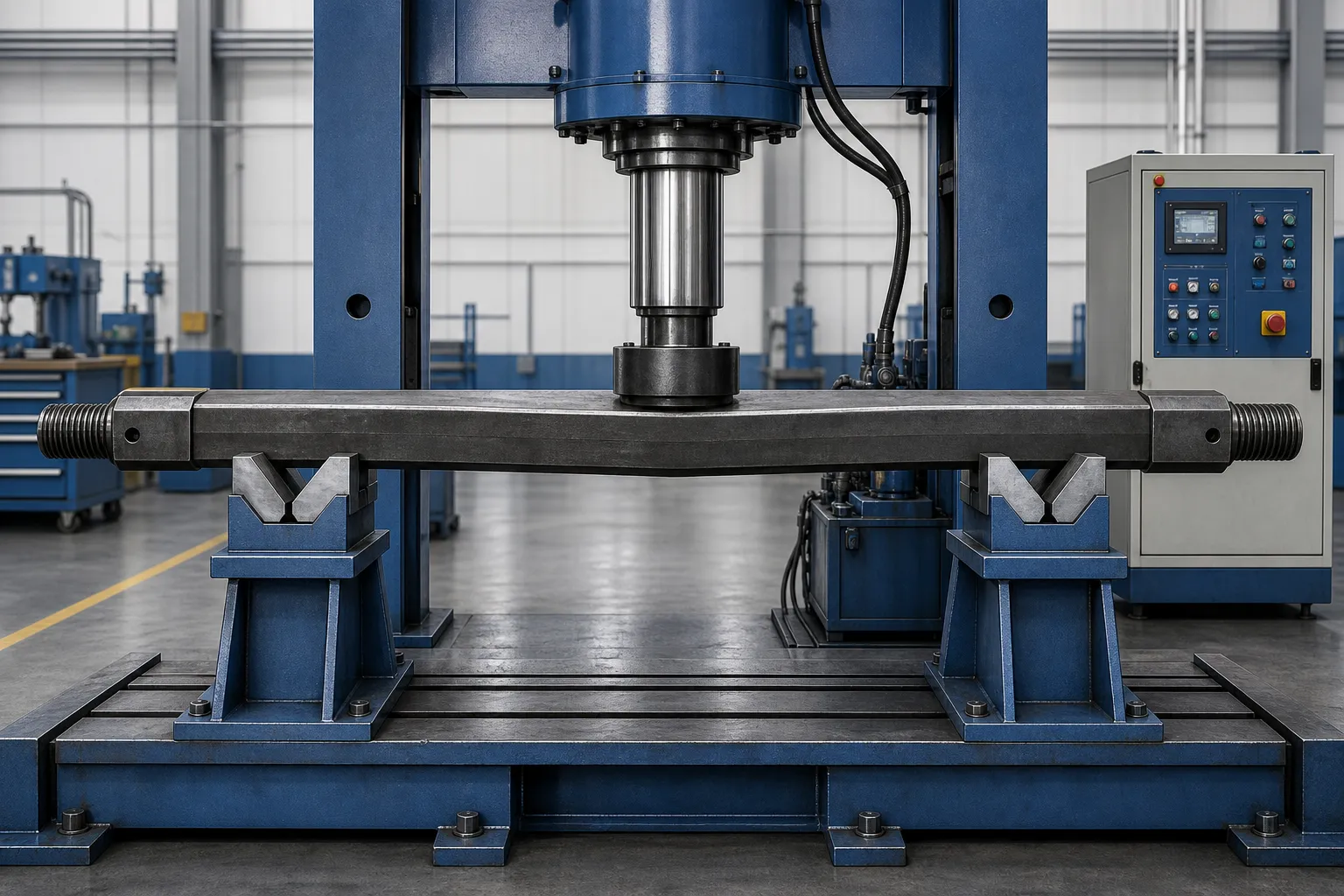
*Insenerikontseptsiooni illustratsioon: a square-section kelly supported and corrected in a press study. See ei ole kliendi saidi foto. Correction zones, force levels and acceptance limits require representative sample tests and the governing standard references.*
What the Kelly Is, and Why Its Geometry Fails
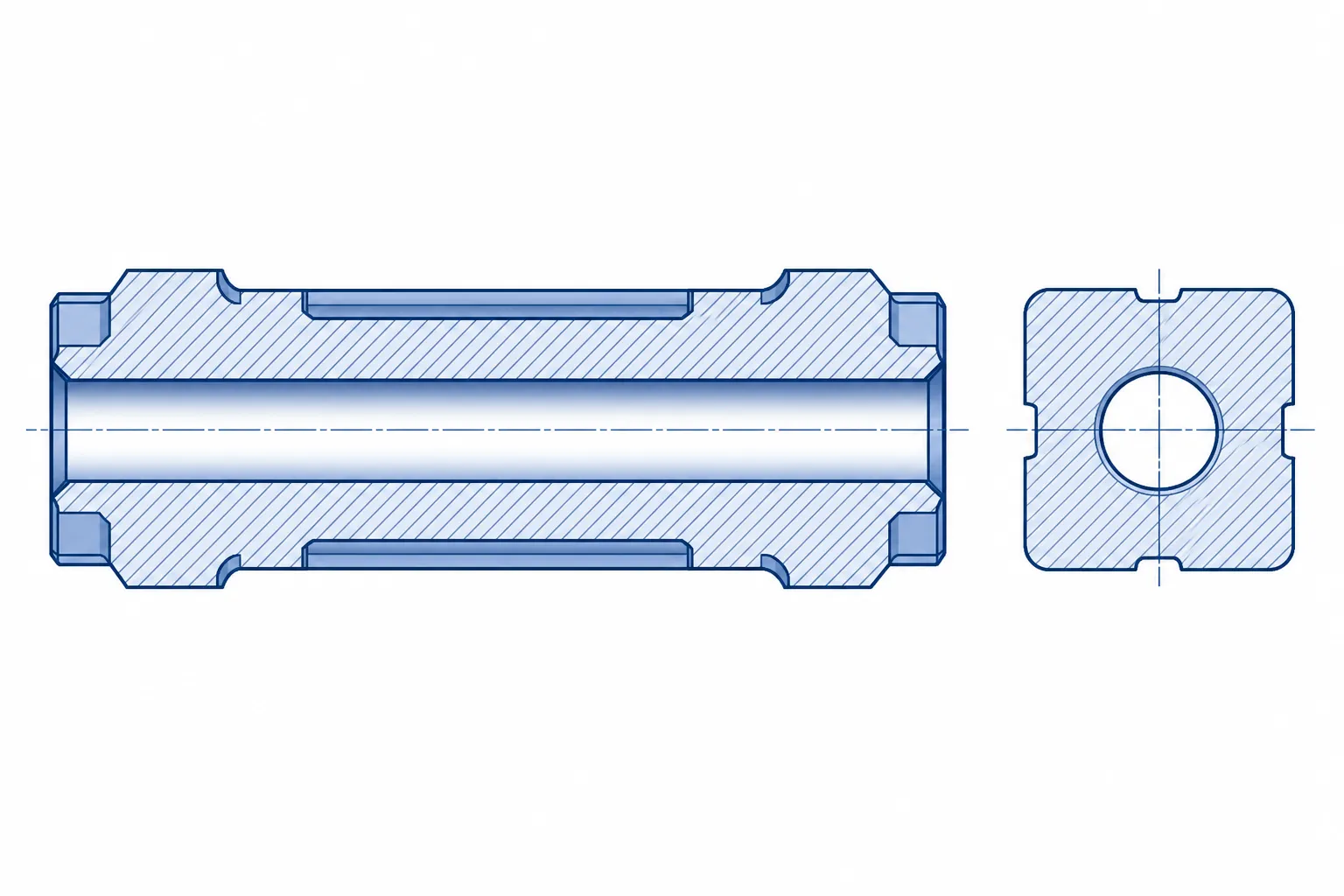
The kelly works in tension, compression, torque and rotation simultaneously: the rotary table drives it through the kelly bushing, the drill line holds it up, and the string below pulls it down, all while mud flows through its centered bore. Publicly visible equipment listings show classic kelly drill rods as long, hexagonal or square sections with a through-bore and threaded connections at both ends. Because the drive section is a machined polygon, kelly geometry can fail in three distinct ways: centerline bow (the section is straight in shape but the axis is curved), section twist (the polygon rotates along the length), and connection runout (the end threads are not coaxial with the drive section). Each has different causes and different cures, and a repair process that only chases bow will send twisted kellys back into service.
Where Kelly Sits in the Drill String Family
| Komponent | Roll | Sirgendav iseloom |
|---|---|---|
| Kelly (square/hex) | Transmits rotary torque from the table to the string; slides through the bushing as the bit advances | Non-round section, drive flats are functional; vibu, twist and connection runout are separate failures |
| Puurtoru | Main string body | Round thin-wall tube — see oil drill pipe straightening |
| HWDP | Stiffness transition into the BHA | Heavy wall with protected center upset — HWDP straightening |
| Puurikrae | Bit weight and BHA stiffness | Near-solid heavy section — puurkrae sirgendamine |
| Imenvarras | Artificial lift rod string (production side) | Long slim round rods — imivarda sirgendamine |
Manufacturing End and Repair End Are Different Jobs
On the manufacturing side, a kelly starts as a formed polygon section (or a machined round with flats), is heat treated for strength and wear, bored through the center, then machined and threaded at the ends. Straightening interleaves with those stages — after heat treatment the section can carry curvature and sometimes twist that must come out before final machining, the sequencing logic we cover in sirgendamine pärast kuumtöötlust. The manufacturer controls section quality from the start, so correction is predictable and the acceptance target belongs to the product drawing.
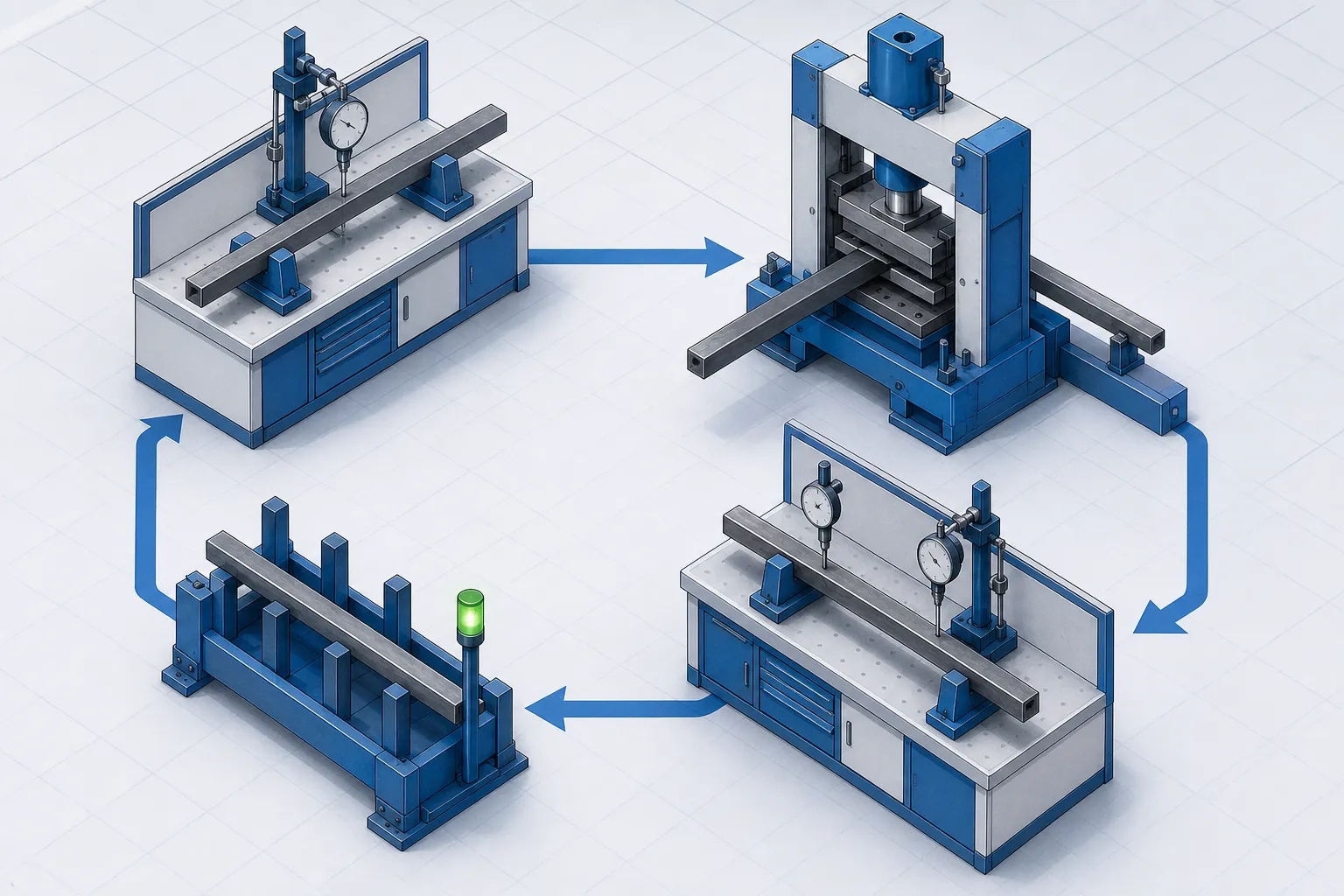
On the repair side — the kelly repair centers referenced in oilfield drilling references — used kellys arrive with service history: bushing wear on the drive flats, bow from stuck-pipe events and whipping, occasionally twist from severe torque spikes. The shop’s sequence is inspection first (wall, korterid, praod, niidid), then straightening on a press with accurate runout checking afterwards, exactly the inspect-then-correct-then-verify loop described in oilfield kelly repair references. Repair acceptance is often tighter than “will it turn” — the kelly must ride the bushing without whipping for another campaign, and the customer’s inspection standard, mitte pressioperaator, defines pass.
Measuring a Non-Round Section
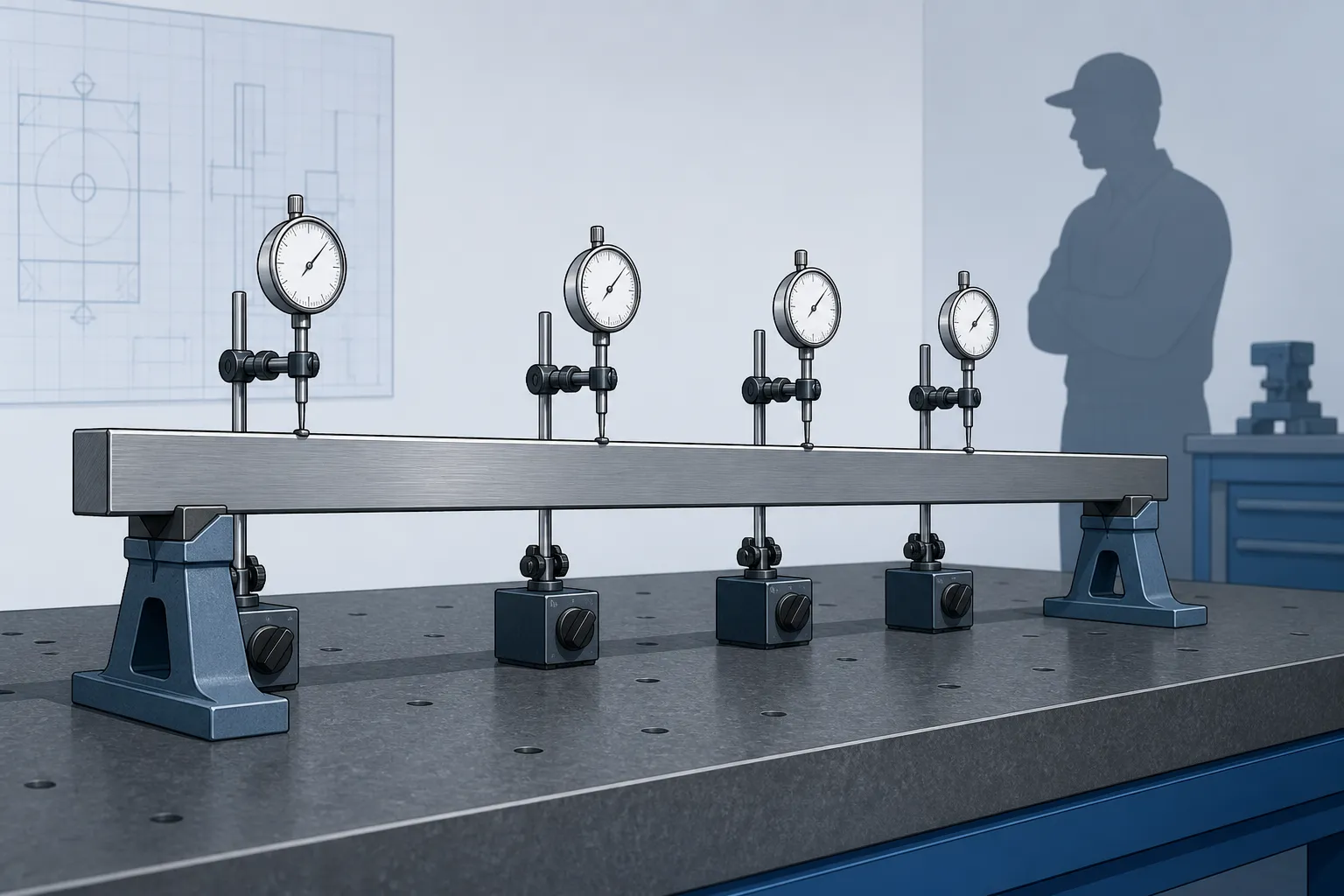
Rotating runout measurement — the natural method for round tubulars — does not transfer directly to a square or hexagonal kelly: spin a polygon on rollers and the profile itself reads as deviation. The practical methods adapt instead: support the kelly at its ends (on V-stands at the round connection sections, or in bushing-simulating supports) and measure the drive section’s flats at intervals along the length with dial or non-contact sensors, clock-referenced per face; or measure between centers using the end connection datums and read radial deviation of the drive lands. Either way the goal is the same map our round-shaft process builds — deviation by station and clock direction — which is what sizes the press program. The underlying metrology choices (what datum, what sensor, loaded or released) are the ones we treat in sirgus vs jooks vs TIR ja kontakti vs kontaktivaba sirguse mõõtmine.
Twist is the kelly-specific third dimension: clock-angle error of the section along the length. It is checked by indexing the same face at successive stations and comparing angular position. Mild twist sometimes relaxes during a full-length bow correction; pronounced twist is a section-form problem that pressing a bow will not remove — it belongs back with engineering disposition, mitte ajakirjandus.
Process Route and Protection Zones
Kellys are press-straightened — a long, jäik, machined polygon with a bore is not a roll-straightening candidate; the comparison of routes is in press vs roller straightening. The press works in the classical gag cycle: supports positioned per the bend map, ram on the high point, sized increment, uuesti mõõta, repeat. Because the section is heavier than string pipe of similar length, force class and frame daylight must respect the real section modulus — sized from samples, not from round-pipe assumptions.
Protection zones are geometric for kellys. The drive flats and their corners are functional bearing surfaces for the bushing: ram contact belongs on face centers through wide, soft-foot tooling if it must touch the drive section at all — never on corners, which can roll or chip under point load. Threaded connections take protectors and never see press force. The centered bore means internal support consideration for extremely heavy walls is usually unnecessary at kelly scale, but bore alignment should be re-checked if bow correction was severe, since the bore was machined on the pre-correction axis. Springback discipline follows the standard model in tagasilöögikompensatsioon, with one caution: polygon sections can spring asymmetrically by face orientation, so the loop re-measures each cycle rather than projecting a single compensation factor.
Deviation Classes and Disposition
| Hälve | Tüüpiline päritolu | Posture |
|---|---|---|
| Drive-section bow | Whipping, stuck-pipe loads, käitlemine | Press program from station map; verify connection runout after |
| Connection runout with straight drive section | Thread machining or connection damage | Not a body-press fix; route to connection rework and re-thread evaluation |
| Sektsiooni keerdumine | Torque spikes, thermal events | Tehniline dispositsioon; pressing bow does not remove twist |
| Worn drive flats | Bushing service wear | Wear restoration is machining/build-up territory; straightness work references the restored geometry |
| Bow with crack indications | Fatigue, mõju | Pole sirgendamise juhtum; NDT disposition first, alati |
Closed Loop, Rekordid, and the Repair Decision
Like every fatigue-critical member in this family, a kelly leaves straightening through a closed loop: map, press increment, uuesti mõõta samadel nullpunktidel, iterate to band, re-verify after settling, and log corrections per serial. The log matters more in repair than anywhere else, because kelly retirement decisions weigh correction count and service exposure together — the same joint-serial traceability logic that inspection shops apply to drill pipe and collars. For shops evaluating equipment, our sirgendusmasina FAT kontrollnimekiri kehtib muutmata kujul: prove the loop on the customer’s worst realistic kelly, with their acceptance gauges, before the machine ships.
Common Mistakes in Kelly Straightening Projects
- Fixtures designed for round pipe, so every square or hex kelly needs improvised blocking — and corners take damage on the first heavy press.
- Measuring only bow and returning kellys with twist or connection runout to service, where the bushing finds the error immediately.
- Assuming one compensation factor fits all faces of a polygon; faces can spring back differently by orientation.
- Pressing without thread protectors or without re-checking bore alignment after severe corrections.
- Buying press capacity by “rod size” instead of by section modulus of the polygon — the stall shows up on the first hex kelly.
RFQ Data for a Kelly-Grade Cell
Suppliers can quote realistically from: section shape (square/hex) and across-flats size; lengths and weights; bore diameter; steel grade and typical hardness; whether connections arrive protected or bare; inbound bow and twist statistics if known; acceptance straightness and runout bands with the invoking standard or customer spec; measurement method required for release; volumes split between manufacturing and repair flow; and bay, crane and handling limits. After that data, the honest next step is a sample test on one representative bent kelly — section modulus, springback behavior and cycle time all come from the part, not the catalog.
KKK
Can a bent kelly be straightened?
Yes — oilfield kelly repair references describe straightening presses in dedicated repair centers, with runout accurately checked after correction. Handling-type bows and moderate service bends are routine candidates; the exceptions are cracks, pronounced twist and connection problems, which belong to inspection disposition, mitte ajakirjandus.
Is a kelly straightened like drill pipe?
The press route is the same family — gag-press correction with re-measurement — but the section is not: a square or hex drive section is stiffer than pipe of equal size, its flats are functional surfaces with their own protection rules, and measurement must adapt to the non-round profile. Fixturing and force sizing, not the basic method, are where kelly work differs.
What about construction kelly bars?
Telescoping piling-rig kelly bars share the name and long-rod character, but they are a different industry’s component with different sections, wear parts and repair economics. The long-member straightening discipline overlaps; the component-specific content does not.
How straight does a kelly need to be?
Functionally, straight enough to ride the kelly bushing without whip at rotating speed; contractually, whatever the invoking customer or repair standard states. The repair shop’s job is to measure the same quantity the standard names, from datums that reflect how the kelly is actually used in the rotary table.
Kokkuvõte ja järgmine samm
Oilfield kelly straightening is long-stiff-member press work with a non-round twist: functional drive flats, three separate geometry failure modes, and a repair market that already runs on dedicated presses with runout verification. Classify the deviation before pressing, protect the flats and threads, measure per-face with clock reference, and close the loop with logged, settled re-verification. If you are equipping a drill stem shop for kelly work, send the section sizes, acceptance bands and one representative bent kelly — and read our adjacent pages on HWDP ja drill collars for the rest of the BHA mix.