
Press straightening bends the part further and lets springback settle it straighter. Heat straightening upsets a zone and lets contraction pull it around. There is a third route that does neither: peening straightening drives a stream of small impacts into one side of the part, and the compressive stress those impacts leave behind stretches that side slightly, rotating the geometry toward straight without any bending load and without any heat. On the right parts, it is the gentlest correction method available — and the only one that leaves the corrected surface mechanically stronger than it found it.
This page explains how peening works as a straightening process, where it beats pressing, where it loses, and how a disciplined peening correction loop is run. It complements our pages on the mechanical route — the proceso de alisado por presión puntual y el efecto Bauschinger en el alisado, which explains why repeated pressing changes the material — and it is one of the routes mentioned for multi-feature parts in our solución para enderezar el cigüeñal.
A workable peening correction decision answers five questions:
- Is the deviation small enough that surface-stretch correction can reach it?
- Which side must be peened, and over what length, to rotate the axis the right way?
- Can the surfaces that must not be peened be masked reliably?
- What peening medium, intensity and coverage are compatible with the part’s finish and fatigue requirements?
- How will the correction be iterated and verified without over-correcting?
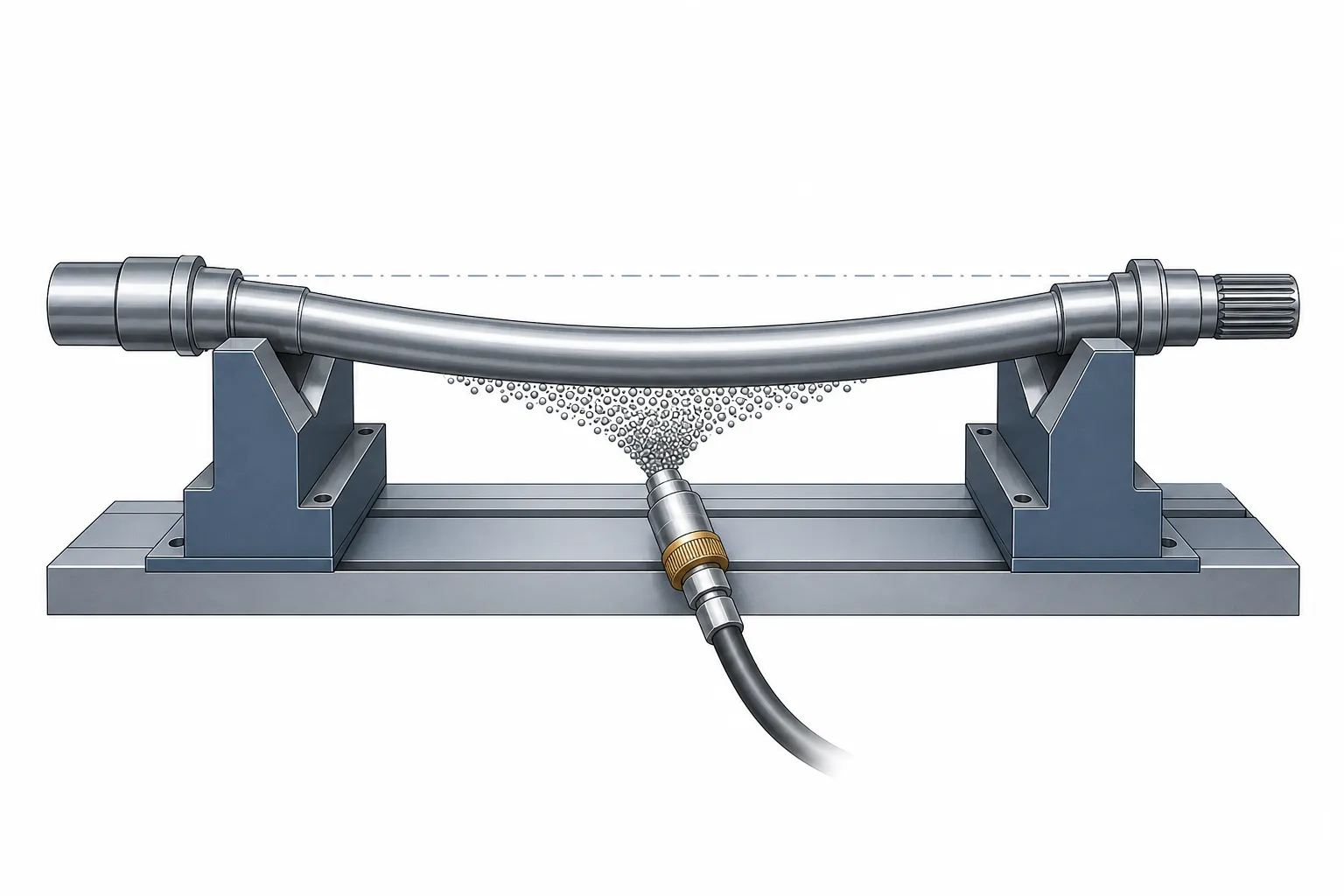
*Ilustración del concepto de ingeniería: a controlled stream of shot impinging the concave side of a bowed shaft on measurement supports. No es una fotografía del sitio del cliente.. Peening parameters require validation on your own parts.*
What the Search Results Miss About Peening as a Correction Method
The public record treats peening and straightening as two separate worlds that occasionally touch. Shot-peen forming is well documented as an aerospace process: service providers describe using the compressive stress of controlled shot peening to form and shape large skin panels, and technical papers in the shot-peening literature describe stress-peen straightening of complex machined parts — shot peening applied while the part is restrained to a predetermined elastic tensile stress. Forum threads show machinists asking how shafts are straightened by peening, with incomplete answers. What is missing is the practical middle: when a precision shaft line should choose peening over pressing, what the control parameters are, and what the method’s honest limits are. That is the gap this page fills.
The Mechanism: Stretching the Short Side
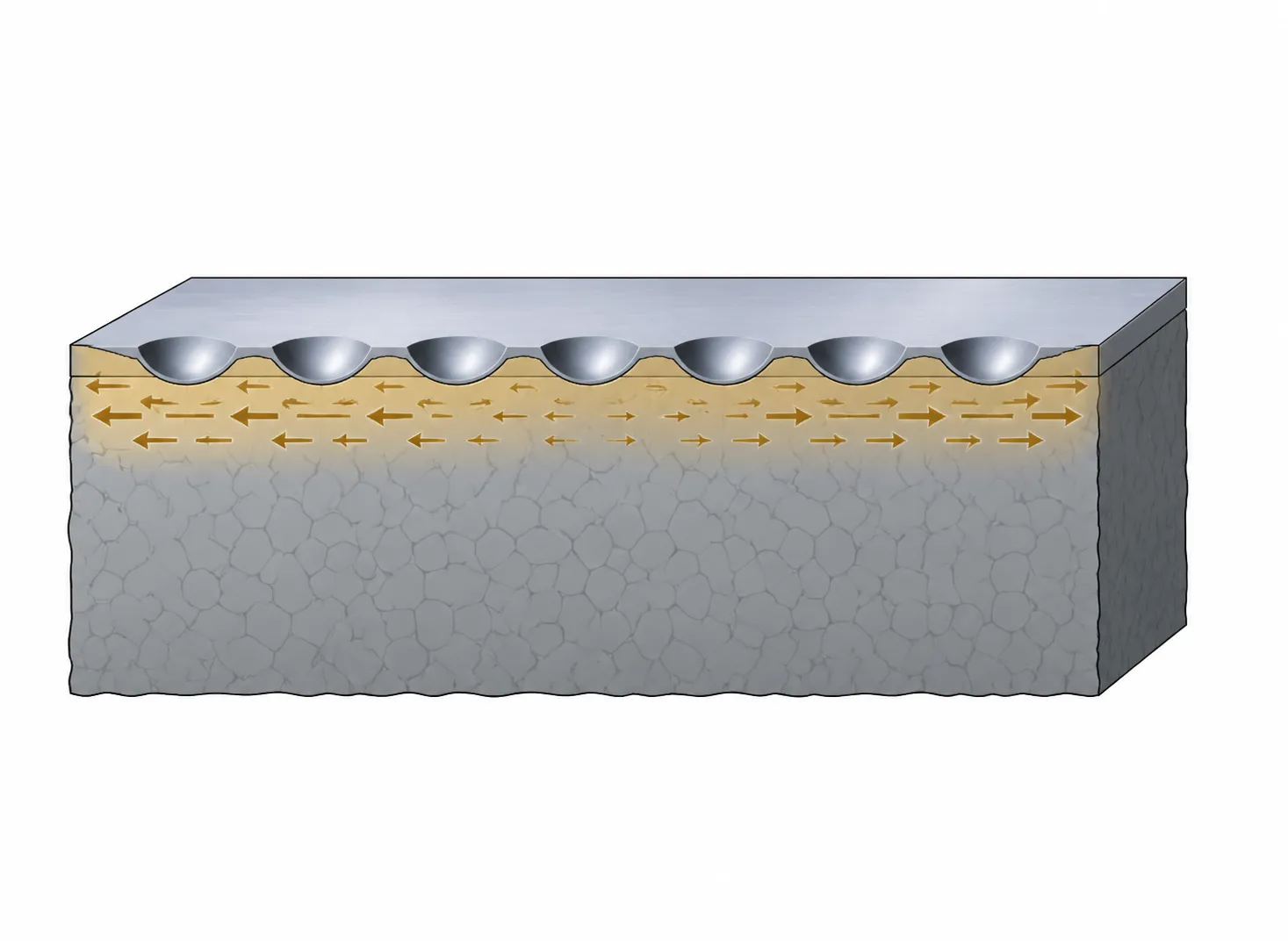
A bent shaft has a long side and a short side: the convex side is stretched, the concave side compressed. Bending-type correction presses the long side to make it permanently shorter. Peening corrects from the opposite direction: each impact dents the surface plastically, and the dent wants to occupy more width than the material below allows, so the peened layer settles into compression and effectively becomes slightly longer in the surface plane. Peening the concave — short — side therefore stretches it, rotating the part toward straight. The correction never loads the section in bending at all, which is the source of every advantage and every limit that follows.
| Variante | How It Works | Contexto típico |
|---|---|---|
| Shot peening (gratis) | Stream of round media impinges the target side | Broad correction zones on accessible surfaces |
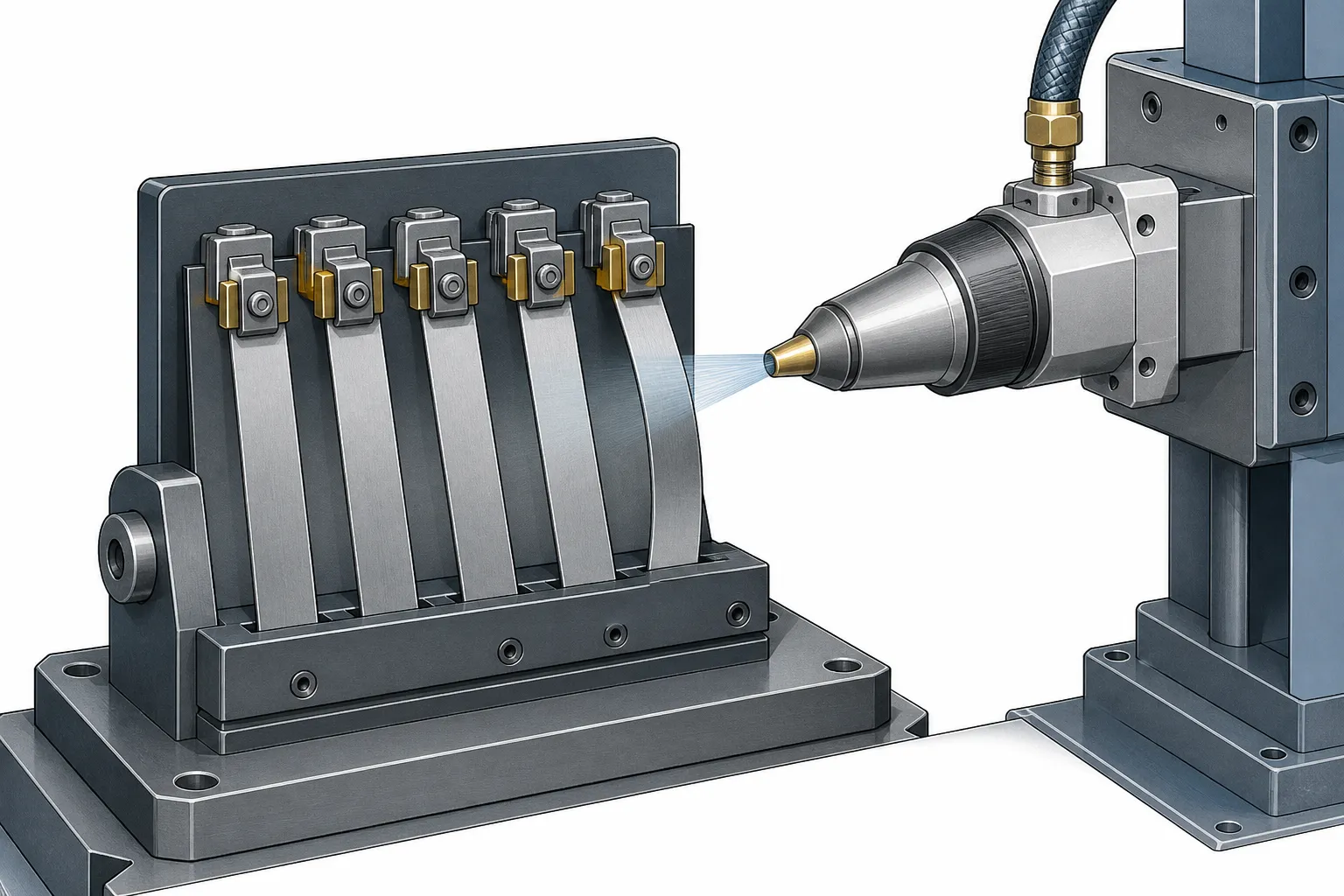
| Needle peening | Cluster of spring-steel needles strikes in rapid repetition | Local zones, shop-floor flexibility, repair work |
| Stress-peen straightening | Peening applied while the part is elastically restrained in tension | Reported in the literature for complex machined parts needing larger controlled correction |
| Laser peening | Plasma shock waves from laser pulses deepen the compressive layer | Reported for straightening plus fatigue-critical applications; equipment-intensive |
| Manual hammer peening | Hand-directed hammer work on the short side | Repair shops; operator-dependent, low equipment cost |
Where Peening Beats Pressing
- Finished functional surfaces. Peening correction can be applied without pressing on journals — relevant whenever tooling contact is the enemy, the concern behind surface-protection tooling for straightening.
- Fatigue-critical parts. The correction leaves compressive residual stress in the treated surface — the same stress state shot peening is specified to create for fatigue life. Correction and surface strengthening arrive together, instead of trading against each other.
- Parts that must not see bending load. Hollow sections, thin walls and parts with internal features can be damaged by press loads that solid shafts shrug off; peening side-steps the load path entirely.
- Small final trim after other operations. A light peening pass is a recognized way to nudge a part the last fraction into tolerance after grinding or heat treatment, where another press cycle would risk the part.
- No Bauschinger exposure. Because the section is never bent plastically, the cyclic softening mechanism that complicates repeated pressing does not enter the picture.
Where Peening Loses to Pressing
- Velocidad. A press corrects a bend in one stroke measured in seconds; peening works incrementally and iteratively, pass after pass with re-measurement. For volume production of ordinary bends, it is not the economic route.
- Correction magnitude. The stretch a peened layer can deliver is bounded; large bends are press territory, or a press-to-rough plus peen-to-finish combination.
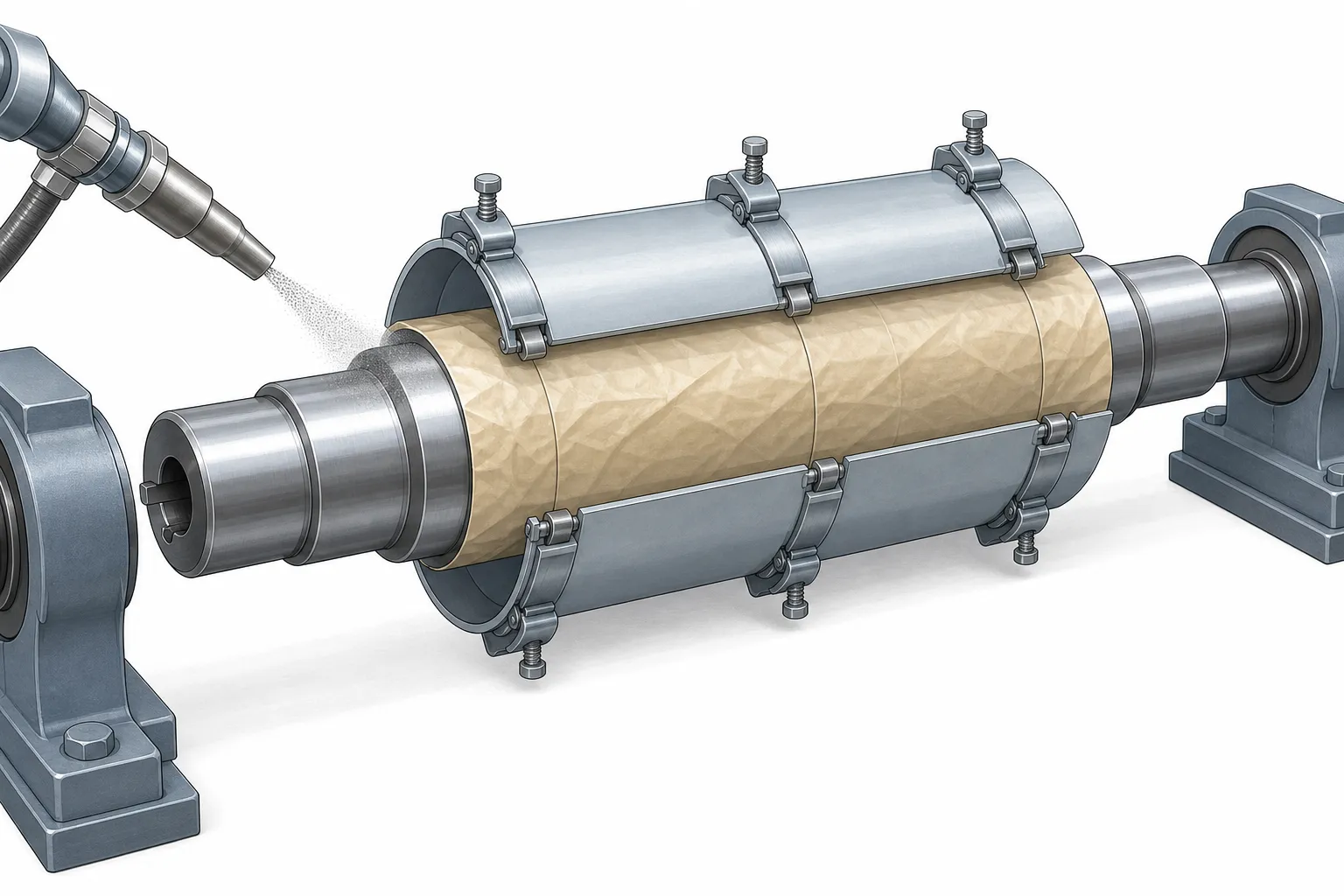
- Surface change. Peening textures the treated surface. On sealing diameters, bearing raceways or gauged features this is unacceptable — those zones must be masked, which consumes time and invites mistakes.
- Control is indirect. The correction amount is steered through media, intensidad, coverage and passes — parameters one step removed from the geometry they produce. Pressing steers displacement directly.
- Media management. Contamination, broken shot and residue control come with the process, on top of masking.
Running a Disciplined Peening Correction Loop
- measure the part on qualified supports and map the bend direction and magnitude;
- identify the concave side and the zone where stretch is needed;
- mask every surface that must not be peened — journals, diámetros de sello, trapos, gauging lands;
- peen a first pass with defined medium, intensity and coverage, using process control of the kind standard in shot-peening practice, where intensity is verified on representative test strips;
- re-measure on the same supports, compare against the map, and iterate in small steps;
- stop inside tolerance without overshooting — over-peening bends the part the other way and cannot be pressed back casually;
- clean, demask, and record parameters with the part’s history, applying the same traceability logic as detección de grietas durante el alisado automático applies to press lines.
Two practical notes keep the loop honest. Primero, always re-measure on the same supports and orientation used for the baseline map; a support change between passes moves the reading by amounts that matter at this scale. Segundo, log the peening parameters with the same seriousness a press line logs its forces — medium condition, intensity checks, coverage and pass count — because without that record, tomorrow’s operator cannot reproduce today’s good correction, and the process silently becomes craft again. Both habits cost minutes; both are what separate a documented peening correction from an anecdote.
Combining Peening With the Other Routes
The strongest practice treats peening as the precision tail of a correction strategy rather than a rival to the press: rough correction by pressing within a validated envelope, optional thermal or vibratory stress management where stability demands it, and a final peening pass to trim the last fraction of deviation while leaving compressive stress in the most fatigue-exposed surface. In remanufacturing, peening serves parts whose bending history or surface condition makes another press cycle unattractive. The route decision is made per part family, from evidence — the same discipline our straightening machine FAT checklist enforces on the press side.
Common Failure Patterns
- Peening the convex side by mistake and worsening the bend — the direction rule must be written into the work instruction.
- Unmasked journals or seal surfaces textured by stray shot, turning a geometry fix into a surface reject.
- Chasing a large bend with peening alone, wasting hours on a correction a press makes in one stroke.
- No intensity or coverage control, so results drift between operators and shifts.
- Over-correcting past zero and trying to peen back from the other side, accumulating confused stress states.
- Specifying peening on parts whose finish, cleanliness or masking cost makes it the expensive option.
What to Put on the Table for a Peening Correction Review
- el dibujo, the tolerance to reach, and where straightness is measured;
- material, hardness profile and heat-treatment state;
- surfaces that must not be peened, marked on the drawing;
- the deviation map: direction, magnitude and zone of the bends in question;
- fatigue or surface requirements that peening could serve or violate;
- volume expectation — production rate or repair count;
- correction history of the parts, including any pressing already applied;
- representative parts for masked trial peening with before/after measurement.
Preguntas frecuentes
What is peen straightening?
Correcting a bend by peening the concave side of the part. The impacted surface layer settles into compression and stretches slightly, rotating the geometry toward straight — without bending load and without heat. It is the same physics that lets shot peening form aircraft panels, applied to correction instead of shaping.
Can a shaft be straightened by peening?
Sí, within the method’s envelope: small to moderate deviations, accessible concave surfaces, maskable functional zones. Machinists and repair shops report hammer- and needle-peening shafts straight, and the peening literature documents stress-peen straightening of machined parts under controlled restraint. Large bends are better routed to a press first.
What are the disadvantages of shot peening in correction?
Slower than pressing, limited correction magnitude, surface texturing on the treated zone, indirect process control through intensity and coverage, and masking effort on functional surfaces. Each is manageable; together they define where the method fits.
Does peening improve fatigue life while it corrects?
The treated surface gains compressive residual stress, which is the same mechanism for which shot peening is specified to improve fatigue resistance. The qualification is local: it applies to the peened zone as peened, with its own intensity and coverage. A correction plan can be designed so the zones needing fatigue benefit are the zones receiving the peening.
Why not just press the part?
Often you should — pressing is faster and directly controlled. Peening earns its place when surfaces must not see tooling contact, when the section cannot tolerate bending load, when the part is fatigue-critical, or when only a final small trim remains and another press cycle is the bigger risk.
How is the correction amount controlled?
Through the standard peening process variables — media, stream or needle energy, exposure time, coverage and number of passes — verified by re-measurement after each step. In stress-peen straightening, the restraint applied to the part adds a further control variable, which is what the technique is reported to offer.
Choose Peening Where Its Physics Pays
We treat peening straightening as a third route with its own territory: correction by surface compressive stress, for parts whose surfaces, sections or fatigue requirements make bending or heat the wrong tool — and as the precision finishing pass on a strategy that starts with the press.
Send the drawing with maskable surfaces marked, the deviation map, material and hardness condition, fatigue requirements and volume expectation. We can then assess whether peening belongs in your correction strategy, and define the masking plan, process parameters and verification loop on your samples.
Relacionado: the mechanical route is covered in the point-press straightening process, and the material mechanism behind repeated pressing in el efecto Bauschinger en el alisado.