
Buyers, process engineers and quality teams ask remarkably similar questions before a straightening machine is selected, installed and accepted. This FAQ gathers the twenty questions we hear most often, answers each in the space of a paragraph, and links to the dedicated technical guide behind every answer — more than a hundred articles deep on this site. Use it as a map: find your question, confirm the short answer, then follow the link that matches your part and process.
The questions are grouped the way they arrive in real projects. Machine selection questions come first, because they define the vocabulary. Process questions follow, because a selected machine still has to deliver geometry on your specific material. Measurement and quality questions come third, because every capability claim rests on how deviation is sensed and verified. Operational and material questions close the list, because a straightening cell is a long-term asset whose economics and upkeep are decided at purchase.
Two reading rules keep the answers honest. أولاً, every numeric claim in a short answer is a context-dependent statement — part geometry, material state and measurement method change what is achievable, and the linked guides state those conditions explicitly. ثانية, where a question has a genuine “it depends” answer, we say so and explain exactly what it depends on, rather than quoting a single flattering number.
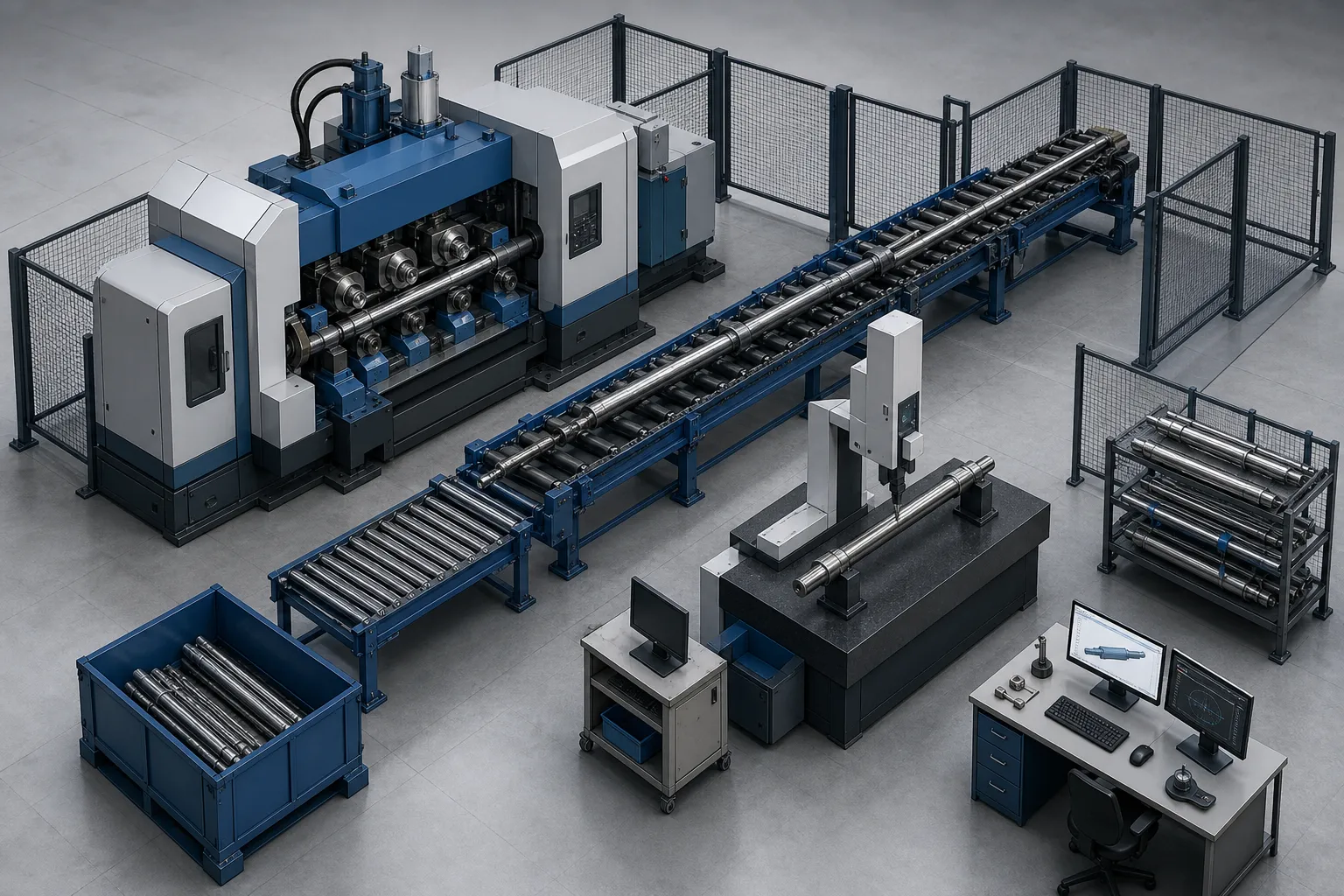
*التوضيح المفهوم الهندسي: a straightening cell seen as a knowledge map. إنها ليست صورة لموقع العميل. Machine configurations and capability values depend on the workpiece and the agreed process.*
Selection and Buying
The first questions are always commercial-technical hybrids: what the machine does, which architecture fits the part, and what budget frame is realistic. These five answers set the vocabulary for everything that follows.
1. What does a straightening machine actually do?
It measures the bend of a part, applies a controlled plastic deformation — a press stroke or roll engagement — opposite to the deviation, and re-measures until the residual bend sits inside the target band. Automatic machines close this loop per part, adapting each correction to the measured profile, and archive the result for every piece. The full measure-correct-verify cycle is described in كيف يعمل استقامة العمود التلقائي.
2. Press or roller straightening — which do I need?
Press straightening corrects discrete bends at measured points and reaches tighter final straightness on precision shafts; roller straightening continuous material like bar, tube and wire at high throughput but with looser per-part accuracy. Many production lines use both at different stages. The decision framework, with strengths and limits of each route, is laid out in استقامة الصحافة مقابل استقامة الأسطوانة.
3. Manual or automatic machine?
Manual machines suit repair work, wide part variety and low volumes where a skilled operator outperforms fixturing. Automatic cells suit repeating part families where they deliver consistent results, full data capture and cycle times measured in seconds. The honest comparison is workpiece-based, not ideology-based — see آلات التمليس اليدوية مقابل الأوتوماتيكية.
4. Which workpieces can be straightened?
The practical envelope is rigid, slender metal parts: مهاوي, الحانات, أنابيب, دبابيس, قضبان, profiles and selected welded or cast components — essentially anything where bending correction is possible without collapsing or buckling the section. Slenderness, صلابة القسم, material state and bend character decide feasibility. The selection logic per part family is in how to select a straightener for shafts, الأنابيب والملامح.
5. كم تكلفة ماكينة التسوية?
Price is driven by part spectrum, force class, automation level, measurement system and verification obligations — not by a single nameplate parameter. Rather than quoting a number, we publish the full cost anatomy and the ROI logic buyers use to justify automation. Start with how much a straightening machine costs and its companion on بناء حالة عائد الاستثمار للاستقامة التلقائية.
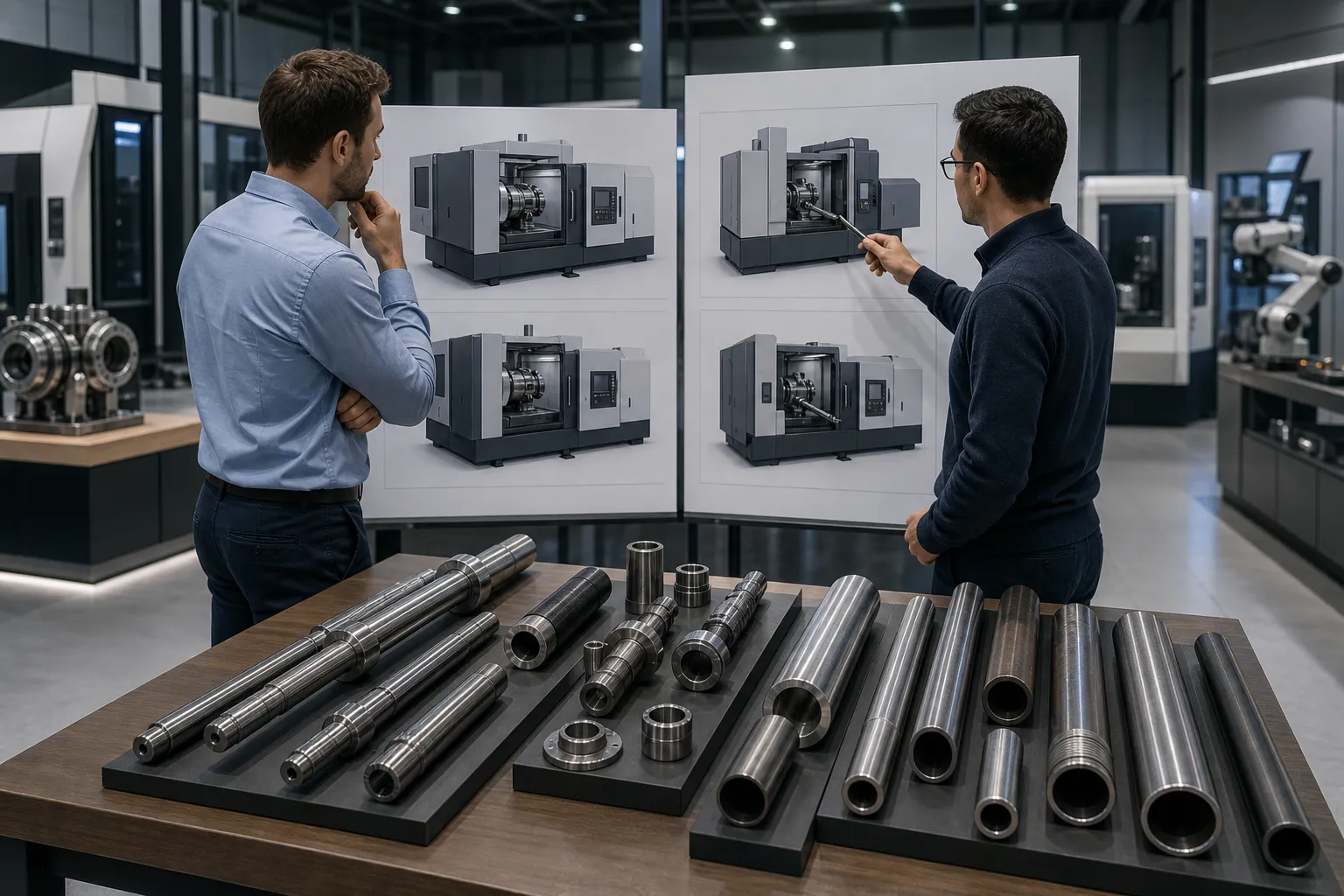
Process and Correction
Once a machine type is on the table, the questions turn to what the process physically delivers: the tolerance it holds, why corrected parts do not always stay put, and what correction does to the material and the surface.
6. What straightness tolerance can a machine hold?
It depends on the part: slenderness, صلابة القسم, material state and measurement method dominate the achievable residual. Published machine values describe demonstrations on defined parts, not a universal promise. To interpret tolerance claims — including general tolerances like ISO 2768 and annotated callouts — read جي دي&T straightness: from drawing to acceptance and our ISO 2768 مرشد.
7. Why do parts sometimes bend again after straightening?
Residual stresses inside the part relax over hours to weeks, and each correction leaves its own stress field. When those stresses rebalance, geometry drifts — parts measured straight on Tuesday can show deviation the following week. The mechanism and the countermeasures (stabilization, تخفيف التوتر, استراتيجية التصحيح) are treated in stress relief after straightening.
8. What is springback and how is it handled?
Springback is the elastic portion of deformation that reverses when the tool retracts, so the correction must overshoot the measured bend to land where you want. The overshoot depends on material, section and local stiffness, and automatic machines adapt it per part. The physics and the compensation logic are covered in تعويض Springback في استقامة العمود.
9. Can hardened parts be straightened?
نعم, with a different recipe: smaller deflections per step, more steps, careful crack control and sometimes local heating or peening instead of pressing. Hardness does not forbid correction — it changes the allowable window, and the as-quenched versus tempered state matters as much as the hardness number itself. The process routes are detailed in استقامة بعد المعالجة الحرارية and our comparison of hardened versus soft part strategies.
10. Does straightening damage the surface?
Tool contact always leaves some trace; whether it matters depends on material hardness, tool geometry and whether the surface is functional or will be machined later. With protected tooling and sensible contact placement, most parts show no functionally relevant change. يقرأ أدوات حماية السطح في استقامة for prevention and علامات الأدوات في استقامة for diagnosis.
Measurement and Quality
Straightening is only as good as the measurement behind it. These five answers cover how deviation is sensed, which vocabulary describes it, and how the measurement chain itself is proven — the questions quality engineers own.
11. How is straightness actually measured?
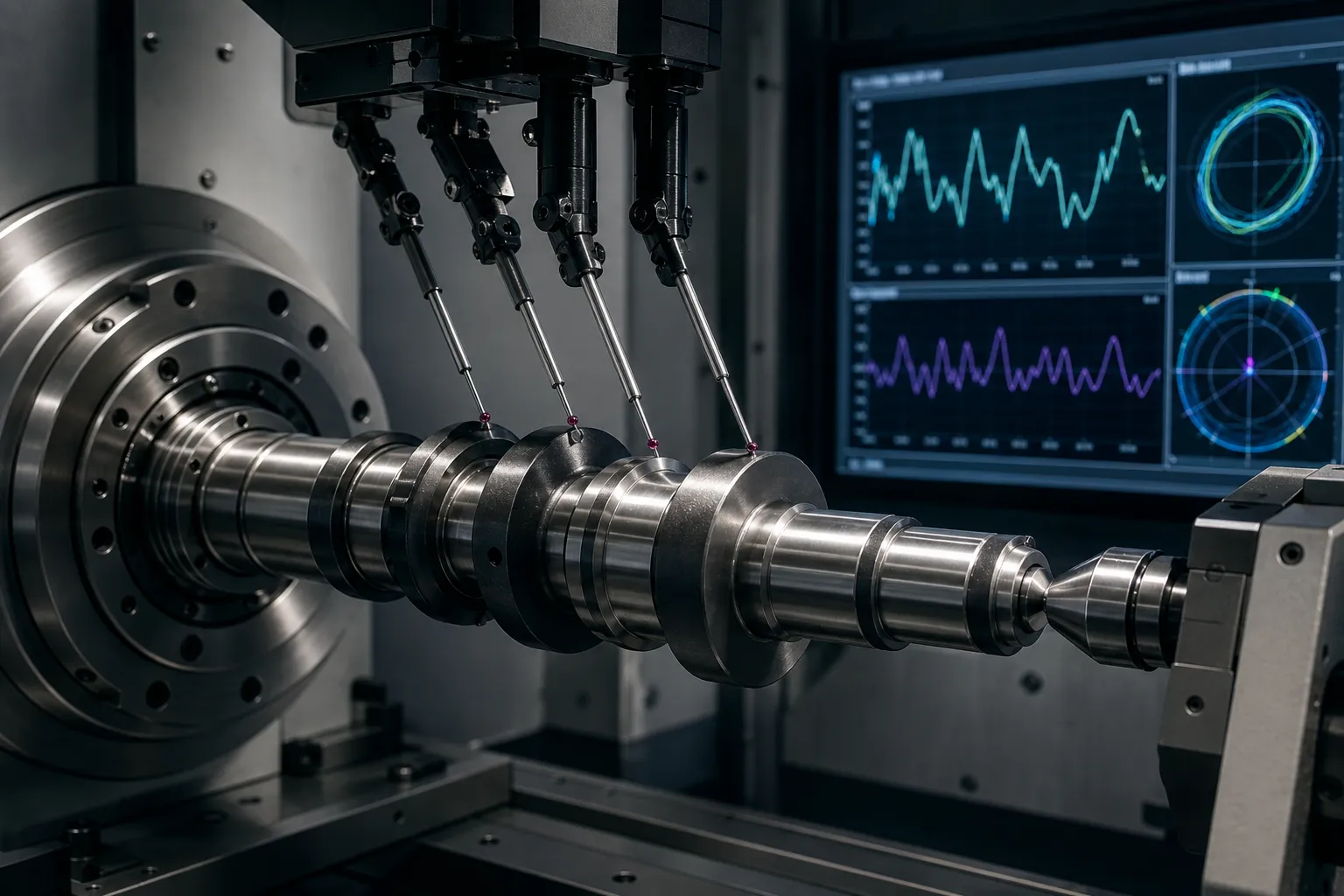
The workhorse is multipoint measurement while the part rotates on supports or between centers: probes track the radial profile, software extracts bend magnitude, direction and location. Non-contact methods extend this to delicate surfaces. The architecture and signal handling are explained in قياس رمح متعدد النقاط LVDT و الاتصال مقابل قياس استقامة عدم الاتصال.
12. استقامة, نفد, TIR — what is the difference?
Straightness is a property of the feature’s centerline; runout compares a surface to a datum axis; TIR is the total indicator reading observed while rotating, which mixes bend with roundness error. Confusing them produces false rejects and false accepts. The definitions, the measurement consequences and a diagnostic method are worked through in استقامة العمود مقابل الجريان مقابل TIR.
13. How do I know my measurement is trustworthy?
Run a measurement system analysis before quoting capability: same gage, same supports, نفس المشغلين, repeated across parts and days. If gage variation consumes a large share of the tolerance, every straightness number is suspect. The method, acceptance thresholds and straightening-specific traps are in غيج ر&R لتسوية الخطوط.
14. What happens to parts that cannot be corrected?
Well-run cells define NOK handling in advance: how many correction attempts are allowed, when a part exits to rework, and when it is scrapped. Limits exist because repeated correction degrades the material. The decision structure is described in حدود الفرز وإعادة العمل NOK في خط الاستقامة.
15. What is verified at a factory acceptance test?
A FAT proves the machine on your parts, not on the builder’s: representative workpieces, agreed gages, agreed tolerance targets, cycle time and data outputs — witnessed and documented. Preparation determines whether the test binds. The complete structure is in قائمة مراجعة FAT لآلة استقامة.
Materials and Operations
The last group covers life with the machine after purchase: material behavior that changes the recipe, throughput economics, upkeep and the mid-life decision between modernizing and replacing.
16. Is straightening aluminum different from steel?
Very much so: aluminum’s lower elastic modulus means bigger deflections and more springback per unit of force, and its softer surface marks more easily under tooling. وصفات, supports and protection strategies differ accordingly. The full comparison — modulus, springback ratio, dent sensitivity — is in aluminum vs steel straightening.
17. What is the Bauschinger effect?
It is the reduction of yield strength in compression after the material has been loaded in tension — and straightening loads bent fibers in exactly this alternating way. It changes the force response of the second and third corrections relative to the first, which is why correction models that ignore it drift. يرى تأثير بوشنجر في الاستقامة.
18. How fast is a straightening cell?
Cycle time per part is usually seconds for automatic press straightening, but the honest number is cell-level: تحميل, قياس, correction passes, unloading and NOK routing. Part mix matters too, because a cell sized for one part family throttles when it meets another. The line layout determines the throughput you actually bank; sizing logic and buffer design are covered in straightening line layout and cycle time.
19. What maintenance does a straightening machine need?
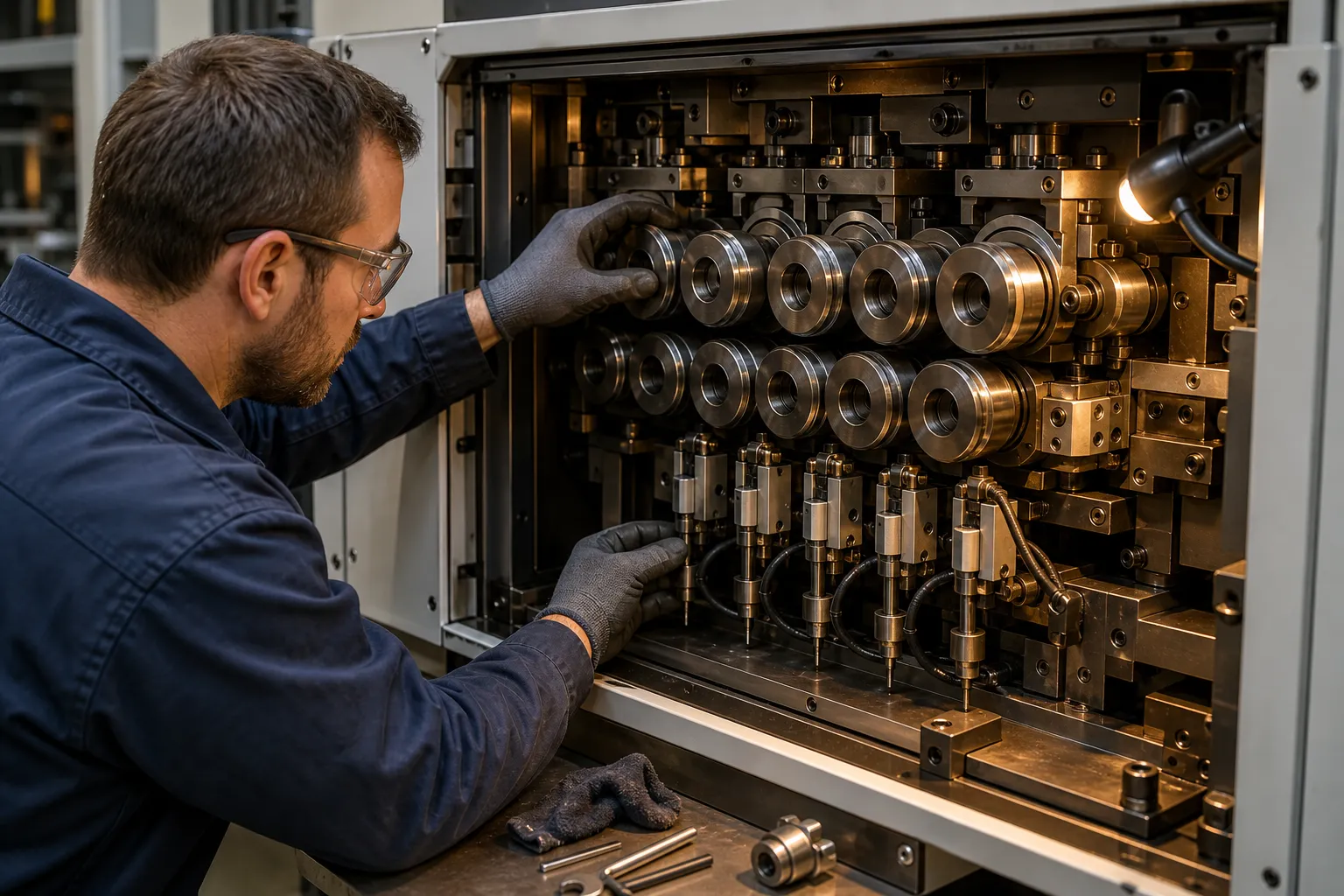
The recurring items are rolls and supports (wear copies onto parts), تحقيقات (drift and damage), hydraulics and the zero-state calibration of the measurement chain. A condition log tied to part data catches degradation before quality does. The schedule and inspection points are listed in straightening roller wear and maintenance.
20. Should I retrofit or replace an old machine?
Retain a solid mechanical frame and modernize measurement, control and tooling when the mechanics still hold geometry; replace when the frame, force class or architecture no longer match the part spectrum. A verification-based decision path — rather than a sales pitch — is laid out in retrofit vs replace a straightening machine.
Where to Go Next
A FAQ compresses; it cannot replace the underlying engineering. Behind these twenty answers stand deeper guides for each decision stage: the RFQ data checklist to prepare a serious inquiry, كيف يعمل استقامة العمود التلقائي for machine architecture, جي دي&قبول الاستقامة for tolerance interpretation, و the sample test and acceptance guide for proving the process on your parts before contract. For statistical acceptance thinking, our Cpk and Ppk guide extends question 13 و 15 into capability language your quality department already uses.
Keep this page as the entry point: each linked guide stays focused on one decision, and together they cover the route from a bent-part problem to an accepted production process. New guides are added as customer questions surface them, so the map keeps growing with the machines.
If your question was not on the list, bring it directly: اتصل بفريقنا الهندسي with the part drawing and the problem — most answers start with a sample of bent parts and an honest measurement.