
“How much does a straightening machine cost?” is the first question every buyer asks and the last one that has a single answer. Two machines that both call themselves shaft straighteners can differ in price by an order of magnitude — and neither is wrong. The difference is not brand markup; it is capability, and capability is driven by your parts and your tolerance requirements.
Rather than quoting numbers that would be wrong for your application, this guide does something more useful: it breaks down the machine attributes that actually drive cost, so you can see where the money goes — and which features your parts genuinely need versus the ones you would be paying for without using.
司機 1: Force Capacity and Machine Size

The baseline cost of any straightening machine is set by what it has to withstand and move:
- Press force (tonnage). Force requirements grow with workpiece section modulus — roughly with diameter cubed for solid round sections, which is why capacity climbs fast as part diameter grows. A machine sized for slender pins is a fundamentally lighter structure than one for truck axles or rails.
- Part length and support spacing. Long parts need long beds, widely spaced supports, extended measurement spans and bigger machine footprints. Steel and rigidity cost money by the kilogram.
- Part weight and handling loads. Heavy parts load every component in the chain — supports, drives, lifting and clamping — and every component must be sized accordingly.
The consequence for buyers: know your true part envelope, including the largest part you will realistically run over the machine’s life, not just today’s portfolio. Buying force capacity you will never use inflates cost permanently; buying one size too small turns into a machine that cannot do the job at all.
司機 2: Measurement System and Measuring Point Count
The measurement system is where straightening machines differentiate most — and a major cost lever:
- Number of measuring points. A single-point measurement can characterize a simple single bend, but complex bends, multiple bends in different planes, S-curves and stepped shafts need multiple measuring stations along the length. Every additional measuring point adds sensors, mechanics, calibration effort and software complexity.
- Sensor technology. 接觸式探頭, LVDT arrays and non-contact optical or laser systems differ substantially in cost, 準確性, speed and maintenance profile. The right choice depends on your tolerance band and part surface — see our comparison of contact vs non-contact straightness measurement.
- Measurement datum strategy. Stepped shafts and parts with functional datums need dedicated datum logic and fixturing. Datum strategy affects both capability and tooling cost; our article on measuring datum selection for stepped shafts explains why this decision matters so early in a project.
- Measurement accuracy class. Tightening acceptance tolerance does not just require a better machine — it requires a measurement system several times more accurate than the tolerance it is verifying, which pushes sensor and calibration cost up nonlinearly.
Rule of thumb: the measurement system is often the difference between a machine that “straightens parts” and one that “verifiably meets tolerance” — and it is the worst place to economize if your tolerances are tight.
司機 3: Automation Level and Correction Intelligence
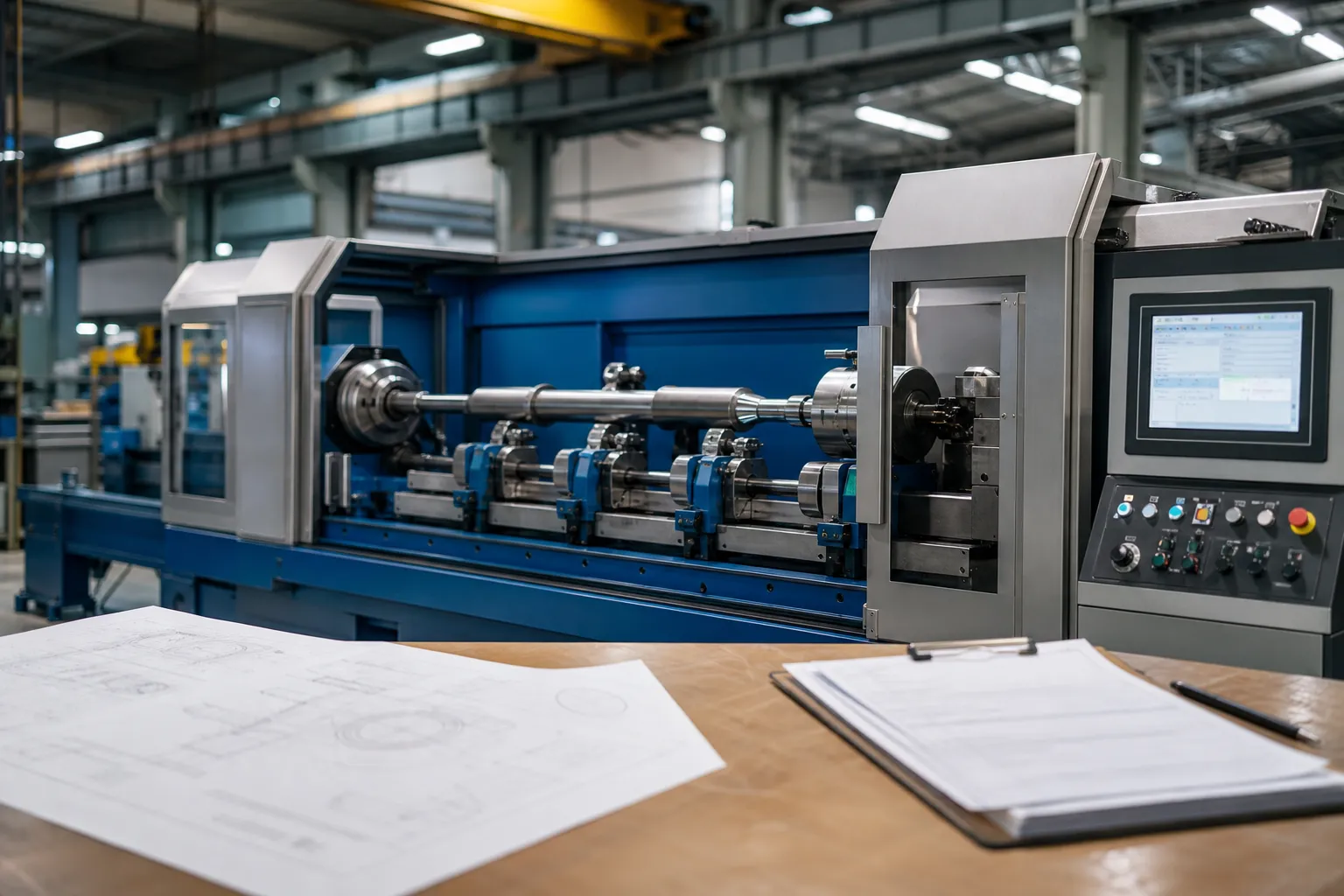
The same physical machine can be delivered at very different levels of intelligence:
- 手動校正. Operator reads the measurement, decides the stroke, presses, rechecks. Lower machine cost, higher labor content, results dependent on operator skill and consistency.
- 半自動. Machine measures and recommends or executes corrections with operator oversight and part handling by hand.
- Fully automatic with closed-loop correction. Machine measures the bend, calculates stroke (including springback compensation), corrects, re-measures and iterates until tolerance — with each part’s cycle data logged. Highest machine cost, lowest per-part labor, and consistent results independent of shift. Our overview of 自動軸校直的工作原理 shows what that loop contains.
The intelligence step-change carries real engineering cost: closed-loop control, springback modeling, part program management, statistics and traceability are software and control-system investments, not steel. But they are also what makes unattended production and tight Cpk targets possible.
司機 4: 載入中, Unloading and Line Integration
The correction machine itself is only part of a production cell:
- Manual load/unload keeps the cell simple and inexpensive but caps cycle rate and adds labor cost per part.
- 自動送料 — magazines, 行走樑, conveyors or robots — adds mechanics, sensors and safety engineering. For high-volume part families it is often where the productivity case is made.
- Upstream/downstream integration. Connecting to a heat treatment line, grinding cell or inspection station adds interfaces, buffer logic and MES/traceability integration.
- Sorting and disposition hardware. OK/NOK gates, rework chutes and marking systems that implement your acceptance workflow.
Integration cost is frequently underestimated because it is quoted separately or discovered after delivery. Define the material flow at specification time, not after the machine arrives.
司機 5: Acceptance Level, Verification and Proof
How you will prove the machine works affects its configuration and price:
- Acceptance tolerance class. Holding a generous commercial tolerance and holding a precision tolerance with statistical capability are different machines — in sensors, frame rigidity, environment sensitivity and control quality.
- FAT/SAT requirements. A factory acceptance test with your real workpieces, gauges and defined process records is engineering work that costs the supplier real hours — and protects you from a machine that only performs on demonstration parts. Our straightening machine FAT checklist outlines what a meaningful acceptance test covers.
- Measurement system validation. If your quality system requires gage R&R on the machine’s measurement, that capability must exist. 看 量具R&R 用於拉直直線 for why validating the measurement before trusting the correction is non-negotiable in regulated industries.
司機 6: Workpiece Spectrum — One Machine or a Family of Parts
A machine dedicated to one part number with fixed tooling is cheaper than a flexible machine that must change between part families:
- Quick-change tooling, adjustable supports and part-program libraries add cost but enable a broader part spectrum.
- Exotic geometries — thin-walled tubes, long slender parts, parts with critical surfaces — need special tooling and process engineering (例如, thin-wall tube straightening has fundamentally different requirements from solid bars).
- Material range. Soft steels, hardened steels, stainless, aluminum and copper each behave differently under correction; a machine spanning several material classes needs a broader process envelope than a single-material machine.
How the Six Drivers Interact
The drivers are not independent — they multiply each other, which is why machine prices resist simple tables:
- Force × automation: automating a heavy-capacity machine means servo or proportional hydraulics, larger drives and heavier handling automation — the cost compounds in both directions.
- Tolerance × measurement: a tight acceptance tolerance demands a high-accuracy measurement system, which in turn demands better machine stability and temperature discipline, which adds cost again.
- Part spectrum × tooling: every additional part family adds its own tooling set, part programs and often quick-change hardware; a “flexible” machine earns that word through configuration effort that is priced in.
- Volume × integration: automatic feeding only pays at volume, and volume makes line integration non-optional — the two cheapest machine configurations (low automation, no integration) are exactly the ones high-volume production cannot use.
A useful mental model: the base machine buys force and structure; the measurement system buys verification; the automation buys consistency; the integration buys throughput. Buy each one to the level your parts require, and the total price takes care of itself as a consequence.
What This Means for Your Budget Process

Because cost is driven by these six factors, the productive way to approach budgeting is not “what does a straightening machine cost” but “what configuration do my parts require”:
- Define the part spectrum — diameters, 部分, 長度, weights, materials, hardness states.
- Define the tolerances per part family, and whether they are commercial or statistically verified.
- Define the volume and takt — parts per hour, shift model, growth expectations.
- Define the boundary conditions — who loads and unloads, what happens upstream and downstream, what proof you need at acceptance.
With those four answers, a machine builder can configure a system — and quote it. Without them, any number is fiction.
One more practical point: total cost of ownership is not the purchase price. Installation, tooling per part family, spare measurement equipment, training and the labor or scrap savings the machine generates all belong in the comparison. A more expensive automatic machine can be the cheaper machine per part; the inverse is equally true. For the framework to make that comparison honestly, see our companion article on building the ROI case for automatic straightening.
Mistakes Buyers Make When Comparing Quotes
Once you have several configurations quoted, the comparison phase creates its own failure modes:
- Comparing headline price while ignoring what is included. One quote’s “機器” may exclude the measurement system validation, tooling for your second part family, or acceptance testing with your parts — all of which the other quote includes. Normalize quotes to identical scope before comparing any numbers.
- Specifying to the easiest part. Configuring the machine around your most frequent part instead of your most demanding one saves money until the demanding part arrives, and then the machine simply cannot do it.
- Buying automation for a volume that does not exist yet. Automation economics scale with volume; below a threshold, a semi-automatic machine with excellent measurement is frequently the better configured — and cheaper — solution.
- Treating tooling as an afterthought. Per-part tooling (支援, 砧座, adapters, datum fixtures) is a real budget line for every future part family. Ask the supplier to quote the tooling philosophy, not just today’s set.
- Forgetting installation conditions. Foundation requirements, power, compressed air, environment temperature stability for precision measurement — these are project costs that belong in the comparison.
The common thread: a quotation is a configuration document. Read the configuration, then read the price.
Key Takeaways
- Straightening machine prices span orders of magnitude because the machines genuinely differ — in force capacity, measurement systems, 自動化, integration, acceptance proof and part flexibility.
- Measurement point count and sensor technology are major cost drivers and the worst place to cut if tolerances are tight.
- Automation shifts cost from machine price to per-part labor; which side wins depends entirely on your volumes.
- Acceptance testing and measurement validation are real engineering content — budget for them and require them.
- Work from a defined part spectrum, tolerance set, volume and boundary conditions; an inquiry-based quotation against those requirements is the only price that means anything.
If you are budgeting a straightening project, send us your part drawings, tolerance requirements and planned volumes. We will configure the machine around them — measurement concept, correction strategy, handling and acceptance plan — and quote that configuration rather than a generic price that fits nobody’s parts.