
Tự động làm thẳng có thể tạo ra các tín hiệu xử lý đáng để điều tra: một phản ứng dịch chuyển lực bất ngờ, một sự kiện âm thanh, một sự thay đổi hình học bất thường, lỗi hiệu chỉnh lặp đi lặp lại hoặc điều kiện xác định khác. Những tín hiệu đó có thể giúp dây chuyền sản xuất dừng lại, cô lập và định tuyến một phần để xem xét. Chúng không tự động chứng minh có vết nứt tồn tại, và chúng không tự động thay thế cho phương pháp NDT đủ tiêu chuẩn.
Bài viết này là một khuôn khổ kiểm soát rủi ro. Họ không khẳng định rằng StraighteningTech hiện đang cung cấp các cảm biến phát hiện vết nứt, phát hiện kích thước vết nứt xác định, đáp ứng một tiêu chuẩn cụ thể hoặc thay thế hạt từ tính, siêu âm, dòng điện xoáy hoặc kiểm tra chính thức khác. Những khả năng đó yêu cầu một phương pháp được xác minh riêng, mẫu đã biết và phê duyệt hệ thống chất lượng.

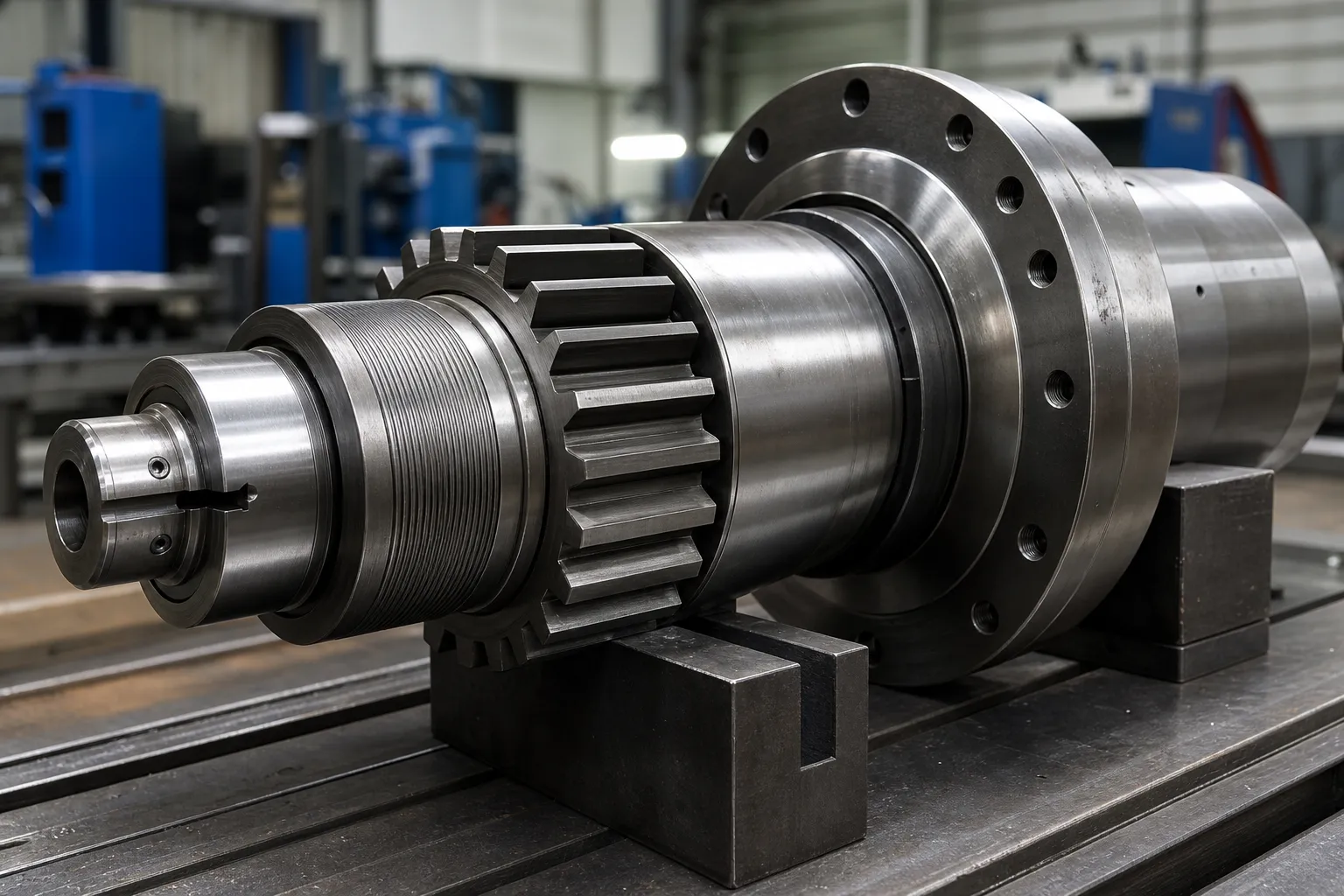
*Minh họa khái niệm kỹ thuật. Nó hiển thị bối cảnh đo lường và sửa lỗi ứng viên; nó không cho biết rằng cảm biến vết nứt hoặc thuật toán phát hiện đã được cài đặt.*
Kế hoạch phát triển nên sử dụng thông thường đã biết, nghi phạm đã biết và, nơi được phép, điều kiện tham chiếu đã biết để xác định xem tín hiệu có tương quan với quyết định cần thiết hay không. Nó không được suy ra hiệu suất phát hiện từ danh sách tính năng của đối thủ cạnh tranh hoặc một bản dùng thử thành công duy nhất.
Why Straightening Is a Natural Integrity Checkpoint
Cracks relevant to straightening have a short list of origins: prior manufacturing wrote them in, or the correction process itself put them there. On the incoming side, quench cracks from heat treatment, seams and folds from rolling or drawing, and grinding abuse on machined surfaces all exist before the part reaches the press — and a part carrying a sharp discontinuity responds differently to plastic bending than a sound one, because the discontinuity concentrates strain locally. On the process side, aggressive correction, repeated reverse bending, and correcting a material in a brittle condition can initiate cracks that no incoming inspection would have found. The two categories demand different responses: incoming cracks are a supplier-quality problem surfaced at your station, while process-initiated cracks are a process-design problem owned inside the correction loop — the boundary worked through in quá thẳng và nứt.
Dù bằng cách nào, the straightening station sees the part in a state no inspection bench replicates: under load, in plastic deformation, with its stiffness and response visible stroke by stroke. That is why the press is a natural integrity checkpoint even though it is not an NDT instrument. The signals are there for the taking; the engineering work is making them mean something.
The Signal Families Available at the Press
Four signal families are realistically available on straightening equipment, and each has a distinct information content. Force–displacement behavior is the richest: a sound section deforms along a repeatable curve, and departures from the qualified curve shape — an early load drop, an unexpected plateau, a step in the response — indicate that the section is behaving abnormally somewhere along the load path, whether from a material discontinuity, a setup fault or a geometry outside the expected map. Acoustic events are the sharpest: a distinct release of strain energy is audible and can be sensed, though ambient noise on a production floor makes standalone acoustic detection fragile. Geometry response covers cases where the part moves less, more, or differently than the qualified correction model predicts — a crack crossing the correction zone reduces local stiffness and shows up as anomalous movement. Convergence failure — repeated correction attempts that never reach the target — is the slowest but most insidious signal, because its common causes are mundane, and the rare cause is a part that cannot be straightened because it is no longer continuous in the way the process assumes.
None of these families is specific to cracking. Each one answers “is this part behaving like the qualified population?”, không “does this part contain a crack of a given size?”. That gap between anomaly detection and flaw detection is the honest boundary of process monitoring, and it is exactly why the verification route — not the alarm itself — carries the quality decision. The force–stroke interpretation background sits alongside point-press process practice, where the same curves are used for correction control.
Tích hợp các biện pháp kiểm soát rủi ro vào vòng điều chỉnh
Một tuyến đường được kiểm soát có thể:
- xác định phần/lô, bản vẽ sửa đổi và công thức đã được phê duyệt;
- hoàn thành kiểm tra đầu vào và kiểm tra từ chối cứng;
- thiết lập mốc thời gian và thu thập dữ liệu hình học/quy trình cơ sở;
- thực hiện trình tự chỉnh sửa đã được phê duyệt;
- đánh giá các tín hiệu quá trình được xác định và phản ứng hình học;
- phát hành và đo lại phần;
- tuyến đường ĐẠT, đủ điều kiện làm lại, kết quả giữ để xác minh và từ chối riêng biệt;
- duy trì khả năng truy xuất nguồn gốc, bằng chứng và cách xử lý của người xem xét.
Tuyến đường phải bao gồm tình trạng không tiến triển. Những nỗ lực sửa chữa lặp đi lặp lại mà không có phản hồi như mong đợi có thể là lý do để dừng và cô lập bộ phận đó., không phải là lý do để tiếp tục áp dụng vũ lực.
Xác định cách ly và xác minh NOK
NOK không phải là một danh mục phổ quát. Dòng này sẽ phân biệt vấn đề đo lường/thiết lập, cảnh báo giám sát quá trình, sự không phù hợp đã được xác nhận, một ứng cử viên làm lại và một phần yêu cầu kiểm tra độc lập hoặc xử lý kỹ thuật. Sự cách ly về mặt vật lý, ghi nhãn trạng thái, khả năng truy xuất nguồn gốc và thẩm quyền phát hành phải được xác định.
*Minh họa khái niệm kỹ thuật. It represents process-routing decisions, not an installed crack-detection or automatic sorting system.*
| Event | Minimum response to define |
|---|---|
| Process signal exceeds threshold | Stop/hold rule, data capture and responsible review |
| Geometry does not respond as expected | No-progress limit and engineering evaluation |
| Formal inspection required | Approved method, acceptance criterion and authority |
| Rework considered | Maximum attempts, remeasurement and separate quality approval |
| Confirmed reject | Isolation, traceability and disposition record |
For the broader line controls, nhìn thấy Giới hạn phân loại và làm lại NOK Và thử nghiệm và chấp nhận mẫu thẳng.
Where measurement response is part of the investigation, tương quan giữa thước đo máy và thước đo của khách hàng helps define the boundary between a line signal and the controlled customer acceptance method.
Thresholds, False Alarms and Missed Events
Any threshold drawn on a process signal trades two failure rates against each other. Set it tight, and normal part-to-part variation — different lots, temperature drift, tooling wear, honest measurement scatter — crosses it regularly, flooding the review route with good parts until operators learn to ignore alarms. Set it loose, and the abnormal parts that motivated the monitoring slip through unflagged. There is no datasheet value that resolves this trade; it is settled empirically by running the signal on a known-normal population to learn its spread, and where permitted, on known-suspect or seeded-reference parts to learn what the abnormal signature actually looks like. Only that pair of distributions justifies a threshold, and the honest summary of what was learned belongs in the validation record — including the false-alarm and missed-event behavior observed, not only the detections celebrated.
Two further rules keep thresholds honest over time. Đầu tiên, drift monitoring: as tooling wears and material lots change, the normal population moves, so the threshold must be reviewed on a schedule, not set once. Thứ hai, change control: a new part revision, a different material family, or a reworked die changes the qualified population, and the threshold work starts over. These are the same habits that keep hệ thống đo lường credible, applied to process signals.
Where Formal NDT Fits After an Alert
When the review route decides a part needs a definitive answer, the method must match the question and the geometry. Magnetic-particle inspection suits ferrous parts and surface-breaking discontinuities, and it is fast enough for segregation decisions in moderate volumes. Penetrant testing suits non-ferrous surfaces where coating and cleanliness permit it. Eddy-current methods respond to near-surface condition and can run in-line, with sensitivity that depends strongly on coil geometry versus part geometry. Ultrasonic methods reach internal volumes along bar and shaft axes, at the cost of coupling, calibration blocks and operator discipline. Selecting among them is a quality-engineering decision driven by the flaw orientation expected, the material, the surface state after straightening contact — witness marks and surface protection practices intersect here — and the acceptance authority. What the straightening station controls is not the NDT verdict but the integrity of the chain before it: the part is identified, isolated, protected from further correction attempts, and accompanied by its process data so the inspector knows why it was pulled.
Validate Before a Capability Claim
Gói xác nhận có trách nhiệm xác định dòng phôi, điều kiện vật liệu/quy trình, phương pháp cảm biến/giám sát, dân số mẫu, tham chiếu điều kiện đã biết, ngưỡng, biến thể dự kiến, đánh giá cảnh báo sai và sự kiện bị bỏ lỡ, lộ trình xác minh, lưu giữ dữ liệu và phê duyệt chất lượng. Nó cũng nêu rõ những gì hệ thống không thể chứng minh.
Không có trang tín hiệu quy trình nào tuyên bố rằng nó tìm thấy tất cả các vết nứt, thay thế NDT hoặc đảm bảo tính toàn vẹn của vật liệu mà không cần phê duyệt, gói bằng chứng cụ thể về phôi.
Câu hỏi thường gặp
Cảnh báo quá trình có chứng tỏ có vết nứt không?
KHÔNG. Nó chỉ ra một điều kiện yêu cầu lộ trình xem xét được xác định. Nguyên nhân phải được đánh giá bằng phương pháp đã được phê duyệt.
Máy duỗi thẳng tự động có thể thay thế NDT được không?
KHÔNG. Giám sát quy trình thẳng và NDT chính thức có các mục đích khác nhau, phương pháp và trách nhiệm chấp nhận.
Một bộ phận có thể được làm lại vô thời hạn sau khi có cảnh báo không?
KHÔNG. Quá trình này yêu cầu giới hạn số lần sửa chữa tối đa và lộ trình xử lý kỹ thuật/chất lượng được xác định.
Which signal family catches cracks best?
None of them catches cracks in the NDT sense. Force–displacement behavior, acoustic events, geometry response and convergence failure all flag parts that behave unlike the qualified population. A part flagged by any of them goes to the verification route; a part that passes all of them is not certified crack-free — it simply behaved normally. That asymmetry is the design premise of every process-monitoring scheme on straightening lines.
How are thresholds set without a standard to cite?
Empirically, on populations. Run the chosen signal across a known-normal production sample to characterize its spread, and where reference conditions are available, across known-suspect parts to characterize the abnormal signature. The threshold is then drawn against both distributions, documented with observed false-alarm and missed-event behavior, and reviewed on a schedule as tooling, lots and seasons change.
What happens to a part after an alert is cleared?
Whatever the written route says, and only that: return to the normal flow with the event recorded, proceed to rework under the attempt limit, or pass to formal inspection with disposition authority named in advance. The failure mode to design against is the quiet return of alerted parts to the good bin by operator judgment, which is why physical segregation and labeling carry as much weight as the signal itself.

*Minh họa khái niệm kỹ thuật.*
Đường cong chuyển vị của lực khi làm thẳng
Một trang dành riêng cho hướng dẫn đường cong dịch chuyển lực thẳng không được duy trì nếu không có nhu cầu truy vấn được xác thực. Giải thích Troke của Force, giới hạn an toàn và điều kiện dừng quy trình được giải thích trong phần nhấn điểm, trang phát hiện vết nứt và đa điểm. Bất kỳ cảnh báo dựa trên đường cong nào cũng phải được xác nhận trên các bộ phận đại diện thay vì sao chép từ họ vật liệu khác.
Crack detection is strongest when the process prevents cracks in the first place – nhìn thấy quá thẳng và nứt for the causes, và so sánh thủ công và tự động for why automated correction limits reduce the risk.