
V industriji izdelave pritrdilnih elementov, upogibanje dolgih vijakov po toplotni obdelavi je univerzalna bolečina. Tradicionalno “ročno zabijanje” ni le neučinkovit, ampak tudi ne zagotavlja dosledne natančnosti. Ta članek deli specializirano Avtomatizirana rešitev za ravnanje vijakov: demonstrating a reported client case in which automation took an 8-person manual line to one operator supervising four machines, with straightness held within 0.1 mm on the client’s acceptance records.
What is the Bolt?
Vijaki so temeljni pritrdilni elementi za stroje, gradbeništvo, in avtomobilska industrija. Tipičen obdelovanec za to rešitev je dolg vijak visoke trdnosti: 15mm premera, 340dolžina mm.
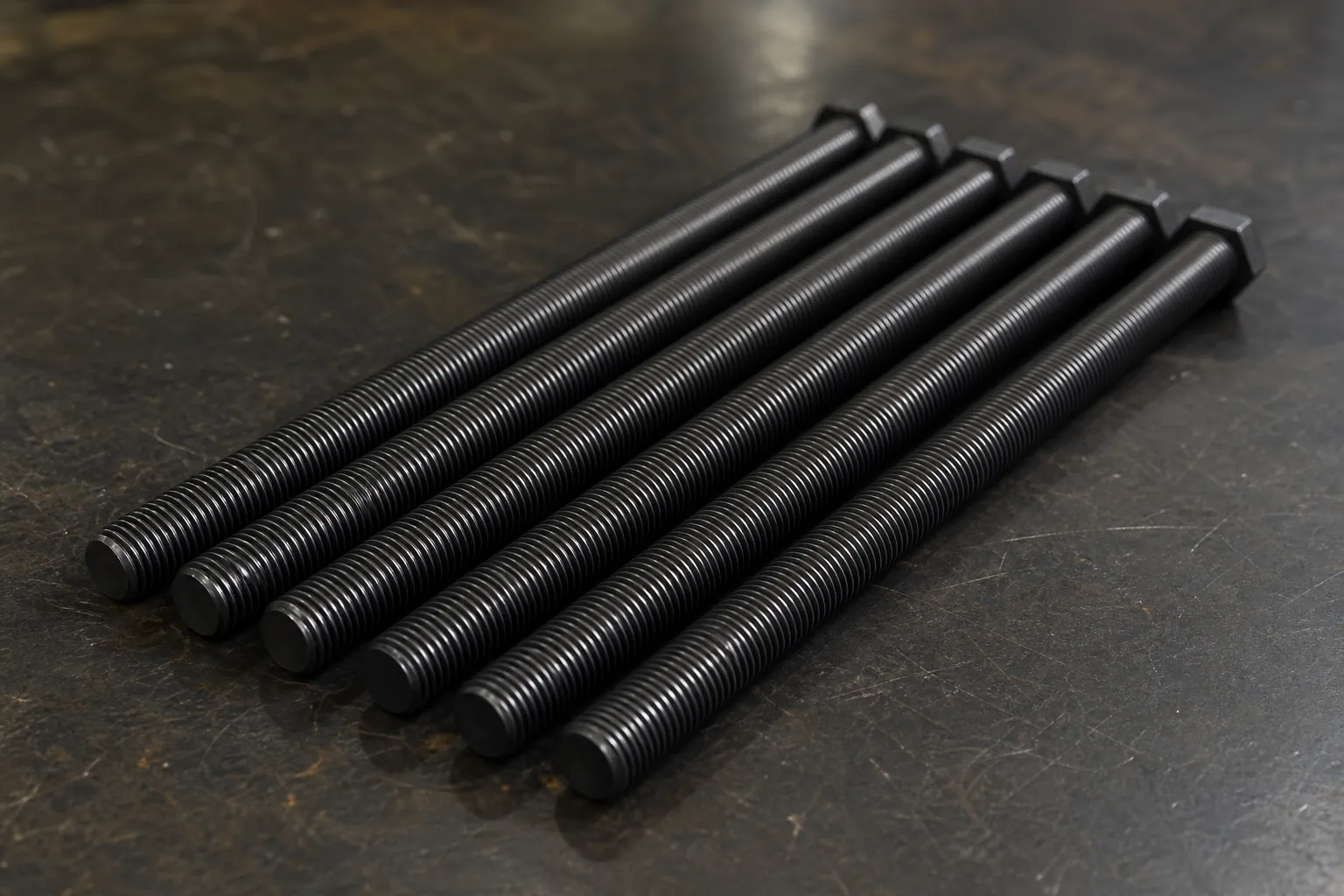
Strukturne značilnosti in izzivi
- Visoko razmerje L/D: Zaradi dolžine 340 mm je vijak zelo dovzeten za začetni upogib 0,5 mm – 1.5mm po toplotni obdelavi.
- Zahteve glede natančnosti: The client required straightness within 0.2 mm; the case acceptance records were held under 0.1 mm.
- Zahteve za zaščito: Postopek ravnanja mora zagotoviti ničelno škodo za natančnost niti in kakovost površine.
Why Heat Treatment Bends Long Bolts in the First Place
Understanding the distortion source is what makes a correction process defensible instead of decorative. During quenching, a long fastener cools unevenly: the section cools at different rates depending on orientation in the basket or fixture, agitation contact, and local mass differences between the plain shank, the threaded length and the head. Each cooling path wants to contract by a different amount, and the resulting locked-in stresses bend the part when it relaxes. The effect scales with length — which is why short bolts leave heat treatment usable while long ones of the same grade systematically arrive bent. Thread rolling and machining before treatment add their own stress history, and any straightening performed at the heat treater counts as prior deformation for everything done afterward.
Two practical consequences follow. najprej, incoming inspection on long heat-treated bolts is not optional paperwork — the bend magnitude and pattern arriving at the straightening station determine both the correction plan and any supplier conversation, and the interaction of prior deformation with correction response is the reason reverse-loading behavior matters, as covered under Bauschingerjev učinek pri ravnanju. drugič, process decisions upstream — how parts are racked or basketed through quench, whether stress relief is applied — change the distribution the straightening station sees, and are usually the cheapest place to reduce total correction work.
Reading the Bend Before Correcting It
Long fasteners arrive with a small vocabulary of bend patterns, and naming the pattern is the first step of an efficient correction loop. A single-arc bow — one gentle curve, maximum near the middle — is the most common heat-treatment signature and the most straightforward to correct with supports positioned around the peak. An S-shaped double bend has two opposite peaks, usually reflecting two constraint points during quench, and demands two coordinated corrections rather than one big press at the largest reading. A local kink near the head or the thread runout concentrates distortion where section stiffness changes, and behaves differently from a distributed bow. Končno, twist about the axis occasionally accompanies bending on parts with asymmetric features. Each pattern requires its own measurement map and correction sequence, which is why an automatic station that scans the full length and builds the map before pressing — rather than chasing the single worst reading — converges in fewer strokes. The measuring-and-correcting loop behind this is described for automatic shaft straightening generally, and for the long-bolt family specifically in the automatic long bolt straightening process.
Zakaj se mora ravnanje vijakov umakniti “Ročno zabijanje”
Tradicionalni postopek vs. Avtomatizirana rešitev
The figures below are this client’s reported baseline and post-commissioning values, not a universal benchmark for every fastener line.
| Točka bolečine | Ročno zabijanje / Ročna stiskalnica | Avtomatizirana rešitev za ravnanje |
| Zahteva po delovni sili | 8 workers per shift (manual baseline, reported case) | 1 operator for 4 stroji (reported case) |
| Naravnost | 0.2 – 0.5 mm spread (reported manual baseline) | ≤ 0,1 mm (client acceptance records) |
| Čas cikla | 120 – 180 s/kos (reported manual baseline) | 10 – 15 s/kos (reported case) |
| Skupni stroški | High labor cost per corrected part | Manpower reduced from 8 operators to 1 supervising 4 stroji (reported case) |
Potek procesa avtomatiziranega ravnanja vijakov
Ta rešitev zajema popoln avtomatiziran proces zaprte zanke od podajanja do sortiranja, zagotavljanje, da vsak vijak izpolnjuje zahteve visokega standarda dobave.
Opisi osnovnih procesov
- Samodejno hranjenje: Upognjeni vijaki se samodejno dovajajo iz lijaka v postajo za ravnanje brez človeškega posredovanja.
- Dinamično merjenje: Visoko natančni senzorji skenirajo vrteči se obdelovanec v realnem času, natančno zajema največjo točko upogiba po celotni dolžini.
- Servo stiskanje: Pametni sistem samodejno izračuna vzmetenje glede na material (ogljikovo jeklo/legirano jeklo), in servo ram izvaja natančen pritisk za korekcijo v enem prehodu.
- Samodejno razvrščanje: Kvalificirani vijaki nadaljujejo na naslednjo stopnjo, while non-conforming parts are automatically isolated before they leave the machine.

UBJ-80 Stroj za ravnanje vijakov
Ta ravnalnik je idealen za toplotno obdelane končne dele (npr., komponente za štampiljke/pisarniške stroje, avtomobilski/moto deli, orodja, vijaki) in palice (jeklo, baker, aluminij, nerjaveče jeklo, titanove zlitine) dolžine 60-600 mm & premer φ3–φ25 mm. Povečuje tako natančnost kot kakovost izdelka.
Izzivi in rešitve osnovnega ravnanja
Izziv 1: Manning and the Reported “1 Operater za 4 Stroji” Case
Opis težave: Manual hammering and press correction depend on operator skill, stamina and shift discipline, so manning levels stay high and results vary from operator to operator.
rešitev:
Naša rešitev izvaja popolna avtomatizacija zaprtega kroga. Logika delovanja je izjemno preprosta, z vgrajenimi recepti za različne specifikacije vijakov. Standardni delavec mora samo občasno napolniti lijak; ostalo—merjenje, ravnanje, in inšpekcijo—stroj izvede samodejno. To rešuje pomanjkanje delovne sile in odpravlja padce natančnosti zaradi utrujenosti.
Izziv 2: Zagotavlja konsistenco do 0,1 mm natančnosti
Opis težave: Ko je vijak izpostavljen udarcem s kladivom, notranja porazdelitev napetosti postane neenakomerna, pogosto vodi do prekomerne korekcije na lokaliziranih območjih.
rešitev:
Rešitev uporablja a popolnoma parametriran servo nadzorni sistem. Za razliko od nejasne človeške presoje, senzorji zaznajo osno krivuljo vijaka z mikronsko natančnostjo. Skozi večstopenjske servo algoritme, sistem natančno premaga elastično vzmetenje S45C ali legiranih jekel, locking final straightness within the 0.1 mm window achieved on this client’s qualified recipe.
How Thread and Head Zones Are Protected During Correction
Thread protection is a contact-zone engineering problem, and the principles are the same ones that govern surface-protection tooling across straightening applications. The correction force and the reaction forces both need somewhere to live, and on a long bolt the plain shank is the region designed to carry load, while the threaded length and the under-head fillet are the regions most easily damaged. A protection concept therefore has three parts: place supports on the shank at controlled span positions around the bend peak; direct press contact onto the shank through tooling that conforms to the section instead of touching thread crests; and keep every edge that could contact the workpiece generously radiused so load spreads instead of concentrating. Cleanliness belongs in the same sentence — debris trapped between press tooling and a thread flank is a scratch generator, and on plated or coated bolts the coating class defines how much contact the finish can tolerate at all.
The validation side is equally concrete. A thread-protection claim is proven by inspection agreed before the trial — thread gauges still running, flank condition reviewed under the method the quality function specifies — together with the released-state straightness result, on representative parts, after repeat setups. Protection and geometry are accepted together or not at all.
What an Acceptance Criteria Package Should Contain
A bolt straightening process is only as good as the acceptance definition it answers to, and a complete one answers five questions in writing. What characteristic governs — straightness of the axis, measured how: on centers, on supports, vrtenje, in what condition, since a reading under restraint is not a released result, per loaded versus released measurement practice. What the limit is, and where it applies — full length or specified spans. What else must survive the process — thread fit, površinska obdelava, premazovanje, head markings. How conformity is sampled — every part through an automatic gauge, or a sampling plan with defined reaction to a failure. And what happens to nonconforming parts — rework limits, segregation and disposition authority, following the NOK sorting and rework-limit framework. Buyers comparing straightening suppliers are well advised to ask for exactly this package; the ability to produce it says more about a supplier than any single machine specification.
Izdelava ohišja: Četrta izbira indijske stranke
Ozadje stranke
Dobro znani indijski dobavitelj pritrdilnih elementov, ki zagotavlja komponente za svetovne blagovne znamke gradbenih strojev.
Rezultati izvajanja
- Ponovi naročila: Na podlagi izjemne zmogljivosti prvih treh enot, stranka je nedavno kupila njihovo 4th stroj.
- Operator Consolidation: The client reported one operator managing all 4 machines after commissioning, with a substantial increase in output per operator.
- Merilo kakovosti: The client’s records report straightness moving from 0.2 mm down to under 0.1 mm after commissioning.
pogosta vprašanja
- Q: Ali bo ravnalni valj poškodoval navoje vijakov?
- št. Oblikovali smo brezkontaktno, oblazinjeni zaščitni kalupi posebej za ravnanje vijakov. Stiskalni bloki se popolnoma ujemajo z ukrivljenostjo vijaka, zagotavlja enakomerno porazdelitev sile in preprečuje površinske vdolbine.
- Q: Ali je mogoče opremo integrirati v sistem MES naše tovarne?
- ja. Naš nadzorni sistem vključuje standardne podatkovne vmesnike za beleženje in izvoz podatkov o ravnanju v realnem času za vsak vijak, izpolnjuje sodobne zahteve glede sledljivosti.
Additional Process Questions
Why do bolts from the same heat-treatment lot arrive with different bend patterns?
Because each part’s position in the basket or rack gave it a different cooling path. Quench distortion is sensitive to orientation, local mass and agitation contact, so even identical bolts leave treatment with different locked-in stress patterns. Mapping incoming parts rather than assuming a uniform error is the practical answer, and it is why scanning-based stations build a per-part correction plan.
How many correction passes does a long bolt need?
It depends on the pattern, not a fixed number. A single-arc bow typically converges in one planned press; an S-bend needs two coordinated corrections; local kinks near section changes respond differently again. The governing rule is a rework limit set before production — parts that stop responding are routed to review, not pressed repeatedly, because each additional plastic cycle consumes fatigue life and changes the material’s response.
Should straightening come before or after thread rolling?
The route belongs to the fastener process engineer, but the trade-off is explicit: correcting before thread rolling lets subsequent operations work from a straight blank, while correcting after heat treatment with finished threads demands the contact-zone protection described above. Whichever route is chosen, the acceptance package must define what state the straightness limit applies to, and the correction validation must be run on parts carrying that state.
Povzetek
Za tovarne pritrdilnih elementov, ki si prizadevajo za visoko učinkovitost in kakovost, an Avtomatizirana rešitev za ravnanje vijakov je bistvena pot do večje konkurenčnosti. Whether the target is lower manning or 0.1 mm delivery precision, the figures in this article are one client’s reported case; your own results depend on the bolt family, incoming distortion and acceptance definition.
Moving from manual bolt correction toward automation? The manual vs automatic selection logic in ROI etui za samodejno ravnanje are the natural next steps.
Če se soočate s težavami pri upravljanju dela ali ozkimi grli natančnosti, brez skrbi Kontaktiraj nas za prilagojen tehnični predlog.