
Tvirtinimo detalių gamybos pramonėje, ilgų varžtų lenkimas po terminio apdorojimo yra universalus skausmo taškas. Tradicinis “rankinis kalimas” yra ne tik neefektyvus, bet ir neužtikrina pastovaus tikslumo. Šiame straipsnyje dalijamasi specializuota Automatinis varžtų tiesinimo sprendimas: demonstrating a reported client case in which automation took an 8-person manual line to one operator supervising four machines, with straightness held within 0.1 mm on the client’s acceptance records.
What is the Bolt?
Varžtai yra pagrindinės mašinos tvirtinimo detalės, statyba, ir automobilių pramonei. Tipiškas šio sprendimo ruošinys yra didelio stiprumo ilgas varžtas: 15mm skersmens, 340mm ilgio.
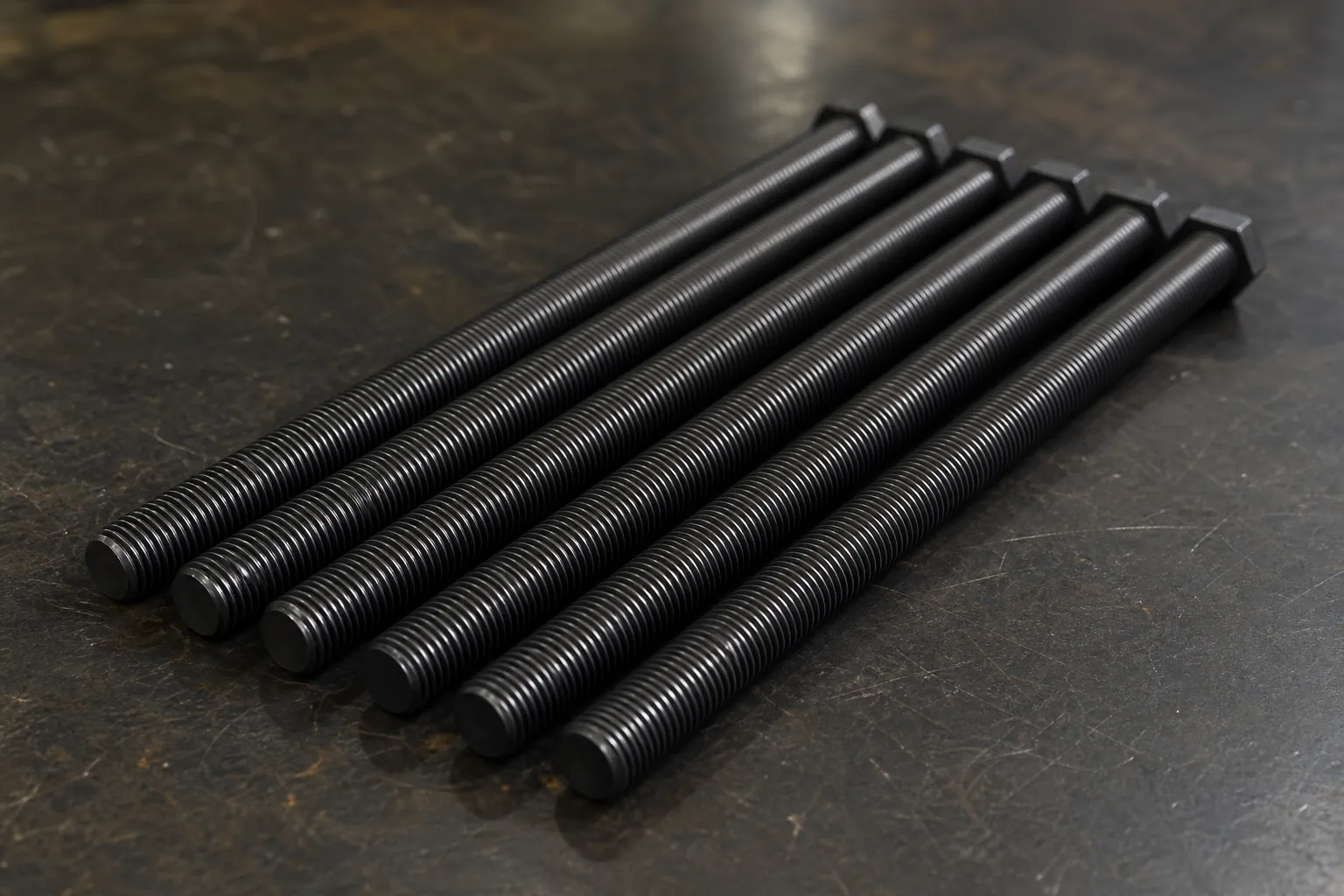
Struktūriniai ypatumai ir iššūkiai
- Didelis L/D santykis: Dėl 340 mm ilgio varžtas yra labai jautrus pradiniam 0,5 mm lenkimui – 1.5mm po terminio apdorojimo.
- Tikslumo reikalavimai: The client required straightness within 0.2 mm; the case acceptance records were held under 0.1 mm.
- Apsaugos reikalavimai: Tiesinimo procesas turi užtikrinti, kad sriegio tikslumas ir paviršiaus kokybė nebūtų pažeista.
Why Heat Treatment Bends Long Bolts in the First Place
Understanding the distortion source is what makes a correction process defensible instead of decorative. During quenching, a long fastener cools unevenly: the section cools at different rates depending on orientation in the basket or fixture, agitation contact, and local mass differences between the plain shank, the threaded length and the head. Each cooling path wants to contract by a different amount, and the resulting locked-in stresses bend the part when it relaxes. The effect scales with length — which is why short bolts leave heat treatment usable while long ones of the same grade systematically arrive bent. Thread rolling and machining before treatment add their own stress history, and any straightening performed at the heat treater counts as prior deformation for everything done afterward.
Two practical consequences follow. Pirma, incoming inspection on long heat-treated bolts is not optional paperwork — the bend magnitude and pattern arriving at the straightening station determine both the correction plan and any supplier conversation, and the interaction of prior deformation with correction response is the reason reverse-loading behavior matters, as covered under Bauschinger efektas tiesinant. Antra, process decisions upstream — how parts are racked or basketed through quench, whether stress relief is applied — change the distribution the straightening station sees, and are usually the cheapest place to reduce total correction work.
Reading the Bend Before Correcting It
Long fasteners arrive with a small vocabulary of bend patterns, and naming the pattern is the first step of an efficient correction loop. A single-arc bow — one gentle curve, maximum near the middle — is the most common heat-treatment signature and the most straightforward to correct with supports positioned around the peak. An S-shaped double bend has two opposite peaks, usually reflecting two constraint points during quench, and demands two coordinated corrections rather than one big press at the largest reading. A local kink near the head or the thread runout concentrates distortion where section stiffness changes, and behaves differently from a distributed bow. Pagaliau, twist about the axis occasionally accompanies bending on parts with asymmetric features. Each pattern requires its own measurement map and correction sequence, which is why an automatic station that scans the full length and builds the map before pressing — rather than chasing the single worst reading — converges in fewer strokes. The measuring-and-correcting loop behind this is described for automatic shaft straightening generally, and for the long-bolt family specifically in the automatic long bolt straightening process.
Kodėl varžtų tiesinimas turi būti pašalintas “Rankinis kalimas”
Tradicinis procesas vs. Automatizuotas sprendimas
The figures below are this client’s reported baseline and post-commissioning values, not a universal benchmark for every fastener line.
| Skausmo taškas | Rankinis kalimas / Rankinis spaudimas | Automatizuotas tiesinimo sprendimas |
| Darbo reikalavimas | 8 workers per shift (manual baseline, reported case) | 1 operatorius 4 mašinos (reported case) |
| Tiesumas | 0.2 – 0.5 mm spread (reported manual baseline) | ≤ 0,1 mm (client acceptance records) |
| Ciklo laikas | 120 – 180 s/vnt (reported manual baseline) | 10 – 15 s/vnt (reported case) |
| Bendra kaina | High labor cost per corrected part | Manpower reduced from 8 operators to 1 supervising 4 mašinos (reported case) |
Automatinis varžtų tiesinimo proceso srautas
Šis sprendimas apima visą uždaro ciklo automatizuotą procesą nuo padavimo iki rūšiavimo, užtikrinti, kad kiekvienas varžtas atitiktų aukštus standartinius pristatymo reikalavimus.
Pagrindinių procesų aprašymai
- Automatinis maitinimas: Sulenkti varžtai automatiškai tiekiami iš bunkerio į tiesinimo stotį be žmogaus įsikišimo.
- Dinaminis matavimas: Didelio tikslumo jutikliai nuskaito besisukantį ruošinį realiu laiku, tiksliai fiksuojant didžiausią lenkimo tašką per visą ilgį.
- Servo presavimas: Išmanioji sistema automatiškai apskaičiuoja spyruokliškumą pagal medžiagą (anglinis plienas / legiruotasis plienas), o servo cilindras taiko tikslų slėgį, kad būtų atlikta vieno praėjimo korekcija.
- Automatinis rūšiavimas: Kvalifikuoti varžtai pereina į kitą etapą, while non-conforming parts are automatically isolated before they leave the machine.

UBJ-80 varžtų tiesinimo mašina
Šis tiesintuvas idealiai tinka termiškai apdorotoms gatavoms detalėms (pvz., štampavimo/biuro mašinos komponentai, automobilių/motociklų dalys, įrankiai, varžtai) ir barai (plieno, vario, aliuminio, Nerūdijantis plienas, titano lydinys) 60-600 mm ilgio & φ3–φ25 mm skersmuo. Tai padidina tiek tikslumą, tiek gaminio kokybę.
Pagrindiniai tiesinimo iššūkiai ir sprendimai
Iššūkis 1: Manning and the Reported “1 Operatorius, skirtas 4 Mašinos” Case
Problemos aprašymas: Manual hammering and press correction depend on operator skill, stamina and shift discipline, so manning levels stay high and results vary from operator to operator.
Sprendimas:
Mūsų sprendimas įgyvendinamas pilna uždaro ciklo automatika. Veikimo logika labai paprasta, su integruotais receptais įvairioms varžtų specifikacijoms. Standartiniam darbuotojui tereikia periodiškai papildyti bunkerį; likusi dalis – matavimas, tiesinimas, ir patikrinimą – automatiškai atlieka mašina. Tai išsprendžia darbo jėgos trūkumą ir pašalina nuovargio sukeltus tikslumo kritimus.
Iššūkis 2: Garantuoja nuoseklumą 0,1 mm tikslumu
Problemos aprašymas: Kai varžtas yra veikiamas plaktuko smūgių, vidinis įtempių pasiskirstymas tampa netolygus, dažnai sukelia pernelyg didelę korekciją lokalizuotose srityse.
Sprendimas:
Sprendimas naudoja a pilnai parametrizuota servo valdymo sistema. Skirtingai nuo neapibrėžto žmogaus sprendimo, jutikliai aptinka varžto ašinę kreivę mikronų tikslumu. Per kelių žingsnių servo algoritmus, sistema tiksliai įveikia elastingą S45C arba legiruotojo plieno spyruoklę, locking final straightness within the 0.1 mm window achieved on this client’s qualified recipe.
How Thread and Head Zones Are Protected During Correction
Thread protection is a contact-zone engineering problem, and the principles are the same ones that govern surface-protection tooling across straightening applications. The correction force and the reaction forces both need somewhere to live, and on a long bolt the plain shank is the region designed to carry load, while the threaded length and the under-head fillet are the regions most easily damaged. A protection concept therefore has three parts: place supports on the shank at controlled span positions around the bend peak; direct press contact onto the shank through tooling that conforms to the section instead of touching thread crests; and keep every edge that could contact the workpiece generously radiused so load spreads instead of concentrating. Cleanliness belongs in the same sentence — debris trapped between press tooling and a thread flank is a scratch generator, and on plated or coated bolts the coating class defines how much contact the finish can tolerate at all.
The validation side is equally concrete. A thread-protection claim is proven by inspection agreed before the trial — thread gauges still running, flank condition reviewed under the method the quality function specifies — together with the released-state straightness result, on representative parts, after repeat setups. Protection and geometry are accepted together or not at all.
What an Acceptance Criteria Package Should Contain
A bolt straightening process is only as good as the acceptance definition it answers to, and a complete one answers five questions in writing. What characteristic governs — straightness of the axis, measured how: on centers, on supports, besisukantis, in what condition, since a reading under restraint is not a released result, per loaded versus released measurement practice. What the limit is, and where it applies — full length or specified spans. What else must survive the process — thread fit, paviršiaus apdaila, danga, head markings. How conformity is sampled — every part through an automatic gauge, or a sampling plan with defined reaction to a failure. And what happens to nonconforming parts — rework limits, segregation and disposition authority, following the NOK sorting and rework-limit framework. Buyers comparing straightening suppliers are well advised to ask for exactly this package; the ability to produce it says more about a supplier than any single machine specification.
Gamybos dėklas: Ketvirtasis Indijos kliento pasirinkimas
Kliento fonas
Gerai žinomas Indijos tvirtinimo detalių tiekėjas, tiekiantis komponentus pasauliniams statybinių mašinų prekių ženklams.
Įgyvendinimo rezultatai
- Pakartotiniai užsakymai: Remiantis išskirtiniu pirmųjų trijų vienetų našumu, klientas neseniai įsigijo savo 4toji mašina.
- Operator Consolidation: The client reported one operator managing all 4 machines after commissioning, with a substantial increase in output per operator.
- Kokybės etalonas: The client’s records report straightness moving from 0.2 mm down to under 0.1 mm after commissioning.
DUK
- K: Ar tiesinimo cilindras nepažeis varžtų sriegių?
- Nr. Suprojektavome nekontaktinis, minkštos apsaugos formos specialiai varžtų tiesinimui. Presavimo blokai puikiai atitinka varžto kreivumą, užtikrinant tolygų jėgos paskirstymą ir išvengiant paviršiaus įdubimų.
- K: Ar įranga gali būti integruota į mūsų gamyklos MES sistemą?
- Taip. Mūsų valdymo sistemoje yra standartinės duomenų sąsajos, leidžiančios įrašyti ir eksportuoti kiekvieno varžto tiesinimo duomenis realiuoju laiku, atitinkantys šiuolaikinius atsekamumo reikalavimus.
Additional Process Questions
Why do bolts from the same heat-treatment lot arrive with different bend patterns?
Because each part’s position in the basket or rack gave it a different cooling path. Quench distortion is sensitive to orientation, local mass and agitation contact, so even identical bolts leave treatment with different locked-in stress patterns. Mapping incoming parts rather than assuming a uniform error is the practical answer, and it is why scanning-based stations build a per-part correction plan.
How many correction passes does a long bolt need?
It depends on the pattern, not a fixed number. A single-arc bow typically converges in one planned press; an S-bend needs two coordinated corrections; local kinks near section changes respond differently again. The governing rule is a rework limit set before production — parts that stop responding are routed to review, not pressed repeatedly, because each additional plastic cycle consumes fatigue life and changes the material’s response.
Should straightening come before or after thread rolling?
The route belongs to the fastener process engineer, but the trade-off is explicit: correcting before thread rolling lets subsequent operations work from a straight blank, while correcting after heat treatment with finished threads demands the contact-zone protection described above. Whichever route is chosen, the acceptance package must define what state the straightness limit applies to, and the correction validation must be run on parts carrying that state.
Santrauka
Tvirtinimo detalių gamykloms, siekiančioms didelio efektyvumo ir kokybės, an Automatinis varžtų tiesinimo sprendimas yra esminis kelias į konkurencingumo didinimą. Whether the target is lower manning or 0.1 mm delivery precision, the figures in this article are one client’s reported case; your own results depend on the bolt family, incoming distortion and acceptance definition.
Moving from manual bolt correction toward automation? The manual vs automatic selection logic ir ROI dėklas automatiniam tiesinimui are the natural next steps.
Jei susiduriate su darbo valdymo problemomis ar tikslumo kliūtimis, nedvejodami Susisiekite su mumis už individualų techninį pasiūlymą.