
Soluzioni di raddrizzamento del tubo del trapano petrolifero
Il tubo del trapano petrolifero è l'attrezzatura centrale per la perforazione petrolifera, e la sua rettilinea e coassialità influenzano direttamente l'efficienza e la sicurezza della perforazione. La nostra soluzione di raddrizzamento adotta attrezzature di raddrizzamento intelligente su larga scala dotate di un sistema di misurazione laser ad alta precisione per garantire che l'accuratezza del raddrizzamento e la coassialità di tutti i tipi di tubi di perforazione petrolifera soddisfi i requisiti degli standard API, che migliora in modo significativo la durata della durata degli strumenti di perforazione e l'efficienza di perforazione.
Applicazione del tubo di perforazione dell'olio

Tubo di perforazione standard
Il tubo di perforazione standard è lo strumento di perforazione più comunemente usato nella perforazione petrolifera e deve garantire l'eccellente coassialità e la rettilinea per migliorare l'efficienza di perforazione.
Applicazione:
- TUBO DRILL STANDARD API
- Asta di perforazione profonda
- Polo di perforazione bene direzionale
- Polo per trapano bene orizzontale
Parametri tecnici:
- Coassialità: ≤0,08 mm/m
- Rettilineità: ≤0,2 mm/m
- Rotondità: ≤0,1 mm
- Efficienza della produzione: 15-20 pezzi/ora
Tubo di perforazione speciale
I tubi di perforazione speciali sono utilizzati in condizioni geologiche speciali e ambienti di lavoro complessi, che richiedono proprietà del materiale più elevate e precisione di elaborazione.
Applicazione:
- perforazione di pozzi ultra profondi
- O-well contenente zolfo
- Perforazione di pozzi ad alta pressione
- Perforazione del pavimento duro
Parametri tecnici:
- Coassialità: ≤0,05 mm/m
- Rettilineità: ≤0,15 mm/m
- Rotondità: ≤0,1 mm
- Efficienza della produzione: 10-15 pezzi/ora

Piegatura di giunzioni con utensili e raddrizzatura di tubi interi
I giunti dell'utensile su ciascuna estremità di un tubo di perforazione sono saldati ad attrito, sezioni forgiate a parete spessa che trasportano le connessioni API: la parte più rigida di un assieme già rigido. In pratica non si piegano quasi mai da soli: quando le bandierine di ispezione fuoriescono o si piegano in corrispondenza della giunzione dell'utensile, la curvatura effettiva solitamente si trova nel corpo del tubo vicino alla transizione della saldatura o nell'interfaccia tra corpo e giunto, e la correzione viene eseguita su tutto il tubo con i giunti in posizione. Raddrizzare il giunto di un utensile nel senso dell'officina significa quindi raddrizzare l'intero tubo, misurato alle articolazioni.
Quel punto di misurazione è importante. Alla connessione è accettato un tubo di perforazione raddrizzato: the runout between the joint thread axis and the pipe body axis is what runs true in the string, so the inspection datum is the joint even when the press acts on the body meters away. The correction route follows the press-versus-roll logic explained in our raddrizzatura con pressa vs raddrizzatura con rulli confronto, with thread protectors installed before any contact and support spacing set from the measured bend map rather than from pipe length habits.
Sequence is the other half of the story. Oilfield inspection contractors describe reconditioning flows in which straightening comes first, before cleaning and the subsequent wall-thickness, drift and crack surveys — the geometry has to be restored before those inspections produce meaningful results (reported service-sequence descriptions from drill pipe reconditioning providers). For the heavier BHA members below the pipe, correction logic escalates in force class: vedi il nostro raddrizzamento del collare del trapano E raddrizzamento di tubi di perforazione pesanti pages for the transition-zone and collar families.
Two practical rules keep tool-joint-related straightening out of trouble. Primo, protect the connections before anything else: thread protectors stay on during measurement and pressing, and no support, roller or clamp ever bears on a shoulder, thread or rotary-shoulder seal face — the connection is the most valuable and least repairable feature on the pipe. Secondo, treat the friction-weld zone as its own inspection item: a bend concentrated near the weld should trigger crack inspection of the transition area before any press cycle, because that zone carries both weld residual stresses and the section change that concentrates service bending. A pipe that passes a straightness check but carries a damaged connection or an uninspected weld anomaly has not been reconditioned — it has only been made harder to reject.
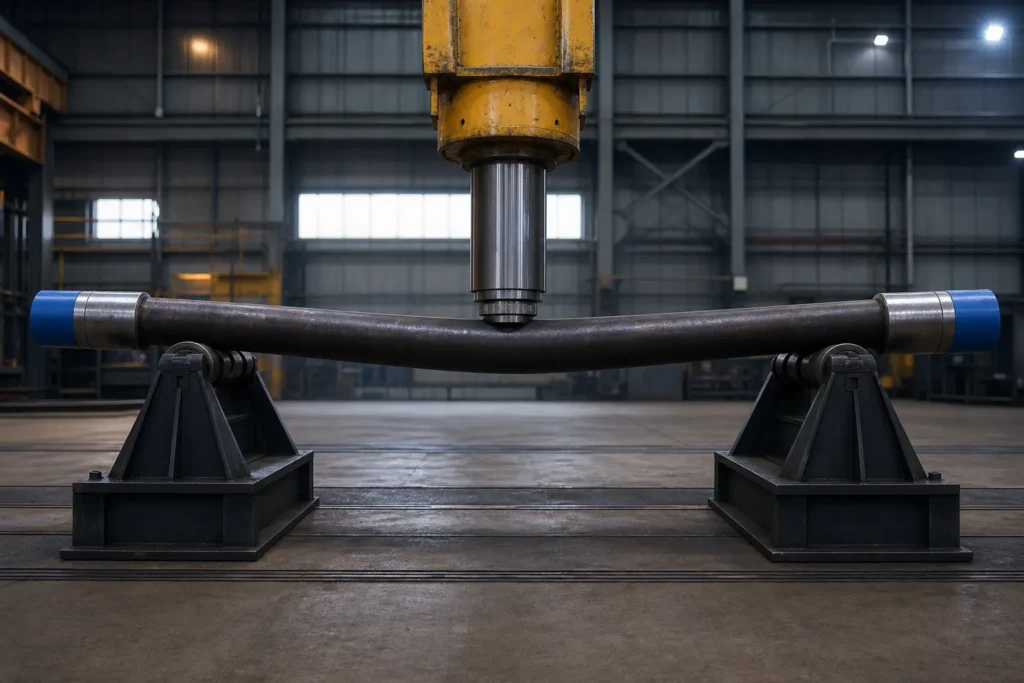
Twisted Pipe Is Not Bent Pipe — the Twist-Off Judgment
Drill pipe accumulates two different kinds of geometric damage, and only one of them belongs on a press. UN curva is deviation in a single plane — the tube reads straight from two perpendicular viewpoints and curved from the others. UN intrecciare is permanent angular displacement around the pipe’s own axis: scribe a longitudinal line down a twisted joint and the line rotates as it travels — one cross-section has permanently rotated against its neighbors. The distinction matters because the two conditions come from different events and leave different damage behind.
Permanent twist is usually an accident record: twist-off events, where the string’s stored torsional energy releases at parting and winds the pipe beyond yield, plus stuck-pipe back-offs and the sustained torque of directional work. By the time the twist is visible, the affected length has already been loaded past yield in torsion — a metallurgical fact, not a geometry problem: no press cycle unwinds it, and rotating the section back cold would add a second plastic episode on top of the first.
This is why press straightening, as a process, declines the job. A straightening press superimposes controlled single-plane bending; twist correction would instead require controlled torque about the axis across the twisted length — a different machine and loading mode — while the yield history that produced the twist remains in the steel either way. The judgment that does apply runs:
- Quantify the twist first. Mark or measure the angular reference along the joint — how many degrees over what length — before any decision, the same measure-first discipline that governs bending.
- Treat visible permanent twist as a material flag. It marks a length that has already yielded once in service — a condition for the inspection standard to evaluate, not a shape to correct.
- Check the connections specifically. A joint that took twist concentrates consequences at the rotary shouldered connections, where make-up reference and shoulder sealing are compromised independently of the body — damage that routes to re-machining or replacement decisions, non alla stampa.
- Route the verdict to the inspection standard. Whether a twisted joint is downgraded, restricted or condemned is decided under the governing inspection practice for drill stem elements — the framework mapped in our API straightness standards overview — not in the shop.
The practical consequence for reconditioning flow: twist is screened out at incoming inspection, before the joint is ever scheduled for press time. That sequencing — classify, then correct only what classification releases — is the organizing principle of our drill pipe reconditioning workflow article. A shop that discovers twist after straightening has wasted press time on a joint that was never a candidate.
One borderline case deserves honesty: a joint can carry both a bend and a mild residual twist, and the bend alone is legitimately correctable. Correct only what measurement defines — plane-by-plane bend correction to the connection-axis datum, with the twist documented and routed to the inspection decision — never “improved” by pressing harder in a diagonal plane.
The RSC Thread Axis Is the Straightness Datum
Ask where straightness is measured on a drill pipe joint and the wrong answer is the most common one: the outside surface of the tube. A chalk line along the OD can read straight while the joint still runs out in the string, and a joint with a visible body bow can run true — because the pipe’s functional axis is not its skin. It is the axis established by the rotary shouldered connections at both ends. The RSC thread axis is the datum the string actually rotates about, and every straightening measurement that matters is taken against it.
The reasoning is mechanical. In servizio, the joint’s position in the drill string is defined entirely by its two connections: shoulders seat, threads engage, and the next joint’s axis continues from the connection axis, not from the mid-body OD. What the rig experiences as “crooked pipe” is eccentricity between those connection axes and the tube between them. A body-straightening pass judged on surface lines can leave that eccentricity untouched — the tube looks better and the string vibrates exactly as before.
Measurement practice follows the datum:
- Simulate the thread axis at both ends. Thread-mounted arbors, expanding mandrels or precision centering in the connection bore stand in for the axis the threads define, and runout is read off the tube body against that simulated axis.
- Or invert the reference. With the joint supported on the connection datum surfaces, body runout is measured directly along the tube — support geometry substitutes for arbors when they are not available, at some cost in setup rigor.
- Read at defined stations, not at the worst-looking spot. A runout profile along the body — the multipoint logic described in our misurazione dell'albero multipunto articolo - è ciò che gira “sembra dritto” in un numero che la certificazione può portare.
Il mondo dell'ispezione delle connessioni mantiene già un ecosistema di misura maturo per la geometria RSC: filettatura a elemento singolo e pratica di misura per la conicità, piombo e forma - e l'accettazione del raddrizzamento dovrebbe essere intesa come un ramo della stessa metrologia definita dalla connessione. I manometri certificano il collegamento; il controllo di concentricità certifica il cassone rispetto all’asse di collegamento; insieme rispondono all'unica domanda posta dalla stringa: questo giunto funziona correttamente attorno all'asse definito dai suoi fili?
Sulla stampa, il dato ha due conseguenze operative. Appoggi e punti di pressione vengono scelti affinché la correzione agisca sul corpo senza mai caricare una connessione, e la verifica post-correzione viene eseguita sul dato dell'asse di connessione prima che il giunto venga rilasciato: l'accettazione in fabbrica e l'accettazione a livello di stringa rimangono le stesse misurazioni, come indicato per i lavori di riparazione tubolari nel ns drill pipe reconditioning workflow. Un record di raddrizzamento che mostra l'eccentricità del corpo misurata rispetto all'asse RSC è quello che un file di ricertificazione può difendere; qualsiasi cosa misurata rispetto a una linea di superficie è documentazione geometrica, non accettazione.
Video del processo di correzione del tubo del trapano petrolio
Caratteristiche del prodotto per la macchina per raddrizzamento del tubo per trapano petrolio
- Per garantire l'accuratezza del test, utilizzare un sensore di spostamento ad alta precisione durante la costruzione e l'elaborazione dei dispositivi di prova.
- Dotato di sistema di caricamento del controllo della posizione ad alta precisione per migliorare la precisione dell'allineamento.
- Coordinare e gestire i vari componenti per abbreviare i tempi del processo di stiratura.
- Informazioni tempestive sull'allarme di situazione anomala perfetta per facilitare la manutenzione dell'apparecchiatura.
- ha una scheda di memoria da 16 g per memorizzare le informazioni di elaborazione, collegamento di comunicazione riservato con il computer host.
- Utensili e attrezzature a cambio rapido, regolazione parametrizzata e commutazione, configurazione automatizzata degli strumenti.


