
Nel settore della produzione di elementi di fissaggio, la flessione dei bulloni lunghi dopo il trattamento termico è un punto dolente universale. Tradizionale “martellatura manuale” non solo è inefficiente ma non riesce nemmeno a garantire una precisione costante. Questo articolo condivide uno specializzato Soluzione automatizzata per il raddrizzamento dei bulloni: demonstrating a reported client case in which automation took an 8-person manual line to one operator supervising four machines, with straightness held within 0.1 mm on the client’s acceptance records.
What is the Bolt?
I bulloni sono elementi di fissaggio fondamentali per i macchinari, costruzione, e industrie automobilistiche. Il pezzo tipico per questa soluzione è un bullone lungo ad alta resistenza: 15diametro mm, 340lunghezza mm.
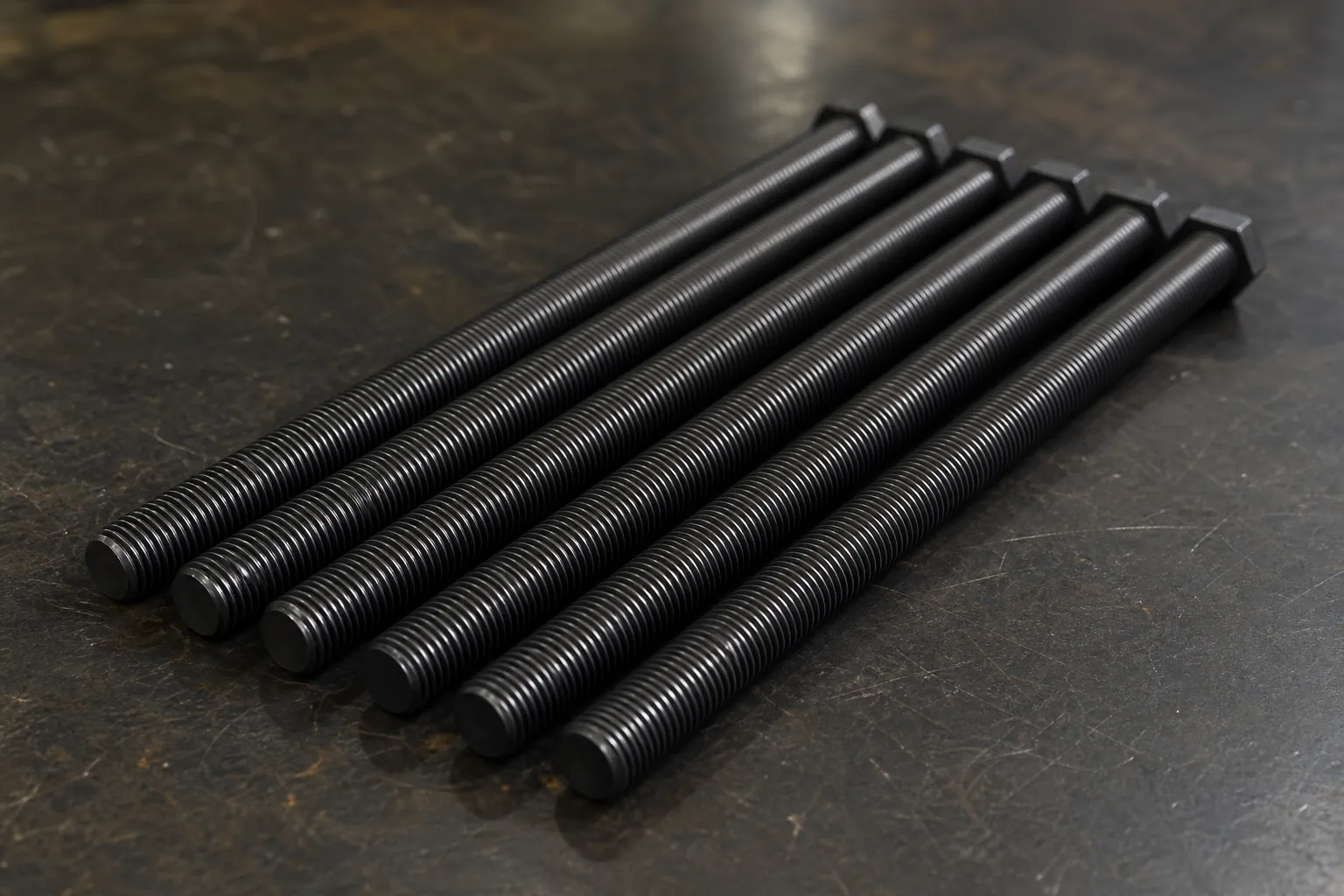
Caratteristiche strutturali e sfide
- Rapporto L/D elevato: La lunghezza di 340 mm rende il bullone altamente suscettibile a una piegatura iniziale di 0,5 mm – 1.5mm dopo il trattamento termico.
- Requisiti di precisione: The client required straightness within 0.2 mm; the case acceptance records were held under 0.1 mm.
- Requisiti di protezione: Il processo di raddrizzatura deve garantire zero danni alla precisione della filettatura e alla qualità della superficie.
Why Heat Treatment Bends Long Bolts in the First Place
Understanding the distortion source is what makes a correction process defensible instead of decorative. During quenching, a long fastener cools unevenly: the section cools at different rates depending on orientation in the basket or fixture, agitation contact, and local mass differences between the plain shank, the threaded length and the head. Each cooling path wants to contract by a different amount, and the resulting locked-in stresses bend the part when it relaxes. The effect scales with length — which is why short bolts leave heat treatment usable while long ones of the same grade systematically arrive bent. Thread rolling and machining before treatment add their own stress history, and any straightening performed at the heat treater counts as prior deformation for everything done afterward.
Two practical consequences follow. Primo, incoming inspection on long heat-treated bolts is not optional paperwork — the bend magnitude and pattern arriving at the straightening station determine both the correction plan and any supplier conversation, and the interaction of prior deformation with correction response is the reason reverse-loading behavior matters, as covered under the Bauschinger effect in straightening. Secondo, process decisions upstream — how parts are racked or basketed through quench, whether stress relief is applied — change the distribution the straightening station sees, and are usually the cheapest place to reduce total correction work.
Reading the Bend Before Correcting It
Long fasteners arrive with a small vocabulary of bend patterns, and naming the pattern is the first step of an efficient correction loop. A single-arc bow — one gentle curve, maximum near the middle — is the most common heat-treatment signature and the most straightforward to correct with supports positioned around the peak. An S-shaped double bend has two opposite peaks, usually reflecting two constraint points during quench, and demands two coordinated corrections rather than one big press at the largest reading. A local kink near the head or the thread runout concentrates distortion where section stiffness changes, and behaves differently from a distributed bow. Finalmente, twist about the axis occasionally accompanies bending on parts with asymmetric features. Each pattern requires its own measurement map and correction sequence, which is why an automatic station that scans the full length and builds the map before pressing — rather than chasing the single worst reading — converges in fewer strokes. The measuring-and-correcting loop behind this is described for automatic shaft straightening generally, and for the long-bolt family specifically in the automatic long bolt straightening process.
Perché il raddrizzamento dei bulloni deve allontanarsi da “Martellatura manuale”
Processo tradizionale vs. Soluzione automatizzata
The figures below are this client’s reported baseline and post-commissioning values, not a universal benchmark for every fastener line.
| Punto dolente | Martellatura manuale / Pressa manuale | Soluzione lisciante automatizzata |
| Fabbisogno di lavoro | 8 workers per shift (manual baseline, reported case) | 1 operatore per 4 macchine (reported case) |
| Rettilineità | 0.2 – 0.5 mm spread (reported manual baseline) | ≤ 0,1 mm (client acceptance records) |
| Tempo di ciclo | 120 – 180 s/pezzo (reported manual baseline) | 10 – 15 s/pezzo (reported case) |
| Costo complessivo | High labor cost per corrected part | Manpower reduced from 8 operators to 1 supervising 4 macchine (reported case) |
Flusso del processo di raddrizzamento automatizzato dei bulloni
Questa soluzione copre un processo completamente automatizzato a ciclo chiuso, dall'alimentazione allo smistamento, garantendo che ogni bullone soddisfi requisiti di consegna di standard elevati.
Descrizioni dei processi principali
- Alimentazione automatica: I bulloni piegati vengono automaticamente alimentati da una tramoggia alla stazione di raddrizzatura senza intervento umano.
- Misurazione dinamica: Sensori ad alta precisione scansionano il pezzo rotante in tempo reale, catturando accuratamente il punto di piegatura massimo su tutta la lunghezza.
- Servo pressatura: Il sistema intelligente calcola automaticamente il ritorno elastico in base al materiale (acciaio al carbonio/acciaio legato), e il servo pistone applica una pressione precisa per una correzione a passaggio singolo.
- Ordinamento automatico: I bulloni qualificati procedono alla fase successiva, while non-conforming parts are automatically isolated before they leave the machine.

Macchina per raddrizzare bulloni UBJ-80
Questa piastra è ideale per le parti finite trattate termicamente (per esempio., componenti di macchine per stampaggio/ufficio, ricambi auto/moto, utensili, viti) e bar (acciaio, rame, alluminio, acciaio inossidabile, Lega di titanio) di lunghezza 60–600 mm & Diametro φ3–φ25 mm. Aumenta sia la precisione che la qualità del prodotto.
Sfide e soluzioni di raddrizzamento fondamentale
Sfida 1: Manning and the Reported “1 Operatore per 4 Macchine” Case
Descrizione del problema: Manual hammering and press correction depend on operator skill, stamina and shift discipline, so manning levels stay high and results vary from operator to operator.
Soluzione:
La nostra soluzione implementa automazione completa a circuito chiuso. La logica di funzionamento è estremamente semplice, con ricette integrate per varie specifiche di bulloni. Un lavoratore standard deve solo riempire periodicamente la tramoggia; il resto... misurazione, raddrizzamento, e l'ispezione vengono gestiti automaticamente dalla macchina. Ciò risolve le carenze di manodopera ed elimina i cali di precisione causati dalla fatica.
Sfida 2: Garantire coerenza con una precisione di 0,1 mm
Descrizione del problema: Quando un bullone è sottoposto a colpi di martello, la distribuzione dello stress interno diventa irregolare, spesso portando a una correzione eccessiva in aree localizzate.
Soluzione:
La soluzione utilizza a sistema di servocontrollo completamente parametrizzato. A differenza del vago giudizio umano, i sensori rilevano la curva assiale del bullone con una precisione a livello di micron. Attraverso algoritmi servo multi-step, il sistema vince con precisione il ritorno elastico degli acciai S45C o legati, locking final straightness within the 0.1 mm window achieved on this client’s qualified recipe.
How Thread and Head Zones Are Protected During Correction
Thread protection is a contact-zone engineering problem, and the principles are the same ones that govern surface-protection tooling across straightening applications. The correction force and the reaction forces both need somewhere to live, and on a long bolt the plain shank is the region designed to carry load, while the threaded length and the under-head fillet are the regions most easily damaged. A protection concept therefore has three parts: place supports on the shank at controlled span positions around the bend peak; direct press contact onto the shank through tooling that conforms to the section instead of touching thread crests; and keep every edge that could contact the workpiece generously radiused so load spreads instead of concentrating. Cleanliness belongs in the same sentence — debris trapped between press tooling and a thread flank is a scratch generator, and on plated or coated bolts the coating class defines how much contact the finish can tolerate at all.
The validation side is equally concrete. A thread-protection claim is proven by inspection agreed before the trial — thread gauges still running, flank condition reviewed under the method the quality function specifies — together with the released-state straightness result, on representative parts, after repeat setups. Protection and geometry are accepted together or not at all.
What an Acceptance Criteria Package Should Contain
A bolt straightening process is only as good as the acceptance definition it answers to, and a complete one answers five questions in writing. What characteristic governs — straightness of the axis, measured how: on centers, on supports, rotante, in what condition, since a reading under restraint is not a released result, per loaded versus released measurement practice. What the limit is, and where it applies — full length or specified spans. What else must survive the process — thread fit, finitura superficiale, rivestimento, head markings. How conformity is sampled — every part through an automatic gauge, or a sampling plan with defined reaction to a failure. And what happens to nonconforming parts — rework limits, segregation and disposition authority, following the NOK sorting and rework-limit framework. Buyers comparing straightening suppliers are well advised to ask for exactly this package; the ability to produce it says more about a supplier than any single machine specification.
Caso di produzione: La quarta scelta del cliente indiano
Sfondo del cliente
Un noto fornitore indiano di elementi di fissaggio che fornisce componenti per marchi globali di macchine edili.
Risultati dell'implementazione
- Ripeti ordini: Basato sulle eccezionali prestazioni delle prime tre unità, il cliente ha recentemente acquistato il loro 4esima macchina.
- Operator Consolidation: The client reported one operator managing all 4 machines after commissioning, with a substantial increase in output per operator.
- Punto di riferimento della qualità: The client’s records report straightness moving from 0.2 mm down to under 0.1 mm after commissioning.
Domande frequenti
- Q: Il pistone raddrizzatore danneggerà le filettature dei bulloni??
- NO. Abbiamo progettato senza contatto, stampi di protezione imbottiti specifico per il raddrizzamento dei bulloni. I blocchi della pressa si adattano perfettamente alla curvatura del bullone, garantendo una distribuzione uniforme della forza ed evitando rientranze superficiali.
- Q: L’apparecchiatura può integrarsi nel sistema MES della nostra fabbrica?
- SÌ. Il nostro sistema di controllo è dotato di interfacce dati standard per registrare ed esportare dati di raddrizzamento in tempo reale per ogni bullone, soddisfare i moderni requisiti di tracciabilità.
Additional Process Questions
Why do bolts from the same heat-treatment lot arrive with different bend patterns?
Because each part’s position in the basket or rack gave it a different cooling path. Quench distortion is sensitive to orientation, local mass and agitation contact, so even identical bolts leave treatment with different locked-in stress patterns. Mapping incoming parts rather than assuming a uniform error is the practical answer, and it is why scanning-based stations build a per-part correction plan.
How many correction passes does a long bolt need?
It depends on the pattern, not a fixed number. A single-arc bow typically converges in one planned press; an S-bend needs two coordinated corrections; local kinks near section changes respond differently again. The governing rule is a rework limit set before production — parts that stop responding are routed to review, not pressed repeatedly, because each additional plastic cycle consumes fatigue life and changes the material’s response.
Should straightening come before or after thread rolling?
The route belongs to the fastener process engineer, but the trade-off is explicit: correcting before thread rolling lets subsequent operations work from a straight blank, while correcting after heat treatment with finished threads demands the contact-zone protection described above. Whichever route is chosen, the acceptance package must define what state the straightness limit applies to, and the correction validation must be run on parts carrying that state.
Riepilogo
Per le fabbriche di elementi di fissaggio che perseguono alta efficienza e qualità, UN Soluzione automatizzata per il raddrizzamento dei bulloni è la via essenziale per una maggiore competitività. Whether the target is lower manning or 0.1 mm delivery precision, the figures in this article are one client’s reported case; your own results depend on the bolt family, incoming distortion and acceptance definition.
Se stai affrontando problemi di gestione del lavoro o colli di bottiglia di precisione, sentiti libero di Contattaci per una proposta tecnica personalizzata.