
Kiinnittimiä valmistavassa teollisuudessa, pitkien pulttien taipuminen lämpökäsittelyn jälkeen on yleinen kipupiste. Perinteinen “manuaalinen vasarointi” ei ole vain tehoton, vaan se ei myöskään takaa tasaista tarkkuutta. Tämä artikkeli jakaa erikoistuneen Automatisoitu pulttien oikaisuratkaisu: demonstrating a reported client case in which automation took an 8-person manual line to one operator supervising four machines, with straightness held within 0.1 mm on the client’s acceptance records.
What is the Bolt?
Pultit ovat koneen peruskiinnikkeet, rakentaminen, ja autoteollisuudessa. Tyypillinen työkappale tälle ratkaisulle on erittäin luja pitkä pultti: 15mm halkaisija, 340mm pituus.
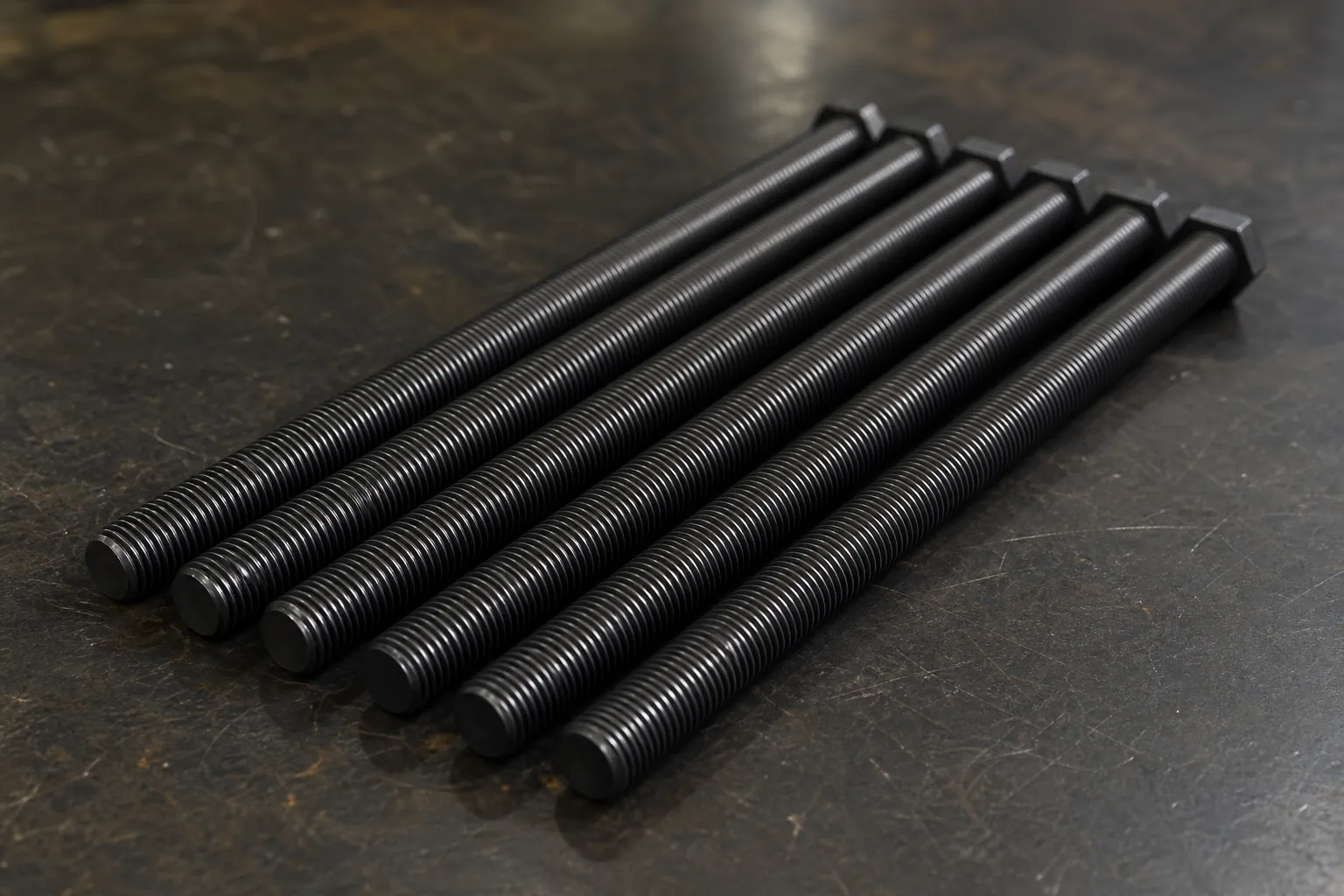
Rakenteelliset ominaisuudet ja haasteet
- Korkea L/D-suhde: 340 mm:n pituus tekee pultin erittäin herkän 0,5 mm:n alkutaivutukselle – 1.5mm lämpökäsittelyn jälkeen.
- Tarkkuusvaatimukset: The client required straightness within 0.2 mm; the case acceptance records were held under 0.1 mm.
- Suojausvaatimukset: Oikaisuprosessin on varmistettava, ettei kierteen tarkkuus ja pinnan laatu vahingoitu.
Why Heat Treatment Bends Long Bolts in the First Place
Understanding the distortion source is what makes a correction process defensible instead of decorative. During quenching, a long fastener cools unevenly: the section cools at different rates depending on orientation in the basket or fixture, agitation contact, and local mass differences between the plain shank, the threaded length and the head. Each cooling path wants to contract by a different amount, and the resulting locked-in stresses bend the part when it relaxes. The effect scales with length — which is why short bolts leave heat treatment usable while long ones of the same grade systematically arrive bent. Thread rolling and machining before treatment add their own stress history, and any straightening performed at the heat treater counts as prior deformation for everything done afterward.
Two practical consequences follow. Ensimmäinen, incoming inspection on long heat-treated bolts is not optional paperwork — the bend magnitude and pattern arriving at the straightening station determine both the correction plan and any supplier conversation, and the interaction of prior deformation with correction response is the reason reverse-loading behavior matters, as covered under Bauschinger-efekti suoristuksessa. Toinen, process decisions upstream — how parts are racked or basketed through quench, whether stress relief is applied — change the distribution the straightening station sees, and are usually the cheapest place to reduce total correction work.
Reading the Bend Before Correcting It
Long fasteners arrive with a small vocabulary of bend patterns, and naming the pattern is the first step of an efficient correction loop. A single-arc bow — one gentle curve, maximum near the middle — is the most common heat-treatment signature and the most straightforward to correct with supports positioned around the peak. An S-shaped double bend has two opposite peaks, usually reflecting two constraint points during quench, and demands two coordinated corrections rather than one big press at the largest reading. A local kink near the head or the thread runout concentrates distortion where section stiffness changes, and behaves differently from a distributed bow. Lopulta, twist about the axis occasionally accompanies bending on parts with asymmetric features. Each pattern requires its own measurement map and correction sequence, which is why an automatic station that scans the full length and builds the map before pressing — rather than chasing the single worst reading — converges in fewer strokes. The measuring-and-correcting loop behind this is described for automatic shaft straightening generally, and for the long-bolt family specifically in the automatic long bolt straightening process.
Miksi pultin oikaisun on siirrettävä pois “Manuaalinen vasarointi”
Perinteinen prosessi vs. Automatisoitu Ratkaisu
The figures below are this client’s reported baseline and post-commissioning values, not a universal benchmark for every fastener line.
| Kipupiste | Manuaalinen vasarointi / Manuaalinen paina | Automaattinen suoristusratkaisu |
| Työvoimavaatimus | 8 workers per shift (manual baseline, reported case) | 1 operaattori 4 koneita (reported case) |
| Suoruus | 0.2 – 0.5 mm spread (reported manual baseline) | ≤ 0,1 mm (client acceptance records) |
| Kierrosaika | 120 – 180 s/kpl (reported manual baseline) | 10 – 15 s/kpl (reported case) |
| Kokonaiskustannukset | High labor cost per corrected part | Manpower reduced from 8 operators to 1 supervising 4 koneita (reported case) |
Automaattinen pulttien oikaisuprosessi
Tämä ratkaisu kattaa täysin suljetun kierron automatisoidun prosessin ruokinnasta lajitteluun, varmistaa, että jokainen pultti täyttää korkeat toimitusvaatimukset.
Ydinprosessien kuvaukset
- Automaattinen ruokinta: Taivutetut pultit syötetään automaattisesti suppilosta oikaisuasemalle ilman ihmisen väliintuloa.
- Dynaaminen mittaus: Erittäin tarkat anturit skannaavat pyörivän työkappaleen reaaliajassa, sieppaa tarkasti maksimitaivutuspisteen koko pituudelta.
- Servo puristus: Älykäs järjestelmä laskee automaattisesti takaisinjousituksen materiaalin perusteella (hiiliteräs/seosteräs), ja servomylinteri käyttää tarkkaa painetta yksikierroskorjausta varten.
- Automaattinen lajittelu: Hyväksytyt pultit jatkavat seuraavaan vaiheeseen, while non-conforming parts are automatically isolated before they leave the machine.

UBJ-80-pultin suoristamiskone
Tämä suoristusrauta soveltuu erinomaisesti lämpökäsitellyille valmiille osille (esim., leimaus/toimistokoneiden komponentit, auton/moottoripyörän osia, työkaluja, ruuvit) ja baareja (teräs, kupari, alumiini, ruostumaton teräs, titaaniseoksesta) pituus 60-600 mm & φ3–φ25mm halkaisija. Se parantaa sekä tarkkuutta että tuotteen laatua.
Oikaisun ydinhaasteet ja ratkaisut
Haaste 1: Manning and the Reported “1 Operaattori for 4 Koneet” Case
Ongelman kuvaus: Manual hammering and press correction depend on operator skill, stamina and shift discipline, so manning levels stay high and results vary from operator to operator.
Ratkaisu:
Ratkaisumme toteuttaa täydellinen suljetun silmukan automaatio. Toimintalogiikka on erittäin yksinkertainen, sisäänrakennetuilla resepteillä erilaisille pulttispesifikaatioille. Tavallisen työntekijän tarvitsee vain täyttää säiliö säännöllisesti; loput - mittaus, suoristus, ja tarkastus – kone hoitaa sen automaattisesti. Tämä ratkaisee työvoimapulan ja eliminoi väsymyksen aiheuttamat tarkkuuspudotukset.
Haaste 2: Taataan johdonmukaisuus 0,1 mm:n tarkkuudella
Ongelman kuvaus: Kun pulttiin kohdistuu vasaraiskuja, sisäinen jännityksen jakautuminen muuttuu epätasaiseksi, johtaa usein ylikorjaukseen paikallisilla alueilla.
Ratkaisu:
Ratkaisu hyödyntää a täysin parametroitu servo-ohjausjärjestelmä. Toisin kuin epämääräinen ihmisen arvostelu, anturit havaitsevat pultin aksiaalikäyrän mikronitason tarkkuudella. Monivaiheisten servo-algoritmien kautta, järjestelmä voittaa tarkasti S45C- tai seosterästen elastisen takaisinjousen, locking final straightness within the 0.1 mm window achieved on this client’s qualified recipe.
How Thread and Head Zones Are Protected During Correction
Thread protection is a contact-zone engineering problem, and the principles are the same ones that govern surface-protection tooling across straightening applications. The correction force and the reaction forces both need somewhere to live, and on a long bolt the plain shank is the region designed to carry load, while the threaded length and the under-head fillet are the regions most easily damaged. A protection concept therefore has three parts: place supports on the shank at controlled span positions around the bend peak; direct press contact onto the shank through tooling that conforms to the section instead of touching thread crests; and keep every edge that could contact the workpiece generously radiused so load spreads instead of concentrating. Cleanliness belongs in the same sentence — debris trapped between press tooling and a thread flank is a scratch generator, and on plated or coated bolts the coating class defines how much contact the finish can tolerate at all.
The validation side is equally concrete. A thread-protection claim is proven by inspection agreed before the trial — thread gauges still running, flank condition reviewed under the method the quality function specifies — together with the released-state straightness result, on representative parts, after repeat setups. Protection and geometry are accepted together or not at all.
What an Acceptance Criteria Package Should Contain
A bolt straightening process is only as good as the acceptance definition it answers to, and a complete one answers five questions in writing. What characteristic governs — straightness of the axis, measured how: on centers, on supports, pyörivä, in what condition, since a reading under restraint is not a released result, per loaded versus released measurement practice. What the limit is, and where it applies — full length or specified spans. What else must survive the process — thread fit, pintakäsittely, pinnoite, head markings. How conformity is sampled — every part through an automatic gauge, or a sampling plan with defined reaction to a failure. And what happens to nonconforming parts — rework limits, segregation and disposition authority, following the NOK sorting and rework-limit framework. Buyers comparing straightening suppliers are well advised to ask for exactly this package; the ability to produce it says more about a supplier than any single machine specification.
Valmistuskotelo: Intialaisen asiakkaan neljäs valinta
Asiakkaan tausta
Tunnettu intialainen kiinnikkeiden toimittaja, joka toimittaa komponentteja maailmanlaajuisille rakennuskonemerkeille.
Toteutuksen tulokset
- Toista tilaukset: Perustuu kolmen ensimmäisen yksikön erinomaiseen suorituskykyyn, asiakas osti äskettäin 4th kone.
- Operator Consolidation: The client reported one operator managing all 4 machines after commissioning, with a substantial increase in output per operator.
- Laatuvertailu: The client’s records report straightness moving from 0.2 mm down to under 0.1 mm after commissioning.
UKK
- K: Vahingoittaako oikaisumäntä pultin kierteitä?
- Ei. Olemme suunnitelleet ei kosketa, pehmustetut suojamuotit erityisesti pulttien oikaisua varten. Puristuslohkot vastaavat täydellisesti pultin kaarevuutta, varmistaa tasaisen voiman jakautumisen ja välttää pinnan painaumat.
- K: Voivatko laitteet integroida tehtaamme MES-järjestelmään?
- Kyllä. Ohjausjärjestelmässämme on vakiotietoliitännät reaaliaikaisten oikaisutietojen tallentamiseen ja vientiin jokaiselle pultille, nykyaikaiset jäljitettävyysvaatimukset.
Additional Process Questions
Why do bolts from the same heat-treatment lot arrive with different bend patterns?
Because each part’s position in the basket or rack gave it a different cooling path. Quench distortion is sensitive to orientation, local mass and agitation contact, so even identical bolts leave treatment with different locked-in stress patterns. Mapping incoming parts rather than assuming a uniform error is the practical answer, and it is why scanning-based stations build a per-part correction plan.
How many correction passes does a long bolt need?
It depends on the pattern, not a fixed number. A single-arc bow typically converges in one planned press; an S-bend needs two coordinated corrections; local kinks near section changes respond differently again. The governing rule is a rework limit set before production — parts that stop responding are routed to review, not pressed repeatedly, because each additional plastic cycle consumes fatigue life and changes the material’s response.
Should straightening come before or after thread rolling?
The route belongs to the fastener process engineer, but the trade-off is explicit: correcting before thread rolling lets subsequent operations work from a straight blank, while correcting after heat treatment with finished threads demands the contact-zone protection described above. Whichever route is chosen, the acceptance package must define what state the straightness limit applies to, and the correction validation must be run on parts carrying that state.
Yhteenveto
Kiinnitintehtaille, jotka tavoittelevat korkeaa tehokkuutta ja laatua, an Automatisoitu pulttien oikaisuratkaisu on keskeinen tie kilpailukyvyn lisäämiseen. Whether the target is lower manning or 0.1 mm delivery precision, the figures in this article are one client’s reported case; your own results depend on the bolt family, incoming distortion and acceptance definition.
Moving from manual bolt correction toward automation? The manual vs automatic selection logic ja ROI-kotelo automaattiseen suoristukseen ovat luonnolliset seuraavat askeleet.
Jos kohtaat työvoiman hallintaan liittyviä ongelmia tai tarkkuuden pullonkauloja, voit vapaasti Ota meihin yhteyttä räätälöityä teknistä ehdotusta varten.