
V průmyslu výroby spojovacího materiálu, ohýbání dlouhých šroubů po tepelném zpracování je univerzálním bodem bolesti. Tradiční “ruční zatloukání” je nejen neefektivní, ale také nezaručuje konzistentní přesnost. Tento článek sdílí specializované Řešení pro automatické vyrovnávání šroubů: demonstrating a reported client case in which automation took an 8-person manual line to one operator supervising four machines, with straightness held within 0.1 mm on the client’s acceptance records.
What is the Bolt?
Šrouby jsou základní spojovací prvky pro strojní zařízení, konstrukce, a automobilový průmysl. Typickým obrobkem pro toto řešení je vysokopevnostní dlouhý šroub: 15průměr mm, 340délka mm.
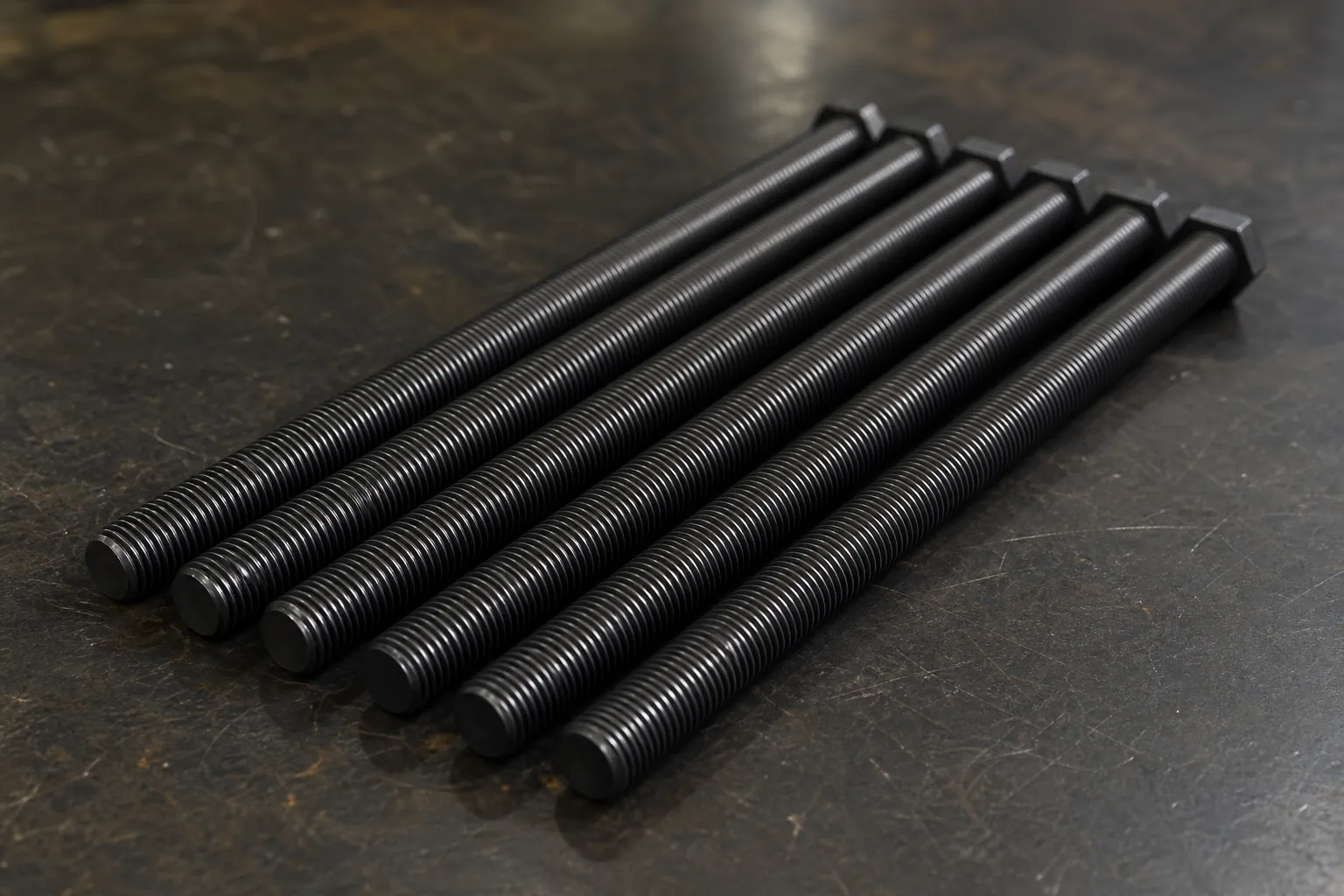
Strukturální vlastnosti a výzvy
- Vysoký poměr L/D: Díky délce 340 mm je šroub vysoce náchylný na počáteční ohyb 0,5 mm – 1.5mm po tepelném zpracování.
- Požadavky na přesnost: The client required straightness within 0.2 mm; the case acceptance records were held under 0.1 mm.
- Požadavky na ochranu: Proces rovnání musí zajistit nulové poškození přesnosti závitu a kvality povrchu.
Why Heat Treatment Bends Long Bolts in the First Place
Understanding the distortion source is what makes a correction process defensible instead of decorative. During quenching, a long fastener cools unevenly: the section cools at different rates depending on orientation in the basket or fixture, agitation contact, and local mass differences between the plain shank, the threaded length and the head. Each cooling path wants to contract by a different amount, and the resulting locked-in stresses bend the part when it relaxes. The effect scales with length — which is why short bolts leave heat treatment usable while long ones of the same grade systematically arrive bent. Thread rolling and machining before treatment add their own stress history, and any straightening performed at the heat treater counts as prior deformation for everything done afterward.
Two practical consequences follow. První, incoming inspection on long heat-treated bolts is not optional paperwork — the bend magnitude and pattern arriving at the straightening station determine both the correction plan and any supplier conversation, and the interaction of prior deformation with correction response is the reason reverse-loading behavior matters, as covered under Bauschingerův efekt při narovnávání. Druhý, process decisions upstream — how parts are racked or basketed through quench, whether stress relief is applied — change the distribution the straightening station sees, and are usually the cheapest place to reduce total correction work.
Reading the Bend Before Correcting It
Long fasteners arrive with a small vocabulary of bend patterns, and naming the pattern is the first step of an efficient correction loop. A single-arc bow — one gentle curve, maximum near the middle — is the most common heat-treatment signature and the most straightforward to correct with supports positioned around the peak. An S-shaped double bend has two opposite peaks, usually reflecting two constraint points during quench, and demands two coordinated corrections rather than one big press at the largest reading. A local kink near the head or the thread runout concentrates distortion where section stiffness changes, and behaves differently from a distributed bow. Konečně, twist about the axis occasionally accompanies bending on parts with asymmetric features. Each pattern requires its own measurement map and correction sequence, which is why an automatic station that scans the full length and builds the map before pressing — rather than chasing the single worst reading — converges in fewer strokes. The measuring-and-correcting loop behind this is described for automatic shaft straightening generally, and for the long-bolt family specifically in the automatic long bolt straightening process.
Proč se musí rovnání šroubů ustoupit “Ruční příklep”
Tradiční proces vs. Automatizované řešení
The figures below are this client’s reported baseline and post-commissioning values, not a universal benchmark for every fastener line.
| Bod bolesti | Ruční příklep / Ruční lis | Řešení pro automatické rovnání |
| Pracovní požadavek | 8 workers per shift (manual baseline, reported case) | 1 operátor pro 4 stroje (reported case) |
| Přímost | 0.2 – 0.5 mm spread (reported manual baseline) | ≤ 0,1 mm (client acceptance records) |
| Doba cyklu | 120 – 180 s/kus (reported manual baseline) | 10 – 15 s/kus (reported case) |
| Celkové náklady | High labor cost per corrected part | Manpower reduced from 8 operators to 1 supervising 4 stroje (reported case) |
Proces automatického vyrovnávání šroubů
Toto řešení pokrývá plně uzavřený automatizovaný proces od podávání až po třídění, zajišťuje, že každý šroub splňuje požadavky na dodávku vysokého standardu.
Základní popis procesu
- Automatické krmení: Ohnuté šrouby jsou automaticky podávány z násypky do rovnací stanice bez lidského zásahu.
- Dynamické měření: Vysoce přesné senzory snímají rotující obrobek v reálném čase, přesné zachycení maximálního bodu ohybu po celé délce.
- Servo lisování: Chytrý systém automaticky vypočítá zpětné odpružení na základě materiálu (uhlíková ocel/legovaná ocel), a beran serva vyvíjí přesný tlak pro jednoprůchodovou korekci.
- Automatické řazení: Kvalifikovaní šrouby postupují do další fáze, while non-conforming parts are automatically isolated before they leave the machine.

Stroj na rovnání šroubů UBJ-80
Tato rovnačka je ideální pro tepelně zpracované hotové díly (např., součásti lisovacích/kancelářských strojů, díly pro automobily/motocykly, nástroje, šrouby) a bary (ocel, měď, hliník, nerezová ocel, slitina titanu) o délce 60-600 mm & Průměr φ3–φ25mm. Zvyšuje jak přesnost, tak kvalitu produktu.
Výzvy a řešení základních narovnání
Výzva 1: Manning and the Reported “1 Operátor pro 4 Stroje” Case
Popis problému: Manual hammering and press correction depend on operator skill, stamina and shift discipline, so manning levels stay high and results vary from operator to operator.
Řešení:
Naše řešení implementuje plně uzavřená automatizace. Operační logika je extrémně jednoduchá, s vestavěnými recepturami pro různé specifikace šroubů. Standardní pracovník potřebuje pouze pravidelně doplňovat násypku; zbytek – měření, rovnání, a inspekce – je prováděna automaticky strojem. To řeší nedostatek pracovních sil a eliminuje poklesy přesnosti způsobené únavou.
Výzva 2: Zaručení konzistence s přesností 0,1 mm
Popis problému: Když je šroub vystaven úderům kladiva, vnitřní rozložení napětí se stává nerovnoměrným, často vede k nadměrné korekci v lokalizovaných oblastech.
Řešení:
Řešení využívá a plně parametrizovaný servo řídicí systém. Na rozdíl od vágního lidského úsudku, senzory detekují axiální křivku šroubu s přesností na úrovni mikronů. Prostřednictvím vícekrokových servo algoritmů, systém přesně překonává pružné odpružení oceli S45C nebo legované oceli, locking final straightness within the 0.1 mm window achieved on this client’s qualified recipe.
How Thread and Head Zones Are Protected During Correction
Thread protection is a contact-zone engineering problem, and the principles are the same ones that govern surface-protection tooling across straightening applications. The correction force and the reaction forces both need somewhere to live, and on a long bolt the plain shank is the region designed to carry load, while the threaded length and the under-head fillet are the regions most easily damaged. A protection concept therefore has three parts: place supports on the shank at controlled span positions around the bend peak; direct press contact onto the shank through tooling that conforms to the section instead of touching thread crests; and keep every edge that could contact the workpiece generously radiused so load spreads instead of concentrating. Cleanliness belongs in the same sentence — debris trapped between press tooling and a thread flank is a scratch generator, and on plated or coated bolts the coating class defines how much contact the finish can tolerate at all.
The validation side is equally concrete. A thread-protection claim is proven by inspection agreed before the trial — thread gauges still running, flank condition reviewed under the method the quality function specifies — together with the released-state straightness result, on representative parts, after repeat setups. Protection and geometry are accepted together or not at all.
What an Acceptance Criteria Package Should Contain
A bolt straightening process is only as good as the acceptance definition it answers to, and a complete one answers five questions in writing. What characteristic governs — straightness of the axis, measured how: on centers, on supports, rotující, in what condition, since a reading under restraint is not a released result, za loaded versus released measurement practice. What the limit is, and where it applies — full length or specified spans. What else must survive the process — thread fit, povrchová úprava, povlak, head markings. How conformity is sampled — every part through an automatic gauge, or a sampling plan with defined reaction to a failure. And what happens to nonconforming parts — rework limits, segregation and disposition authority, following the NOK sorting and rework-limit framework. Buyers comparing straightening suppliers are well advised to ask for exactly this package; the ability to produce it says more about a supplier than any single machine specification.
Výrobní pouzdro: Čtvrtá volba indického klienta
Zákazník pozadí
Známý indický dodavatel spojovacího materiálu poskytující komponenty pro světové značky stavebních strojů.
Výsledky implementace
- Opakované objednávky: Na základě vynikajícího výkonu prvních tří jednotek, klient je nedávno zakoupil 4tý stroj.
- Operator Consolidation: The client reported one operator managing all 4 machines after commissioning, with a substantial increase in output per operator.
- Srovnávací měřítko kvality: The client’s records report straightness moving from 0.2 mm down to under 0.1 mm after commissioning.
Nejčastější dotazy
- Q: Poškodí rovnací píst závity šroubů?
- Žádný. Navrhli jsme bezkontaktní, polstrované ochranné formy speciálně pro rovnání šroubů. Lisovací bloky dokonale odpovídají zakřivení šroubu, zajišťující rovnoměrné rozložení síly a zamezení promáčknutí povrchu.
- Q: Může se zařízení integrovat do systému MES naší továrny?
- Ano. Náš řídicí systém obsahuje standardní datová rozhraní pro záznam a export dat rovnání v reálném čase pro každý šroub, splňující moderní požadavky na sledovatelnost.
Additional Process Questions
Why do bolts from the same heat-treatment lot arrive with different bend patterns?
Because each part’s position in the basket or rack gave it a different cooling path. Quench distortion is sensitive to orientation, local mass and agitation contact, so even identical bolts leave treatment with different locked-in stress patterns. Mapping incoming parts rather than assuming a uniform error is the practical answer, and it is why scanning-based stations build a per-part correction plan.
How many correction passes does a long bolt need?
It depends on the pattern, not a fixed number. A single-arc bow typically converges in one planned press; an S-bend needs two coordinated corrections; local kinks near section changes respond differently again. The governing rule is a rework limit set before production — parts that stop responding are routed to review, not pressed repeatedly, because each additional plastic cycle consumes fatigue life and changes the material’s response.
Should straightening come before or after thread rolling?
The route belongs to the fastener process engineer, but the trade-off is explicit: correcting before thread rolling lets subsequent operations work from a straight blank, while correcting after heat treatment with finished threads demands the contact-zone protection described above. Whichever route is chosen, the acceptance package must define what state the straightness limit applies to, and the correction validation must be run on parts carrying that state.
Shrnutí
Pro továrny na spojovací materiál, které sledují vysokou účinnost a kvalitu, an Řešení pro automatické vyrovnávání šroubů je základní cestou ke zvýšení konkurenceschopnosti. Whether the target is lower manning or 0.1 mm delivery precision, the figures in this article are one client’s reported case; your own results depend on the bolt family, incoming distortion and acceptance definition.
Moving from manual bolt correction toward automation? The manual vs automatic selection logic a ROI pouzdro pro automatické narovnání are the natural next steps.
Pokud čelíte problémům s řízením práce nebo problémům s přesností, klidně Kontaktujte nás pro přizpůsobenou technickou nabídku.