
An industrial roller is a rotating precision component, not simply a large round bar. Its bearing journals establish the installed rotation axis, while the barrel may carry a specified cylindrical, tapered, crowned or otherwise controlled profile. The roll may be solid, 空洞的, fabricated, 投擲, 鍛造的, 塗層, heated or internally cooled. These details determine whether pressure straightening is feasible and where force may safely enter the part.
A reliable industrial roller shaft straightening solution must define the roll family, manufacturing or service stage, journal datum, barrel geometry, support model, permissible contact zones, released-state measurement and the sequence between straightening, 磨削, coating and balancing. Textile machinery shafts are a related slender rotating family covered separately.

This is an engineering concept illustration of a rough-machined solid roll blank, 不是客戶現場照片. Actual roll construction, 過程階段, 工裝, force and machine size require drawings and representative sample tests.
Industrial Roller Workpiece vs Roller Straightening Machine
The word “roller” can describe either the workpiece or the machine method. They are not the same search intent.
| 學期 | 意義 | This Page Covers It? |
|---|---|---|
| Industrial roller shaft | A rotating roll with a central barrel and end journals | 是的 |
| Work roll or backup roll | Roll used in a rolling mill or related process | 是的, after roll-specific feasibility review |
| Paper, film or web-handling roll | 高的- or low-speed roll that guides or processes flexible material | 是的 |
| Roller straightening machine | A machine with multiple straightening rolls for bars, tubes or profiles | 不; 看 壓力矯正與滾筒矯直 |
| Long round bar | Semi-finished stock without a functional roll barrel | 請參閱 長鋼筋輥式矯直解決方案 |
This page treats the industrial roll as the workpiece and focuses on point or controlled pressure correction. It does not describe feeding the finished roll through a multi-roll straightener.
Define the Roll Family
The proposal should identify the real construction rather than only overall diameter and length:
- solid forged or cast work roll;
- backup roll, intermediate roll or smaller process roll;
- hollow tube roll with welded or shrink-fitted journals;
- fabricated roll with end heads and internal ribs;
- rubber-, polyurethane-, chrome-, 陶瓷製品- or otherwise coated roll;
- internally heated or cooled roll with bores, channels and rotary-union features;
- smooth, 有凹槽的, textured, engraved or patterned barrel;
- straight, tapered, crowned or compensated barrel profile;
- roll with integral gears, 聯軸器, keyways or drive features;
- new-production roll versus a serviced/reconditioned roll;
- rigid rotor versus a long flexible rotor whose operating shape changes with speed.
A solid rough-machined roll can accept a very different load path from a thin-wall fabricated shell. One recipe cannot safely cover both.
Freeze the Manufacturing or Service Stage
After Forging or Casting
The roll blank may have scale, machining allowance and incomplete journals. Correction can support downstream machining, but measurement must distinguish surface stock variation from actual axis bend.
熱處理後, 精磨前
The material state and major section geometry are established, while grinding stock may remain. This is often the most useful point for correlating the journal axis and barrel before final surface generation.
精磨後
Barrel profile, 圓度, crown and surface finish are functional. Direct press or support contact can mark the roll and can change the carefully generated profile. Correction permission normally becomes more restrictive.
After Plating or Coating
Hard chrome, rubber, polyurethane, ceramic and other surfaces require a coating-specific contact and strain review. A geometry correction that cracks, debonds or locally compresses the coating is not acceptable.
After Service
A used roll may contain wear, thermal damage, local yielding, 腐蝕, 裂縫, bearing-seat damage or residual unbalance. Straightening must not be used to hide a condition that requires regrinding, repair or rejection.
| 階段 | Datum Quality | 主要風險 | 所需的決定 |
|---|---|---|---|
| 毛坯 | Limited and stock-dependent | Surface variation can appear as bend | Process datum and machining allowance |
| 熱處理, 預研磨 | Journals and body are more defined | Material strength and crack risk | Force/springback envelope and final grinding stock |
| Finish-ground | Functional barrel profile available | 凹痕, scratching and profile change | Protected contact and final full-length measurement |
| 塗層 | Final surface system present | 開裂, debonding or compression set | Coating-owner approval and strain/contact limits |
| Service return | Functional history available | Wear or damage can be misclassified as bend | 檢查, repair and rejection route |
Define What “Straight” Means for a Roll
One dial-indicator value cannot describe the complete workpiece. 繪圖可單獨控制:
- 每個軸承軸頸的徑向跳動;
- coaxial relationship between the two journal axes;
- barrel runout relative to the journal axis;
- straightness of the derived barrel centerline;
- barrel diameter by axial station;
- cylindrical, tapered, convex, concave or custom crown/profile;
- 圓度和圓柱度;
- face or shoulder runout;
- journal-to-coupling or gear relationship;
- surface waviness, chatter, roughness or texture;
- 靜態和力偶不平衡;
- operating deflection, nip, web tracking or product-quality behavior.
使用 軸直線度、跳動與 TIR 指南 分離形式, axis and rotational indication. 拉直可以改變全局軸關係; it does not automatically correct local roundness, crown, texture, wear or mass distribution.
建立基準層次結構
解決方案應區分:
- drawing datums that define the roll tolerance;
- bearing journals that establish the installed rotation axis;
- centers or process datums used by turning and grinding machines;
- 矯直機支架和旋轉裝置;
- barrel and journal sensor tracks;
- 平衡機支架和校正平面;
- the final machine bearings, nip or product-process reference.
These references may be related but are not automatically equivalent. Centers can be stable for grinding while damaged or irrelevant to the final bearing axis. A single barrel runout trace can combine journal eccentricity, barrel form, support error and actual bend.
Measure Journal Axis and Barrel Profile Separately
Herkules uses roll-specific measuring technology, including two-point C-frame measurement and separate inspection methods. The transferable principle is that roll diameter/profile and journal-axis behavior require structured measurement; the competitor machine performance is not a StraighteningTech guarantee.
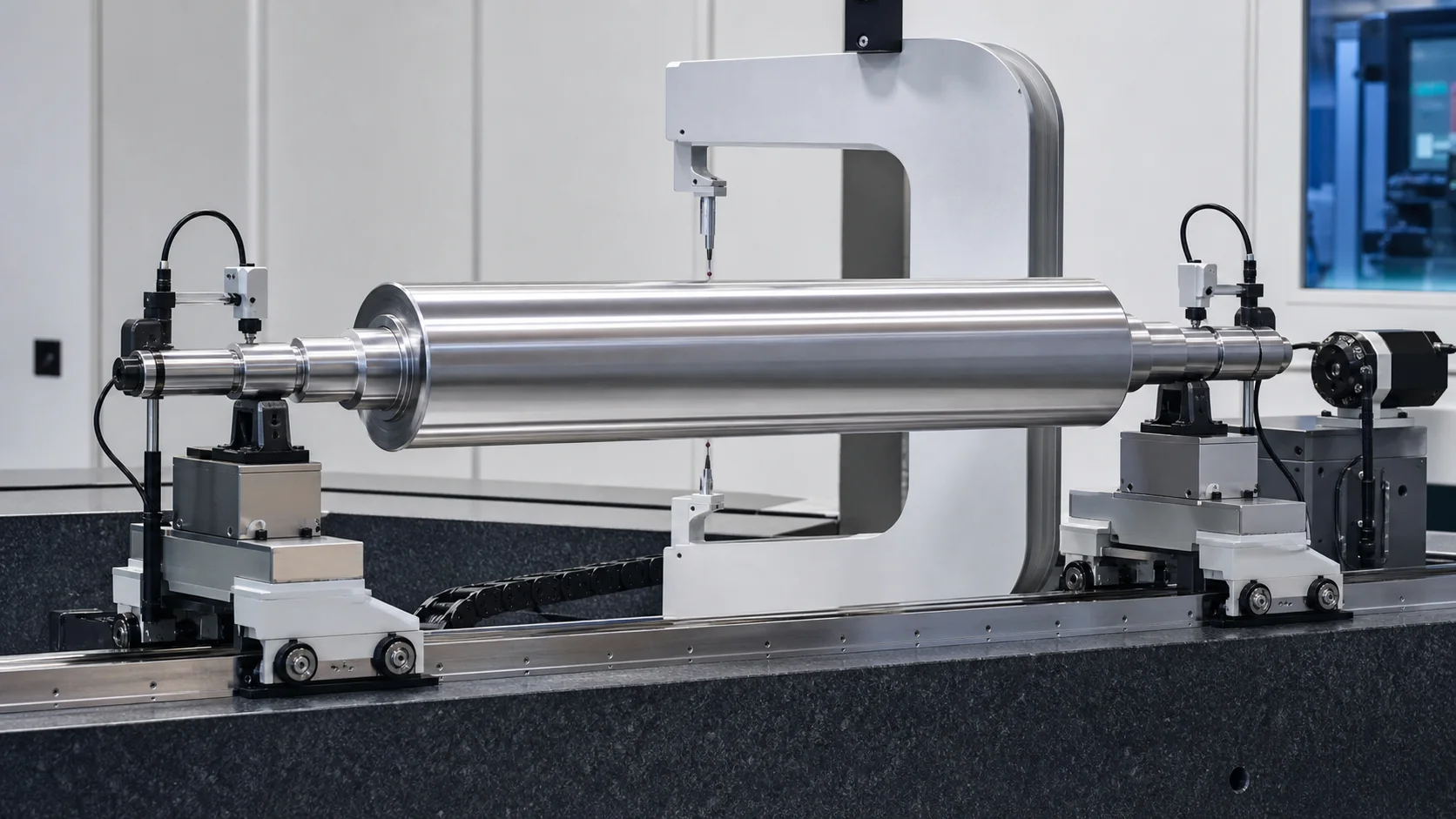
This engineering concept illustration shows a roll supported on its journals with a traveling two-point barrel gauge. Actual probe type, 接觸力, station spacing and profile evaluation follow the drawing.
| 測量軌道 | 主輸出 | 解釋風險 |
|---|---|---|
| Left and right journals | 功能旋轉軸和軸頸跳動 | Local roundness or damaged seats can bias the axis |
| Barrel with two-point gauge | Diameter and profile by axial station | Does not alone show eccentricity to the journal axis |
| Barrel with single-point runout sensor | Barrel position relative to rotation | Mixes form, eccentricity and support error |
| Faces and shoulders | Axial runout and assembly location | Chamfers and burrs must be masked |
| Internal bore/channels | Wall distribution and structural condition | Requires separate internal measurement/inspection |
| Balance reference planes | Mass-axis relationship | Does not define geometric straightness |
For crowned rolls, the algorithm must compare the measured profile with the intended crown—not with a perfectly straight cylinder. For grooved or textured rolls, the feature pattern must be masked or measured with a suitable method.
Control Sag, Support Reaction and Temperature
Long heavy rolls deflect under their own mass. The observed curve changes with journal support position, roller width, contact stiffness, temperature and rotation angle.
測量配方應定義:
- exact journal support coordinates and profile;
- whether the roll is on centers, journal rollers or bearing-equivalent supports;
- sag treatment and mathematical model;
- multiple angular positions;
- contact-probe force or non-contact standoff;
- roll temperature and stabilization condition;
- released-state measurement after correction;
- correlation to the roll grinder, balancing machine or customer installation.
Thermal bow must be treated separately. A roll that bends only at operating temperature may not be safely corrected from one cold measurement. Heating/cooling channels, shell thickness and operating thermal profile require engineering review.
Build a Safe Contact Map
典型保護區
- finished barrel surface, crown and texture;
- chrome, rubber, polyurethane, ceramic or other coating;
- 軸承軸頸, seal tracks and finished fits;
- 肩膀, 圓角和斷面過渡;
- 鍵槽, 樣條線, threads and cross-holes;
- rotary-union passages and internal channels;
- 焊接, shrink-fit interfaces and end-head transitions;
- local hardened zones or repaired areas;
- identification marks and balance-correction features.
Correction Principles
- prefer approved rough-machined process lands before final grinding;
- use broad radiused shoes and supports matched to the local diameter;
- avoid transmitting a point load through a thin hollow shell;
- prevent edge loading at shoulders and barrel ends;
- allow controlled axial movement where required;
- 監控整個行程的力道和位移;
- limit correction count and accumulated strain;
- fully unload before judging the result.
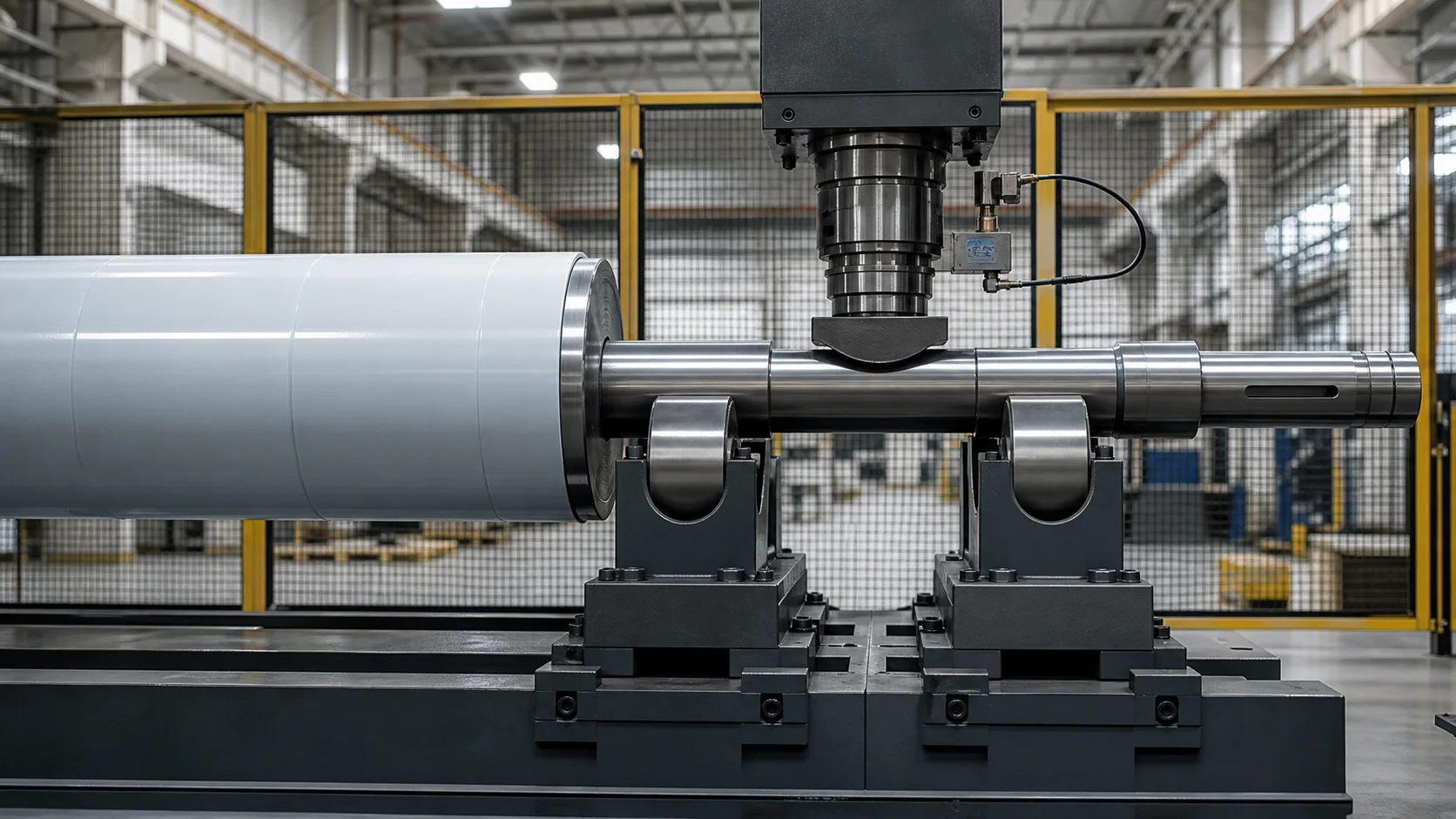
This concept illustration keeps the protected finished barrel outside the press frame and confines correction to an approved exposed shaft span. Not every roll provides such a span; the actual load path requires drawing and sample validation.
Solid Roll vs Hollow Fabricated Roll
| 建造 | Potential Advantage | 主要矯正風險 | 所需證據 |
|---|---|---|---|
| Solid forged roll | Continuous load path and predictable section | High force, hardened surface and crack risk | 物質狀態, hardness and force/springback trials |
| Cast roll | Integral body and journals | Brittle microstructure or casting defects | Metallurgical approval and inspection route |
| Hollow tube roll | Lower mass and long span | Shell ovalization, local denting or collapse | Wall map, seam/end-head design and structural analysis |
| Fabricated roll | Custom internal structure | Weld residual stress and discontinuous stiffness | Weld map, 肋骨, end-head interfaces and NDT |
| Coated roll | Final functional surface present | Coating damage or debonding | Coating strain/contact limits and post-check |
這 薄壁管矯直不塌陷 page explains why centerline correction and cross-section preservation must be controlled together on hollow parts. A hollow roll adds journals, end heads and a functional barrel, so it still needs its own recipe.
Straightening vs Roll Grinding
Roll grinding and straightening are complementary but different operations.
Grinding Can Address
- barrel diameter and profile;
- crown or taper;
- surface finish and texture preparation;
- limited runout/eccentricity through stock removal;
- local wear within the available grinding allowance.
矯直可以潛在地解決
- global bend of the shaft/roll body;
- journal-axis relationship;
- excessive eccentricity that would consume too much grinding stock;
- intermediate geometry before final grinding.
Neither Process Alone Proves
- freedom from cracks or harmful indications;
- correct internal wall/channel geometry;
- coating adhesion;
- acceptable dynamic balance;
- operating thermal shape or product quality.
Herkules integrates geometry measurement with roll grinding and inspection. That supports a process sequence in which geometry, stock and surface are coordinated. It does not justify assuming that grinding can safely remove every bent-axis condition.
Straightening vs Balancing
Schenck lists high- and low-speed rollers for paper and film production as balancing applications and supports rotors on their own journals or other application-specific bearings. Balancing handles mass-axis error; it does not make a bent roll geometrically straight.
| 狀態 | Geometry Result | Balance Result | Correct Route |
|---|---|---|---|
| Bent journal/barrel axis | Runout or axis relation fails | May also generate vibration | Correct geometry within approved limits, 然後重新平衡 |
| Straight but mass-unbalanced roll | Geometry passes | Unbalance fails | Balance in defined planes |
| Barrel profile error | Diameter/crown map fails | Balance may pass | Regrind or machine the profile |
| 熱弓 | Cold check may pass | Operating vibration can change | Thermal/operating-state investigation |
| 本地日記帳格式錯誤 | Journal geometry fails | Support signal may be unstable | Repair/machine/reject; 不視為全域彎曲 |
If a roll is straightened after balancing, the final balance condition must be reverified. If mass is removed during regrinding, balance also requires review.
Closed-Loop Roller Shaft Straightening Process
1. Identify the Roll
從零件號碼中選擇經過驗證的配方, 建造, 材料, 塗層, 輪廓, process stage and drawing revision.
2. 檢查和清潔
檢查期刊, barrel, 塗層, 焊接, transitions, internal passages and known repair areas. Remove contamination from approved datum and contact surfaces.
3. Load on Approved Supports
Confirm orientation, journal seating and lifting points without dragging the barrel or finished journals.
4. Measure Journals and Barrel
Rotate the roll and reconstruct journal-axis behavior. Measure barrel diameter/profile and runout with drawing-based axial stations and feature masks.
5. 對偏差進行分類
Separate correctable global bend from journal form error, barrel profile error, shell ovality, 塗層損壞, weld distortion, thermal bow or mass unbalance.
6. 選擇安全的校正範圍
Use only approved process lands or exposed shaft zones. Confirm the load path does not cross a fragile shell, 塗層, shoulder or internal feature.
7. 應用受控校正
Use validated support span, force/displacement limits and springback model. Stop on abnormal stiffness, 滑動或感測器行為.
8. 完全釋放並重新測量
Judge only the unloaded roll. 複核期刊, barrel runout and full profile because one correction can change multiple characteristics.
9. 檢查和佈線
執行所需的表面, 裂縫, 塗層, weld or internal checks. Route the roll to final grinding, 塗層, balancing or engineering review.
10. 記錄和卸載
Store identity, 配方修改, 之前/之後的地圖, 校正座標, 力-位移曲線, 需要追溯時的警報和處置.
建議的電池配置
特定於項目的單元格可能包括:
- heavy electromechanical or hydraulic press sized from sample force data;
- moving gantry or adjustable workpiece table;
- 軸頸滾子, centers or custom bearing-equivalent supports;
- traveling barrel measurement and separate journal sensors;
- interchangeable broad radiused shoes and protected pads;
- slow rotation and angular indexing;
- cranes, manipulators or conveyors matched to roll mass;
- 力量, 排氣量和配方控制;
- 釋放狀態重新測量;
- 磨削接口, balancing and roll-shop records.
The architecture for a rough forged work roll is not automatically suitable for a finished coated web-handling roll.
樣品測試和驗收計劃
代表性樣品應涵蓋:
- smallest and largest barrel and journal diameters;
- 最小和最大長度和質量;
- 堅硬的, 空洞的, cast and fabricated constructions;
- 材料, heat treatment and hardness states;
- straight, crowned, tapered and textured profiles;
- 粗糙的, ground and coated surface conditions;
- 預期的傳入彎曲幅度與方向;
- journal and barrel measurement correlation;
- approved and prohibited correction zones;
- cold and stabilized temperature conditions;
- grinding-stock and final-profile requirements;
- balance verification and customer gauge correlation;
- 表面, 塗層, weld and crack inspection after correction.
使用 矯直樣品測試及驗收指南 分離可行性, 胖的, SAT及生產能力. Do not convert a competitor’s roll-grinder or balancing-machine rating into a straightening guarantee.
技術提案所需的數據
請提供:
- roll and journal drawings with revisions;
- roll function and application;
- 堅硬的, 空洞的, cast or fabricated construction;
- 材料, 熱處理, hardness and coating;
- 筒體輪廓, crown, 錐度, texture and surface requirements;
- 長度, 大量的, barrel diameter and journal dimensions;
- manufacturing/service stage at straightening;
- 傳入彎道, runout and profile maps;
- drawing datums and customer measurement method;
- 批准的支持區和新聞區;
- internal channels, 焊接, interfaces and prohibited regions;
- 研磨原料與下游製程順序;
- balancing planes and verification method;
- 檢查, 可追溯性和報告要求;
- 試驗代表性樣品.
常見問題解答
Can a Finished Roll Barrel Be Used as the Press Surface?
不要這麼認為. Finished profile, 塗層, texture and surface integrity are functional. The default solution uses approved rough process lands or exposed shaft spans unless the roll designer validates a protected barrel-contact method.
Can Grinding Remove a Bent Roll Condition?
Grinding can correct profile and limited eccentricity within the available stock. It may not restore the required journal-to-barrel axis relationship without excessive stock removal. Measure the complete geometry first.
Can a Hollow Roll Be Straightened Like a Solid Roll?
不. Shell thickness, 接縫, end heads, ribs and internal channels change stiffness and collapse risk. The load path requires a separate structural and sample-test review.
Should the Roll Be Balanced Before or After Straightening?
Final balance should follow the last operation that materially changes geometry or mass. A roll straightened or reground after balancing requires balance verification.
Does Low Runout Prove the Barrel Profile Is Correct?
不. A roll can show low rotational runout and still have the wrong crown, 錐度, roundness or waviness. Profile and axis relationship must be evaluated separately.
Build the Solution Around the Real Roll
We develop industrial roller shaft straightening solutions around the actual roll construction, 製造階段, journal datum, 筒體輪廓, protected surface, safe load path and downstream grinding/balancing route. The result may be a heavy rough-roll cell or a precision protected-shaft station, but the machine selection follows evidence from drawings and sample trials.
Send the roll drawing, 建造, material/coating, 傳入幾何圖形, grinding allowance and balancing method. 然後我們可以定義測量策略, 工裝圖, 修正包絡線, sample matrix and traceable acceptance plan for your industrial roller application.