
Bağlantı elemanı imalat sektöründe, Isıl işlemden sonra uzun cıvataların bükülmesi evrensel bir sorundur. Geleneksel “manuel çekiçleme” yalnızca verimsiz olmakla kalmıyor, aynı zamanda tutarlı hassasiyeti garanti edemiyor. Bu makale bir uzman paylaşıyor Otomatik Cıvata Düzeltme Çözümü: demonstrating a reported client case in which automation took an 8-person manual line to one operator supervising four machines, with straightness held within 0.1 mm on the client’s acceptance records.
What is the Bolt?
Cıvatalar makineler için temel bağlantı elemanlarıdır, yapı, ve otomotiv endüstrileri. Bu çözümün tipik iş parçası yüksek mukavemetli uzun bir cıvatadır: 15mm çap, 340mm uzunluk.
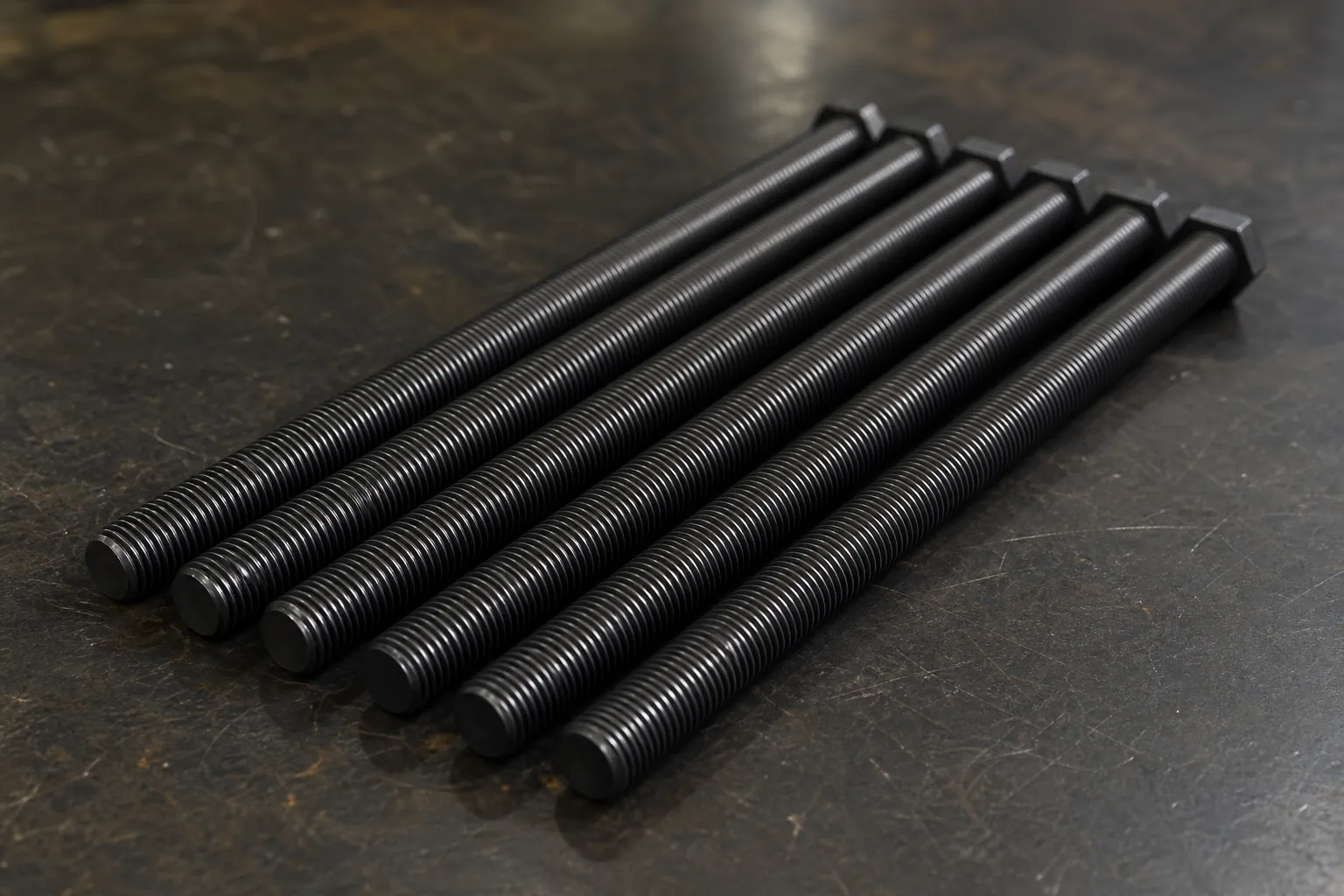
Yapısal Özellikler ve Zorluklar
- Yüksek L/D Oranı: 340 mm'lik uzunluk, cıvatanın 0,5 mm'lik ilk bükülmeye karşı oldukça duyarlı olmasını sağlar – 1.5mm ısıl işlemden sonra.
- Hassasiyet Gereksinimleri: The client required straightness within 0.2 mm; the case acceptance records were held under 0.1 mm.
- Koruma Gereksinimleri: Düzleştirme işlemi diş hassasiyetine ve yüzey kalitesine sıfır hasar sağlamalıdır.
Why Heat Treatment Bends Long Bolts in the First Place
Understanding the distortion source is what makes a correction process defensible instead of decorative. During quenching, a long fastener cools unevenly: the section cools at different rates depending on orientation in the basket or fixture, agitation contact, and local mass differences between the plain shank, the threaded length and the head. Each cooling path wants to contract by a different amount, and the resulting locked-in stresses bend the part when it relaxes. The effect scales with length — which is why short bolts leave heat treatment usable while long ones of the same grade systematically arrive bent. Thread rolling and machining before treatment add their own stress history, and any straightening performed at the heat treater counts as prior deformation for everything done afterward.
Two practical consequences follow. Birinci, incoming inspection on long heat-treated bolts is not optional paperwork — the bend magnitude and pattern arriving at the straightening station determine both the correction plan and any supplier conversation, and the interaction of prior deformation with correction response is the reason reverse-loading behavior matters, as covered under düzleştirmede Bauschinger etkisi. Saniye, process decisions upstream — how parts are racked or basketed through quench, whether stress relief is applied — change the distribution the straightening station sees, and are usually the cheapest place to reduce total correction work.
Reading the Bend Before Correcting It
Long fasteners arrive with a small vocabulary of bend patterns, and naming the pattern is the first step of an efficient correction loop. A single-arc bow — one gentle curve, maximum near the middle — is the most common heat-treatment signature and the most straightforward to correct with supports positioned around the peak. An S-shaped double bend has two opposite peaks, usually reflecting two constraint points during quench, and demands two coordinated corrections rather than one big press at the largest reading. A local kink near the head or the thread runout concentrates distortion where section stiffness changes, and behaves differently from a distributed bow. Nihayet, twist about the axis occasionally accompanies bending on parts with asymmetric features. Each pattern requires its own measurement map and correction sequence, which is why an automatic station that scans the full length and builds the map before pressing — rather than chasing the single worst reading — converges in fewer strokes. The measuring-and-correcting loop behind this is described for automatic shaft straightening generally, and for the long-bolt family specifically in the automatic long bolt straightening process.
Cıvata Doğrultma Neden Uzaklaşmalıdır? “Manuel Çekiçleme”
Geleneksel Süreç vs. Otomatik Çözüm
The figures below are this client’s reported baseline and post-commissioning values, not a universal benchmark for every fastener line.
| Ağrı Noktası | Manuel Çekiçleme / Manuel Pres | Otomatik Doğrultma Çözümü |
| İşçilik Gereksinimi | 8 workers per shift (manual baseline, reported case) | 1 için operatör 4 makineler (reported case) |
| Doğruluk | 0.2 – 0.5 mm spread (reported manual baseline) | ≤ 0,1 mm (client acceptance records) |
| Döngü Süresi | 120 – 180 adet/adet (reported manual baseline) | 10 – 15 adet/adet (reported case) |
| Genel Maliyet | High labor cost per corrected part | Manpower reduced from 8 operators to 1 supervising 4 makineler (reported case) |
Otomatik Cıvata Düzeltme Proses Akışı
Bu çözüm, beslemeden sınıflandırmaya kadar tam kapalı döngü otomatikleştirilmiş bir süreci kapsar, Her cıvatanın yüksek standart teslimat gereksinimlerini karşılamasını sağlamak.
Temel Süreç Açıklamaları
- Otomatik Besleme: Bükülmüş cıvatalar, insan müdahalesi olmadan bir hazneden otomatik olarak düzeltme istasyonuna beslenir.
- Dinamik Ölçüm: Yüksek hassasiyetli sensörler dönen iş parçasını gerçek zamanlı olarak tarar, tüm uzunluk boyunca maksimum bükülme noktasının doğru bir şekilde yakalanması.
- Servo Presleme: Akıllı sistem, malzemeye göre geri esnemeyi otomatik olarak hesaplar (karbon çeliği/alaşımlı çelik), ve servo şahmerdan tek geçişli düzeltme için hassas basınç uygular.
- Otomatik Sıralama: Nitelikli cıvatalar bir sonraki aşamaya geçiyor, while non-conforming parts are automatically isolated before they leave the machine.

UBJ-80 Cıvata Doğrultma Makinası
Bu düzleştirici ısıl işlem görmüş bitmiş parçalar için idealdir (örneğin, damgalama/ofis makinesi bileşenleri, otomobil/motosiklet parçaları, aletler, vidalar) ve barlar (çelik, bakır, alüminyum, paslanmaz çelik, titanyum alaşımı) 60–600 mm uzunluğunda & φ3–φ25mm çap. Hem hassasiyeti hem de ürün kalitesini artırır.
Çekirdek Düzeltme Zorlukları ve Çözümleri
Meydan okumak 1: Manning and the Reported “1 Operatör 4 Makineler” Case
Sorun Açıklaması: Manual hammering and press correction depend on operator skill, stamina and shift discipline, so manning levels stay high and results vary from operator to operator.
Çözüm:
Çözümümüz uygulanır tam kapalı döngü otomasyonu. Çalışma mantığı son derece basittir, çeşitli cıvata özellikleri için yerleşik tariflerle. Standart bir çalışanın yalnızca hazneyi periyodik olarak yeniden doldurması gerekir; geri kalanı - ölçüm, doğrultma, ve denetim — makine tarafından otomatik olarak gerçekleştirilir. Bu, iş gücü eksikliğini çözer ve yorgunluktan kaynaklanan hassas düşüşleri ortadan kaldırır.
Meydan okumak 2: 0,1 mm Hassasiyet İçinde Tutarlılığın Garanti Edilmesi
Sorun Açıklaması: Bir cıvata çekiç darbesine maruz kaldığında, iç stres dağılımı dengesiz hale gelir, genellikle yerel alanlarda aşırı düzeltmeye yol açar.
Çözüm:
Çözüm şunu kullanır: tamamen parametrelendirilmiş servo kontrol sistemi. Belirsiz insan yargısının aksine, sensörler cıvatanın eksenel eğrisini mikron düzeyinde doğrulukla algılar. Çok adımlı servo algoritmaları sayesinde, sistem, S45C veya alaşımlı çeliklerin elastik geri yaylanma sorununun tam olarak üstesinden gelir, locking final straightness within the 0.1 mm window achieved on this client’s qualified recipe.
How Thread and Head Zones Are Protected During Correction
Thread protection is a contact-zone engineering problem, and the principles are the same ones that govern surface-protection tooling across straightening applications. The correction force and the reaction forces both need somewhere to live, and on a long bolt the plain shank is the region designed to carry load, while the threaded length and the under-head fillet are the regions most easily damaged. A protection concept therefore has three parts: place supports on the shank at controlled span positions around the bend peak; direct press contact onto the shank through tooling that conforms to the section instead of touching thread crests; and keep every edge that could contact the workpiece generously radiused so load spreads instead of concentrating. Cleanliness belongs in the same sentence — debris trapped between press tooling and a thread flank is a scratch generator, and on plated or coated bolts the coating class defines how much contact the finish can tolerate at all.
The validation side is equally concrete. A thread-protection claim is proven by inspection agreed before the trial — thread gauges still running, flank condition reviewed under the method the quality function specifies — together with the released-state straightness result, on representative parts, after repeat setups. Protection and geometry are accepted together or not at all.
What an Acceptance Criteria Package Should Contain
A bolt straightening process is only as good as the acceptance definition it answers to, and a complete one answers five questions in writing. What characteristic governs — straightness of the axis, measured how: on centers, on supports, dönen, in what condition, since a reading under restraint is not a released result, başına loaded versus released measurement practice. What the limit is, and where it applies — full length or specified spans. What else must survive the process — thread fit, yüzey kalitesi, kaplama, head markings. How conformity is sampled — every part through an automatic gauge, or a sampling plan with defined reaction to a failure. And what happens to nonconforming parts — rework limits, segregation and disposition authority, following the NOK sorting and rework-limit framework. Buyers comparing straightening suppliers are well advised to ask for exactly this package; the ability to produce it says more about a supplier than any single machine specification.
Üretim Durumu: Hintli Müşterinin Dördüncü Tercihi
Müşteri Geçmişi
Küresel inşaat makineleri markalarına bileşenler sağlayan tanınmış bir Hintli bağlantı elemanı tedarikçisi.
Uygulama Sonuçları
- Siparişleri Tekrarla: İlk üç ünitenin olağanüstü performansına dayanarak, müşteri yakın zamanda satın aldı 4makine.
- Operator Consolidation: The client reported one operator managing all 4 machines after commissioning, with a substantial increase in output per operator.
- Kalite Karşılaştırması: The client’s records report straightness moving from 0.2 mm down to under 0.1 mm after commissioning.
SSS
- Q: Düzleştirici koç cıvata dişlerine zarar verir mi??
- HAYIR. Biz tasarladık temassız, yastıklı koruma kalıpları özellikle cıvata düzeltme için. Pres blokları cıvatanın eğriliğine mükemmel uyum sağlar, eşit kuvvet dağılımının sağlanması ve yüzey girintilerinin önlenmesi.
- Q: Ekipman fabrikamızın MES sistemine entegre edilebilir mi??
- Evet. Kontrol sistemimiz, her cıvata için gerçek zamanlı düzeltme verilerini kaydetmek ve dışa aktarmak için standart veri arayüzlerine sahiptir., modern izlenebilirlik gereksinimlerini karşılıyor.
Additional Process Questions
Why do bolts from the same heat-treatment lot arrive with different bend patterns?
Because each part’s position in the basket or rack gave it a different cooling path. Quench distortion is sensitive to orientation, local mass and agitation contact, so even identical bolts leave treatment with different locked-in stress patterns. Mapping incoming parts rather than assuming a uniform error is the practical answer, and it is why scanning-based stations build a per-part correction plan.
How many correction passes does a long bolt need?
It depends on the pattern, not a fixed number. A single-arc bow typically converges in one planned press; an S-bend needs two coordinated corrections; local kinks near section changes respond differently again. The governing rule is a rework limit set before production — parts that stop responding are routed to review, not pressed repeatedly, because each additional plastic cycle consumes fatigue life and changes the material’s response.
Should straightening come before or after thread rolling?
The route belongs to the fastener process engineer, but the trade-off is explicit: correcting before thread rolling lets subsequent operations work from a straight blank, while correcting after heat treatment with finished threads demands the contact-zone protection described above. Whichever route is chosen, the acceptance package must define what state the straightness limit applies to, and the correction validation must be run on parts carrying that state.
Özet
Yüksek verimlilik ve kaliteyi hedefleyen bağlantı elemanı fabrikaları için, BİR Otomatik Cıvata Düzeltme Çözümü rekabet gücünü artırmanın temel yoludur. Whether the target is lower manning or 0.1 mm delivery precision, the figures in this article are one client’s reported case; your own results depend on the bolt family, incoming distortion and acceptance definition.
Moving from manual bolt correction toward automation? The manuel ve otomatik seçim mantığı ve Otomatik düzeltme için yatırım getirisi durumu doğal sonraki adımlardır.
İşgücü yönetimi sorunları veya hassas darboğazlarla karşı karşıyaysanız, çekinmeyin Bize Ulaşın özelleştirilmiş bir teknik teklif için.