
Point-press ravnanje je metoda nadzorovane lokalne korekcije, ne preprosto pritiskati, kjer koli je del videti upognjen. Postopek mora povezati veljavno geometrično karto z odobreno referenčno točko, podporne točke, reakcijska pot, dovoljene lokacije popravkov, inkrementalni nadzor in ponovno merjenje sproščenega stanja. Brez te zanke, pritisk lahko ustvari znamenje, premakniti sosednjo funkcijo ali zmanjšati začasni odčitek indikatorja, ne da bi izpolnili dejansko zahtevo glede sprejemljivosti.
To je okvir procesa. Ne zahteva stiskalne sile StraighteningTech, kap, nadzorni algoritem, obseg materiala, natančnost, čas cikla ali združljivost obdelovanca. Te vrednosti zahtevajo pregled risbe in potrjene vzorce.
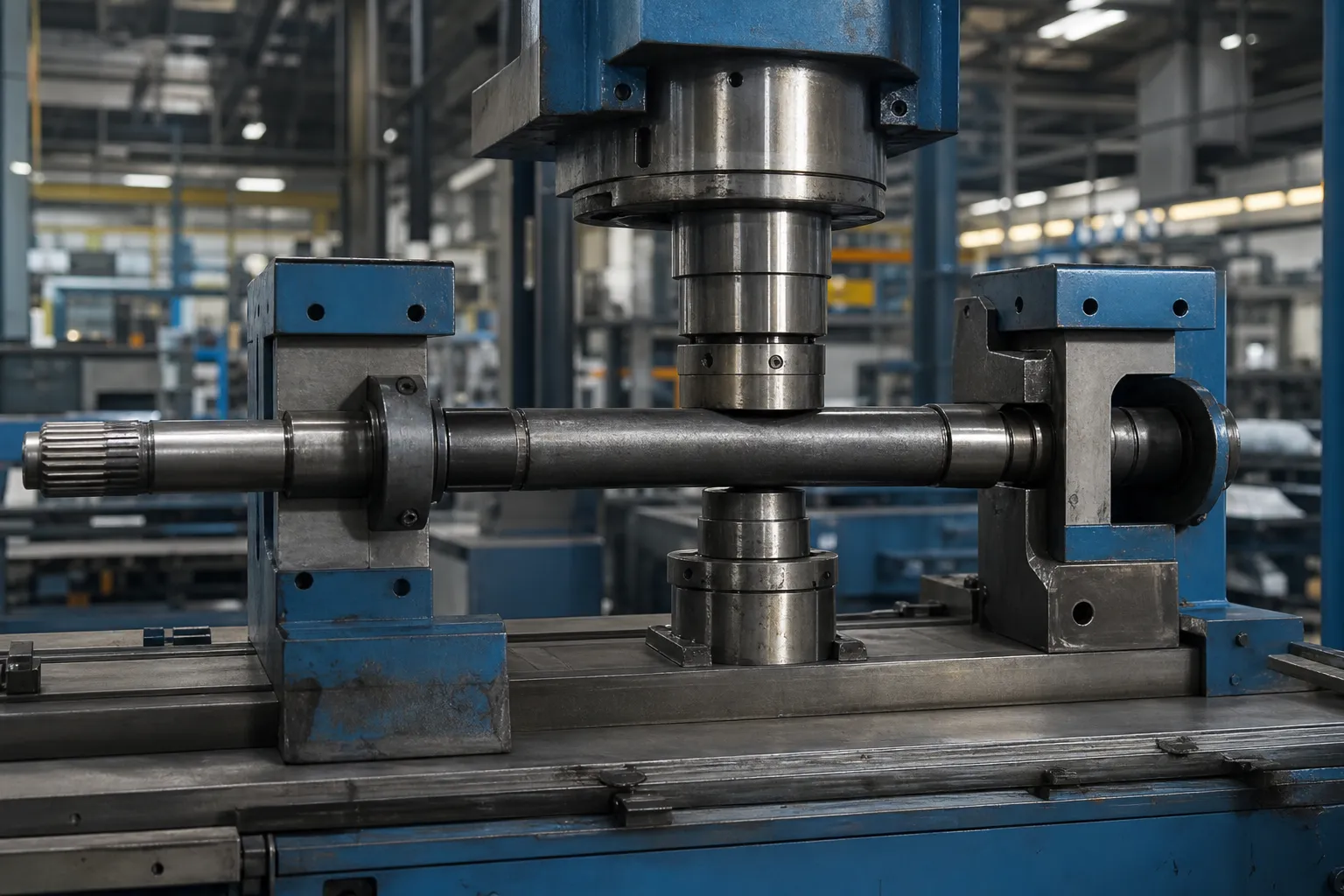
*Ilustracija inženirskega koncepta. Prikazuje možen kontekst popravka stiskanja za določeno družino obdelovancev, ni univerzalni procesni recept ali preverjena lokalna zmogljivost.*
Določite, kaj postopek popravlja
Zahtevana lastnost je lahko ravnost v razponu, radialno odtekanje glede na referenčno os, stransko pometanje, lokalno razmerje značilnosti ali drugo nadzorovano geometrijo. Preden izberete stiskalnico, jo morate poimenovati. Napaka krožnosti, površinska prekinitev, signala vpenjanja ali namernega pregiba ni mogoče popraviti, kot da bi šlo za isto vrsto ovinka.
Uporaba ravnost gredi, iztek in TIR ko je del rotacijsko pregledan. Cev, profil, pomlad, obroči in varjeni obdelovanci zahtevajo lastno geometrijo in procesne meje.
Zgradite začetni zemljevid napak
Merilni načrt mora opredeliti odobreno referenčno točko, usmerjenost dela, aksialne postaje, stanje podpore, senzorsko metodo in preverjanje ponovitve/sedenja. En sam odčitek sredinske točke lahko zgreši več ovinkov ali zameša gravitacijsko povešanje in variacijo vpenjanja z geometrijo dela.

*Ilustracija inženirskega koncepta. Ponazarja zemljevid meritev pred popravkom; dejanske lokacije postaj, sonde in referenčne točke je treba določiti iz kontrolirane risbe.*
| Vhod za zamrznitev | Odločitev, ki jo podpira |
|---|---|
| Nič risbe in pravilo prevzema | Določi, kaj mora meritev predstavljati |
| Začetna geometrijska karta | Identificira možna korekcijska območja in tveganje interakcije |
| Odobrene podpore in reakcijske točke | Preprečuje, da bi pot sile ustvarila nenameren signal |
| Zaščitene značilnosti in površinske omejitve | Določa, kje je stik prepovedan |
| Faza materiala in postopka | Določa možen odziv, vzmetne in nizvodne omejitve |
The Mechanics of a Point-Press Stroke
A point-press correction is a three-point bend executed on purpose. Two supports and one press point form a loading frame: the press pushes the section toward the supports, bending moment peaks at the press point and falls toward the supports, and the outer fibers at the correction location pass yield while the core of the section stays elastic. When the force is released, the elastic core tries to spring the section back while the yielded fibers hold their new shape — the permanent set is the difference, and the art of the process is delivering just enough plastic work to land the released part inside tolerance. Three consequences follow directly from this picture. The correction is local: the plastic zone concentrates around the press point, which is why error maps guide where to press rather than intuition. The process is self-limiting only if treated incrementally: a single stroke sized optimistically cannot be un-pressed. And the section’s own geometry — its stiffness variation, its transitions, its prior deformation history — modulates everything, which is why identical stroke settings do not transfer blindly between diameters, materials or lots, and why reverse-loading effects, as described for the Bauschinger effect, change the response of a part that has already been corrected once.
Support Span Is the Primary Tuning Parameter
Operators reach for force when they should reach for geometry. Moving the supports changes the correction before any force value is touched: supports spread wide give a long, gentle bending field — the same press force produces a larger deflection spread over a longer zone, appropriate for a single broad bow; supports close in around the correction point concentrate the same energy into a short, deep correction, appropriate for a local kink but harder on the surface and the section. Span also sets the mechanical advantage of the stroke: the closer the supports, the more force the same correction demands, which is why narrowing the span on a stiff section quickly reaches the machine’s or the part’s limits. Two practical rules fall out. najprej, choose span from the error map’s wavelength — long bows get long spans, kinks get short ones — and document the choice in the setup record, because span is a process parameter like any other. drugič, treat support condition as part of the tooling: kontaktna geometrija, cleanliness and wear change the reaction path silently, in surface-protection tooling discipline applies to supports exactly as it does to the press nose.
Skupaj izberite podpore in korekcijske točke
Stiskalne točke ni mogoče izbrati neodvisno od njenih nosilcev. Podporni razmik, togost odseka, smer sile in kontaktna geometrija ustvarita reakcijsko pot. Napačna podpora lahko naredi lokalni tisk učinkovit, medtem ko prenese napako drugam ali poškoduje funkcijo.
Pred vzorčnim poskusom, dokument:
- podporne in reakcijske lokacije, vključno z brezkontaktnimi conami;
- korekcijska točka, smer sile in dovoljena orientacija;
- kontaktni material, čistoča in nadzor tveganja označevanja;
- največji inkrementalni popravek in število poskusov;
- merilni načrt vzmeti/sprostitve;
- zahtevna zavrnitev in pogoji tehničnega pregleda.
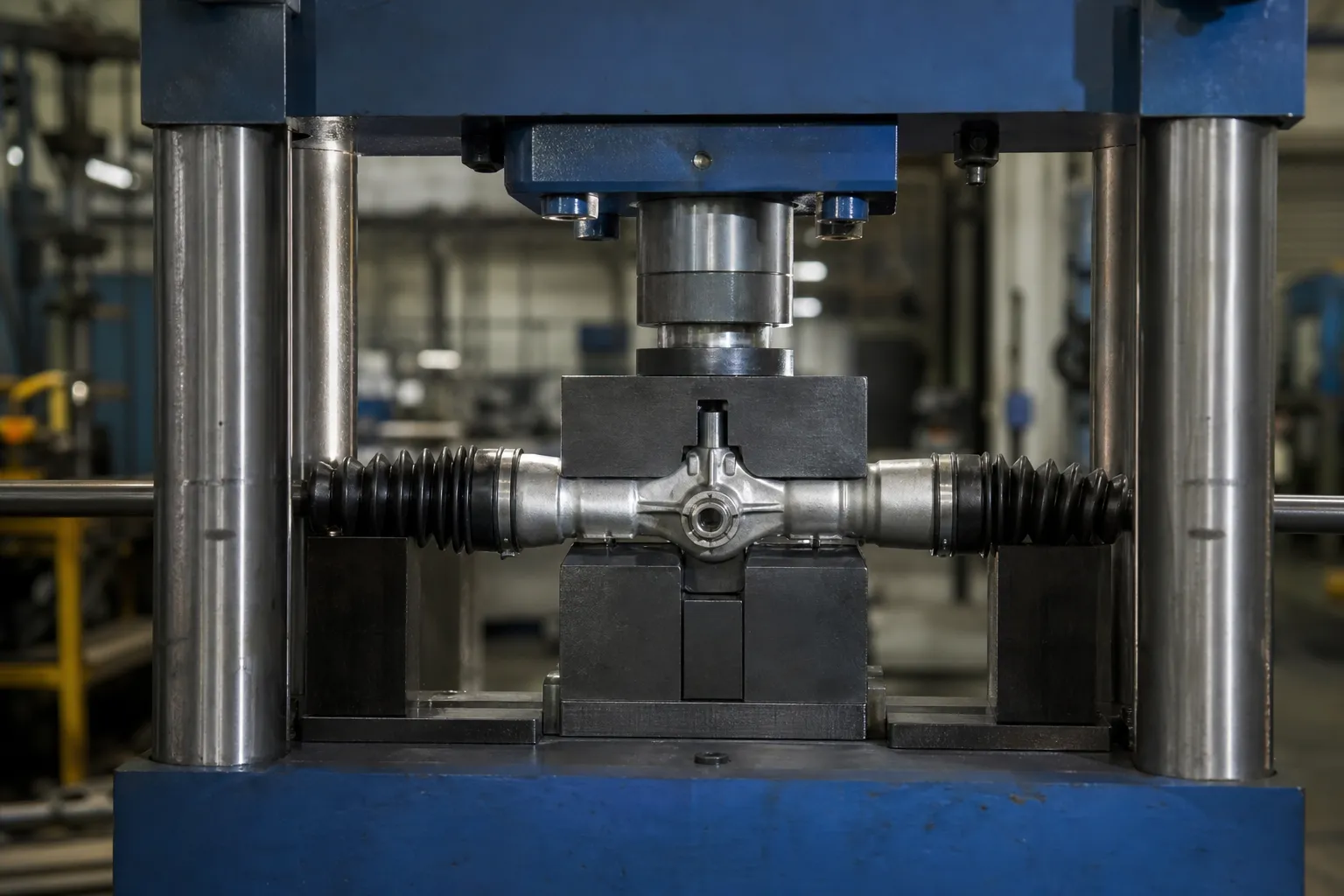
*Ilustracija inženirskega koncepta. Prikazuje koncept postopne korekcije; ne predpisuje obremenitve stiskalnice, kap, orodja ali odobreno korekcijsko točko za drug obdelovanec.*
Postopoma popravite in znova preverite po izdaji
Zaporedje zaprte zanke je:
- identificirati nadzorovano družino obdelovancev in revizijo risbe;
- pregledati glede poškodb, napačen del, prepovedano stanje površine ali deformacija izven obsega;
- naložite odobreno referenčno točko in preverite namestitev;
- izmerite začetni zemljevid geometrije;
- izberite dovoljeno podporo in načrt popravkov;
- uporabite inkrementalni popravek znotraj meje vzorec-test;
- popolnoma sprostite silo, sponke in zadrževanje;
- ponovno izmerite vse zahtevane sledi in zabeležite rezultat;
- usmerite del v OK, NOK ali inženirski pregled.
Končni sprejem je po sprostitvi. Odčitkov, medtem ko je del pod pritiskom ali zadrževalnikom, ni mogoče uporabiti kot dokaz končnega rezultata.
Springback as a Process Variable, Not a Constant
Because the released shape is set by the competition between yielded fibers and the elastic core, the same stroke delivers different permanent set on parts that differ in material condition, section or prior history. That is springback as a process variable, and treating it as a fixed correction factor is how lines end up oscillating around tolerance. The discipline that handles it honestly is described for kompenzacija vzmeti pri ravnanju gredi: learn the response on representative samples, correct incrementally, and re-learn when the material lot or part revision changes. A related trap deserves its own sentence: pressing a part past nominal on purpose — overshoot to pre-compensate springback — is legitimate within a validated recipe and a defined limit, but repeated overshoot-and-press-back cycles accumulate reverse-loading damage, and the correction-attempt limit exists precisely to stop that sequence before it becomes a cracking risk, per the integrity-review framework.
Reading the Data Between Strokes
Each stroke in the incremental loop is also an experiment, and the data between strokes tells the operator when to continue and when to stop. A healthy convergence shows the remaining error shrinking by a decreasing amount each stroke — the response per stroke falling as the part approaches target, which is the natural signature of a stable correction. Three patterns break that signature and each demands stopping rather than pressing harder. No progress: the geometry stops responding, meaning the process is no longer engaging the error — the correction point, support condition or part state has changed under the operator. Diminishing returns with rising effort: each stroke moves the part less while the press works harder — the section is fighting back through strain hardening, and continuing trades diminishing geometry gain for accumulating material damage. Oscillation: the part crosses nominal in alternate directions stroke by stroke — the correction rule is over-reacting, often because it was calibrated on a different response, and the fix is the recipe, not the part. Building these three stop patterns into the operating procedure converts the between-stroke data from noise into the line’s earliest quality alarm.
Vedite, kdaj pritisk na točko ni prava pot
Točkovno stiskanje ni privzeta metoda za vsak izdelek. Neprekinjena žica, tankostenska cev, asimetrični profil, prstan, pomlad, del, ki je kritičen zaradi utrujenosti ali občutljiv na zvar, bo morda potreboval drugačen pristop, namensko orodje ali ločen pregled postopka. glej stiskalnica proti ravnanju z valji za mejo izbire metode.
Test vzorca in prevzem
Vzorčni načrt mora vključevati normalne in najslabše dohodne dele, surova pred/po geometriji, ponovljivost ponovne namestitve, pregled površine, zahtevana preverjanja materiala/značilnosti, omejitev največjega poskusa in korelacija z referenčnim merilom stranke. Če razpoke, trdota, NDT, brušenje ali uravnoteženje, ostanejo neodvisni prevzemni odgovornosti.
Uporaba preskus vzorca ravnanja in prevzem za opredelitev dokazov, ki se zahtevajo pred zahtevkom za proizvodnjo ali odločitvijo FAT/SAT.
pogosta vprašanja
Točkovno stiskanje lahko zagotovi posebno natančnost?
št. Dosežen rezultat je odvisen od obdelovanca, datum, materialno stanje, podporo, kontaktne cone, vzorec odziva in dogovorjena metoda pregleda.
Ali je najvišja indikatorska točka vedno korekcijska točka?
št. Korekcijsko točko je treba izbrati iz zemljevida geometrije in odobrene reakcijske poti, ne iz izoliranega vizualnega ali indikatorskega opazovanja.
Ali lahko stiskalnica popravi razpoko ali zamenja NDT?
št. Ravnanje ne popravlja materialnih napak in ne nadomešča kvalificiranih pregledov.
Why does the same press stroke move two identical-looking parts differently?
Because released geometry depends on material condition, section detail and prior deformation, not on appearance. Different lots, heat-treatment states or a previous correction cycle all change the plastic-versus-elastic balance the stroke works against. The remedy is learning the response per family on samples and re-checking it when lots change.
When should supports be moved closer together?
When the error map shows a short, local kink rather than a broad bow. A narrow span concentrates the correction where the error lives; a broad span spreads it. The span choice belongs in the documented setup, because it changes both the correction shape and the force the part must carry.
What does it mean when a part stops responding to corrections?
The process is no longer engaging the error — a no-progress condition. Causes range from a changed correction point to a setup or part-state shift, and the defined response is to stop and route the part to review, not to increase force. Continuing to press spends the part’s deformation budget on nothing.
Ravnanje pred in po brušenju
Ne vzdržuje se nobena neodvisna kanonična stran ravnanje pred in po brušenju ker je industrijsko povpraševanje po natančnem ujemanju majhno. Zaporedje stopenj, Dodatek zaloge in prenos datuma spadata v kovano palico, točke za stiskanje in večtočkovne procesne strani. Preden zaklenete proizvodno pot, preverite, ali brušenje odstrani material, ki bi razveljavil prejšnji odčitek ravnosti.
Krivulje premika sile pri ravnanju
Posebna stran za vodilo krivulje premika sile ravnanja se ne vzdržuje brez potrjene zahteve po poizvedbi. Forceova interpretacija Troke, varne meje in pogoji za zaustavitev procesa so razloženi v točkovnem tisku, večtočkovne strani in strani za odkrivanje razpok. Vsak alarm, ki temelji na krivulji, je treba potrditi na reprezentativnih delih in ne kopirati iz druge družine materialov.
Point-press work lives or dies by stroke control – read why over-correction cracks parts before you size a machine, then use the potek izbire ravnalnika to match press concepts to your part family.