
Samodejno ravnanje lahko ustvari procesne signale, ki si zaslužijo preiskavo: nepričakovan odziv sile-premika, akustični dogodek, nenormalna sprememba geometrije, ponavljajoča se napaka popravka ali drugo opredeljeno stanje. Ti signali lahko pomagajo ustaviti proizvodno linijo, izolirajte in usmerite del za pregled. Niso samodejni dokaz, da razpoka obstaja, in niso samodejno nadomestilo za kvalificirano metodo NDT.
Ta članek je okvir za nadzor tveganja. Ne trdi, da StraighteningTech trenutno dobavlja senzorje za zaznavanje razpok, zazna določeno velikost razpoke, izpolnjuje določen standard ali nadomešča magnetne delce, ultrazvočni, vrtinčni tok ali drug formalni pregled. Te zmogljivosti zahtevajo ločeno preverjeno metodo, znani vzorci in odobritev sistema kakovosti.

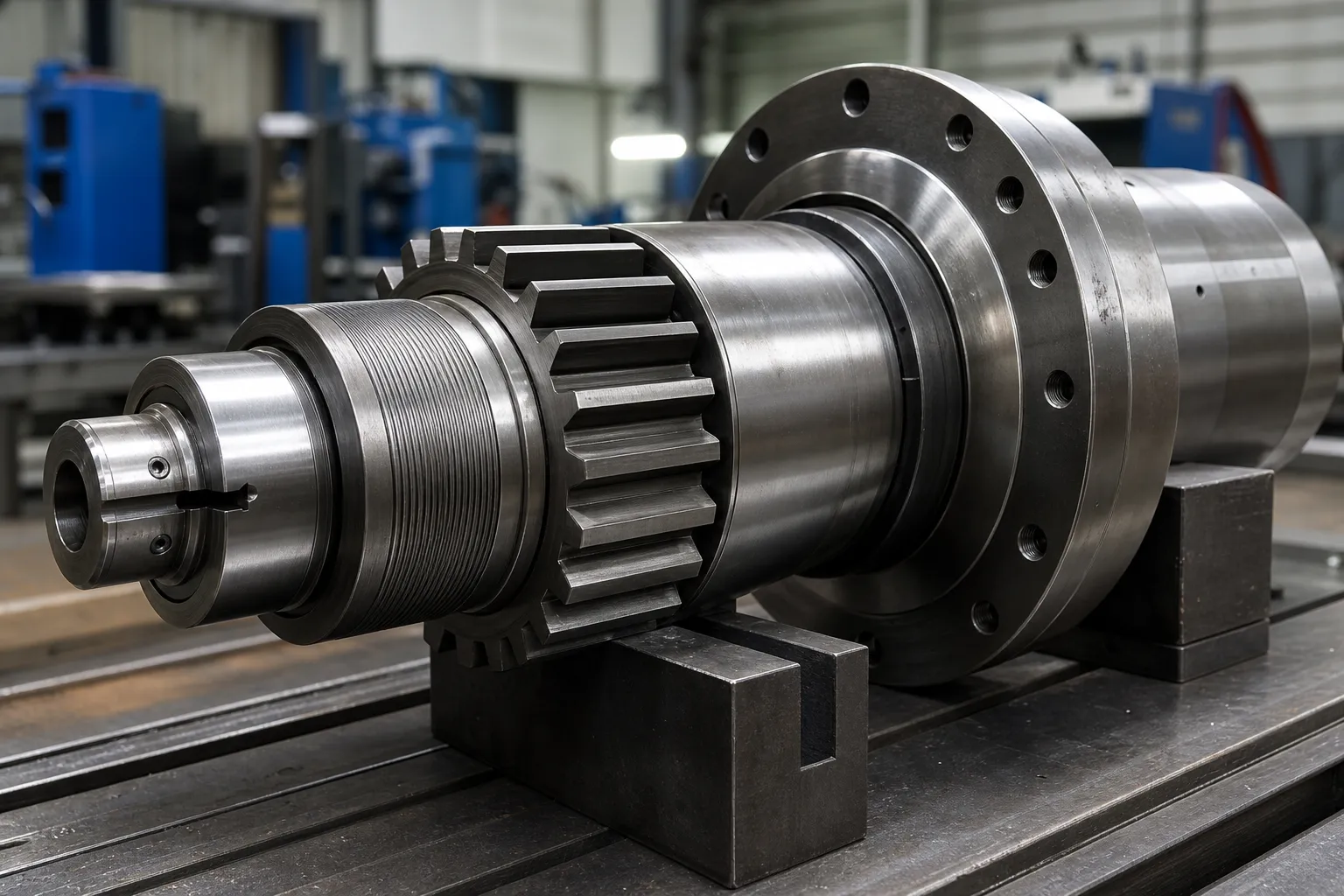
*Ilustracija inženirskega koncepta. Prikazuje kandidatni kontekst merjenja in popravljanja; ne pomeni, da je nameščen senzor razpok ali algoritem za zaznavanje.*
Razvojni načrt mora uporabljati znano normalno, znani osumljenec in, kjer je dovoljeno, znanih referenčnih pogojev, da se ugotovi, ali je signal v korelaciji z zahtevano odločitvijo. Učinkovitosti zaznavanja ne sme sklepati iz seznama funkcij konkurenta ali enega samega uspešnega poskusa.
Why Straightening Is a Natural Integrity Checkpoint
Cracks relevant to straightening have a short list of origins: prior manufacturing wrote them in, or the correction process itself put them there. On the incoming side, quench cracks from heat treatment, seams and folds from rolling or drawing, and grinding abuse on machined surfaces all exist before the part reaches the press — and a part carrying a sharp discontinuity responds differently to plastic bending than a sound one, because the discontinuity concentrates strain locally. On the process side, aggressive correction, repeated reverse bending, and correcting a material in a brittle condition can initiate cracks that no incoming inspection would have found. The two categories demand different responses: incoming cracks are a supplier-quality problem surfaced at your station, while process-initiated cracks are a process-design problem owned inside the correction loop — the boundary worked through in prekomerno ravnanje in pokanje.
Kakorkoli že, the straightening station sees the part in a state no inspection bench replicates: under load, in plastic deformation, with its stiffness and response visible stroke by stroke. That is why the press is a natural integrity checkpoint even though it is not an NDT instrument. The signals are there for the taking; the engineering work is making them mean something.
The Signal Families Available at the Press
Four signal families are realistically available on straightening equipment, and each has a distinct information content. Force–displacement behavior is the richest: a sound section deforms along a repeatable curve, and departures from the qualified curve shape — an early load drop, an unexpected plateau, a step in the response — indicate that the section is behaving abnormally somewhere along the load path, whether from a material discontinuity, a setup fault or a geometry outside the expected map. Acoustic events are the sharpest: a distinct release of strain energy is audible and can be sensed, though ambient noise on a production floor makes standalone acoustic detection fragile. Geometry response covers cases where the part moves less, more, or differently than the qualified correction model predicts — a crack crossing the correction zone reduces local stiffness and shows up as anomalous movement. Convergence failure — repeated correction attempts that never reach the target — is the slowest but most insidious signal, because its common causes are mundane, and the rare cause is a part that cannot be straightened because it is no longer continuous in the way the process assumes.
None of these families is specific to cracking. Each one answers “is this part behaving like the qualified population?”, ne “does this part contain a crack of a given size?”. That gap between anomaly detection and flaw detection is the honest boundary of process monitoring, and it is exactly why the verification route — not the alarm itself — carries the quality decision. The force–stroke interpretation background sits alongside point-press process practice, where the same curves are used for correction control.
Integrirajte nadzor tveganja v korekcijsko zanko
Nadzorovana pot je lahko:
- identificirati del/lot, revizija risbe in odobren recept;
- popolni vhodni pregled in preverjanja trde zavrnitve;
- določite referenčno točko in pridobite podatke o osnovni geometriji/procesu;
- izvedite odobreno zaporedje popravkov;
- ovrednotiti definirane procesne signale in odziv geometrije;
- sprostite in ponovno izmerite del;
- pot PASS, primerno za predelavo, ločeno zadrži za preverjanje in zavrni rezultate;
- ohraniti sledljivost, dokazila in dispozicija recenzenta.
Pot mora vključevati stanje brez napredovanja. Ponavljajoči se poskusi popravljanja brez pričakovanega odziva so lahko razlog za ustavitev in izolacijo dela, ni razlog za nadaljnjo uporabo sile.
Definirajte izolacijo in preverjanje NOK
NOK ni ena univerzalna kategorija. Črta naj označuje težavo z meritvijo/nastavitvijo, opozorilo za nadzor procesa, potrjeno neskladnostjo, kandidat za predelavo in del, ki zahteva neodvisen pregled ali inženirsko odstranitev. Fizična segregacija, statusno označevanje, treba je opredeliti sledljivost in pooblastilo za sprostitev.
*Ilustracija inženirskega koncepta. Predstavlja odločitve o usmerjanju procesa, ni nameščen sistem za zaznavanje razpok ali samodejni sistem za razvrščanje.*
| Dogodek | Najmanjši odziv za opredelitev |
|---|---|
| Procesni signal presega prag | Pravilo zaustavi/zadrži, zajem podatkov in odgovoren pregled |
| Geometrija se ne odziva po pričakovanjih | Omejitev brez napredka in inženirska ocena |
| Potreben uradni pregled | Odobrena metoda, merilo sprejemljivosti in avtoriteto |
| Upoštevana predelava | Največji poskusi, ponovno merjenje in ločena odobritev kakovosti |
| Potrjena zavrnitev | Izolacija, evidenca sledljivosti in odlaganja |
Za krmiljenje širših linij, glej Omejitve razvrščanja in predelave NOK in preskus vzorca ravnanja in prevzem.
Kadar je merilni odziv del preiskave, korelacija meril stroja in merila kupca pomaga določiti mejo med linijskim signalom in nadzorovano metodo sprejemanja strank.
Thresholds, False Alarms and Missed Events
Any threshold drawn on a process signal trades two failure rates against each other. Set it tight, and normal part-to-part variation — different lots, temperature drift, tooling wear, honest measurement scatter — crosses it regularly, flooding the review route with good parts until operators learn to ignore alarms. Set it loose, and the abnormal parts that motivated the monitoring slip through unflagged. There is no datasheet value that resolves this trade; it is settled empirically by running the signal on a known-normal population to learn its spread, and where permitted, on known-suspect or seeded-reference parts to learn what the abnormal signature actually looks like. Only that pair of distributions justifies a threshold, and the honest summary of what was learned belongs in the validation record — including the false-alarm and missed-event behavior observed, not only the detections celebrated.
Two further rules keep thresholds honest over time. najprej, drift monitoring: as tooling wears and material lots change, the normal population moves, so the threshold must be reviewed on a schedule, not set once. drugič, change control: a new part revision, a different material family, or a reworked die changes the qualified population, and the threshold work starts over. These are the same habits that keep merilni sistemi credible, applied to process signals.
Where Formal NDT Fits After an Alert
When the review route decides a part needs a definitive answer, the method must match the question and the geometry. Magnetic-particle inspection suits ferrous parts and surface-breaking discontinuities, and it is fast enough for segregation decisions in moderate volumes. Penetrant testing suits non-ferrous surfaces where coating and cleanliness permit it. Eddy-current methods respond to near-surface condition and can run in-line, with sensitivity that depends strongly on coil geometry versus part geometry. Ultrasonic methods reach internal volumes along bar and shaft axes, at the cost of coupling, calibration blocks and operator discipline. Selecting among them is a quality-engineering decision driven by the flaw orientation expected, the material, the surface state after straightening contact — witness marks and surface protection practices intersect here — and the acceptance authority. What the straightening station controls is not the NDT verdict but the integrity of the chain before it: the part is identified, isolated, protected from further correction attempts, and accompanied by its process data so the inspector knows why it was pulled.
Potrdite pred zahtevkom o zmogljivosti
Odgovoren validacijski paket identificira družino obdelovancev, stanje materiala/procesa, metoda zaznavanja/nadzora, vzorčna populacija, reference znanih stanj, pragovi, pričakovana variacija, lažni alarm in ocena zamujenega dogodka, pot preverjanja, hrambo podatkov in odobritev kakovosti. Navaja tudi, česa sistem ne more dokazati.
Nobena stran s procesnimi signali ne sme trditi, da najde vse razpoke, nadomešča NDT ali zagotavlja celovitost materiala brez odobritve, dokazni paket za posamezne obdelovance.
pogosta vprašanja
Ali procesni alarm dokazuje, da je prišlo do razpoke?
št. Označuje stanje, ki zahteva opredeljeno pot pregleda. Vzrok je treba ovrednotiti z odobreno metodo.
Ali lahko samodejno ravnanje nadomesti NDT?
št. Spremljanje procesa ravnanja in formalni NDT imata različne namene, metode in prevzemne odgovornosti.
Ali je mogoče del predelati za nedoločen čas po opozorilu?
št. Postopek zahteva najvišjo omejitev poskusa popravka in opredeljeno inženirsko/kakovostno odstranitev.
Which signal family catches cracks best?
None of them catches cracks in the NDT sense. Force–displacement behavior, acoustic events, geometry response and convergence failure all flag parts that behave unlike the qualified population. A part flagged by any of them goes to the verification route; a part that passes all of them is not certified crack-free — it simply behaved normally. That asymmetry is the design premise of every process-monitoring scheme on straightening lines.
How are thresholds set without a standard to cite?
Empirically, on populations. Run the chosen signal across a known-normal production sample to characterize its spread, and where reference conditions are available, across known-suspect parts to characterize the abnormal signature. The threshold is then drawn against both distributions, documented with observed false-alarm and missed-event behavior, and reviewed on a schedule as tooling, lots and seasons change.
What happens to a part after an alert is cleared?
Whatever the written route says, and only that: return to the normal flow with the event recorded, proceed to rework under the attempt limit, or pass to formal inspection with disposition authority named in advance. The failure mode to design against is the quiet return of alerted parts to the good bin by operator judgment, which is why physical segregation and labeling carry as much weight as the signal itself.

*Ilustracija inženirskega koncepta.*
Krivulje premika sile pri ravnanju
Posebna stran za vodilo krivulje premika sile ravnanja se ne vzdržuje brez potrjene zahteve po poizvedbi. Forceova interpretacija Troke, varne meje in pogoji za zaustavitev procesa so razloženi v točkovnem tisku, večtočkovne strani in strani za odkrivanje razpok. Vsak alarm, ki temelji na krivulji, je treba potrditi na reprezentativnih delih in ne kopirati iz druge družine materialov.
Crack detection is strongest when the process prevents cracks in the first place – glej prekomerno ravnanje in pokanje for the causes, in ročna in samodejna primerjava for why automated correction limits reduce the risk.