
Every serious straightening machine buyer reaches the same fork in the road. One path is a standard machine: a platform the supplier has built before, documented, priced from a list, deliverable from a known schedule. The other is a custom machine: a cell designed around your parts, your line and your data. Both paths contain good decisions and expensive mistakes, and the mistake is usually not choosing the wrong path — it is choosing without knowing which question decides the path. This page is that question set, written from the machine builder’s side of the table.
The page completes a trio of buyer-side guides: how to select a straightener for shafts, tuburi si profile covers the machine-type decision, şi what a straightening machine costs covers the cost structure. This page covers the decision structure that sits above both: when a standard platform is the right answer, when genuine customization pays for itself, and where the gray zone between them hides most of the project risk.
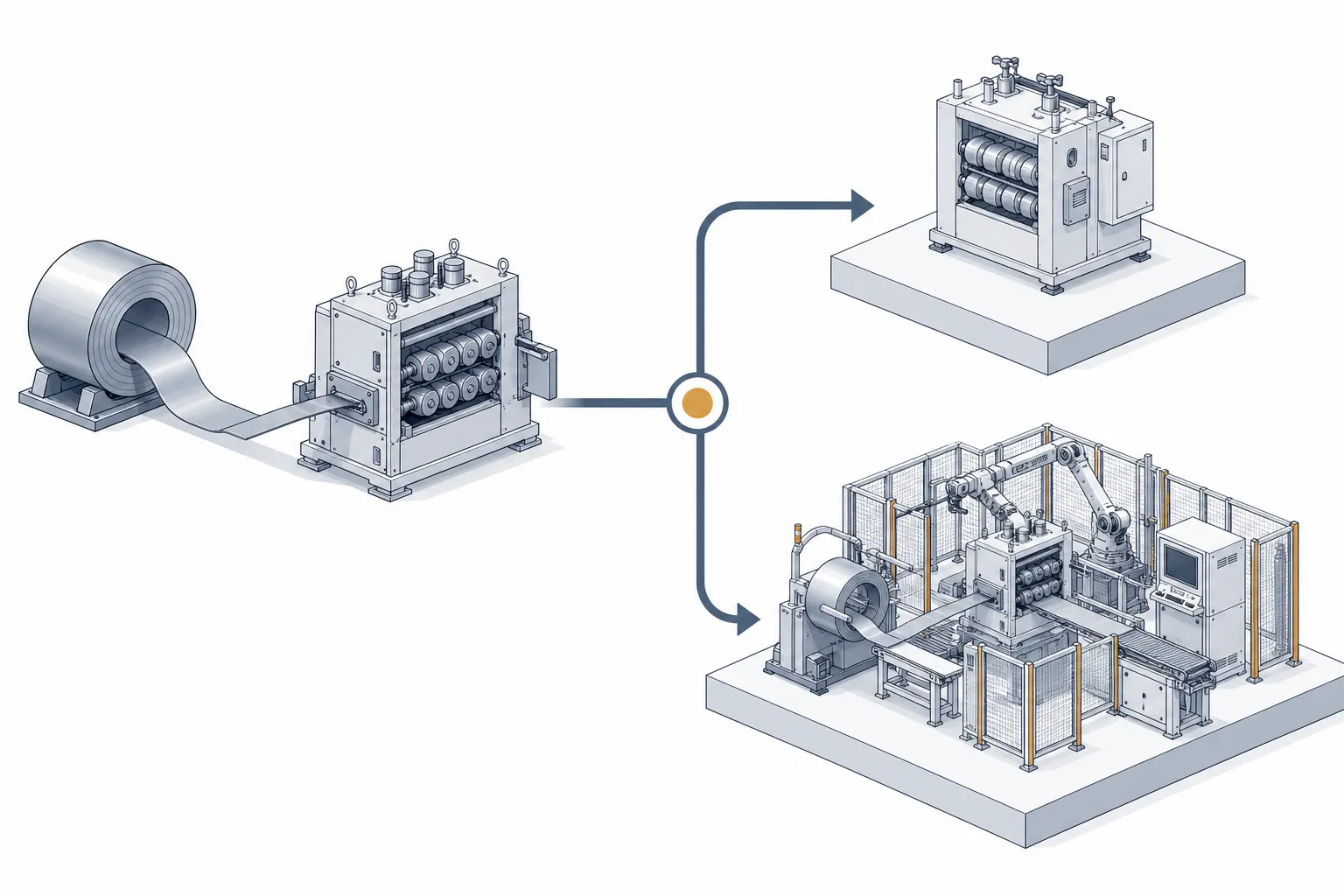
Illustration note: the images on this page are engineering concept illustrations, not photographs of specific products. They show decision structures, not deliverable machines.
The custom-versus-standard decision answers five questions:
- How wide is the real workpiece spectrum the machine must cover — today and across its service life?
- Does any requirement in the specification break a standard platform: toleranţă, geometrie, timpul ciclului, automatizare, trasabilitate?
- What is the true cost of each path, including the costs that appear after delivery?
- How much schedule risk can the project absorb, and who owns the commissioning risk?
- Which parts of the machine will your team maintain, and can a custom design still be supported ten years out?
There Is No Binary: The Customization Spectrum
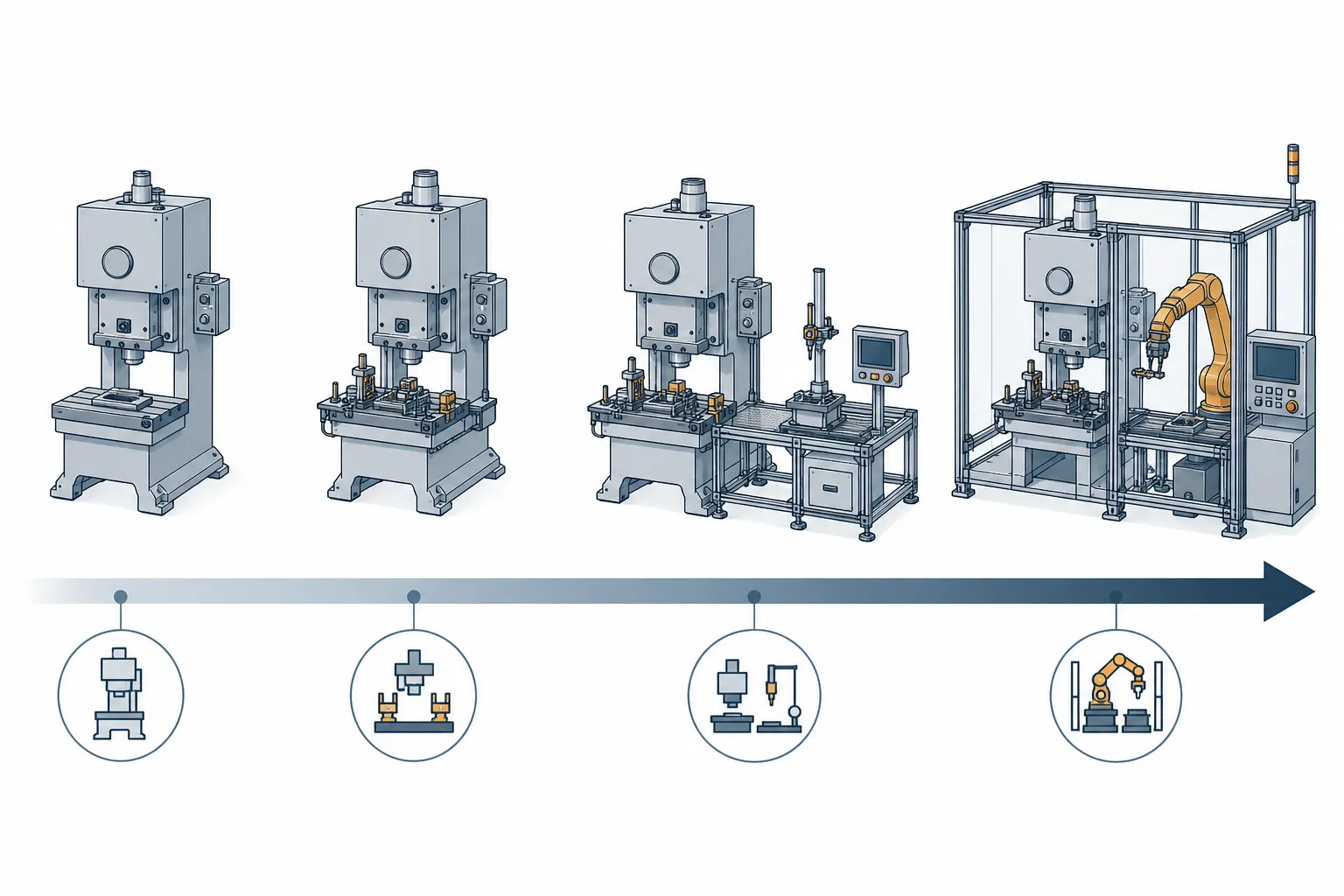
Buyers often frame the choice as standard-or-custom, but machine builders work along a spectrum, and most projects land in the middle of it:
- Standard machine, standard tooling. The platform and its fixtures are catalog items. Fastest delivery, proven capability, no engineering risk — if your parts fit.
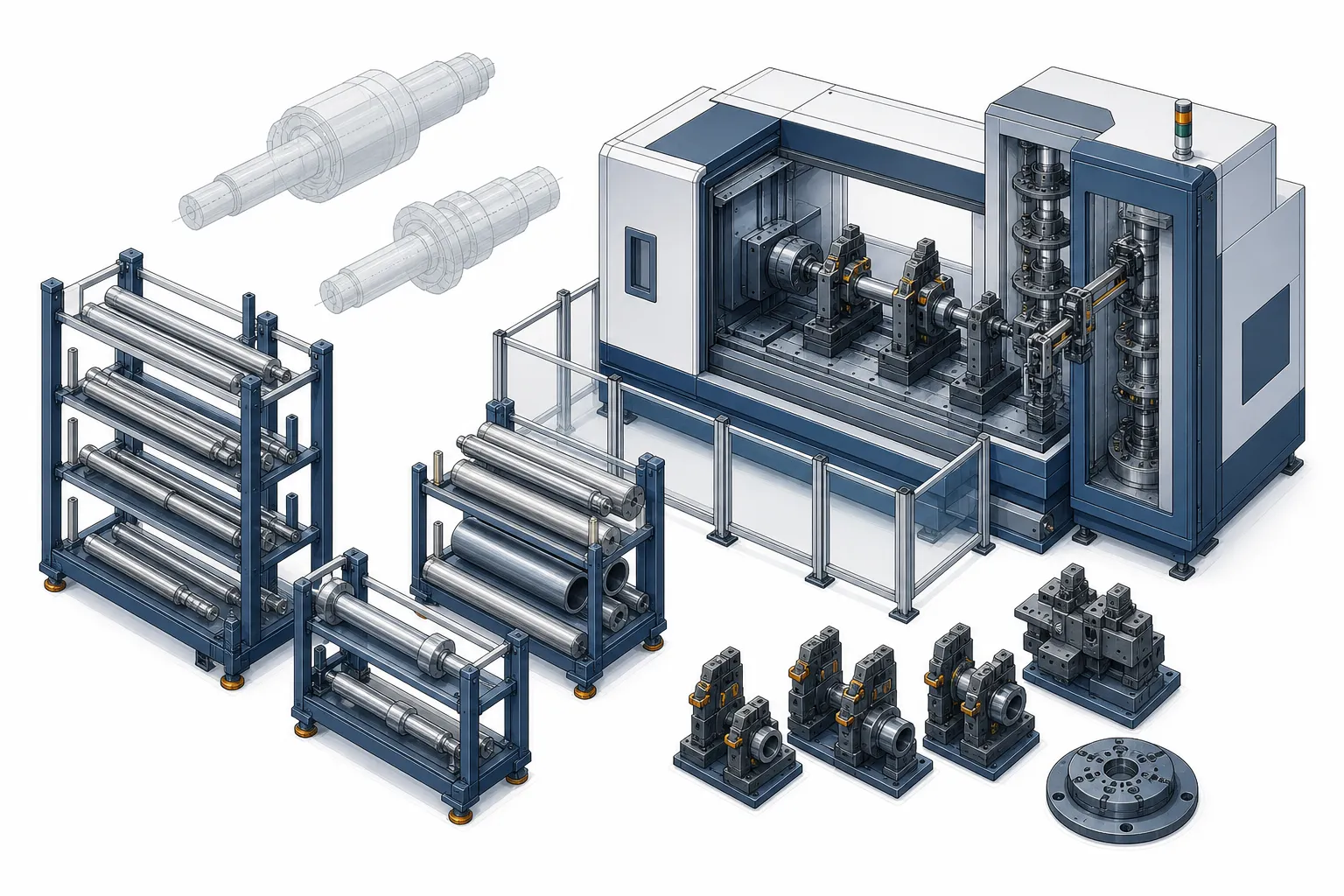
- Standard platform, custom tooling. The frame, presa, measurement and control are standard; the V-blocks, suporturi, protective tooling and part programs are made for your families. This is the most common configuration in precision shaft work.
- Modified platform. A standard machine with an engineered change: longer bed, higher press force, extra measurement station, a different automation interface. Most of the platform’s validation carries over; the change is engineered and re-validated.
- Custom cell. Maşină, metrology, handling and sorting designed as one system around a defined part set and factory layout. Full engineering project, full capability match, full project risk profile.
The practical insight: the further right on this spectrum, the more of the machine is validated for the first time on your project. Customization is not a virtue or a sin — it is the purchase of fit, paid for in engineering time, commissioning time and validation effort.
The Workpiece Spectrum Test
The single strongest predictor of the right path is the width of your part mix. A cell feeding one part family — one motor shaft, one piston rod — with stable geometry is a standard-platform problem: the machine is chosen, the tooling is cut, and the engineering content sits in the fixtures. A cell that must straighten six families spanning solid shafts, tuburi si profile, with automated changeover between them, has stopped being a machine purchase and become a process-engineering project. Test your own situation honestly: are the diameters, lungimi, section types and tolerances clustered, or scattered? A scattered spectrum on a standard machine produces compromise at every family boundary — changeover time consumed, tooling swapped, capability verified family by family until the “standard” machine has absorbed a custom project’s effort anyway, without receiving the custom design’s benefits.
When the Standard Machine Wins
Choose standard when: the part families sit inside the platform’s documented working envelope; the tolerance class is one the platform has proven on reference parts; the line runs standalone, without deep integration into upstream or downstream automation; and the schedule is driven by production needs, not by a plant milestone that engineering delays would threaten. The standard machine’s advantages are structural: the supplier has already made the design mistakes on someone else’s project, the spare parts are catalog items, the documentation exists, and the acceptance test follows a proven script of the kind described in the Lista de verificare a mașinii de îndreptat FAT. You are buying accumulated validation, and that is worth real money.
When Custom Engineering Wins
Customization earns its cost when a requirement is both real and unreachable by adaptation: an extreme length-to-diameter combination needing a bespoke support and measurement architecture; a tolerance band tighter than the platform’s standard metrology; multi-family automated changeover with in-line measurement and sorting; physical integration with robot loading of the kind discussed in our robot tending pages; or a traceability requirement that reaches into the machine control itself. The honest test for each claimed requirement is: can the standard platform demonstrably meet it on test parts — not in principle, on parts? Where the answer is yes, “custom” is an emotional preference. Where the answer is no, forcing the standard machine to try converts engineering risk into a permanent capability compromise that no discount can repair.
The Hidden Costs on Both Paths
The purchase price is the visible difference; the total cost difference is made of quieter items. On the standard path: adaptation cost — fixtoring compromises, manual changeover, families that never quite reach first-pass yield targets; and sometimes a second machine, bought two years later, because the spectrum outgrew the platform. On the custom path: engineering and project management time; a longer, riskier acceptance phase with re-run qualification lots; documentation and spare parts that must be specified into the contract or they will not exist; and support that depends on the supplier staying in business and staying engaged. Neither list is an argument against its path — both are the invoice items that belong in the comparison, next to the machine price. The cost structure of straightening machines in general is broken down in our machine cost guide.
The Middle Path Most Projects Should Take
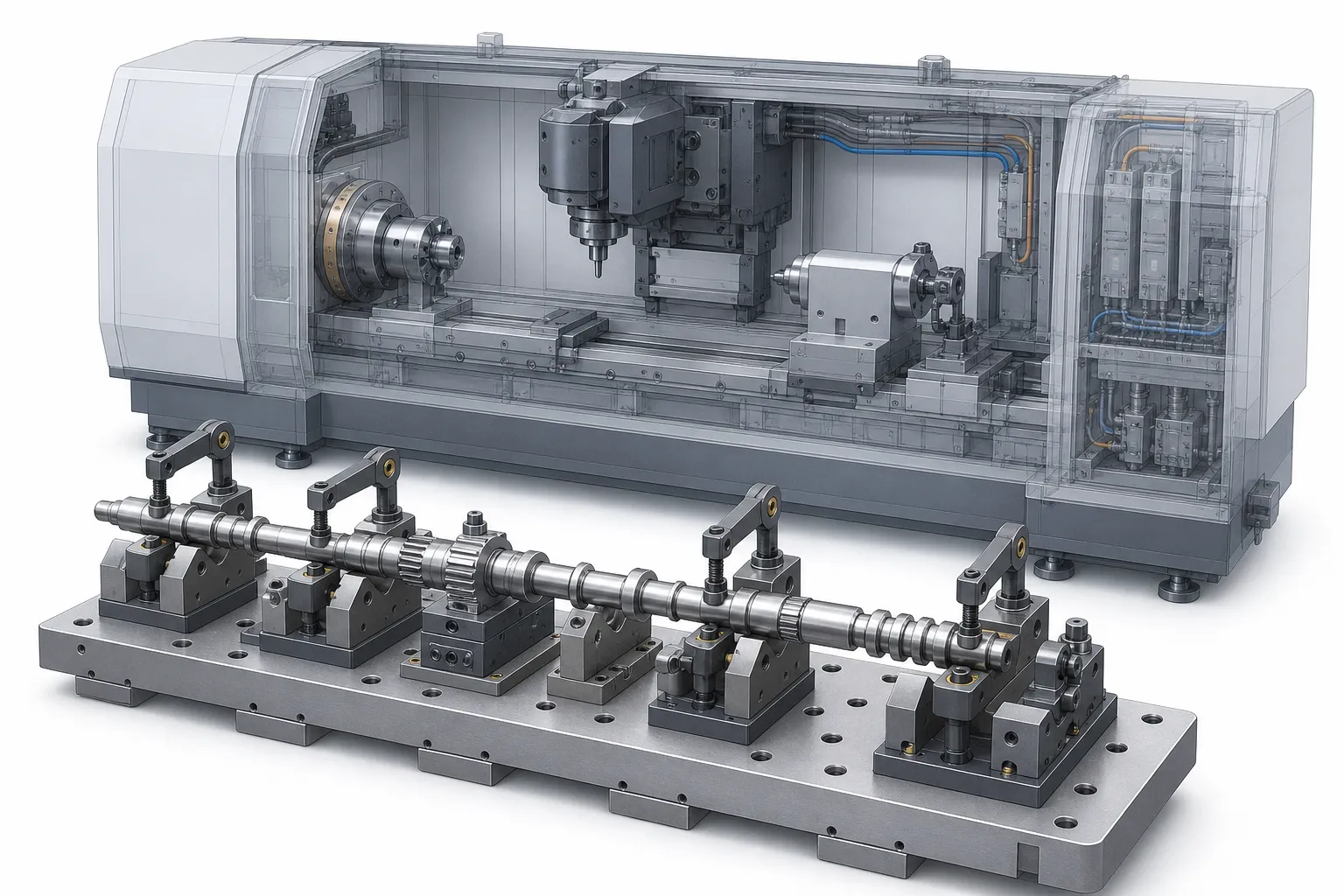
Between the caricatures — catalog machine and dream cell — sits the configuration that most precision parts manufacturers should seriously evaluate: a validated platform whose engineering content is deliberately concentrated where it pays. Standard press, measurement and control; custom tooling and fixtures built to the datum logic of your parts, a theme developed in straightening fixture design; part programs written against your families during a structured FAT; and automation scoped to the parts-per-hour number your line actually needs rather than the number that impresses in a presentation. This configuration buys most of the standard platform’s validation and most of the custom cell’s fit, at a fraction of the engineering risk of full customization.
Two Failure Patterns Worth Recognizing
The forced standard machine. The pattern begins innocently: the price gap looks large, the schedule pressure is real, and the standard machine is ordered with the phrase “we will make it work.” Making it work then becomes a permanent occupation — hand-finished changeovers, families routed around the cell, a fixture drawer that grows every quarter, and a yield discussion that never ends. The tell in hindsight is always the same: during evaluation, at least one part family was described as “close enough” to the platform envelope. Close enough is a custom requirement wearing a standard price tag.
The over-customized cell. The mirror pattern: every wish that surfaced in an internal meeting became a specification line, and the machine grew into a one-of-a-kind system whose every function is real but whose total validation burden lands on a single project. The tell: specification items that cannot be traced to a part family, a tolerance or a throughput number. Every line in a custom specification should survive the question “which production number does this protect?” — and the ones that cannot should be deleted before contract, not debugged after delivery.
How Automation Changes the Equation
Manual versus automatic is a separate decision — covered in manual versus automatic straightening machines — but it interacts with custom versus standard in one direction: automation pushes toward customization. A manually loaded machine tolerates family differences through the operator’s hands; an automated cell must contain them mechanically. Every additional automated function — loading, orientare, măsurare, sorting — is a place where your specific part geometry must be engineered in. This is why “standard automated cell” is close to an oxymoron beyond a narrow family envelope, and why the closed-loop logic described in cum funcționează îndreptarea automată a arborelui is always instantiated, never merely installed.
Protecting a Custom Project Contractually
If the decision lands on custom, the risk management moves into the contract: a written specification of every part family with tolerances and incoming condition; a data package per the discipline in our RFQ data checklist; staged acceptance with defined test parts and gauges; documentation deliverables listed as contract items — as-built drawings, electrical schematics, part programs, spare parts list; and a support commitment with response terms. A custom machine without a documentation contract is a machine whose second decade is not guaranteed.
Întrebări frecvente
Is a custom machine always more expensive than a standard one?
Its purchase price is almost always higher, but the total comparison can go either way. A standard machine forced onto an unsuitable spectrum generates adaptation costs, yield losses and sometimes a second purchase. The honest comparison is total cost over the machine’s service life, including changeover, yield and support.
How much longer does a custom machine take to deliver?
Engineering time adds to the front of the schedule, and qualification adds to the back. The honest answer is project-specific; what can be stated generally is that the schedule risk concentrates in qualification runs, which is why staged acceptance with defined parts and gauges matters more on custom projects than on standard ones.
Can we start standard and customize later?
Partly. Scule, fixtures and part programs extend naturally on most platforms. Structural changes — longer beds, more press force, additional measurement stations — are usually designed in or not at all, which is why the workpiece spectrum should be projected across the machine’s whole service life, not just the current order book.
What should we send a supplier to get a real answer?
Drawings with tolerances and datums, the family spectrum with volumes, incoming part condition data, the target cycle time, and the integration boundary — what the machine must talk to upstream and downstream. With that package, a competent supplier can tell you where on the spectrum your project actually sits.
How do we verify that a standard platform really fits, rather than nearly fits?
Ask for evidence at the family boundary, not the family center: the hardest part in each family — smallest diameter with tightest tolerance, longest length, weakest section — and test parts run on a reference machine. A platform quotation that never mentions your boundary parts is offering an opinion; one that runs them during FAT planning is offering a capability.
Decide With the Spectrum, Not the Brochure
We build both standard-platform machines and engineered cells, and we prefer customers who ask which one they actually need. Send us the part spectrum, tolerances and volumes described above, and we will tell you where the engineering content belongs in your case — platform, scule, or full cell — and what each path costs in money, schedule and risk. Start with the selection logic in how to select a straightener, then pressure-test the economics in the straightening machine cost guide.