
A straightened part is not a finished part. The moment correction ends, a clock starts: leftover press oil holds swarf against the surface, fingerprints begin their slow chemistry on bare steel, measurement fixtures leave marks, and a part that was geometrically perfect at the press can arrive at assembly rusty, dirty, or — because careless handling between cleaning and packaging bends it — no longer straight at all. The operations between straightening and shipment are cleaning, corrosion protection and packaging, and in most plants they are treated as warehouse chores instead of process steps. The parts that come back with rust claims disagree.
This page treats the post-straightening chain as a specified process: what the straightening operation leaves on and in the part, how cleaning decisions interact with corrosion behavior, which protection options fit which shipping timeline, and how packaging can protect geometry as well as surface. It is the downstream companion of our surface-protection tooling guide, which covers protecting the part during corecţie; this page covers protecting it after.
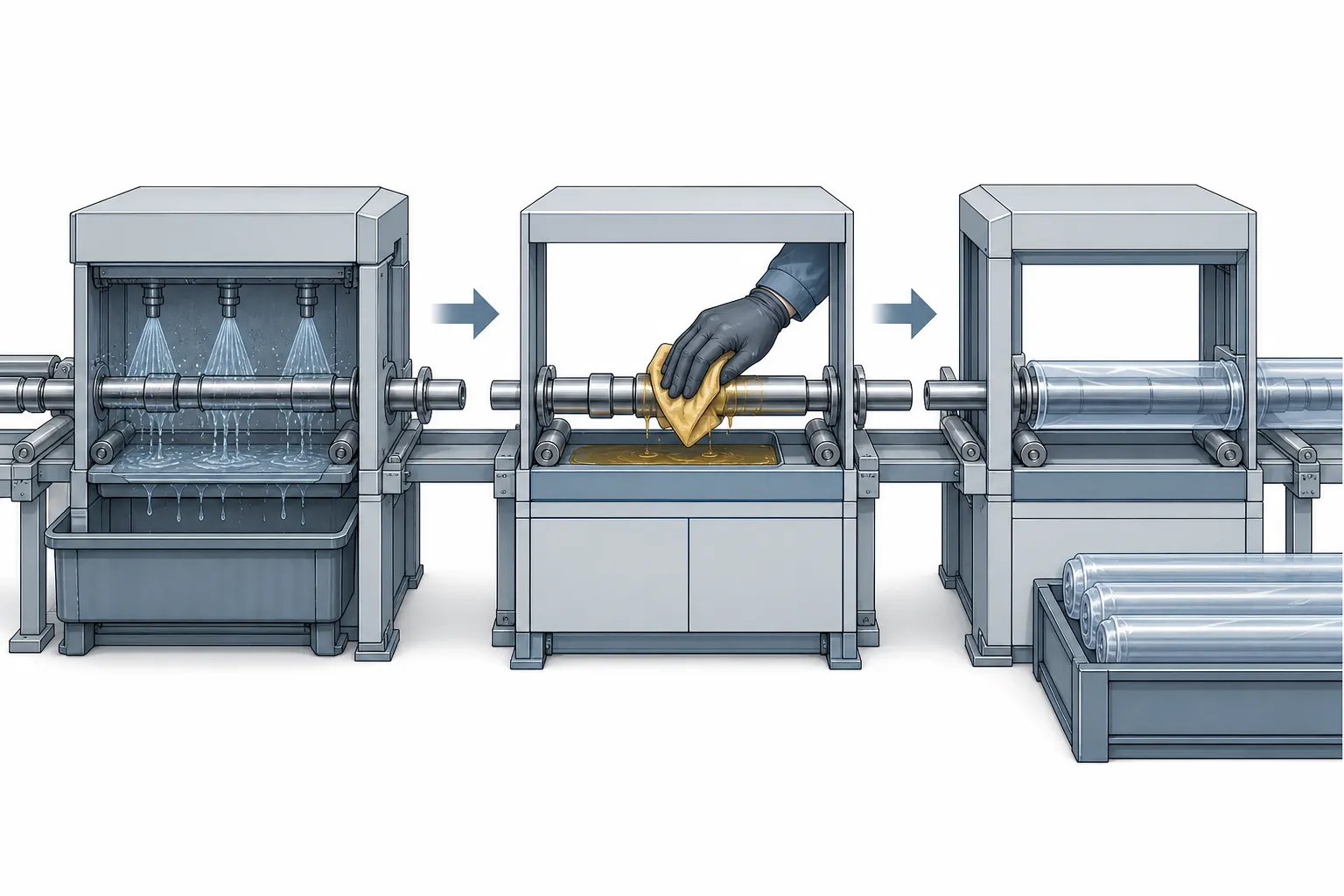
Illustration note: the images on this page are engineering concept illustrations, not photographs of a specific plant. They show the intent of each stage; your agents, equipment and packaging will differ.
The post-straightening chain answers five questions:
- What residues does the straightening process actually leave, and where do they hide?
- How quickly does corrosion start on a freshly handled part, and what defines the safe window to protection?
- Which cleaning and drying methods fit the part’s material and the available equipment?
- Which corrosion protection matches the real shipping and storage timeline — weeks, luni, or indefinite?
- How does packaging carry both the surface and the straightness to the customer?
Why the Window After Straightening Matters
Straightening is a hands-on process. Parts are loaded, sprijinit, presat, rotated, measured and unloaded — usually with gloves that carry oil from the previous batch, on supports that carry residue from the last part, in air that the HVAC shares with machining coolant mist. Corrosion literature and industrial practice agree on the essentials: bare carbon steel with salt-bearing or acid-bearing residues can show first staining within days, and the widely cited rule among corrosion protection suppliers is that prevention applied immediately costs a fraction of remediation later. The window is not a fixed number — humidity, temperatură, residue type and alloy decide it — but the process design principle is fixed: protection is applied on a schedule measured in hours, not weeks. A part waiting in a queue for a free washing station is not neutral; it is aging.
What the Straightening Process Leaves Behind
The residue inventory after a straightening cell is predictable: press and way oil from tooling and machine slides; marking media and layout ink from setup; measurement artifacts — clamp marks, indicator tip traces, felt-tip section markers; swarf and debris carried in from upstream machining; and the fingerprints of every handler since the last wash. Two straightening-specific items deserve special attention. Primul, residue trapped in protected features — oil pools under temporary protective sleeves, in center holes and in thread forms, exactly where cleaning is hardest and where trapped moisture does the most damage. Doilea, newly created fresh surfaces: any contact mark or tooling impression described in our tooling marks discussion disturbs surface layers; on parts with coatings or oxide layers, the mark can become the starting point of corrosion attack, because the damaged site behaves differently from the surrounding surface.
Curatenie: Matched to the Part, Not to Habit
Industrial cleaning options form a ladder, and the correct rung depends on the residue, the part geometry and what happens next. Solvent wiping removes oil films from accessible surfaces and is the workshop default; its weaknesses are trapped residues in holes and threads and operator variability. Alkaline aqueous washing — immersion or spray — handles oils and many marking media, is the backbone of batch cleaning, and adds two obligations the wipe does not have: the water must be of controlled quality, and the part must be dried completely. Ultrasonic immersion reaches the trapped volumes — center holes, deep threads, blind features — that defeat both of the above. The material rules are not optional: chloride-bearing chemistry is a known hazard for stainless steels and many corrosion-resistant alloys, a constraint documented across cleaning chemistry practice; copper alloys and aluminum respond to different chemistry than steel; and hardened, high-strength parts must not see any process step — cleaning included — that risks hydrogen exposure without a documented basis.
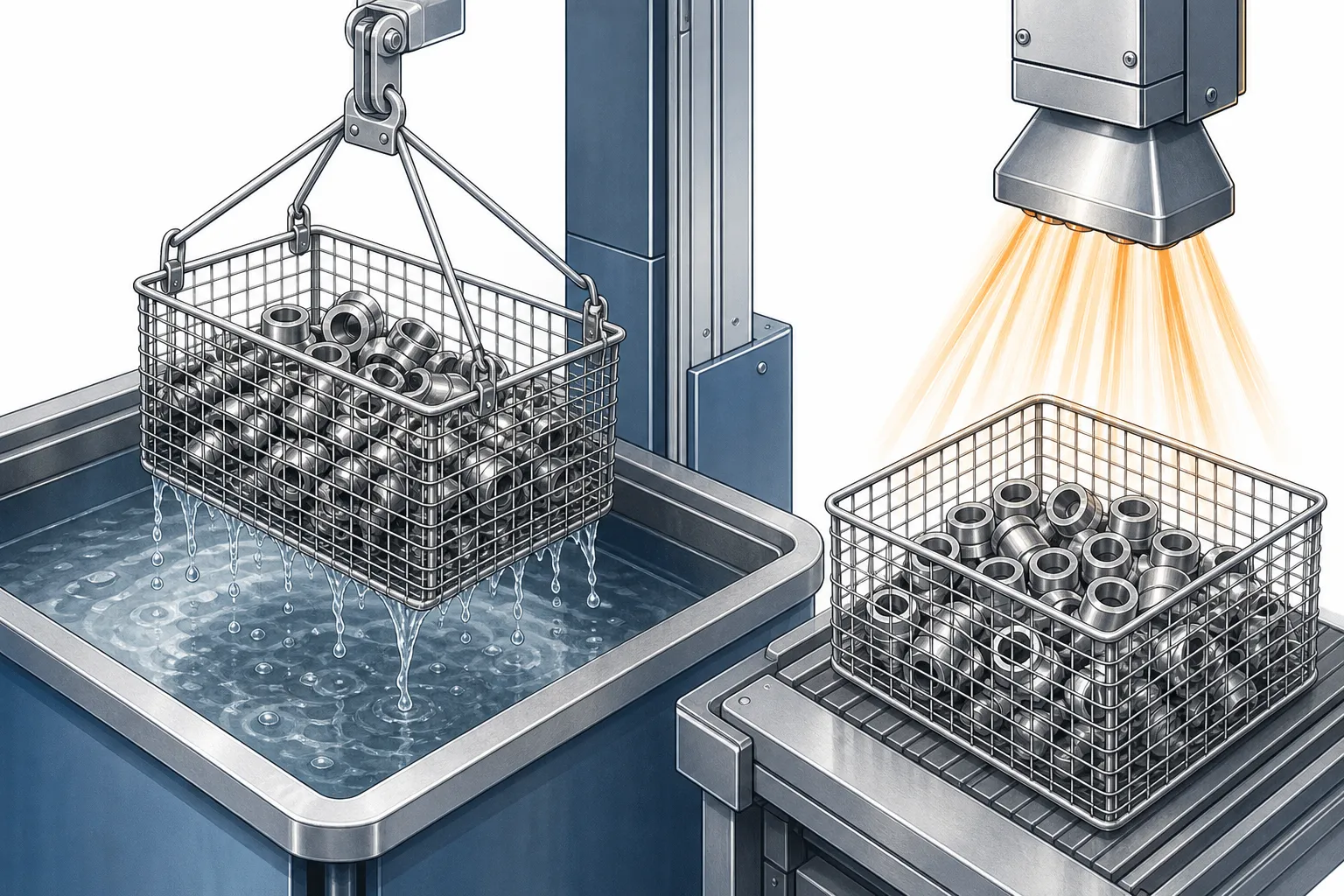
Drying Is Part of Cleaning
An aqueous-washed part left to air-dry in humid shop air carries a water film into exactly the features that are hardest to reach — and water plus residual salts is a corrosion cell assembled in advance. Compressed-air blowing, heated drying, or wipe-down of accessible surfaces after a controlled drain are all workable; the failure pattern is the part that looks dry at the surface and holds a droplet inside a center hole or thread runout. On precision parts there is a second, subtler reason drying matters: residual film and moisture interfere with measurement, a point that belongs to measurement system discipline — a clean, dry, temperature-settled part is the entry condition for a trustworthy reading, asa cum s-a discutat in Gage R&R pentru liniile de îndreptare şi incertitudinea de măsurare în inspecția dreptății.
Corrosion Protection Matched to the Timeline
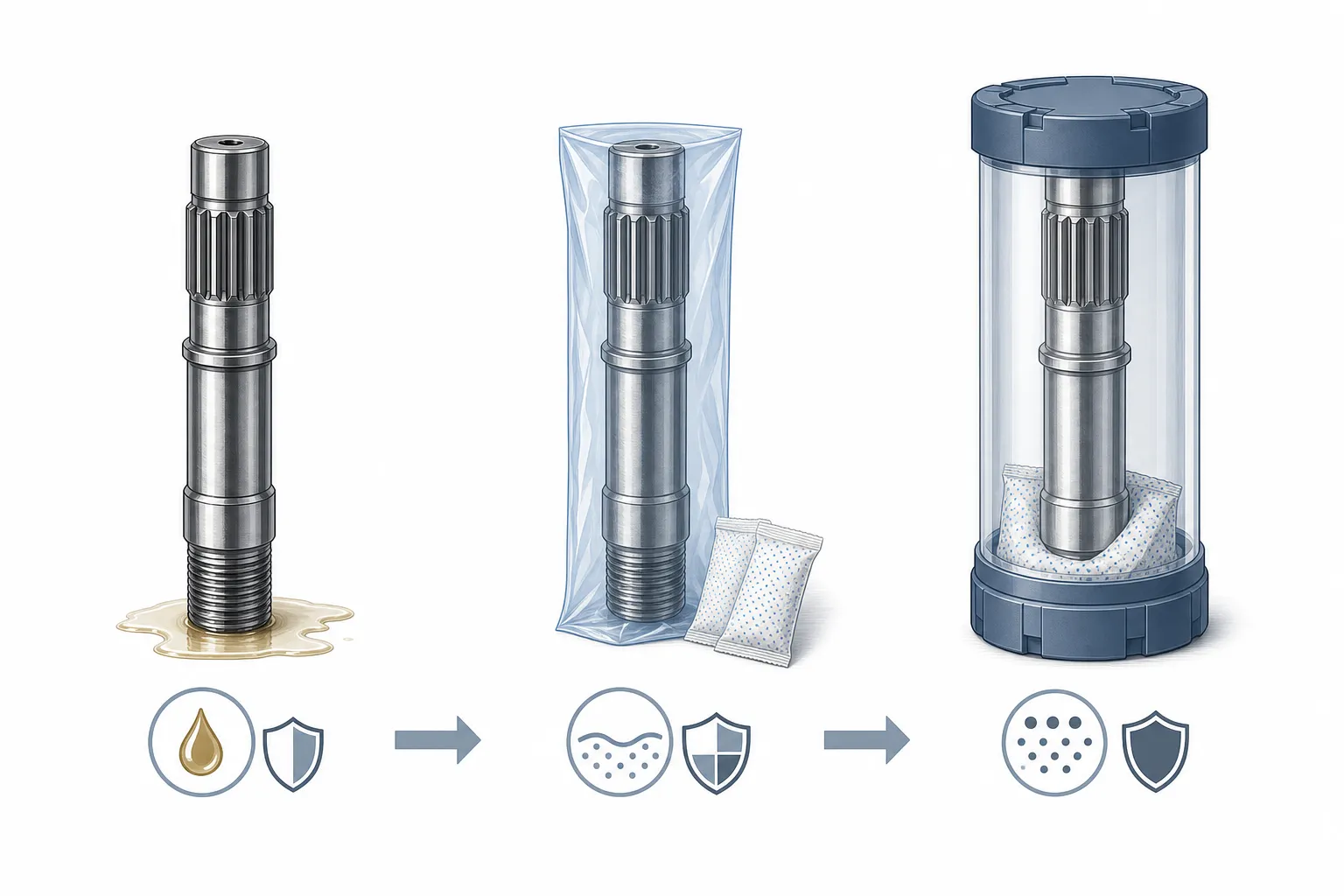
Protection options sort naturally by intended life. Short-term oils and fingerprint-removing films cover days to weeks of indoor storage and are the default between process steps. Medium-term rust preventives — heavier oils, soft films, waxes — carry parts through months of sheltered storage or a domestic shipment. Long-term systems — barrier films combined with vapor phase inhibitors, sealed packaging with desiccant, or dedicated interleave papers — are what export shipments over oceans and long warehouse lives require. Three selection rules keep the decision honest: match the protection life to the real logistics timeline including worst-case delay, not the planned one; verify compatibility between the preventive and the next process step — an assembly line or a grinding operation downstream will have an opinion about residual film; and write the specified protection into the part’s control plan so that “clean and oil” is a defined operation with a defined agent and duration, not a habit of the shipping department.
Packaging That Protects Geometry, Not Just Surface
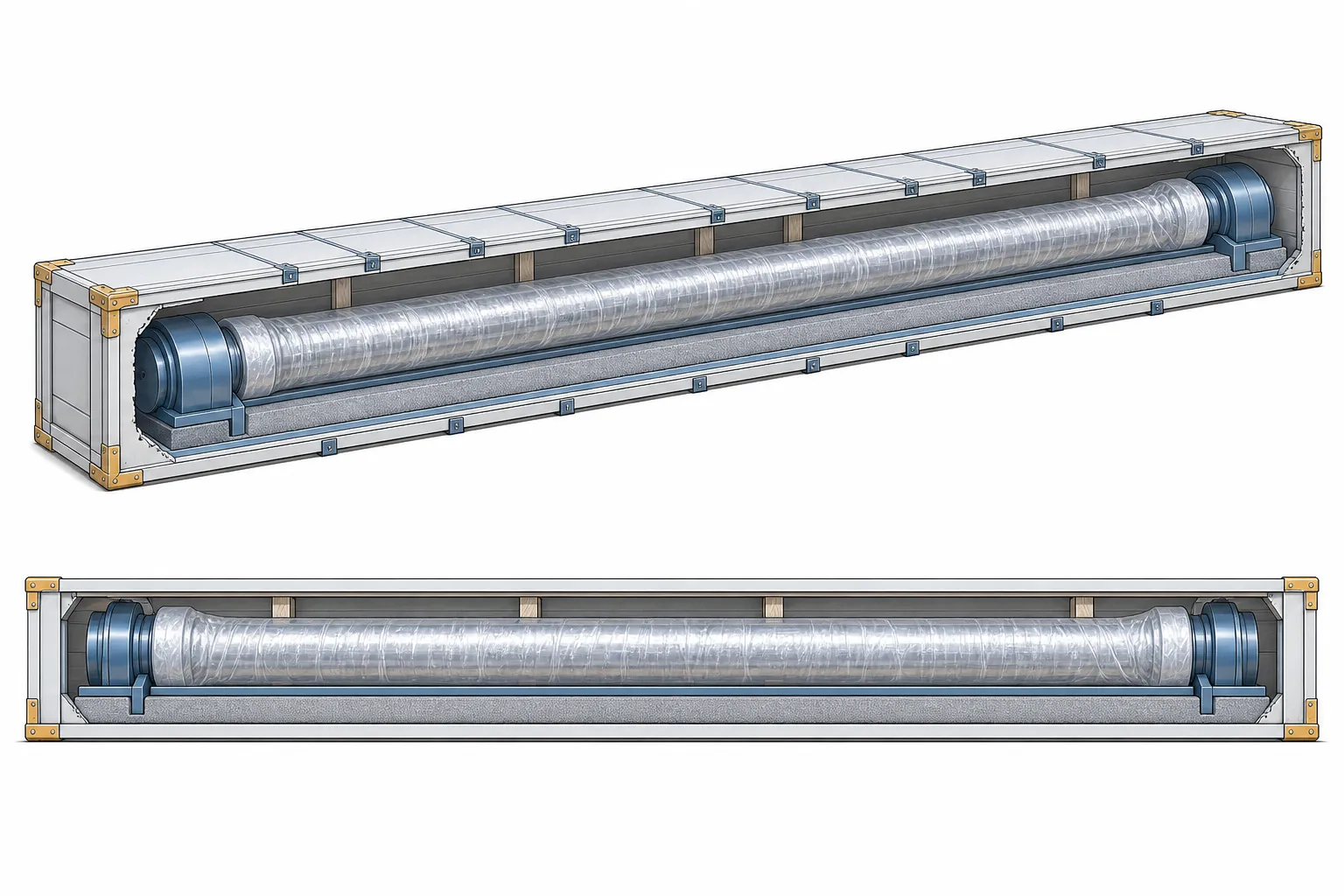
The most self-defeating failure in this chain is the part that ships straight and arrives bent. Straightened long parts are fragile by definition — they were bent once already, and thin sections, tubes and precision shafts regain curvature under point loads and their own weight. Packaging rules that follow from practice: support long parts along their length or hang them vertically rather than stacking weight across a mid-span; isolate parts from each other so that steel-on-steel contact in transit cannot coin marks or rust at touch points; keep protective end caps and thread protectors on until final use; and label orientation-sensitive packaging clearly. The geometry risk and the corrosion risk share one packaging solution family — vapor-inhibited bags and films, interleaves and capped tubes protect both at once — which is why the protection decision and the packaging decision should be made together, at the same desk, before the first batch ships.
Cleanliness Feeds the Acceptance Chain
Post-process cleanliness is not only cosmetic; it enters the measurement and acceptance chain. Final inspection of straightness assumes the part surface represents the part geometry — a chip riding on a support surface or an oil film holding debris adds error that no calibration removes. Sample-based acceptance runs of the kind described in our sample test and acceptance guide should therefore specify the part’s cleanliness state as part of the measurement conditions. The same logic runs through machine acceptance: parts presented at a test de acceptare din fabrică and then packed for transport should leave in a defined preservation state, and the transport locking and corrosion protection specified between FAT and site installation — themes in our SAT checklist — are the same discipline at machine scale. And parts routed out of the correction window follow the NOK handling logic of our NOK sorting guide, including their cleaning and protection, because a reject part waiting for disposition ages too.
Material-Specific Notes
Carbon and alloy steels are the default corrosion case; everything above applies directly, with protection strength scaled to humidity and timeline. Stainless steels do not rust like carbon steel but are vulnerable to pitting from chloride-bearing residues and to cosmetic staining from carbon steel contact — routing stainless parts through fixtures, brushes and containers that have served steel parts is a documented contamination path. Aluminum tolerates atmosphere well but stains under alkaline residues and galvanic contact with steel in the presence of moisture. Copper alloys tarnish rather than corrode catastrophically, but finger oils etch fingerprints into polished surfaces within days — the classic argument for gloves at final handling. None of these behaviors is exotic; the failure is always the process that treated all metals as one metal.
Moduri de eșec comune
The recurring claims: rust under the sleeve — protection applied over trapped contamination, sealing the corrosion cell in with the part; water in the center hole — aqueous cleaning without a drying step that reaches inside; the wrong chemistry on the right part — chloride cleaner on stainless, alkaline residue left on aluminum; protection weaker than the delay — a short-term film chosen against a three-month shipping reality; stacked bends — long parts crated with mid-span point support that returned part of the curvature the press had just removed; şi the undocumented process — cleaning and oiling performed differently by every shift, invisible until a customer claim makes it suddenly everyone’s problem. Every one of these is prevented by writing the chain down: agent, method, sincronizare, ambalaj, and who verifies.
Întrebări frecvente
How soon after straightening must parts be protected?
Hours, not days, for bare carbon steel in normal shop air — especially after aqueous cleaning or any handling with bare hands. The exact safe window depends on humidity, residue and alloy; the process design should treat same-shift protection as the default and anything longer as an exception needing justification.
Is a rust preventive film compatible with downstream assembly?
Sometimes — light fingerprint-removing films are often specified as assembly-compatible, while heavier waxes usually require removal. This is a decision made with the customer’s process, not in the shipping department, and it belongs in the control plan.
Do straightened parts need different packaging than other machined parts?
They need packaging chosen with their stiffness in mind. A freshly straightened slender part has a documented history of bending; mid-span support, stacking loads and point contacts are how that history repeats. Long parts are supported along their length or hung, and never carry other parts across their span.
What about parts that will be heat treated or ground after straightening?
Then the intermediate protection only needs to bridge to the next process — but it still needs to be specified, because the corrosion clock runs during in-process queue time too, and rust entering a grinding operation becomes abrasive and surface defect problems downstream.
Ship the Geometry You Measured
We treat the post-straightening chain — cleaning, protection, packaging — as part of the straightening solution, specified alongside the correction and measurement process rather than left to the loading dock. When you send parts for straightening, tell us the material, the downstream process, the shipping destination and the expected timeline to use; the preservation concept that fits those facts is defined with the process, not improvised after it. The protection philosophy starts in the machine with scule de protecție a suprafețelor and ends at your dock with a part that is still straight, clean and bright.