
În industria producției de elemente de fixare, îndoirea în șuruburi lungi după tratamentul termic este un punct de durere universal. Tradiţional “ciocănirea manuală” nu este doar ineficient, dar nici nu garantează o precizie constantă. Acest articol împărtășește o specialitate Soluție automată de îndreptare a șuruburilor: demonstrating a reported client case in which automation took an 8-person manual line to one operator supervising four machines, with straightness held within 0.1 mm on the client’s acceptance records.
What is the Bolt?
Șuruburile sunt elemente de fixare de bază pentru mașini, construcție, și industriile auto. Piesa de prelucrat tipică pentru această soluție este un șurub lung de înaltă rezistență: 15mm diametru, 340mm lungime.
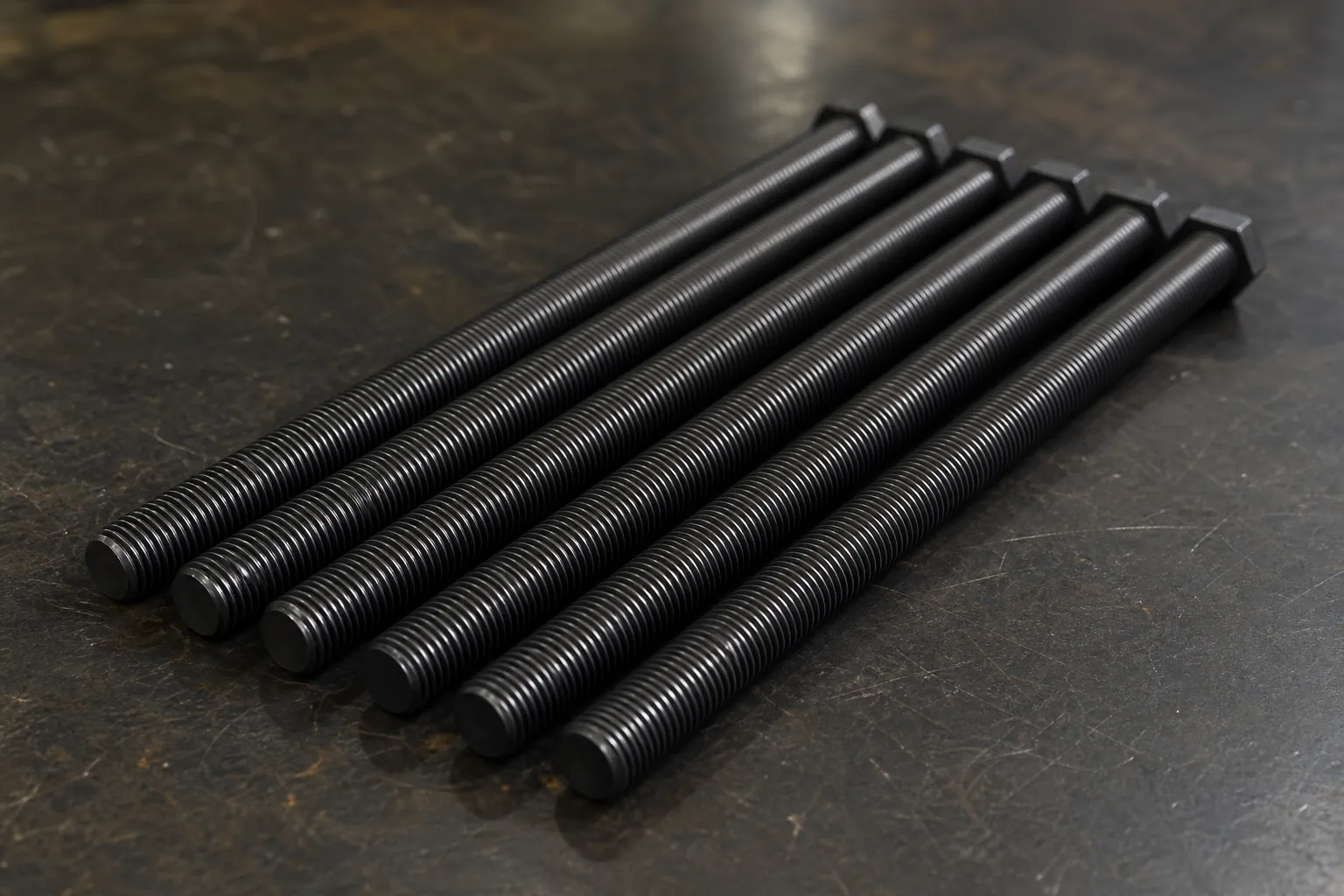
Caracteristici structurale și provocări
- Raport mare L/D: Lungimea de 340 mm face șurubul foarte susceptibil la o îndoire inițială de 0,5 mm – 1.5mm după tratamentul termic.
- Cerințe de precizie: The client required straightness within 0.2 mm; the case acceptance records were held under 0.1 mm.
- Cerințe de protecție: Procesul de îndreptare trebuie să asigure zero deteriorare a preciziei filetului și a calității suprafeței.
Why Heat Treatment Bends Long Bolts in the First Place
Understanding the distortion source is what makes a correction process defensible instead of decorative. During quenching, a long fastener cools unevenly: the section cools at different rates depending on orientation in the basket or fixture, agitation contact, and local mass differences between the plain shank, the threaded length and the head. Each cooling path wants to contract by a different amount, and the resulting locked-in stresses bend the part when it relaxes. The effect scales with length — which is why short bolts leave heat treatment usable while long ones of the same grade systematically arrive bent. Thread rolling and machining before treatment add their own stress history, and any straightening performed at the heat treater counts as prior deformation for everything done afterward.
Two practical consequences follow. Primul, incoming inspection on long heat-treated bolts is not optional paperwork — the bend magnitude and pattern arriving at the straightening station determine both the correction plan and any supplier conversation, and the interaction of prior deformation with correction response is the reason reverse-loading behavior matters, as covered under efectul Bauschinger în îndreptare. Doilea, process decisions upstream — how parts are racked or basketed through quench, whether stress relief is applied — change the distribution the straightening station sees, and are usually the cheapest place to reduce total correction work.
Reading the Bend Before Correcting It
Long fasteners arrive with a small vocabulary of bend patterns, and naming the pattern is the first step of an efficient correction loop. A single-arc bow — one gentle curve, maximum near the middle — is the most common heat-treatment signature and the most straightforward to correct with supports positioned around the peak. An S-shaped double bend has two opposite peaks, usually reflecting two constraint points during quench, and demands two coordinated corrections rather than one big press at the largest reading. A local kink near the head or the thread runout concentrates distortion where section stiffness changes, and behaves differently from a distributed bow. In sfarsit, twist about the axis occasionally accompanies bending on parts with asymmetric features. Each pattern requires its own measurement map and correction sequence, which is why an automatic station that scans the full length and builds the map before pressing — rather than chasing the single worst reading — converges in fewer strokes. The measuring-and-correcting loop behind this is described for automatic shaft straightening generally, and for the long-bolt family specifically in the automatic long bolt straightening process.
De ce trebuie să se îndepărteze îndreptarea bolturilor “Ciocanirea manuală”
Procesul tradițional vs. Soluție automatizată
The figures below are this client’s reported baseline and post-commissioning values, not a universal benchmark for every fastener line.
| Punctul de durere | Ciocanirea manuală / Presă manuală | Soluție de îndreptare automată |
| Cerința de muncă | 8 workers per shift (manual baseline, reported case) | 1 operator pentru 4 masini (reported case) |
| Corectitudine | 0.2 – 0.5 mm spread (reported manual baseline) | ≤ 0,1 mm (client acceptance records) |
| Timp de ciclu | 120 – 180 s/bucata (reported manual baseline) | 10 – 15 s/bucata (reported case) |
| Costul total | High labor cost per corrected part | Manpower reduced from 8 operators to 1 supervising 4 masini (reported case) |
Fluxul procesului de îndreptare automată a șuruburilor
Această soluție acoperă un proces complet automatizat în buclă închisă, de la alimentare la sortare, asigurându-vă că fiecare șurub îndeplinește cerințele de livrare la standarde înalte.
Descrieri de proces de bază
- Alimentare automată: Șuruburile îndoite sunt introduse automat dintr-un buncăr în stația de îndreptare fără intervenție umană.
- Măsurare dinamică: Senzorii de înaltă precizie scanează piesa de prelucrat în rotație în timp real, captând cu precizie punctul maxim de îndoire pe toată lungimea.
- Servo Presare: Sistemul inteligent calculează automat returul elastic pe baza materialului (oțel carbon/oțel aliat), iar pistonul servo aplică o presiune precisă pentru o corecție cu o singură trecere.
- Sortare automată: Șuruburile calificate trec la următoarea etapă, while non-conforming parts are automatically isolated before they leave the machine.

Mașină de îndreptat șuruburi UBJ-80
Această placă de îndreptat este ideală pentru piesele finite tratate termic (de ex., Componente mașini de ștanțat/de birou, piese auto/motociclete, unelte, şuruburi) și baruri (oţel, cupru, aluminiu, oţel inoxidabil, aliaj de titan) de 60–600 mm lungime & φ3–φ25mm diametru. Îmbunătățește atât precizia, cât și calitatea produsului.
Provocări și soluții de îndreptare de bază
Provocare 1: Manning and the Reported “1 Operator pt 4 Mașini” Case
Descrierea problemei: Manual hammering and press correction depend on operator skill, stamina and shift discipline, so manning levels stay high and results vary from operator to operator.
Soluţie:
Soluția noastră implementează automatizare completă în buclă închisă. Logica de operare este extrem de simplă, cu rețete încorporate pentru diferite specificații pentru șuruburi. Un muncitor standard trebuie doar să reumple buncărul periodic; restul — măsurarea, îndreptarea, și inspecția — este gestionată automat de mașină. Acest lucru rezolvă lipsa forței de muncă și elimină scăderile de precizie cauzate de oboseală.
Provocare 2: Garantarea consistenței cu o precizie de 0,1 mm
Descrierea problemei: Când un șurub este supus unor lovituri de ciocan, distribuția internă a tensiunilor devine neuniformă, conducând adesea la supracorecții în zonele localizate.
Soluţie:
Soluția utilizează a sistem de control servo complet parametrizat. Spre deosebire de judecata umană vagă, senzorii detectează curba axială a șurubului cu o precizie la nivel de microni. Prin algoritmi servo cu mai multe etape, sistemul depășește cu exactitate elasticitatea în spate a oțelurilor S45C sau aliate, locking final straightness within the 0.1 mm window achieved on this client’s qualified recipe.
How Thread and Head Zones Are Protected During Correction
Thread protection is a contact-zone engineering problem, and the principles are the same ones that govern surface-protection tooling across straightening applications. The correction force and the reaction forces both need somewhere to live, and on a long bolt the plain shank is the region designed to carry load, while the threaded length and the under-head fillet are the regions most easily damaged. A protection concept therefore has three parts: place supports on the shank at controlled span positions around the bend peak; direct press contact onto the shank through tooling that conforms to the section instead of touching thread crests; and keep every edge that could contact the workpiece generously radiused so load spreads instead of concentrating. Cleanliness belongs in the same sentence — debris trapped between press tooling and a thread flank is a scratch generator, and on plated or coated bolts the coating class defines how much contact the finish can tolerate at all.
The validation side is equally concrete. A thread-protection claim is proven by inspection agreed before the trial — thread gauges still running, flank condition reviewed under the method the quality function specifies — together with the released-state straightness result, on representative parts, after repeat setups. Protection and geometry are accepted together or not at all.
What an Acceptance Criteria Package Should Contain
A bolt straightening process is only as good as the acceptance definition it answers to, and a complete one answers five questions in writing. What characteristic governs — straightness of the axis, measured how: on centers, on supports, rotind, in what condition, since a reading under restraint is not a released result, pe loaded versus released measurement practice. What the limit is, and where it applies — full length or specified spans. What else must survive the process — thread fit, finisarea suprafeței, acoperire, head markings. How conformity is sampled — every part through an automatic gauge, or a sampling plan with defined reaction to a failure. And what happens to nonconforming parts — rework limits, segregation and disposition authority, following the NOK sorting and rework-limit framework. Buyers comparing straightening suppliers are well advised to ask for exactly this package; the ability to produce it says more about a supplier than any single machine specification.
Cazul de fabricație: A patra alegere a clientului indian
Contextul clientului
Un cunoscut furnizor indian de elemente de fixare care furnizează componente pentru mărcile globale de mașini de construcții.
Rezultate de implementare
- Comenzi repetate: Bazat pe performanța remarcabilă a primelor trei unități, clientul și-a achiziționat recent 4mașina.
- Operator Consolidation: The client reported one operator managing all 4 machines after commissioning, with a substantial increase in output per operator.
- Benchmark de calitate: The client’s records report straightness moving from 0.2 mm down to under 0.1 mm after commissioning.
Întrebări frecvente
- Q: Berbecul de îndreptare va deteriora filetele șuruburilor?
- Nu. Noi am proiectat non-contact, matrițe de protecție amortizate special pentru îndreptarea șuruburilor. Blocurile de presare se potrivesc perfect cu curbura șurubului, asigurând o distribuție uniformă a forței și evitând adânciturile de suprafață.
- Q: Se poate integra echipamentul în sistemul MES al fabricii noastre?
- Da. Sistemul nostru de control dispune de interfețe de date standard pentru a înregistra și a exporta datele de îndreptare în timp real pentru fiecare șurub, îndeplinind cerințele moderne de trasabilitate.
Additional Process Questions
Why do bolts from the same heat-treatment lot arrive with different bend patterns?
Because each part’s position in the basket or rack gave it a different cooling path. Quench distortion is sensitive to orientation, local mass and agitation contact, so even identical bolts leave treatment with different locked-in stress patterns. Mapping incoming parts rather than assuming a uniform error is the practical answer, and it is why scanning-based stations build a per-part correction plan.
How many correction passes does a long bolt need?
It depends on the pattern, not a fixed number. A single-arc bow typically converges in one planned press; an S-bend needs two coordinated corrections; local kinks near section changes respond differently again. The governing rule is a rework limit set before production — parts that stop responding are routed to review, not pressed repeatedly, because each additional plastic cycle consumes fatigue life and changes the material’s response.
Should straightening come before or after thread rolling?
The route belongs to the fastener process engineer, but the trade-off is explicit: correcting before thread rolling lets subsequent operations work from a straight blank, while correcting after heat treatment with finished threads demands the contact-zone protection described above. Whichever route is chosen, the acceptance package must define what state the straightness limit applies to, and the correction validation must be run on parts carrying that state.
Rezumat
Pentru fabricile de elemente de fixare care urmăresc eficiență și calitate ridicate, un Soluție automată de îndreptare a șuruburilor este calea esențială către creșterea competitivității. Whether the target is lower manning or 0.1 mm delivery precision, the figures in this article are one client’s reported case; your own results depend on the bolt family, incoming distortion and acceptance definition.
Moving from manual bolt correction toward automation? The manual vs automatic selection logic iar cel Carcasă ROI pentru îndreptare automată are the natural next steps.
Dacă vă confruntați cu probleme de management al muncii sau blocaje de precizie, simțiți-vă liber să Contactaţi-ne pentru o propunere tehnică personalizată.