
Een zuigstang is geen korte stalen staaf voor algemeen gebruik en geen holle boorpijp. Het is een lange, slank, cyclisch belaste component in een staafliftstring. Het gewone staaflichaam, vervalste of verstoorde uiteinden, moersleutel kenmerken, schouders vastzetten, schroefdraad en vlakken vormen één gecontroleerd werkstuk. Materiaalkwaliteit, warmtebehandeling, coating, Blootstelling aan corrosie en onderhoudsgeschiedenis kunnen de veilige correctieroute veranderen.
Een betrouwbare oplossing voor het richten van zuigstangen moet vijf vragen beantwoorden voordat een machine wordt geselecteerd:
- Is het werkstuk een nieuwe stalen zuigstang, ponyhengel, gebruikte terugwinningsstaaf, gepolijste staaf, zinklood of composietstaaf?
- Hoe wordt de lichaamsbuiging over de volledige lengte gescheiden van de doorzakking door eigen gewicht?, installatiefout, plaatselijke slijtage en onjuiste uitlijning van de eindkenmerken?
- Welke vlakke lichaamszones in contact kunnen komen met rollen of steunen, en welke pin, schouder, draad, gezichts- of gecoate zones worden beschermd?
- Does the material and inspection condition permit correction, or should the rod be rejected before force is applied?
- How will the fully released rod be remeasured, inspected, graded and traced after correction?
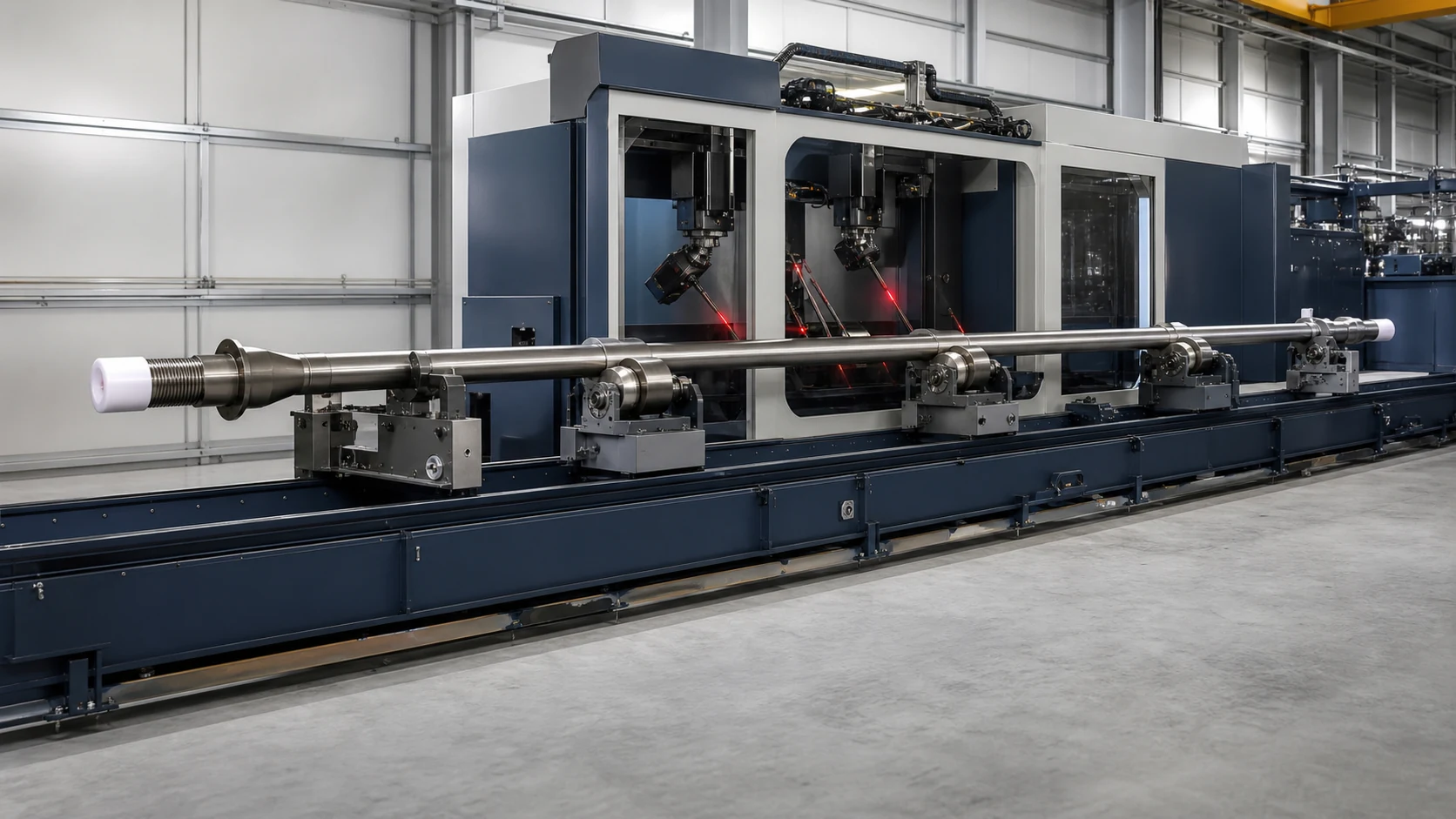
*Engineering concept illustration of a solid steel sucker rod in a long-bed measurement and straightening cell. Het is geen foto op de locatie van de klant of een prestatieclaim. Werkelijke steunen, rollen, sensors and acceptance limits require the controlled rod specification and representative sample tests.*
Define the Rod Family Before Selecting Equipment
SLB publicly distinguishes sucker rods, shorter pony rods and several coupling types. API identifies Spec 11B as covering sucker rods and rod-related products. Those product families should not be treated as interchangeable machine recipes.
| Rod or Component Family | Belangrijkste verschil | Deze pagina |
|---|---|---|
| Steel sucker rod | Long solid body with forged pin ends | Primair bereik |
| Stalen ponystang | Soortgelijke eindgeometrie maar kortere lengte | Hetzelfde concept, afzonderlijke ondersteuning en receptvalidatie |
| Gebruikte sucker rod voor terugwinning | Onbekende dienst, corrosie, geschiedenis van slijtage en vermoeiing | Alleen inspectie-eerste route |
| Gepolijste staaf | Kritisch afdichtingsoppervlak en verschillende serviceposities | Afzonderlijk oppervlaktebeschermingsproject |
| Glasvezel of composiet sucker rod | Verschillende stijfheid, faalmodus en verbindingsontwerp | Buiten de correctieroute met stalen staven |
| Zinkstaaf | Zwaardere sectie en verschillende laadrollen | Aparte werkstukfamilie |
| Koppeling | Connector met interne schroefdraad, geen lange staaf | Afzonderlijk inspecteren en behandelen |
| Boor pijp, behuizing of buis | Holle buis met gereedschapsverbindingen of aansluitingen | Gebruik de olieveldbuisoplossing |
| Doorlopende staaf of opgerolde staaf | Verschillende handling- en installatiesystemen | Apart lijnconcept |
Deze pagina richt zich op massief stalen sucker- en ponyhengels. Er wordt niet beweerd dat het een pijprichter is, wapeningmachine of generieke staafrichter voldoet automatisch aan inspectie- en verbindingsvereisten voor sucker-rod.
Continuous Rod: A Different Factory, Not a Longer Sucker Rod
Continuous rod — coiled rod, best known by trade names such as COROD — replaces the jointed sucker rod string with a single coiled alloy rod run into and out of the well as a coil. It removes the threaded connections, and with them the dominant fatigue and handling cost of rod lift, at the price of a completely different manufacturing and logistics chain: spool-based transport, injector-head handling, and a rod body that arrives carrying coil curvature memory.
At the manufacturing end, straightening is a continuous-process operation inside the rod mill, not a bench operation. Rod producers describe lines in which the coil passes through straightening, heat treatment and quenching in sequence (reported process descriptions from continuous rod manufacturing), and patent literature describes dedicated multi-roll, two-axis rod straighteners for cold straightening of coiled rod (reported patent documents). This is roller-based, through-feed straightening — a different machine species from the measured single-part correction cells discussed on this page, and the comparison logic in druk rechttrekken versus rollen rechttrekken explains why the two categories rarely share a supplier.
Where single-part discipline does enter the continuous rod world is localized repair. A continuous rod section can acquire a local bend in transport, spooling or service, and a measured point-press correction of that zone follows the same physics as any rod body correction: breng de bocht in kaart, protect the surface, press in bounded increments, release and remeasure. The project differences are real, though — coil memory means the rod must be restrained or supported against its residual curvature rather than assumed flat like a cut rod, and handling is spool-centric rather than rack-centric, which changes the loading and support hardware more than the press itself.
The practical boundary for equipment buyers: if the requirement is rod-mill throughput straightening of coiled product, specify a continuous multi-roll line and evaluate suppliers in that category. If the requirement is re-straightening discrete continuous-rod sections or local damage zones in a service shop, the single-part correction logic of this page applies, preceded by a fixture study for the coil-memory behavior. The two projects share a workpiece name and almost nothing else.
Pony Rods: Short Lengths Change the Support Mathematics
Pony rods are the length-adjustment members of a rod string: the same forged pin ends as a sucker rod, no coupling in the middle, and much shorter bodies. Supplier catalogs list them in standard increments — reported listings from SLB, ChampionX-Norris and oilfield steel suppliers run from about two feet up to ten feet — and they exist so the string can be spaced to well depth without cutting into a full-length rod.
Shortness changes the straightening problem in three specific ways. Eerst, the protected fraction grows. Upset ends, wrench squares, pin shoulders and threads occupy roughly the same absolute length as on a full rod, so on the shortest pony rods the approved plain-body zones may amount to a third of the part or less. Support stations and press points must be chosen inside that reduced window — the fixture plan, not operator judgment, has to encode it, and a fixture designed around full-length rods may simply have no legal support positions left when a two-meter pony is on the stands.
Seconde, the measurement model simplifies — with a caution. A full-length sucker rod deflects under its own weight and demands the frozen support-spacing discipline described later in this article; a short pony rod is stiff enough that self-weight sag between two supports shrinks to a much smaller term. The trap is assuming the simplification carries over automatically: mixed shops still measure ponies on the same controlled supports and record the same stations, because the acceptance question — global bow, end-feature eccentricity, or local damage — does not change with length, and neither does the customer’s grading system.
Derde, production mixing drives the machine specification. A cell that runs full-length rods and short ponies on the same line needs support stations that reposition across the whole length range, sensors that hold resolution at short lengths, and changeover that does not re-teach the machine from scratch for the family. These are exactly the parameters a sample-test program exposes — cover both extreme lengths in the validation matrix, as recommended in rechttrekken monstertest en acceptatie, because a recipe validated only on full rods says nothing about the shortest pony in the mix.
Polished Rods: Straightness Where the Rod String Meets the Seal
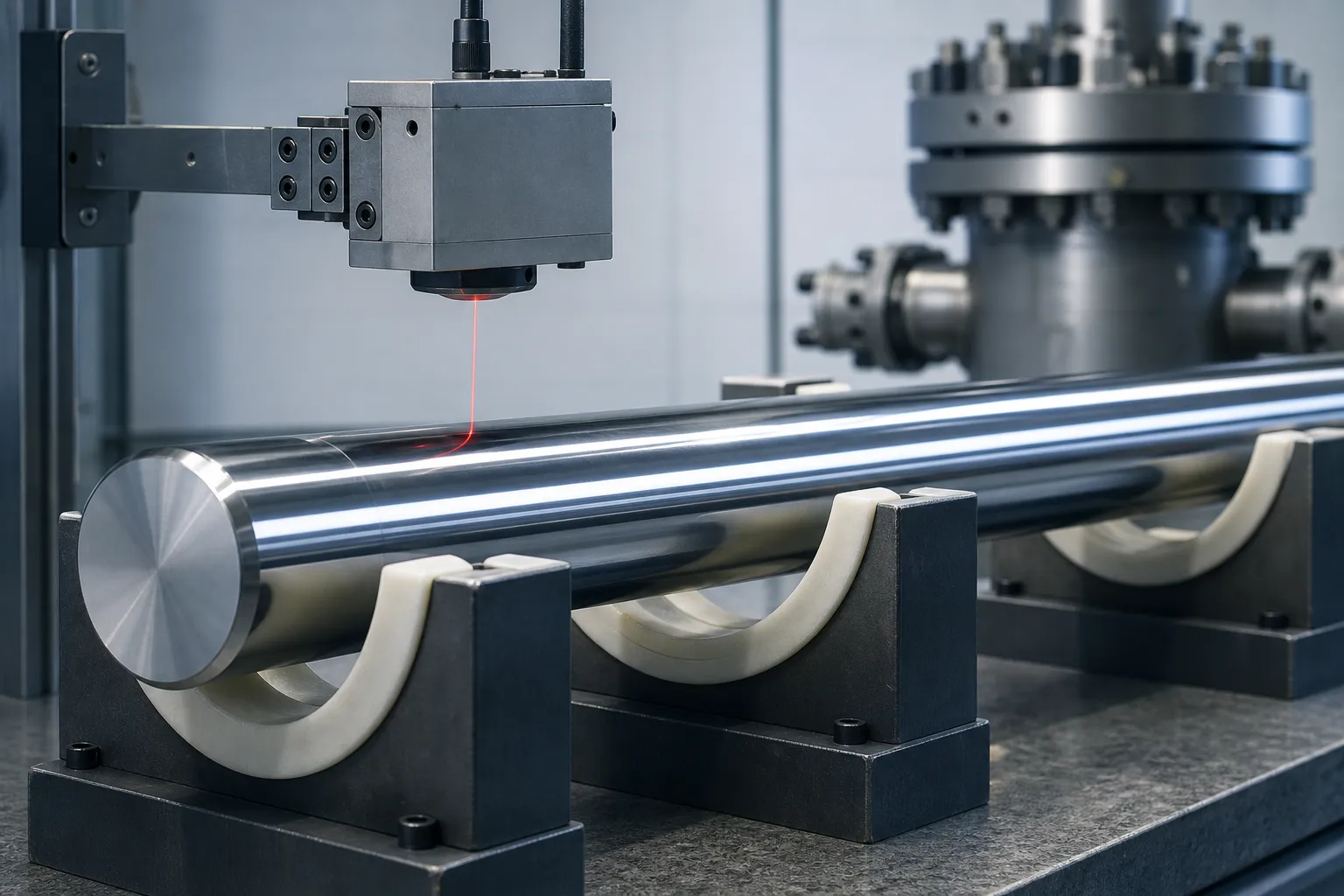
At the top of the rod string sits the polished rod — the one member of the API 11B family whose surface is a dynamic sealing surface. It passes through the stuffing box at the wellhead on every stroke, riding inside the polished rod packing, and its name describes the requirement: a straight, smooth body that lets the seal do its work. Every other rod in the string can carry cosmetic marks within limits; on the polished rod, a mark or a bend has a direct functional consequence at the surface.
The failure chain is what makes straightness an economic input rather than a cosmetic one. A bowed polished rod does not simply run crooked: on each stroke it sweeps laterally inside the packing, loading one side of the seal and relaxing the other. The packing wears unevenly, seal compression has to be increased to compensate, friction and rod surface wear rise together, and the wellhead ends up on a packing-replacement cycle far shorter than a straight rod would allow. Straightness and surface finish act together — restoring one without the other does not restore seal life.
As a straightening workpiece, the polished rod is therefore the most protected member of the family. Contact materials, support cleanliness and clamping rules are set against a sealing surface, not a structural body — the tooling questions in oppervlaktebeschermingsgereedschap voor rechttrekken are the right starting checklist, applied at full strictness. Measurement distinguishes two zones: the full-body profile, relevant for handling and fatigue like any rod, and the packing travel zone, where the acceptance discussion starts from the tightest band on the part rather than the loosest. Suppliers catalog polished rods as their own product line within the 11B family, with their own end and surface variants — the machine project should treat them the same way: same correction physics, stricter contact map.
Disposition is a maintenance decision as much as a geometry one. A polished rod with corrosion pits or scoring in the travel zone is not a straightening candidate — the seal does not care that the centerline is now straight. A rod that is geometrically sound but was run with a damaged seal should be inspected for surface pickup before it is re-straightened and returned to service. For shops consolidating rod work, the practical split is simple: body-straightening capability extends naturally to polished rods, but only with the contact map and measurement plan above, not by recipe transfer from standard sucker rods.
Breng het volledige werkstuk in kaart
Het voorstel moet elk gecontroleerd kenmerk en zijn axiale positie identificeren:
- gewoon staaflichaam;
- lichaamsdiameter en eventuele coating of slijtvaste behandeling;
- verstoord of gesmeed eindgedeelte;
- overgang van lichaam naar verstoorde toestand;
- sleutelvierkant of platte sleutel;
- schouder vastzetten;
- externe pindraad;
- gezicht vastzetten;
- identificatie, kwaliteits- en traceerbaarheidsmarkeringen;
- geïnstalleerde stanggeleiders of geleidingslocaties, indien aanwezig;
- corrosie, dragen, putjes of eerdere reparatiezones op gebruikte hengels;
- koppeling staat: VERWIJDERD, losjes beschermd of buiten het richtbereik.
NOV's public sucker-rod services sheet separates full-length visual inspection of the body, pin-uiteinden, draad en gezicht. Dat is de juiste mentaliteit voor het rechttrekken: a rod is not acceptable merely because a dial indicator on the middle body reads lower after processing.
Freeze the Manufacturing or Reclamation Stage
New Rod Before Heat Treatment
The material may be more responsive to correction, maar latere warmtebehandeling kan vervorming veroorzaken. Straightening here must support the next manufacturing operation and cannot replace final inspection.
Na warmtebehandeling
SLB states that its sucker rods are manufactured, heat-treated and tested. In dit stadium, cijfer, hardheid, restspanning en scheurgevoeligheid worden correctie-inputs. A recipe from untreated bar stock cannot be transferred without validation.
Before Final End or Surface Finishing
Wanneer de procesplanning dit toelaat, remaining stock or later finishing may reduce marking risk and restore functional surfaces. De stroomafwaartse bewerking moet een compatibel referentiepunt gebruiken en mag geen bocht nabootsen.
Gecoate of afgewerkte nieuwe staaf
SLB beschrijft corrosie- en slijtvaste staafcoatings voor zware omstandigheden. Een afgewerkte of gecoate staaf heeft een goedgekeurd contactmateriaal nodig, reinheidsnorm en oppervlakte-inspectie na het proces. De coating is geen opofferingsrollenbaan.
Terugwinning van gebruikte hengels
NOV maakt een openbare lijst van schoonmaakwerkzaamheden, magnetische deeltjesinspectie, elektromagnetische inspectie, visuele inspectie over de volledige lengte, koppeling verwijderen, dimensionale verificatie, demagnetisatie en sortering voor nieuwe en gebruikte sucker rods. Het rechttrekken hoort binnen dat inspectietraject; het kan het niet vervangen.
Meet de volledige lengte zonder de steunverzakking te meten
Lange, slanke staven buigen door hun eigen gewicht. Als steunafstand, overhang of oriëntatieveranderingen, het gemeten profiel verandert, zelfs als het materiaal dat niet heeft gedaan. Een systeem over de volledige lengte heeft daarom een bevroren ondersteuningsmodel nodig.
Het meetplan moet definiëren:
- axiale oorsprong en staaforiëntatie;
- steun tellen, afstand, hoogte en contactkracht;
- definitie van rechtheid in vrije staat of gecontroleerde ondersteuning;
- lichaamsprofiel over de volledige lengte op gecontroleerde axiale stations;
- plaatselijke lichaamsdiameter, dwarsdoorsnede of slijtagecontroles indien nodig;
- pin-end, schouder, draad- en vlakinspectie als afzonderlijke functies;
- toegestane uitsluitingsafstand rond verstoorde overgangen;
- invloed van coating of oppervlakteconditie op de sensor;
- temperatuur, reinigings- en stabilisatieconditie;
- herhaalbaarheid na het lossen, rotatie en herklemming;
- correlation with the customer's inspection and grading system.
Lezen rechtheid van de as vs. slingering vs. TIR voordat u een gerapporteerde waarde selecteert. Een stationair ondersteund profiel, een roterend slingerspoor en een rechtheidsresultaat in vrije toestand zijn niet uitwisselbaar.

*Engineering concept illustratie van lichaamsmeting met meerdere stations met beschermde pinuiteinden. Het is geen voorgeschreven meterindeling. Werkelijke steunafstand, compensatie voor doorzakken, Voor sensortracks en controles van eindfuncties zijn de staafspecificaties en de correlatie van de klantmeter vereist.*
Aparte buiging door schade en installatiefout
| Waargenomen signaal | Mogelijke oorzaak | Vereiste route |
|---|---|---|
| Glad langgolvig profiel herhaald na herklemming | Mondiale lichaamsboog | Kandidaat voor gevalideerde rol- of perscorrectie |
| Scherpe lokale verandering op één positie | Knik, invloed, corrosieverlies of plaatselijke schade | Inspecteren en doorsturen naar engineering of afkeuren; middel het niet in een mondiale bocht |
| Profielveranderingen met ondersteuningsafstanden | Zelfgewicht doorzakking of onstabiel ondersteuningsmodel | Bevries de steuntoestand en herhaal de meting |
| Traceer veranderingen na het reinigen | Schaal, olie, coatingafzetting of vuil | Reinig en kwalificeer het meetoppervlak |
| Het lichaam is stabiel, maar één pinuiteinde lijkt excentrisch | Gesmeed uiteinde, schouder- of draadasprobleem | Inspecteer het eindelement; Het rechttrekken van het lichaam corrigeert dit mogelijk niet |
| Hoog signaal nabij de verstoorde overgang | Beoogde sectiewijziging, plaatselijke stijfheid of vormfout | Gebruik een functiespecifieke uitsluitings- en technische beoordeling |
| Oppervlakteput- of scheurindicatie valt samen met bocht | Corrosie- of vermoeiingsschade | Inspectie/afkeurtraject vóór correctie |
| De hengel is recht, maar de prestaties bij het heffen van de hengel blijven slecht | Koppeling, gids, slangen, uitlijning, probleem met laden of goede staat | Evalueer het complete hengeltouw en het kunstmatige liftsysteem |
Rechttrekken kan de geometrie veranderen. Het kan metaal dat verloren is gegaan door corrosie niet herstellen, verwijder een vermoeiingsscheur of bewijs dat een gebruikte stang geschikt is voor een volgende onderhoudscyclus.
Bouw een inspectiepoort vóór de stijltang
Voor nieuwe hengels, de poort moet de materiaalkwaliteit bevestigen, warmtebehandeling staat, oppervlakte conditie, traceerbaarheid en het toegestane correctiestadium.
Voor gebruikte hengels, de poort is restrictiever. NOV maakt een openbare lijst:
- reinigen en gritreinigen of stralen;
- visuele inspectie van het lichaam over de volledige lengte, pin-uiteinden, draad en gezicht;
- magnetische deeltjesinspectie;
- elektromagnetische inspectie;
- laserdwarsdoorsnede of buitendiameterverificatie;
- koppeling verwijderen en inspecteren;
- demagnetisatie;
- sortering en kleurcodering volgens API- of klantvereisten.
The exact inspection sequence and acceptance values belong to the customer's applicable standard and procedure. De machine moet een inspectiestatus gebruiken, Ga er niet van uit dat elke verbogen staaf die de cel binnenkomt, veilig kan worden gecorrigeerd.
Bescherm de pinuiteinden en het oppervlak
Standaard zonder rol, Zones zonder ondersteuning of zonder pers
- externe pindraden;
- speld gezicht en schouder;
- steeksleutel plat of vierkant sleutel;
- verstoord of vervalst einde;
- overgang van lichaam naar verstoorde toestand;
- identificatie- en cijfermarkeringen;
- hengelgeleiders of geleidingsbevestigingszones;
- niet-goedgekeurde coating, geplateerde of speciaal behandelde oppervlakken;
- corrosie putten, scheuren, gutsen, slijtagevlakken of stootschade;
- koppeling en draadbeschermer, tenzij het hanteringsontwerp dit expliciet ondersteunt.
Potentieel goedgekeurde contactzones
- gereinigde staaflichaamlanden met geverifieerde diameter en oppervlakteconditie;
- onafgewerkte carrosserie vóór de laatste oppervlaktebehandeling, wanneer het procesplan dit toelaat;
- brede gepolijste rollen of vervangbare inzetstukken gevalideerd voor contactdruk en markering;
- gecontroleerde steunpunten geselecteerd uit de buurt van overgangen en bekende schade.
De veilige kaart moet aan de hengelfamilie worden gekoppeld, lengte, cijfer, coating, eindontwerp en revisie. Een steun die voor de ene ponyhengel acceptabel is, kan op een gesmede overgangs- of geleidelocatie bij een andere familie vallen.

*Engineering concept illustratie van zes gladde rollen die inwerken op het gewone staaflichaam terwijl de gesmede pen en draad buiten de rolcassette blijven. Het is geen universele machine-indeling. Rolgeometrie, gecompenseerd, contactstress en materiaalreactie vereisen monstervalidatie.*
Kies de correctiemethode uit de foutenkaart
Rechttrekken met meerdere rollen
Een kruisrol- of verspringend rolsysteem kan geschikt zijn voor lichaamskromming met lange golven en continue verwerking wanneer het staaflichaam een stabiele stabiliteit biedt, goedgekeurde rollenbaan. Boyu Petro brengt publiekelijk apparatuur voor het richten van rollen voor olieveldbuizen op de markt, behuizing, boor pijp, stalen buis en zuigstangen. Dat bevestigt een uitrustingscategorie; er wordt geen universeel sucker-rod-recept of inspectieresultaat vastgelegd.
Het rolconcept vereist nog steeds:
- correcte rolgeometrie voor het massieve hengellichaam;
- gecontroleerde offsets en aandrijfcondities;
- bescherming van pin-uiteinden en gesmede overgangen;
- oppervlaktemarkering en coatingproeven;
- in- en uitstapondersteuningscontrole;
- volledige verificatie vrijgegeven;
- een inspectieroute voor nieuwe versus gebruikte hengels.
Punt Druk op rechttrekken
Een gemeten drukroute kan worden overwogen voor gedefinieerde lokale lichaamskromming wanneer veilige ondersteuningen en een drukpunt kunnen worden vastgesteld. Er zijn kracht- en verplaatsingslimieten nodig, een beveiligde contactkaart, terugveringslogica en volledig vrijgegeven hermeting. Het is niet geschikt voor een scherpe knik, scheurindicatie of beschadigd uiteinde alleen maar omdat de fout lokaal is.
Lezen druk rechttrekken versus rollen rechttrekken voor de algemene methodevergelijking, pas vervolgens de sucker-rod-inspectie en contactpoorten toe.
Afwijzen, Vervangen of opnieuw rangschikken
De correctie moet stoppen wanneer de hengel een niet-goedgekeurde scheurindicatie vertoont, overmatige corrosie of sectieverlies, ernstige knik, beschadigde pin/draad/vlak, onzekere graad, ongeschikte coatingconditie, onaanvaardbare eerdere reparaties of een andere omstandigheid die buiten de goedgekeurde terugvorderingsprocedure valt.
Ontwerp een gesloten lus voor vrijgegeven onderdelen
De geaccepteerde waarde moet worden gemeten nadat de staaf de actieve rol- of persbelasting heeft verlaten.
- Identificeer de staaffamilie, lengte, cijfer, eindontwerp en nieuw/gebruikt status.
- Bevestig de inkomende inspectieprocedure en verwijder koppelingen indien nodig.
- Reinig het lichaam en bescherm de pindraden en vlakken.
- Laad de hengel op het gecontroleerde ondersteuningssysteem over de volledige lengte.
- Meet het lichaamsprofiel en scheid signalen van eindkenmerken of lokale schade.
- Classificeer de fout en selecteer de rol, druk, route voor afwijzing of technische beoordeling.
- Pas alleen de begrensde correctie toe die is toegewezen aan de goedgekeurde lichaamszone.
- Laat de hengel volledig los en stabiliseer hem.
- Meet hetzelfde profiel opnieuw onder dezelfde ondersteuningsconditie.
- Herhaal dit alleen binnen iteratie, kracht, verplaatsing en oppervlaktegrenzen.
- Voer de vereiste visuele weergave na het proces uit, dimensionale en NDT-controles.
- Cijfer, markering, traceer en routeer de hengel volgens de goedgekeurde kwaliteitsprocedure.
De controller moet zowel het geometrieresultaat als de kwaliteitsdispositie opslaan. Een groen rechtheidsresultaat mag een NOK-thread niet overschrijven, oppervlakte- of NDT-resultaat.
Configureer de productie- of terugwinningscel
| Celfunctie | Sucker-Rod-vereiste |
|---|---|
| Identificatie | Familie Rod, cijfer, lengte, eind ontwerp, coating en nieuw/gebruikt status |
| Inkomende inspectie | Reinigingsstatus, visueel resultaat, dimensionaal resultaat, NDT-status en -dispositie |
| Behandeling | Langbedondersteuning zonder slepen, pin-impact of draadschade |
| Meting | Lichaamsprofiel over de volledige lengte met bevroren steun-/doorzakmodel en eindscheiding |
| Correctie | Beschermde multi-roll of gemeten persroute met begrensde instellingen |
| Einde bescherming | Draaddoppen of gecontroleerde behandeling buiten de correctiezone |
| Verificatie | Volledig vrijgegeven profiel plus vereiste carrosserie-/eind-/oppervlaktecontroles |
| Kwaliteitsroutering | OK, opnieuw meten, begrensde herwerking, regel, technische beoordeling of afwijzing |
| Traceerbaarheid | Staaf-ID, recept, inspectiestatus, initiële/definitieve profiel, correctiegeschiedenis en alarmen |
Automatisering kan transportbanden omvatten, lopende balken, automatische eindidentificatie, schoonmaak, lasermeting, aanpassing van de rollen, NDT-integratie en -beoordeling. The required configuration depends on rod-family mix and the customer's existing reclamation line; dit mag niet worden afgeleid uit een generieke specificatie voor staafrichters.
Valideer met representatieve staven
Een voorbeeldprogramma moet de daadwerkelijke variatie die in de productie wordt verwacht, bevatten:
- minimale en maximale hengel- of ponyhengellengte;
- alles omvatte lichaamsdiameters en eindgeometrieën;
- materiaalkwaliteiten en warmtebehandelingstoestanden;
- alleen gecoate en ongecoate varianten als beide binnen de scope vallen;
- realistische langegolfbogen en bekende lokale NOK-omstandigheden;
- nieuwe en gebruikte hengels in afzonderlijke validatiegroepen;
- verschillende corrosie, slijtage- en reinigingsomstandigheden voor gebruikte hengels;
- herhaaldelijk laden, rotatie- en herklemmingsproeven;
- draad, gezicht, schouder, lichaamsoppervlak- en NDT-controlemonsters;
- klantmeter en beoordelingscorrelatie.
In het acceptatierapport moet het aantal monsters worden vermeld, identificatie van de staaf, inspectiestatus, ondersteuning instellen, herhaalbaarheid van metingen, initiële en definitieve profielen, rol- of persinstellingen, iteraties, oppervlakkige bevindingen, NDT-resultaten, beoordelingsresultaat en uitgesloten voorwaarden.
Lezen rechttrekken monstertest en acceptatie voor de algemene FAT/SAT-bewijsstructuur. Het sucker-rod-project moet de toepasselijke inspectie- en terugvorderingsprocedure toevoegen.
Wat de richtmachine niet bewijst
Een lagere lichaamsbuiging is op zichzelf geen bewijs:
- naleving van API Spec 11B of een standaard voor terugvordering van klanten;
- herstelde levensduur van vermoeidheid;
- verwijderen van scheuren, corrosie putten, slijtage of sectieverlies;
- acceptabele pindraad, schouder- of gezichtsaandoening;
- correcte koppelingssamenstelling of verbindingsintegriteit;
- compatibility with a particular well's load and corrosion environment;
- aanvaardbare hengelgeleider, toestand van het buizen- of stangensysteem;
- veilig hergebruik van elke gebruikte hengel.
API identificeert officieel de 28e editie van Spec 11B als de huidige specificatie voor sucker-rods en rod-gerelateerde producten. De koper en de kwaliteitsautoriteit moeten de toepasselijke editie verstrekken, acceptatiewaarden en inspectieprocedure voor het project. StraighteningTech mag geen ontoegankelijke standaardlimieten verzinnen of parafraseren.
Informatie die nodig is voor een Sucker Rod-voorstel
Gelieve op te geven:
- hengel- en ponyroedtekeningen met revisie;
- applicable standard and customer inspection/reclamation procedure;
- body diameter, lengte bereik, upset/end geometry and thread details;
- materiële kwaliteit, hardheid en warmtebehandelingstoestand;
- coating, guide and surface-protection requirements;
- new-manufacturing or used-reclamation stage;
- incoming cleaning, visueel, dimensional and NDT route;
- initial body-profile distribution and local NOK examples;
- straightness or runout definition, support condition and target;
- goedgekeurde en verboden contactzones;
- pin thread, gezicht, shoulder and body acceptance requirements;
- productievolume, family mix and changeover frequency;
- laden, lossen, coupling-removal and end-protection method;
- traceerbaarheid, grading and data-export requirements;
- representatieve OK- en NOK-monsters.
StraighteningTech can then develop the measurement model, beveiligde contactkaart, method selection, machine configuration, sample-test plan and acceptance evidence for the defined rod family. Het resultaat is een gecontroleerd sucker-rod-proces – en geen generieke belofte om een gebogen olieveldstaaf door een staaf- of pijprichter te voeren.