
In de bevestigingsindustrie, het buigen van lange bouten na warmtebehandeling is een universeel pijnpunt. Traditioneel “handmatig hameren” is niet alleen inefficiënt, maar garandeert ook geen consistente nauwkeurigheid. Dit artikel deelt een gespecialiseerde Geautomatiseerde oplossing voor het rechttrekken van bouten: demonstrating a reported client case in which automation took an 8-person manual line to one operator supervising four machines, with straightness held within 0.1 mm on the client’s acceptance records.
What is the Bolt?
Bouten zijn fundamentele bevestigingsmiddelen voor de machine, bouw, en auto-industrie. Het typische werkstuk voor deze oplossing is een lange bout met hoge sterkte: 15mm diameter, 340mm lengte.
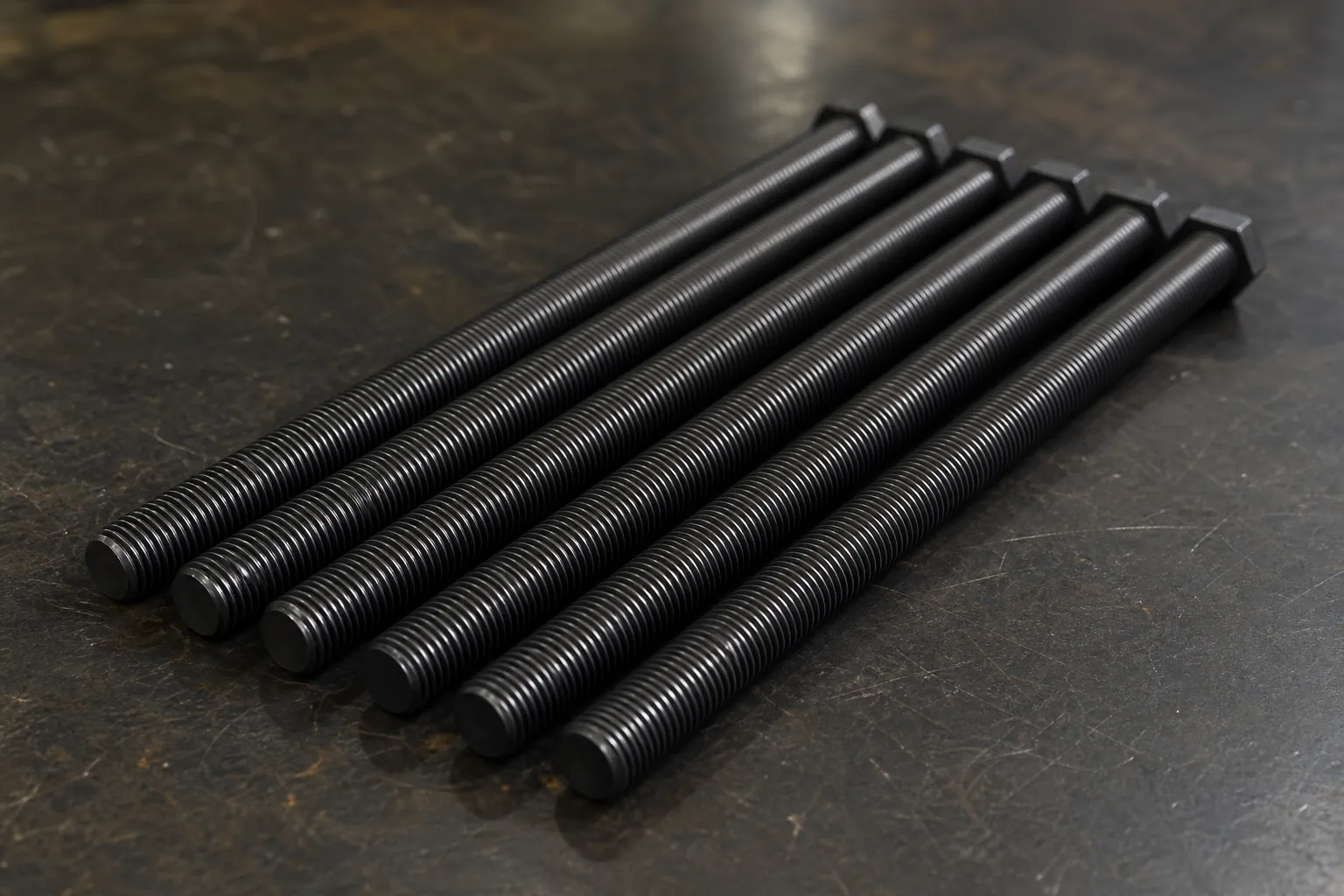
Structurele kenmerken en uitdagingen
- Hoge L/D-verhouding: Door de lengte van 340 mm is de bout zeer gevoelig voor een initiële buiging van 0,5 mm – 1.5mm na warmtebehandeling.
- Precisievereisten: The client required straightness within 0.2 mm; the case acceptance records were held under 0.1 mm.
- Beschermingsvereisten: Het richtproces moet ervoor zorgen dat er geen schade aan de draadprecisie en oppervlaktekwaliteit wordt toegebracht.
Why Heat Treatment Bends Long Bolts in the First Place
Understanding the distortion source is what makes a correction process defensible instead of decorative. During quenching, a long fastener cools unevenly: the section cools at different rates depending on orientation in the basket or fixture, agitation contact, and local mass differences between the plain shank, the threaded length and the head. Each cooling path wants to contract by a different amount, and the resulting locked-in stresses bend the part when it relaxes. The effect scales with length — which is why short bolts leave heat treatment usable while long ones of the same grade systematically arrive bent. Thread rolling and machining before treatment add their own stress history, and any straightening performed at the heat treater counts as prior deformation for everything done afterward.
Two practical consequences follow. Eerst, incoming inspection on long heat-treated bolts is not optional paperwork — the bend magnitude and pattern arriving at the straightening station determine both the correction plan and any supplier conversation, and the interaction of prior deformation with correction response is the reason reverse-loading behavior matters, as covered under het Bauschinger-effect bij het rechttrekken. Seconde, process decisions upstream — how parts are racked or basketed through quench, whether stress relief is applied — change the distribution the straightening station sees, and are usually the cheapest place to reduce total correction work.
Reading the Bend Before Correcting It
Long fasteners arrive with a small vocabulary of bend patterns, and naming the pattern is the first step of an efficient correction loop. A single-arc bow — one gentle curve, maximum near the middle — is the most common heat-treatment signature and the most straightforward to correct with supports positioned around the peak. An S-shaped double bend has two opposite peaks, usually reflecting two constraint points during quench, and demands two coordinated corrections rather than one big press at the largest reading. A local kink near the head or the thread runout concentrates distortion where section stiffness changes, and behaves differently from a distributed bow. Eindelijk, twist about the axis occasionally accompanies bending on parts with asymmetric features. Each pattern requires its own measurement map and correction sequence, which is why an automatic station that scans the full length and builds the map before pressing — rather than chasing the single worst reading — converges in fewer strokes. The measuring-and-correcting loop behind this is described for automatic shaft straightening generally, and for the long-bolt family specifically in the automatisch rechttrekken van lange bouten.
Waarom het rechttrekken van bouten moet verdwijnen “Handmatig hameren”
Traditioneel proces vs. Geautomatiseerde oplossing
The figures below are this client’s reported baseline and post-commissioning values, not a universal benchmark for every fastener line.
| Pijn punt | Handmatig hameren / Handmatige pers | Geautomatiseerde ontkruloplossing |
| Arbeidsvereiste | 8 workers per shift (manual baseline, reported case) | 1 operator for 4 machines (reported case) |
| Rechtheid | 0.2 – 0.5 mm spread (reported manual baseline) | ≤ 0,1 mm (client acceptance records) |
| Cyclustijd | 120 – 180 s/stuk (reported manual baseline) | 10 – 15 s/stuk (reported case) |
| Totale kosten | High labor cost per corrected part | Manpower reduced from 8 operators to 1 supervising 4 machines (reported case) |
Automated Bolt Straightening Process Flow
This solution covers a full closed-loop automated process from feeding to sorting, ensuring every bolt meets high-standard delivery requirements.
Core Process Descriptions
- Auto-Feeding: Bent bolts are automatically fed from a hopper into the straightening station without human intervention.
- Dynamic Measurement: High-precision sensors scan the rotating workpiece in real-time, accurately capturing the maximum bend point across the entire length.
- Servo Pressing: The smart system automatically calculates spring-back based on the material (carbon steel/alloy steel), and the servo ram applies precise pressure for a single-pass correction.
- Auto-Sorting: Qualified bolts proceed to the next stage, while non-conforming parts are automatically isolated before they leave the machine.

UBJ-80 Boutrichtmachine
Deze stijltang is ideaal voor warmtebehandelde afgewerkte onderdelen (bijv., stempel-/kantoormachine-onderdelen, auto-/motoronderdelen, hulpmiddelen, schroeven) en balken (staal, koper, aluminium, roestvrij staal, titanium legering) van 60-600 mm lengte & φ3–φ25 mm diameter. Het verhoogt zowel de precisie als de productkwaliteit.
Kernuitdagingen en oplossingen voor het rechttrekken
Uitdaging 1: Manning and the Reported “1 Operator voor 4 Machines” Case
Probleembeschrijving: Manual hammering and press correction depend on operator skill, stamina and shift discipline, so manning levels stay high and results vary from operator to operator.
Oplossing:
Onze oplossing implementeert volledige gesloten lusautomatisering. De bedieningslogica is uiterst eenvoudig, met ingebouwde recepten voor diverse boutspecificaties. Een standaardwerker hoeft de trechter slechts periodiek bij te vullen; de rest: meten, rechttrekken, en inspectie – wordt automatisch door de machine afgehandeld. Dit lost tekorten aan arbeidskrachten op en elimineert precisieval veroorzaakt door vermoeidheid.
Uitdaging 2: Garandeert consistentie binnen een nauwkeurigheid van 0,1 mm
Probleembeschrijving: Wanneer een bout wordt onderworpen aan hamerslagen, de interne spanningsverdeling wordt ongelijkmatig, wat vaak leidt tot overcorrectie in gelokaliseerde gebieden.
Oplossing:
De oplossing maakt gebruik van a volledig geparametriseerd servobesturingssysteem. In tegenstelling tot een vaag menselijk oordeel, sensoren detecteren de axiale curve van de bout met nauwkeurigheid op micronniveau. Via meerstaps servo-algoritmen, het systeem overwint nauwkeurig de elastische terugvering van S45C of gelegeerd staal, locking final straightness within the 0.1 mm window achieved on this client’s qualified recipe.
How Thread and Head Zones Are Protected During Correction
Thread protection is a contact-zone engineering problem, and the principles are the same ones that govern surface-protection tooling across straightening applications. The correction force and the reaction forces both need somewhere to live, and on a long bolt the plain shank is the region designed to carry load, while the threaded length and the under-head fillet are the regions most easily damaged. A protection concept therefore has three parts: place supports on the shank at controlled span positions around the bend peak; direct press contact onto the shank through tooling that conforms to the section instead of touching thread crests; and keep every edge that could contact the workpiece generously radiused so load spreads instead of concentrating. Cleanliness belongs in the same sentence — debris trapped between press tooling and a thread flank is a scratch generator, and on plated or coated bolts the coating class defines how much contact the finish can tolerate at all.
The validation side is equally concrete. A thread-protection claim is proven by inspection agreed before the trial — thread gauges still running, flank condition reviewed under the method the quality function specifies — together with the released-state straightness result, on representative parts, after repeat setups. Protection and geometry are accepted together or not at all.
What an Acceptance Criteria Package Should Contain
A bolt straightening process is only as good as the acceptance definition it answers to, and a complete one answers five questions in writing. What characteristic governs — straightness of the axis, measured how: on centers, on supports, roterend, in what condition, since a reading under restraint is not a released result, per geladen versus vrijgegeven meetpraktijk. What the limit is, and where it applies — full length or specified spans. What else must survive the process — thread fit, oppervlakteafwerking, coating, head markings. How conformity is sampled — every part through an automatic gauge, or a sampling plan with defined reaction to a failure. And what happens to nonconforming parts — rework limits, segregation and disposition authority, following the NOK-framework voor sorteren en herwerken. Buyers comparing straightening suppliers are well advised to ask for exactly this package; the ability to produce it says more about a supplier than any single machine specification.
Productie behuizing: De vierde keuze van de Indiase klant
Achtergrond van de klant
Een bekende Indiase leverancier van bevestigingsmiddelen die componenten levert voor wereldwijde merken bouwmachines.
Implementatieresultaten
- Herhaal bestellingen: Gebaseerd op de uitstekende prestaties van de eerste drie eenheden, de klant heeft onlangs hun gekocht 4e machine.
- Operator Consolidation: The client reported one operator managing all 4 machines after commissioning, with a substantial increase in output per operator.
- Kwaliteitsbenchmark: The client’s records report straightness moving from 0.2 mm down to under 0.1 mm after commissioning.
Veelgestelde vragen
- Q: Zal de richtram de schroefdraad van de bout beschadigen??
- Nee. Wij hebben ontworpen contactloos, gedempte beschermingsvormen speciaal voor het rechttrekken van bouten. De persblokken passen perfect bij de kromming van de bout, waardoor een gelijkmatige krachtverdeling wordt gegarandeerd en inkepingen in het oppervlak worden vermeden.
- Q: Kan de apparatuur worden geïntegreerd in het MES-systeem van onze fabriek??
- Ja. Ons besturingssysteem beschikt over standaard data-interfaces om real-time richtgegevens voor elke bout vast te leggen en te exporteren, voldoen aan de moderne traceerbaarheidseisen.
Additional Process Questions
Why do bolts from the same heat-treatment lot arrive with different bend patterns?
Because each part’s position in the basket or rack gave it a different cooling path. Quench distortion is sensitive to orientation, local mass and agitation contact, so even identical bolts leave treatment with different locked-in stress patterns. Mapping incoming parts rather than assuming a uniform error is the practical answer, and it is why scanning-based stations build a per-part correction plan.
How many correction passes does a long bolt need?
It depends on the pattern, not a fixed number. A single-arc bow typically converges in one planned press; an S-bend needs two coordinated corrections; local kinks near section changes respond differently again. The governing rule is a rework limit set before production — parts that stop responding are routed to review, not pressed repeatedly, because each additional plastic cycle consumes fatigue life and changes the material’s response.
Should straightening come before or after thread rolling?
The route belongs to the fastener process engineer, but the trade-off is explicit: correcting before thread rolling lets subsequent operations work from a straight blank, while correcting after heat treatment with finished threads demands the contact-zone protection described above. Whichever route is chosen, the acceptance package must define what state the straightness limit applies to, and the correction validation must be run on parts carrying that state.
Samenvatting
Voor bevestigingsfabrieken die hoge efficiëntie en kwaliteit nastreven, een Geautomatiseerde oplossing voor het rechttrekken van bouten is de essentiële weg naar een groter concurrentievermogen. Whether the target is lower manning or 0.1 mm delivery precision, the figures in this article are one client’s reported case; your own results depend on the bolt family, incoming distortion and acceptance definition.
Moving from manual bolt correction toward automation? De handmatige versus automatische selectielogica en de ROI-koffer voor automatisch rechttrekken are the natural next steps.
Als u te maken krijgt met problemen met arbeidsbeheer of precisieknelpunten, voel je vrij om Neem contact met ons op voor een technisch voorstel op maat.