
Dalam industri pembuatan pengikat, membongkok dalam bolt panjang selepas rawatan haba adalah titik kesakitan sejagat. tradisional “memalu manual” bukan sahaja tidak cekap tetapi juga gagal menjamin ketepatan yang konsisten. Artikel ini berkongsi khusus Penyelesaian Meluruskan Bolt Automatik: demonstrating a reported client case in which automation took an 8-person manual line to one operator supervising four machines, with straightness held within 0.1 mm on the client’s acceptance records.
What is the Bolt?
Bolt adalah pengikat asas untuk jentera, pembinaan, dan industri automotif. Bahan kerja biasa untuk penyelesaian ini ialah bolt panjang berkekuatan tinggi: 15diameter mm, 340panjang mm.
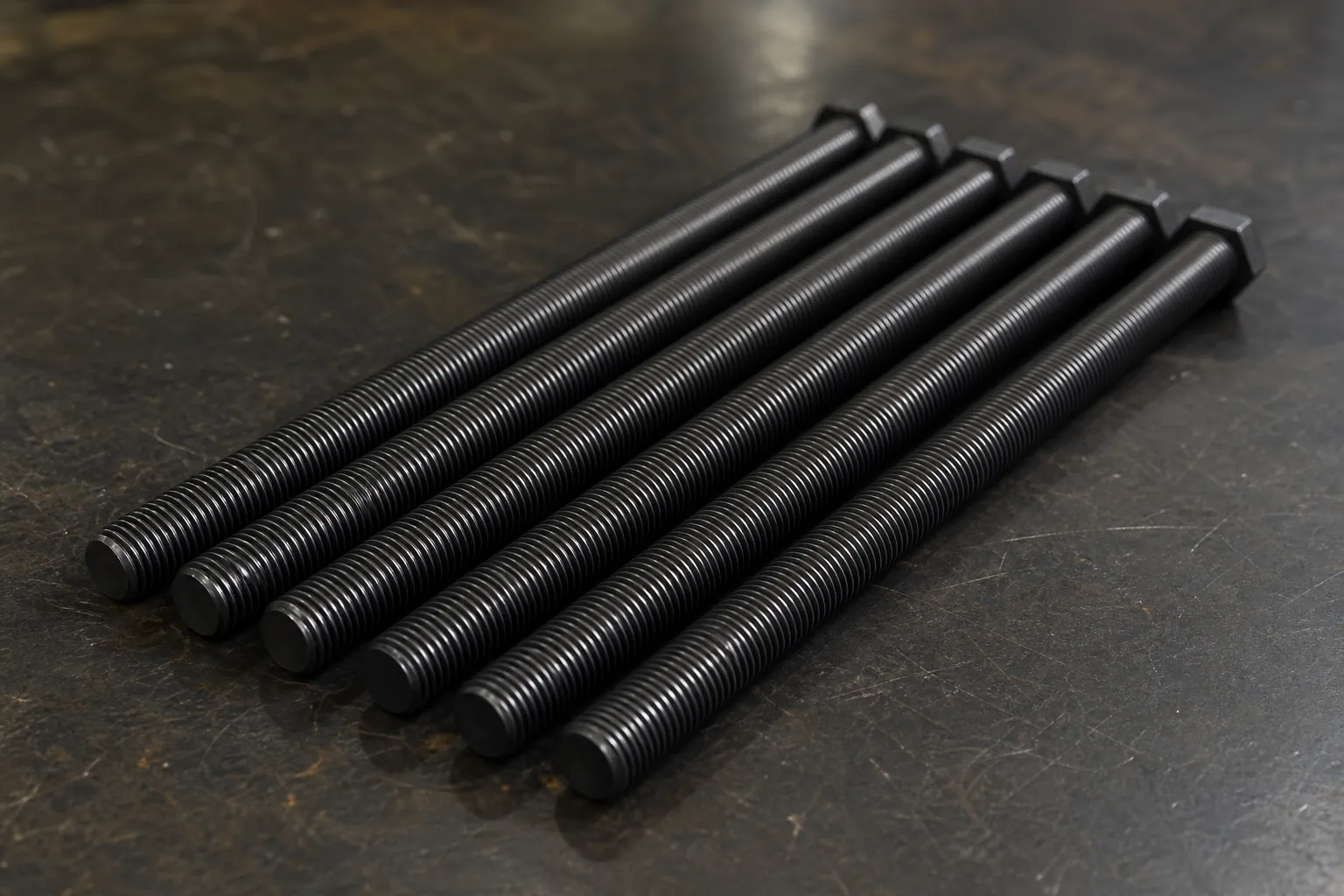
Ciri dan Cabaran Struktur
- Nisbah L/D Tinggi: Panjang 340mm menjadikan bolt sangat mudah terdedah kepada lenturan awal 0.5mm – 1.5mm selepas rawatan haba.
- Keperluan Ketepatan: The client required straightness within 0.2 mm; the case acceptance records were held under 0.1 mm.
- Keperluan Perlindungan: Proses meluruskan mesti memastikan sifar kerosakan pada ketepatan benang dan kualiti permukaan.
Why Heat Treatment Bends Long Bolts in the First Place
Understanding the distortion source is what makes a correction process defensible instead of decorative. During quenching, a long fastener cools unevenly: the section cools at different rates depending on orientation in the basket or fixture, agitation contact, and local mass differences between the plain shank, the threaded length and the head. Each cooling path wants to contract by a different amount, and the resulting locked-in stresses bend the part when it relaxes. The effect scales with length — which is why short bolts leave heat treatment usable while long ones of the same grade systematically arrive bent. Thread rolling and machining before treatment add their own stress history, and any straightening performed at the heat treater counts as prior deformation for everything done afterward.
Two practical consequences follow. Pertama, incoming inspection on long heat-treated bolts is not optional paperwork — the bend magnitude and pattern arriving at the straightening station determine both the correction plan and any supplier conversation, and the interaction of prior deformation with correction response is the reason reverse-loading behavior matters, as covered under the Bauschinger effect in straightening. Kedua, process decisions upstream — how parts are racked or basketed through quench, whether stress relief is applied — change the distribution the straightening station sees, and are usually the cheapest place to reduce total correction work.
Reading the Bend Before Correcting It
Long fasteners arrive with a small vocabulary of bend patterns, and naming the pattern is the first step of an efficient correction loop. A single-arc bow — one gentle curve, maximum near the middle — is the most common heat-treatment signature and the most straightforward to correct with supports positioned around the peak. An S-shaped double bend has two opposite peaks, usually reflecting two constraint points during quench, and demands two coordinated corrections rather than one big press at the largest reading. A local kink near the head or the thread runout concentrates distortion where section stiffness changes, and behaves differently from a distributed bow. Akhirnya, twist about the axis occasionally accompanies bending on parts with asymmetric features. Each pattern requires its own measurement map and correction sequence, which is why an automatic station that scans the full length and builds the map before pressing — rather than chasing the single worst reading — converges in fewer strokes. The measuring-and-correcting loop behind this is described for automatic shaft straightening generally, and for the long-bolt family specifically in the automatic long bolt straightening process.
Mengapa Bolt Straightening Mesti Beralih dari “Memalu Manual”
Proses Tradisional lwn. Penyelesaian Automatik
The figures below are this client’s reported baseline and post-commissioning values, not a universal benchmark for every fastener line.
| Titik Sakit | Memalu Manual / Tekan Manual | Penyelesaian Meluruskan Automatik |
| Keperluan Buruh | 8 workers per shift (manual baseline, reported case) | 1 pengendali untuk 4 mesin (reported case) |
| Kelurusan | 0.2 – 0.5 mm spread (reported manual baseline) | ≤ 0.1mm (client acceptance records) |
| Masa Kitaran | 120 – 180 s/piece (reported manual baseline) | 10 – 15 s/piece (reported case) |
| Kos Keseluruhan | High labor cost per corrected part | Manpower reduced from 8 operators to 1 supervising 4 mesin (reported case) |
Aliran Proses Meluruskan Bolt Automatik
Penyelesaian ini merangkumi proses automatik gelung tertutup penuh daripada penyuapan kepada pengisihan, memastikan setiap bolt memenuhi keperluan penghantaran standard tinggi.
Penerangan Proses Teras
- Auto-Makan: Bolt bengkok dimasukkan secara automatik dari corong ke stesen pelurus tanpa campur tangan manusia.
- Pengukuran Dinamik: Penderia ketepatan tinggi mengimbas bahan kerja berputar dalam masa nyata, menangkap titik lentur maksimum dengan tepat merentasi keseluruhan panjang.
- Menekan Servo: Sistem pintar secara automatik mengira spring-back berdasarkan bahan (keluli karbon/keluli aloi), dan ram servo menggunakan tekanan yang tepat untuk pembetulan satu laluan.
- Auto-Isih: Bolt yang layak meneruskan ke peringkat seterusnya, while non-conforming parts are automatically isolated before they leave the machine.

Mesin pelurus bolt UBJ-80
Pelurus ini sesuai untuk bahagian siap yang dirawat haba (cth., komponen mesin setem/pejabat, alat ganti kereta/motosikal, alatan, skru) dan bar (keluli, tembaga, aluminium, keluli tahan karat, aloi titanium) dengan panjang 60–600mm & φ3–φ25mm diameter. Ia meningkatkan ketepatan dan kualiti produk.
Cabaran dan Penyelesaian Pembetulan Teras
Cabaran 1: Manning and the Reported “1 Operator untuk 4 Mesin” Kes
Huraian Masalah: Manual hammering and press correction depend on operator skill, stamina and shift discipline, so manning levels stay high and results vary from operator to operator.
Penyelesaian:
Penyelesaian kami melaksanakan automasi gelung tertutup penuh. Logik operasi adalah sangat mudah, dengan resipi terbina dalam untuk pelbagai spesifikasi bolt. Seorang pekerja standard hanya perlu mengisi semula corong secara berkala; selebihnya-pengukuran, meluruskan, dan pemeriksaan—dikendalikan secara automatik oleh mesin. Ini menyelesaikan kekurangan buruh dan menghapuskan penurunan ketepatan yang disebabkan oleh keletihan.
Cabaran 2: Menjamin Ketekalan dalam Ketepatan 0.1mm
Huraian Masalah: Apabila bolt dikenakan hentakan tukul, pengagihan tekanan dalaman menjadi tidak sekata, selalunya membawa kepada pembetulan berlebihan di kawasan setempat.
Penyelesaian:
Penyelesaiannya menggunakan a sistem kawalan servo berparameter sepenuhnya. Tidak seperti penilaian manusia yang samar-samar, sensor mengesan lengkung paksi bolt dengan ketepatan tahap mikron. Melalui algoritma servo berbilang langkah, sistem dengan tepat mengatasi spring-back anjal S45C atau keluli aloi, locking final straightness within the 0.1 mm window achieved on this client’s qualified recipe.
How Thread and Head Zones Are Protected During Correction
Thread protection is a contact-zone engineering problem, and the principles are the same ones that govern surface-protection tooling across straightening applications. The correction force and the reaction forces both need somewhere to live, and on a long bolt the plain shank is the region designed to carry load, while the threaded length and the under-head fillet are the regions most easily damaged. A protection concept therefore has three parts: place supports on the shank at controlled span positions around the bend peak; direct press contact onto the shank through tooling that conforms to the section instead of touching thread crests; and keep every edge that could contact the workpiece generously radiused so load spreads instead of concentrating. Cleanliness belongs in the same sentence — debris trapped between press tooling and a thread flank is a scratch generator, and on plated or coated bolts the coating class defines how much contact the finish can tolerate at all.
The validation side is equally concrete. A thread-protection claim is proven by inspection agreed before the trial — thread gauges still running, flank condition reviewed under the method the quality function specifies — together with the released-state straightness result, on representative parts, after repeat setups. Protection and geometry are accepted together or not at all.
What an Acceptance Criteria Package Should Contain
A bolt straightening process is only as good as the acceptance definition it answers to, and a complete one answers five questions in writing. What characteristic governs — straightness of the axis, measured how: on centers, on supports, berputar, in what condition, since a reading under restraint is not a released result, per loaded versus released measurement practice. What the limit is, and where it applies — full length or specified spans. What else must survive the process — thread fit, kemasan permukaan, salutan, head markings. How conformity is sampled — every part through an automatic gauge, or a sampling plan with defined reaction to a failure. And what happens to nonconforming parts — rework limits, segregation and disposition authority, following the NOK sorting and rework-limit framework. Buyers comparing straightening suppliers are well advised to ask for exactly this package; the ability to produce it says more about a supplier than any single machine specification.
Kes Pembuatan: Pilihan Keempat Pelanggan India
Latar Belakang Pelanggan
Pembekal pengikat India yang terkenal menyediakan komponen untuk jenama jentera pembinaan global.
Keputusan Pelaksanaan
- Pesanan Berulang: Berdasarkan prestasi cemerlang tiga unit pertama, pelanggan baru-baru membeli mereka 4mesin ke.
- Operator Consolidation: The client reported one operator managing all 4 machines after commissioning, with a substantial increase in output per operator.
- Penanda Aras Kualiti: The client’s records report straightness moving from 0.2 mm down to under 0.1 mm after commissioning.
Soalan Lazim
- Q: Adakah ram pelurus akan merosakkan benang bolt?
- Tidak. Kami telah merancang tidak bersentuhan, acuan perlindungan berkusyen khusus untuk meluruskan bolt. Blok akhbar sepadan dengan kelengkungan bolt dengan sempurna, memastikan pengagihan daya sekata dan mengelakkan lekukan permukaan.
- Q: Bolehkah peralatan itu disepadukan ke dalam sistem MES kilang kami?
- ya. Sistem kawalan kami menampilkan antara muka data standard untuk merekod dan mengeksport data pelurus masa nyata untuk setiap bolt, memenuhi keperluan kebolehkesanan moden.
Additional Process Questions
Why do bolts from the same heat-treatment lot arrive with different bend patterns?
Because each part’s position in the basket or rack gave it a different cooling path. Quench distortion is sensitive to orientation, local mass and agitation contact, so even identical bolts leave treatment with different locked-in stress patterns. Mapping incoming parts rather than assuming a uniform error is the practical answer, and it is why scanning-based stations build a per-part correction plan.
How many correction passes does a long bolt need?
It depends on the pattern, not a fixed number. A single-arc bow typically converges in one planned press; an S-bend needs two coordinated corrections; local kinks near section changes respond differently again. The governing rule is a rework limit set before production — parts that stop responding are routed to review, not pressed repeatedly, because each additional plastic cycle consumes fatigue life and changes the material’s response.
Should straightening come before or after thread rolling?
The route belongs to the fastener process engineer, but the trade-off is explicit: correcting before thread rolling lets subsequent operations work from a straight blank, while correcting after heat treatment with finished threads demands the contact-zone protection described above. Whichever route is chosen, the acceptance package must define what state the straightness limit applies to, and the correction validation must be run on parts carrying that state.
Ringkasan
Untuk kilang pengikat yang mengejar kecekapan dan kualiti yang tinggi, an Penyelesaian Meluruskan Bolt Automatik adalah laluan penting untuk meningkatkan daya saing. Whether the target is lower manning or 0.1 mm delivery precision, the figures in this article are one client’s reported case; your own results depend on the bolt family, incoming distortion and acceptance definition.
Jika anda menghadapi isu pengurusan buruh atau kesesakan ketepatan, berasa bebas untuk Hubungi Kami untuk cadangan teknikal yang disesuaikan.