
Az automatikus egyengetés olyan folyamatjeleket generálhat, amelyek vizsgálatot érdemelnek: váratlan erő-elmozdulás reakciója, akusztikus esemény, abnormális geometriaváltozás, ismételt korrekciós hiba vagy más meghatározott állapot. Ezek a jelek segíthetnek a gyártósor leállításában, izolálja és irányítsa át az alkatrészt felülvizsgálatra. Nem jelentik automatikusan azt, hogy repedés létezik, és nem helyettesítik automatikusan a minősített NDT módszert.
Ez a cikk egy kockázatkezelési keretrendszer. Nem állítja, hogy a StraighteningTech jelenleg repedésérzékelő érzékelőket szállít, meghatározott repedésméretet észlel, megfelel egy adott szabványnak, vagy helyettesíti a mágneses részecskét, ultrahangos, örvényáramú vagy egyéb formális ellenőrzés. Ezek a képességek külön ellenőrzött módszert igényelnek, ismert minták és a minőségbiztosítási rendszer jóváhagyása.

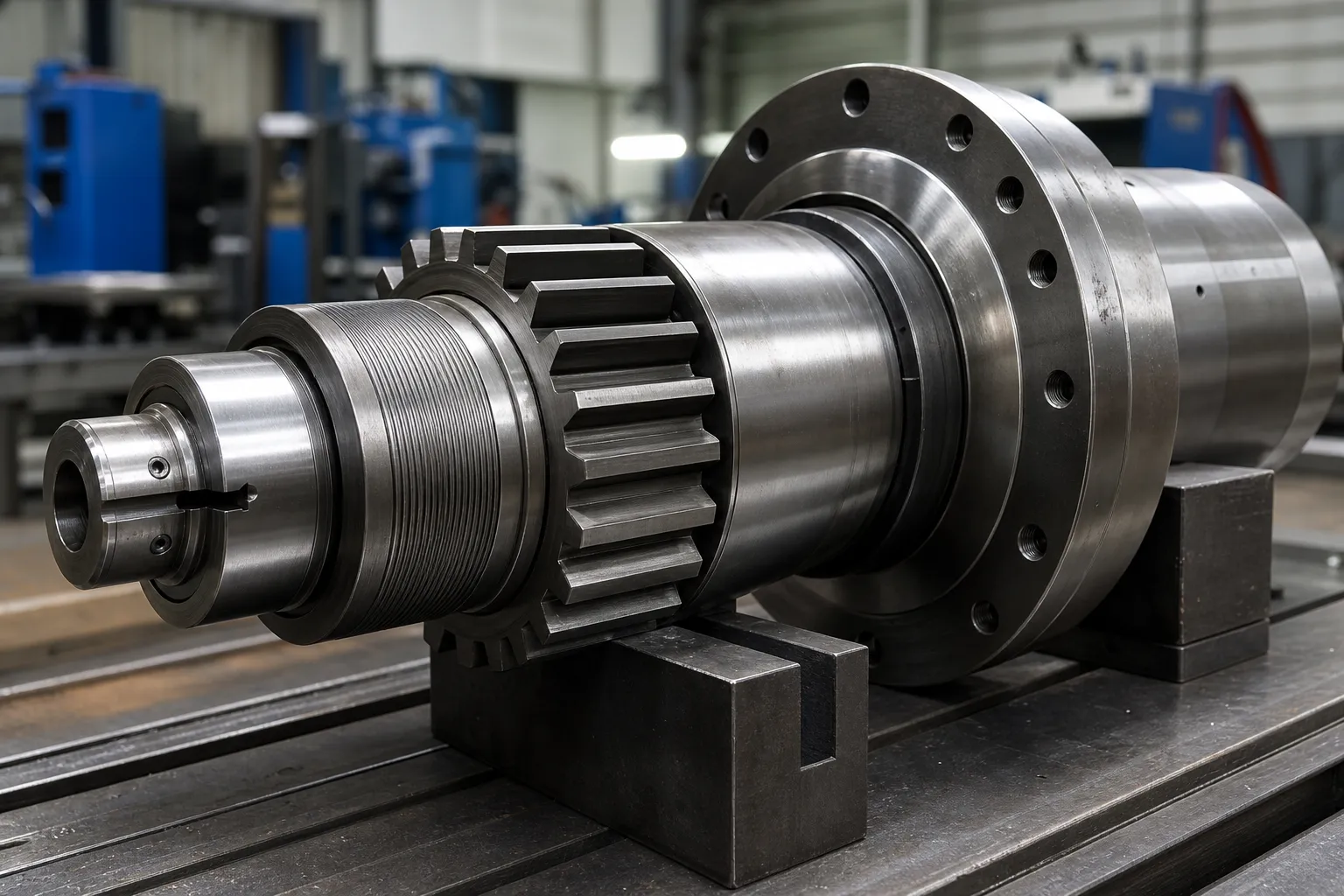
*Mérnöki koncepció illusztráció. Megmutat egy jelölt mérési és korrekciós kontextust; nem azt jelzi, hogy repedésérzékelő vagy érzékelő algoritmus van telepítve.*
A fejlesztési tervben az ismert normált kell használni, ismert gyanúsított és, ahol megengedett, ismert referenciafeltételek annak megállapítására, hogy a jel korrelál-e a szükséges döntéssel. Nem következtethet az észlelési teljesítményre a versenytársak szolgáltatáslistájából vagy egyetlen sikeres kísérletből.
Why Straightening Is a Natural Integrity Checkpoint
Cracks relevant to straightening have a short list of origins: prior manufacturing wrote them in, or the correction process itself put them there. On the incoming side, quench cracks from heat treatment, seams and folds from rolling or drawing, and grinding abuse on machined surfaces all exist before the part reaches the press — and a part carrying a sharp discontinuity responds differently to plastic bending than a sound one, because the discontinuity concentrates strain locally. On the process side, aggressive correction, repeated reverse bending, and correcting a material in a brittle condition can initiate cracks that no incoming inspection would have found. The two categories demand different responses: incoming cracks are a supplier-quality problem surfaced at your station, while process-initiated cracks are a process-design problem owned inside the correction loop — the boundary worked through in túlzott kiegyenesedés és repedés.
Akárhogy is, the straightening station sees the part in a state no inspection bench replicates: under load, in plastic deformation, with its stiffness and response visible stroke by stroke. That is why the press is a natural integrity checkpoint even though it is not an NDT instrument. The signals are there for the taking; the engineering work is making them mean something.
The Signal Families Available at the Press
Four signal families are realistically available on straightening equipment, and each has a distinct information content. Force–displacement behavior is the richest: a sound section deforms along a repeatable curve, and departures from the qualified curve shape — an early load drop, an unexpected plateau, a step in the response — indicate that the section is behaving abnormally somewhere along the load path, whether from a material discontinuity, a setup fault or a geometry outside the expected map. Acoustic events are the sharpest: a distinct release of strain energy is audible and can be sensed, though ambient noise on a production floor makes standalone acoustic detection fragile. Geometry response covers cases where the part moves less, more, or differently than the qualified correction model predicts — a crack crossing the correction zone reduces local stiffness and shows up as anomalous movement. Convergence failure — repeated correction attempts that never reach the target — is the slowest but most insidious signal, because its common causes are mundane, and the rare cause is a part that cannot be straightened because it is no longer continuous in the way the process assumes.
None of these families is specific to cracking. Each one answers “is this part behaving like the qualified population?”, nem “does this part contain a crack of a given size?”. That gap between anomaly detection and flaw detection is the honest boundary of process monitoring, and it is exactly why the verification route — not the alarm itself — carries the quality decision. The force–stroke interpretation background sits alongside point-press process practice, where the same curves are used for correction control.
Integrálja a kockázatkezelést a korrekciós hurokba
Ellenőrzött útvonal lehet:
- alkatrész/tétel azonosítása, rajz felülvizsgálata és jóváhagyott receptje;
- befejezni a bejövő ellenőrzéseket és a szigorúan elutasított ellenőrzéseket;
- állítsa fel a nullapontot és szerezze be az alapvonal geometriai/folyamatadatokat;
- hajtsa végre a jóváhagyott korrekciós sorozatot;
- értékelje a meghatározott folyamatjeleket és a geometriai választ;
- engedje el és mérje meg újra az alkatrészt;
- útvonal PASS, átdolgozható, külön-külön tartsa vissza az ellenőrzést és utasítsa el az eredményeket;
- nyomon követhetőségét, bizonyítékok és bírálói rendelkezés.
Az útvonalnak tartalmaznia kell a nem haladó feltételt. A várt válasz nélküli ismételt javítási kísérletek okot adhatnak az alkatrész leállítására és elkülönítésére, nem ok arra, hogy továbbra is erőt alkalmazzon.
Határozza meg a NOK elkülönítését és ellenőrzését
A NOK nem egy univerzális kategória. A vonalnak meg kell különböztetnie a mérési/beállítási problémát, folyamatfigyelő riasztás, megerősített nem megfelelőség, utómunkára jelölt és független vizsgálatot vagy mérnöki elhelyezést igénylő alkatrész. Fizikai elkülönítés, állapotcímkézés, meg kell határozni a nyomon követhetőséget és a kibocsátási jogosultságot.
*Mérnöki koncepció illusztráció. A folyamat-útválasztási döntéseket képviseli, nem telepített repedésérzékelő vagy automatikus válogató rendszer.*
| Esemény | Meghatározandó minimális válasz |
|---|---|
| A folyamatjel túllépi a küszöbértéket | Stop/tart szabály, adatgyűjtés és felelős felülvizsgálat |
| A geometria nem a várt módon reagál | Nem haladási korlát és műszaki értékelés |
| Hivatalos ellenőrzés szükséges | Jóváhagyott módszer, elfogadási kritérium és jogosultság |
| Megfontolt átdolgozás | Maximális próbálkozás, újramérés és külön minőségi jóváhagyás |
| Megerősített elutasítás | Elkülönítés, nyomon követhetőségi és selejtezési nyilvántartás |
A szélesebb vonalvezérlőkhöz, lásd NOK rendezési és átdolgozási határok és egyengető minta vizsgálat és átvétel.
Ahol a mérési válasz a vizsgálat részét képezi, gépi mérőműszer versus vevői mérőeszköz korreláció segít meghatározni a határvonalat a vonaljel és az ellenőrzött ügyfélfogadási mód között.
Thresholds, False Alarms and Missed Events
Any threshold drawn on a process signal trades two failure rates against each other. Set it tight, and normal part-to-part variation — different lots, temperature drift, tooling wear, honest measurement scatter — crosses it regularly, flooding the review route with good parts until operators learn to ignore alarms. Set it loose, and the abnormal parts that motivated the monitoring slip through unflagged. There is no datasheet value that resolves this trade; it is settled empirically by running the signal on a known-normal population to learn its spread, and where permitted, on known-suspect or seeded-reference parts to learn what the abnormal signature actually looks like. Only that pair of distributions justifies a threshold, and the honest summary of what was learned belongs in the validation record — including the false-alarm and missed-event behavior observed, not only the detections celebrated.
Two further rules keep thresholds honest over time. Első, drift monitoring: as tooling wears and material lots change, the normal population moves, so the threshold must be reviewed on a schedule, not set once. Második, change control: a new part revision, a different material family, or a reworked die changes the qualified population, and the threshold work starts over. These are the same habits that keep measurement systems credible, applied to process signals.
Where Formal NDT Fits After an Alert
When the review route decides a part needs a definitive answer, the method must match the question and the geometry. Magnetic-particle inspection suits ferrous parts and surface-breaking discontinuities, and it is fast enough for segregation decisions in moderate volumes. Penetrant testing suits non-ferrous surfaces where coating and cleanliness permit it. Eddy-current methods respond to near-surface condition and can run in-line, with sensitivity that depends strongly on coil geometry versus part geometry. Ultrasonic methods reach internal volumes along bar and shaft axes, at the cost of coupling, calibration blocks and operator discipline. Selecting among them is a quality-engineering decision driven by the flaw orientation expected, az anyagot, the surface state after straightening contact — witness marks and surface protection practices intersect here — and the acceptance authority. What the straightening station controls is not the NDT verdict but the integrity of the chain before it: the part is identified, isolated, protected from further correction attempts, and accompanied by its process data so the inspector knows why it was pulled.
Érvényesítés a képességigénylés előtt
Egy felelős érvényesítési csomag azonosítja a munkadarab családot, anyag/folyamat állapota, érzékelési/monitoring módszerrel, mintapopuláció, ismert állapotú referenciák, küszöbértékeket, várható eltérés, téves riasztás és elmulasztott esemény értékelése, ellenőrzési útvonal, adatmegőrzés és minőségi jóváhagyás. Kimondja azt is, amit a rendszer nem tud bizonyítani.
Egy folyamatjel-oldal sem állíthatja, hogy minden repedést megtalál, helyettesíti az NDT-t vagy garantálja az anyag sértetlenségét jóváhagyás nélkül, munkadarab-specifikus bizonyítékcsomag.
GYIK
A folyamatriasztás bizonyítja-e, hogy repedés van?
Nem. Olyan állapotot jelez, amely a meghatározott felülvizsgálati útvonalat igényli. Az okot a jóváhagyott módszerrel kell értékelni.
Az automatikus egyengetés helyettesítheti az NDT-t?
Nem. A kiegyenesítő folyamatfigyelés és a formális NDT célja eltérő, módszerek és elfogadási kötelezettségek.
Egy alkatrész korlátlanul átdolgozható-e riasztás után?
Nem. A folyamat megköveteli a korrekciós kísérlet maximális határát és egy meghatározott műszaki/minőségi elhelyezési útvonalat.
Which signal family catches cracks best?
None of them catches cracks in the NDT sense. Force–displacement behavior, acoustic events, geometry response and convergence failure all flag parts that behave unlike the qualified population. A part flagged by any of them goes to the verification route; a part that passes all of them is not certified crack-free — it simply behaved normally. That asymmetry is the design premise of every process-monitoring scheme on straightening lines.
How are thresholds set without a standard to cite?
Empirically, on populations. Run the chosen signal across a known-normal production sample to characterize its spread, and where reference conditions are available, across known-suspect parts to characterize the abnormal signature. The threshold is then drawn against both distributions, documented with observed false-alarm and missed-event behavior, and reviewed on a schedule as tooling, lots and seasons change.
What happens to a part after an alert is cleared?
Whatever the written route says, and only that: return to the normal flow with the event recorded, proceed to rework under the attempt limit, or pass to formal inspection with disposition authority named in advance. The failure mode to design against is the quiet return of alerted parts to the good bin by operator judgment, which is why physical segregation and labeling carry as much weight as the signal itself.

*Mérnöki koncepció illusztráció.*
Erő-eltolódási görbék az egyenesítésben
Egy dedikált oldal a egyengető erő elmozdulási görbevezető nem karbantartható érvényesített lekérdezési igény nélkül. Force's Troke értelmezése, a biztonságos határértékeket és a folyamatleállítási feltételeket a pontprés ismerteti, többpontos és repedésérzékelő oldalak. Minden görbe alapú riasztást a reprezentatív alkatrészeken kell érvényesíteni, nem pedig egy másik anyagcsaládból másolni.
Crack detection is strongest when the process prevents cracks in the first place – lásd túlzott kiegyenesedés és repedés for the causes, és a kézi és automatikus összehasonlítás for why automated correction limits reduce the risk.