
A kötőelemeket gyártó iparban, a hőkezelés utáni hosszú csavarok behajlítása univerzális fájdalompont. Hagyományos “kézi kalapálás” nemcsak nem hatékony, de nem garantálja az egyenletes pontosságot. Ez a cikk egy speciális Automatizált csavaregyenesítő megoldás: demonstrating a reported client case in which automation took an 8-person manual line to one operator supervising four machines, with straightness held within 0.1 mm on the client’s acceptance records.
What is the Bolt?
A csavarok a gépek alapvető rögzítőelemei, építés, és az autóipar. Ennek a megoldásnak a tipikus munkadarabja egy nagy szilárdságú hosszú csavar: 15mm átmérőjű, 340mm hosszúságú.
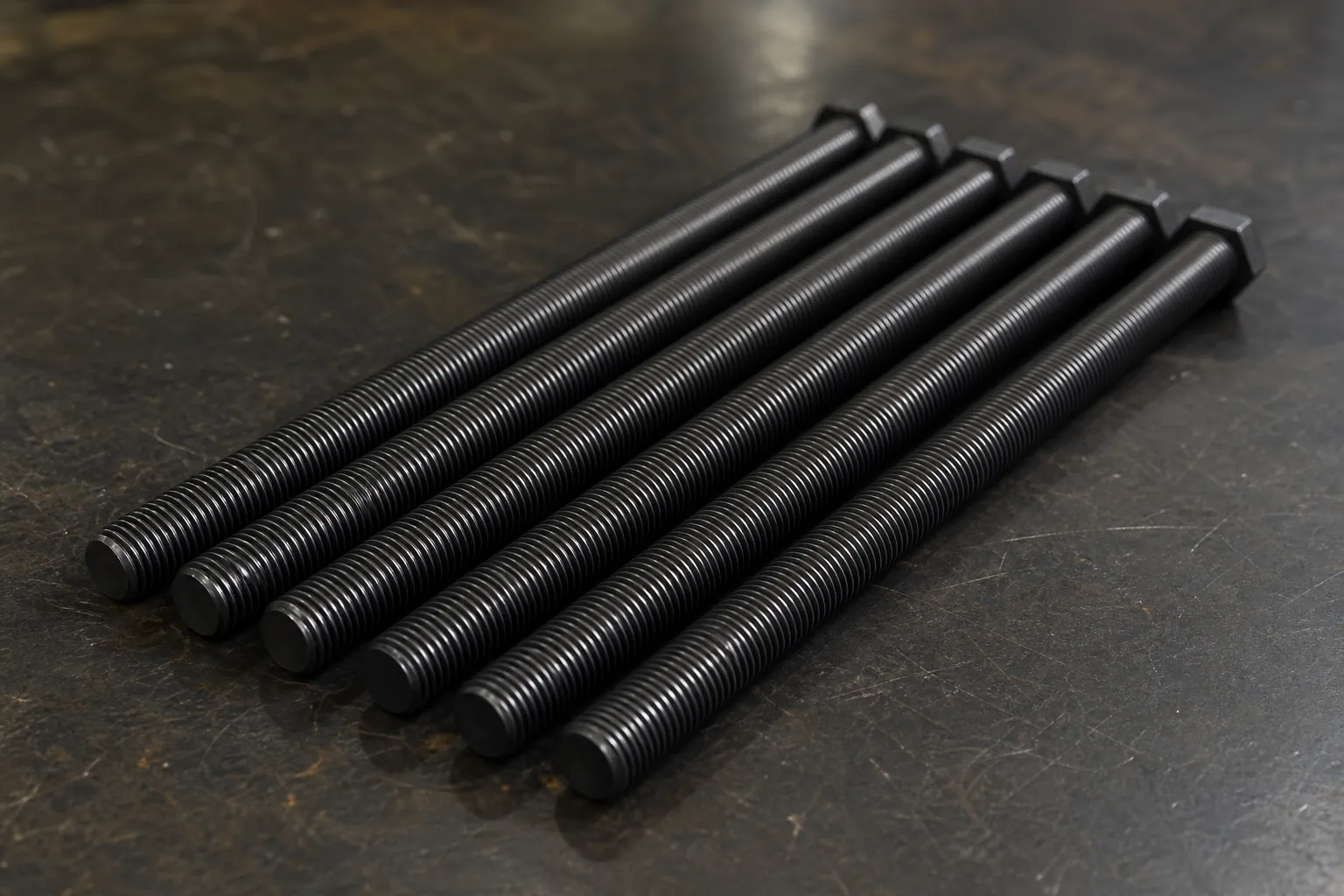
Szerkezeti jellemzők és kihívások
- Magas L/D arány: A 340 mm-es hossznak köszönhetően a csavar nagyon érzékeny a kezdeti 0,5 mm-es hajlításra – 1.5mm hőkezelés után.
- Pontossági követelmények: The client required straightness within 0.2 mm; the case acceptance records were held under 0.1 mm.
- Védelmi követelmények: Az egyengetési folyamatnak biztosítania kell a menet pontosságának és a felületi minőségnek a sérülésmentességét.
Why Heat Treatment Bends Long Bolts in the First Place
Understanding the distortion source is what makes a correction process defensible instead of decorative. During quenching, a long fastener cools unevenly: the section cools at different rates depending on orientation in the basket or fixture, agitation contact, and local mass differences between the plain shank, the threaded length and the head. Each cooling path wants to contract by a different amount, and the resulting locked-in stresses bend the part when it relaxes. The effect scales with length — which is why short bolts leave heat treatment usable while long ones of the same grade systematically arrive bent. Thread rolling and machining before treatment add their own stress history, and any straightening performed at the heat treater counts as prior deformation for everything done afterward.
Two practical consequences follow. Első, incoming inspection on long heat-treated bolts is not optional paperwork — the bend magnitude and pattern arriving at the straightening station determine both the correction plan and any supplier conversation, and the interaction of prior deformation with correction response is the reason reverse-loading behavior matters, as covered under a Bauschinger-effektus az egyenesítésben. Második, process decisions upstream — how parts are racked or basketed through quench, whether stress relief is applied — change the distribution the straightening station sees, and are usually the cheapest place to reduce total correction work.
Reading the Bend Before Correcting It
Long fasteners arrive with a small vocabulary of bend patterns, and naming the pattern is the first step of an efficient correction loop. A single-arc bow — one gentle curve, maximum near the middle — is the most common heat-treatment signature and the most straightforward to correct with supports positioned around the peak. An S-shaped double bend has two opposite peaks, usually reflecting two constraint points during quench, and demands two coordinated corrections rather than one big press at the largest reading. A local kink near the head or the thread runout concentrates distortion where section stiffness changes, and behaves differently from a distributed bow. Végül, twist about the axis occasionally accompanies bending on parts with asymmetric features. Each pattern requires its own measurement map and correction sequence, which is why an automatic station that scans the full length and builds the map before pressing — rather than chasing the single worst reading — converges in fewer strokes. The measuring-and-correcting loop behind this is described for automatic shaft straightening generally, and for the long-bolt family specifically in the automatikus hosszú csavar kiegyenesítési folyamat.
Miért kell eltávolodni a csavarkiegyenesítéstől? “Kézi kalapácsolás”
Hagyományos eljárás vs. Automatizált megoldás
The figures below are this client’s reported baseline and post-commissioning values, not a universal benchmark for every fastener line.
| Fájdalompont | Kézi kalapácsolás / Kézi megnyomás | Automatizált egyengető megoldás |
| Munkaügyi Követelmény | 8 workers per shift (manual baseline, reported case) | 1 operator for 4 gépek (reported case) |
| Egyenesség | 0.2 – 0.5 mm spread (reported manual baseline) | ≤ 0,1 mm (client acceptance records) |
| Ciklusidő | 120 – 180 s/db (reported manual baseline) | 10 – 15 s/db (reported case) |
| Teljes költség | High labor cost per corrected part | Manpower reduced from 8 operators to 1 supervising 4 gépek (reported case) |
Automatizált csavaregyenesítési folyamat
Ez a megoldás egy teljes zárt hurkú automatizált folyamatot takar az adagolástól a válogatásig, biztosítja, hogy minden csavar megfeleljen a magas színvonalú szállítási követelményeknek.
Az alapvető folyamatleírások
- Automatikus etetés: A meghajlított csavarok automatikusan, emberi beavatkozás nélkül kerülnek a tartályból az egyengető állomásra.
- Dinamikus mérés: A nagy pontosságú érzékelők valós időben pásztázzák a forgó munkadarabot, a maximális hajlítási pont pontos rögzítése a teljes hosszon.
- Szervó préselés: Az intelligens rendszer automatikusan kiszámítja a visszarugózást az anyag alapján (szénacél/ötvözött acél), és a szervo nyomószár precíz nyomást fejt ki az egymenetes korrekció érdekében.
- Automatikus rendezés: A minősített csavarok továbblépnek a következő szakaszba, while non-conforming parts are automatically isolated before they leave the machine.

UBJ-80 csavar kiegyenesítő gép
Ez az egyengető ideális hőkezelt kész alkatrészekhez (például, bélyegző/irodagép alkatrészek, autó/motorkerékpár alkatrészek, eszközöket, csavarok) és bárok (acél, réz, alumínium, rozsdamentes acél, titán ötvözet) 60-600 mm hosszúságú & φ3–φ25 mm átmérőjű. Növeli a pontosságot és a termékminőséget egyaránt.
Alapvető egyenesítési kihívások és megoldások
Kihívás 1: Manning and the Reported “1 Operator for 4 Gépek” Case
Probléma leírása: Manual hammering and press correction depend on operator skill, stamina and shift discipline, so manning levels stay high and results vary from operator to operator.
Megoldás:
Megoldásunk megvalósítja teljes zárt hurkú automatizálás. A működési logika rendkívül egyszerű, beépített receptekkel a különféle csavarspecifikációkhoz. Egy átlagos dolgozónak csak időnként kell újratöltenie a garatot; a többi – mérés, kiegyenesítés, és ellenőrzés – a gép automatikusan kezeli. Ez megoldja a munkaerőhiányt és kiküszöböli a fáradtság okozta precíziós eséseket.
Kihívás 2: Konzisztencia garantált 0,1 mm-es pontossággal
Probléma leírása: Amikor egy csavart kalapácsütés ér, a belső feszültségeloszlás egyenetlenné válik, gyakran túlkorrekcióhoz vezet a lokalizált területeken.
Megoldás:
A megoldás a teljesen paraméterezett szervo vezérlőrendszer. Ellentétben a homályos emberi ítélettel, Az érzékelők mikron szintű pontossággal érzékelik a csavar axiális görbéjét. Többlépcsős szervo algoritmusokon keresztül, a rendszer pontosan legyőzi az S45C vagy ötvözött acélok rugalmas visszarugózását, locking final straightness within the 0.1 mm window achieved on this client’s qualified recipe.
How Thread and Head Zones Are Protected During Correction
Thread protection is a contact-zone engineering problem, and the principles are the same ones that govern surface-protection tooling across straightening applications. The correction force and the reaction forces both need somewhere to live, and on a long bolt the plain shank is the region designed to carry load, while the threaded length and the under-head fillet are the regions most easily damaged. A protection concept therefore has three parts: place supports on the shank at controlled span positions around the bend peak; direct press contact onto the shank through tooling that conforms to the section instead of touching thread crests; and keep every edge that could contact the workpiece generously radiused so load spreads instead of concentrating. Cleanliness belongs in the same sentence — debris trapped between press tooling and a thread flank is a scratch generator, and on plated or coated bolts the coating class defines how much contact the finish can tolerate at all.
The validation side is equally concrete. A thread-protection claim is proven by inspection agreed before the trial — thread gauges still running, flank condition reviewed under the method the quality function specifies — together with the released-state straightness result, on representative parts, after repeat setups. Protection and geometry are accepted together or not at all.
What an Acceptance Criteria Package Should Contain
A bolt straightening process is only as good as the acceptance definition it answers to, and a complete one answers five questions in writing. What characteristic governs — straightness of the axis, measured how: on centers, on supports, forgó, in what condition, since a reading under restraint is not a released result, per betöltött versus kiadott mérési gyakorlat. What the limit is, and where it applies — full length or specified spans. What else must survive the process — thread fit, felületkezelés, bevonat, head markings. How conformity is sampled — every part through an automatic gauge, or a sampling plan with defined reaction to a failure. And what happens to nonconforming parts — rework limits, segregation and disposition authority, following the NOK rendezés és átdolgozás-limit keretrendszer. Buyers comparing straightening suppliers are well advised to ask for exactly this package; the ability to produce it says more about a supplier than any single machine specification.
Gyártási tok: Az indiai ügyfél negyedik választása
Ügyfél háttér
Egy jól ismert indiai kötőelem-beszállító, amely globális építőipari gépmárkák számára szállít alkatrészeket.
Megvalósítási eredmények
- Ismételt parancsok: Az első három egység kiemelkedő teljesítménye alapján, az ügyfél nemrég vásárolta meg 4th gép.
- Operator Consolidation: The client reported one operator managing all 4 machines after commissioning, with a substantial increase in output per operator.
- Minőségi viszonyítási alap: The client’s records report straightness moving from 0.2 mm down to under 0.1 mm after commissioning.
GYIK
- K: Az egyengető henger károsítja-e a csavarmeneteket?
- Nem. Mi terveztük érintkezésmentes, párnázott védőformák kifejezetten csavaregyenesítéshez. A nyomótömbök tökéletesen illeszkednek a csavar görbületéhez, egyenletes erőeloszlást és a felületi benyomódások elkerülését biztosítva.
- K: Integrálható-e a berendezés gyárunk MES rendszerébe?
- Igen. Vezérlőrendszerünk szabványos adatfelületekkel rendelkezik, amelyek minden csavarhoz rögzítik és exportálják a valós idejű egyengetési adatokat, megfelel a modern nyomon követhetőségi követelményeknek.
Additional Process Questions
Why do bolts from the same heat-treatment lot arrive with different bend patterns?
Because each part’s position in the basket or rack gave it a different cooling path. Quench distortion is sensitive to orientation, local mass and agitation contact, so even identical bolts leave treatment with different locked-in stress patterns. Mapping incoming parts rather than assuming a uniform error is the practical answer, and it is why scanning-based stations build a per-part correction plan.
How many correction passes does a long bolt need?
It depends on the pattern, not a fixed number. A single-arc bow typically converges in one planned press; an S-bend needs two coordinated corrections; local kinks near section changes respond differently again. The governing rule is a rework limit set before production — parts that stop responding are routed to review, not pressed repeatedly, because each additional plastic cycle consumes fatigue life and changes the material’s response.
Should straightening come before or after thread rolling?
The route belongs to the fastener process engineer, but the trade-off is explicit: correcting before thread rolling lets subsequent operations work from a straight blank, while correcting after heat treatment with finished threads demands the contact-zone protection described above. Whichever route is chosen, the acceptance package must define what state the straightness limit applies to, and the correction validation must be run on parts carrying that state.
Összegzés
Kötőelemgyárak számára, amelyek magas hatékonyságra és minőségre törekszenek, an Automatizált csavaregyenesítő megoldás a versenyképesség növelésének alapvető útja. Whether the target is lower manning or 0.1 mm delivery precision, the figures in this article are one client’s reported case; your own results depend on the bolt family, incoming distortion and acceptance definition.
Moving from manual bolt correction toward automation? A manual vs automatic selection logic és a ROI tok automatikus egyengetéshez are the natural next steps.
Ha munkaerő-gazdálkodási problémákkal vagy precíziós szűk keresztmetszettel kell szembenéznie, nyugodtan Lépjen kapcsolatba velünk személyre szabott műszaki ajánlatért.