
Nan endistri manifakti Fastener, koube nan boulon long apre tretman chalè se yon pwen doulè inivèsèl. Tradisyonèl “mato manyèl” se pa sèlman efikas, men tou echwe pou garanti presizyon ki konsistan. Atik sa a pataje yon espesyalis Otomatik boulon redresman solisyon: demonstrating a reported client case in which automation took an 8-person manual line to one operator supervising four machines, with straightness held within 0.1 mm on the client’s acceptance records.
What is the Bolt?
Boulon yo se fixation fondamantal pou machin nan, konstriksyon, ak endistri otomobil. Pyès tipik pou solisyon sa a se yon boulon long ki gen gwo fòs: 15mm dyamèt, 340mm longè.
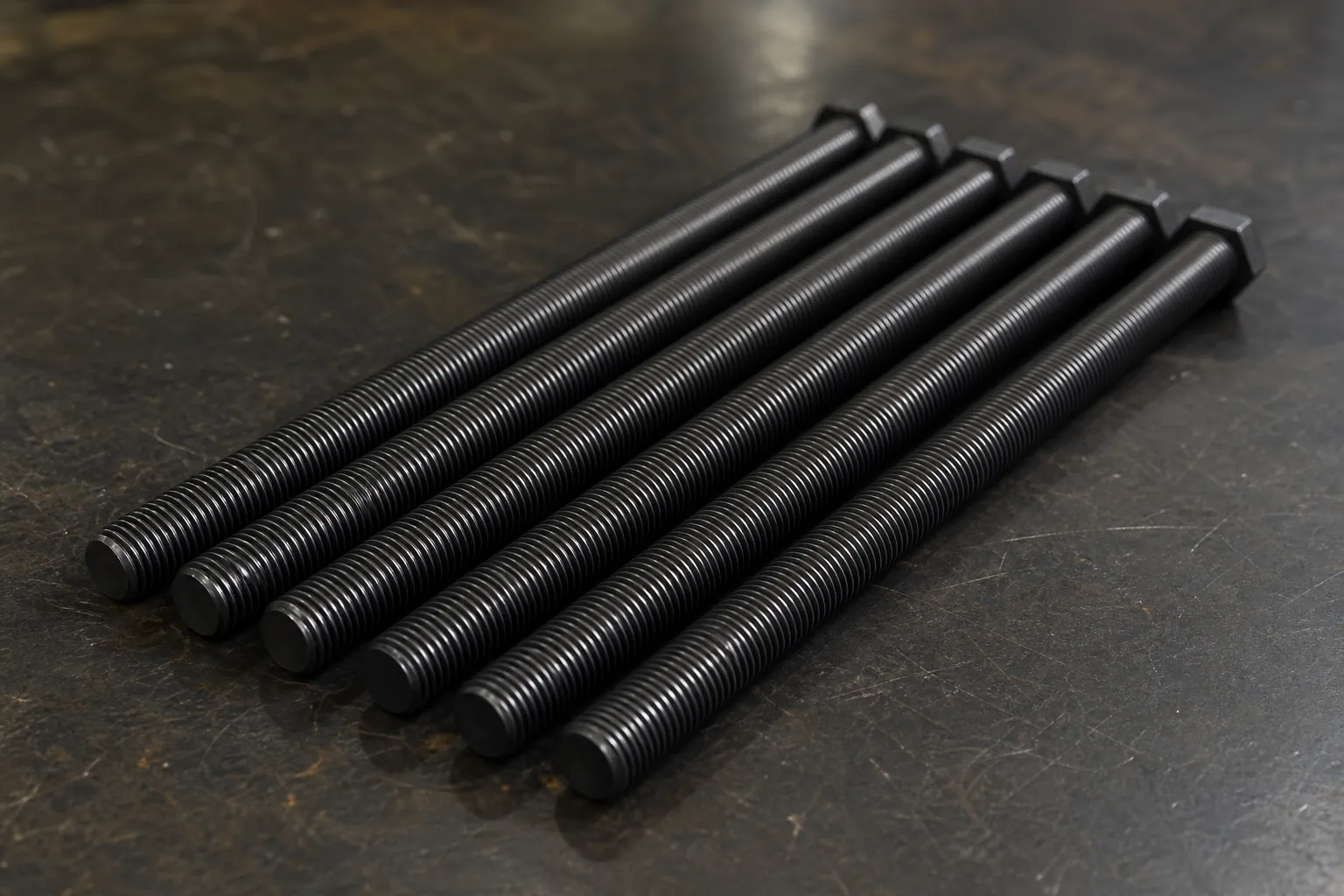
Karakteristik estriktirèl ak defi
- Segondè rapò L/D: Longè a 340mm fè boulon an trè sansib a yon koube inisyal nan 0.5mm – 1.5mm apre tretman chalè.
- Kondisyon presizyon: The client required straightness within 0.2 mm; the case acceptance records were held under 0.1 mm.
- Kondisyon Pwoteksyon: Pwosesis redresman an dwe asire zewo domaj nan presizyon fil ak bon jan kalite sifas yo.
Why Heat Treatment Bends Long Bolts in the First Place
Understanding the distortion source is what makes a correction process defensible instead of decorative. During quenching, a long fastener cools unevenly: the section cools at different rates depending on orientation in the basket or fixture, agitation contact, and local mass differences between the plain shank, the threaded length and the head. Each cooling path wants to contract by a different amount, and the resulting locked-in stresses bend the part when it relaxes. The effect scales with length — which is why short bolts leave heat treatment usable while long ones of the same grade systematically arrive bent. Thread rolling and machining before treatment add their own stress history, and any straightening performed at the heat treater counts as prior deformation for everything done afterward.
Two practical consequences follow. Premye, incoming inspection on long heat-treated bolts is not optional paperwork — the bend magnitude and pattern arriving at the straightening station determine both the correction plan and any supplier conversation, and the interaction of prior deformation with correction response is the reason reverse-loading behavior matters, as covered under efè Bauschinger nan redresman. Dezyèmman, process decisions upstream — how parts are racked or basketed through quench, whether stress relief is applied — change the distribution the straightening station sees, and are usually the cheapest place to reduce total correction work.
Reading the Bend Before Correcting It
Long fasteners arrive with a small vocabulary of bend patterns, and naming the pattern is the first step of an efficient correction loop. A single-arc bow — one gentle curve, maximum near the middle — is the most common heat-treatment signature and the most straightforward to correct with supports positioned around the peak. An S-shaped double bend has two opposite peaks, usually reflecting two constraint points during quench, and demands two coordinated corrections rather than one big press at the largest reading. A local kink near the head or the thread runout concentrates distortion where section stiffness changes, and behaves differently from a distributed bow. Finalman, twist about the axis occasionally accompanies bending on parts with asymmetric features. Each pattern requires its own measurement map and correction sequence, which is why an automatic station that scans the full length and builds the map before pressing — rather than chasing the single worst reading — converges in fewer strokes. The measuring-and-correcting loop behind this is described for automatic shaft straightening generally, and for the long-bolt family specifically in the automatic long bolt straightening process.
Poukisa boulon redresman dwe deplase lwen “Manyèl mato”
Pwosesis tradisyonèl vs. Otomatik solisyon
The figures below are this client’s reported baseline and post-commissioning values, not a universal benchmark for every fastener line.
| Pwen Doulè | Manyèl mato / Manyèl Press | Otomatik solisyon redresman |
| Egzijans Travay | 8 workers per shift (manual baseline, reported case) | 1 operator for 4 machin (reported case) |
| Dwat | 0.2 – 0.5 mm spread (reported manual baseline) | ≤ 0.1mm (client acceptance records) |
| Tan Sik | 120 – 180 s/moso (reported manual baseline) | 10 – 15 s/moso (reported case) |
| Pri an jeneral | High labor cost per corrected part | Manpower reduced from 8 operators to 1 supervising 4 machin (reported case) |
Otomatik boulon redresman pwosesis koule
Solisyon sa a kouvri yon bouk fèmen konplè otomatik ki soti nan manje jiska klasman, asire ke chak boulon satisfè kondisyon livrezon wo-estanda.
Deskripsyon Pwosesis Nwayo
- Oto-Manje: Boulon Bent yo otomatikman manje soti nan yon Hopper nan estasyon an redresman san entèvansyon imen.
- Mezi dinamik: Detèktè segondè-presizyon eskane materyo a wotasyon an tan reyèl, avèk presizyon kaptire pwen an pliye maksimòm sou tout longè a.
- Servo peze: Sistèm entelijan otomatikman kalkile sezon prentan-tounen ki baze sou materyèl la (asye kabòn / asye alyaj), ak belye mouton an servo aplike presyon egzak pou yon koreksyon sèl-pas.
- Oto-Triyay: Boulon ki kalifye ale nan pwochen etap la, while non-conforming parts are automatically isolated before they leave the machine.

UBJ-80 boulon redresman machin
Sa a straightener se ideyal pou pati fini trete chalè (pa egzanp, Stamping / konpozan machin biwo, pati oto / motosiklèt, zouti, vis) ak ba (asye, kwiv, aliminyòm, asye pur, alyaj Titàn) nan longè 60-600mm & φ3–φ25mm dyamèt. Li ranfòse tou de presizyon ak bon jan kalite pwodwi.
Nwayo redresman defi ak solisyon
Defi 1: Manning and the Reported “1 Operatè pou 4 Machin” Case
Deskripsyon pwoblèm: Manual hammering and press correction depend on operator skill, stamina and shift discipline, so manning levels stay high and results vary from operator to operator.
Solisyon:
Solisyon nou an aplike automatisation konplè bouk fèmen. Lojik operasyon an trè senp, ak bati-an resèt pou espesifikasyon boulon divès kalite. Yon travayè estanda sèlman bezwen ranpli Hopper a detanzantan; rès la-mezi, redresman, ak enspeksyon-se okipe otomatikman pa machin nan. Sa a rezoud mank travayè ak elimine gout presizyon ki te koze pa fatig.
Defi 2: Garanti konsistans nan 0.1mm Precision
Deskripsyon pwoblèm: Lè yon boulon sibi frape mato, distribisyon estrès entèn vin inegal, souvan ki mennen nan koreksyon twòp nan zòn lokalize yo.
Solisyon:
Solisyon an itilize yon sistèm kontwòl servo konplètman paramèt. Kontrèman ak jijman vag imen, detèktè detekte koub axial boulon an ak presizyon nan nivo micron. Atravè algoritm servo milti-etap, sistèm nan jisteman genyen batay la elastik sezon prentan-tounen nan S45C oswa asye alyaj, locking final straightness within the 0.1 mm window achieved on this client’s qualified recipe.
How Thread and Head Zones Are Protected During Correction
Thread protection is a contact-zone engineering problem, and the principles are the same ones that govern surface-protection tooling across straightening applications. The correction force and the reaction forces both need somewhere to live, and on a long bolt the plain shank is the region designed to carry load, while the threaded length and the under-head fillet are the regions most easily damaged. A protection concept therefore has three parts: place supports on the shank at controlled span positions around the bend peak; direct press contact onto the shank through tooling that conforms to the section instead of touching thread crests; and keep every edge that could contact the workpiece generously radiused so load spreads instead of concentrating. Cleanliness belongs in the same sentence — debris trapped between press tooling and a thread flank is a scratch generator, and on plated or coated bolts the coating class defines how much contact the finish can tolerate at all.
The validation side is equally concrete. A thread-protection claim is proven by inspection agreed before the trial — thread gauges still running, flank condition reviewed under the method the quality function specifies — together with the released-state straightness result, on representative parts, after repeat setups. Protection and geometry are accepted together or not at all.
What an Acceptance Criteria Package Should Contain
A bolt straightening process is only as good as the acceptance definition it answers to, and a complete one answers five questions in writing. What characteristic governs — straightness of the axis, measured how: on centers, on supports, wotasyon, in what condition, since a reading under restraint is not a released result, pou chak loaded versus released measurement practice. What the limit is, and where it applies — full length or specified spans. What else must survive the process — thread fit, fini sifas, kouch, head markings. How conformity is sampled — every part through an automatic gauge, or a sampling plan with defined reaction to a failure. And what happens to nonconforming parts — rework limits, segregation and disposition authority, following the NOK sorting and rework-limit framework. Buyers comparing straightening suppliers are well advised to ask for exactly this package; the ability to produce it says more about a supplier than any single machine specification.
Ka Faktori: Katriyèm Chwa Kliyan Endyen an
Background Kliyan
Yon distribitè Fastener Endyen ki byen koni bay konpozan pou mak machin konstriksyon mondyal yo.
Rezilta aplikasyon
- Repete Lòd: Ki baze sou pèfòmans eksepsyonèl twa premye inite yo, kliyan an fèk achte yo 4machin th.
- Operator Consolidation: The client reported one operator managing all 4 machines after commissioning, with a substantial increase in output per operator.
- Kalite Benchmark: The client’s records report straightness moving from 0.2 mm down to under 0.1 mm after commissioning.
FAQ
- K: Èske belye mouton an redresman domaje fil boulon yo?
- Non. Nou te fèt ki pa kontakte, mwazi pwoteksyon kousen espesyalman pou redresman boulon. Blòk laprès yo matche ak koub boulon an parfe, asire distribisyon fòs menm ak evite endentasyon sifas yo.
- K: Èske ekipman an ka entegre nan sistèm MES faktori nou an?
- Wi. Sistèm kontwòl nou an gen koòdone done estanda pou anrejistre ak ekspòte done redresman an tan reyèl pou chak boulon, satisfè kondisyon modèn trasabilite.
Additional Process Questions
Why do bolts from the same heat-treatment lot arrive with different bend patterns?
Because each part’s position in the basket or rack gave it a different cooling path. Quench distortion is sensitive to orientation, local mass and agitation contact, so even identical bolts leave treatment with different locked-in stress patterns. Mapping incoming parts rather than assuming a uniform error is the practical answer, and it is why scanning-based stations build a per-part correction plan.
How many correction passes does a long bolt need?
It depends on the pattern, not a fixed number. A single-arc bow typically converges in one planned press; an S-bend needs two coordinated corrections; local kinks near section changes respond differently again. The governing rule is a rework limit set before production — parts that stop responding are routed to review, not pressed repeatedly, because each additional plastic cycle consumes fatigue life and changes the material’s response.
Should straightening come before or after thread rolling?
The route belongs to the fastener process engineer, but the trade-off is explicit: correcting before thread rolling lets subsequent operations work from a straight blank, while correcting after heat treatment with finished threads demands the contact-zone protection described above. Whichever route is chosen, the acceptance package must define what state the straightness limit applies to, and the correction validation must be run on parts carrying that state.
Rezime
Pou faktori Fastener pouswiv efikasite segondè ak bon jan kalite, yon Otomatik boulon redresman solisyon se chemen esansyèl pou ogmante compétitivité. Whether the target is lower manning or 0.1 mm delivery precision, the figures in this article are one client’s reported case; your own results depend on the bolt family, incoming distortion and acceptance definition.
Moving from manual bolt correction toward automation? La manual vs automatic selection logic ak la ROI case for automatic straightening are the natural next steps.
Si w ap fè fas a pwoblèm jesyon travay oswa boulon presizyon, santi yo lib Kontakte nou pou yon pwopozisyon teknik Customized.