
पॉइंट-प्रेस स्ट्रेटनिंग एक नियंत्रित स्थानीय-सुधार विधि है, जहां कोई हिस्सा मुड़ा हुआ दिखता है वहां केवल दबाना नहीं. प्रक्रिया को एक वैध ज्यामिति मानचित्र को एक अनुमोदित डेटाम से जोड़ना होगा, समर्थन बिंदु, प्रतिक्रिया पथ, अनुमत सुधार स्थान, वृद्धिशील नियंत्रण और एक जारी-राज्य पुनर्माप. उस पाश के बिना, एक प्रेस स्ट्रोक एक निशान बना सकता है, वास्तविक स्वीकृति आवश्यकता को पूरा किए बिना किसी आसन्न सुविधा को स्थानांतरित करें या अस्थायी संकेतक रीडिंग को कम करें.
यह एक प्रक्रिया रूपरेखा है. यह स्ट्रेटनिंगटेक प्रेस फोर्स का दावा नहीं करता है, आघात, नियंत्रण एल्गोरिथ्म, सामग्री रेंज, शुद्धता, चक्र समय या वर्कपीस अनुकूलता. उन मानों के लिए ड्राइंग समीक्षा और मान्य नमूनों की आवश्यकता होती है.
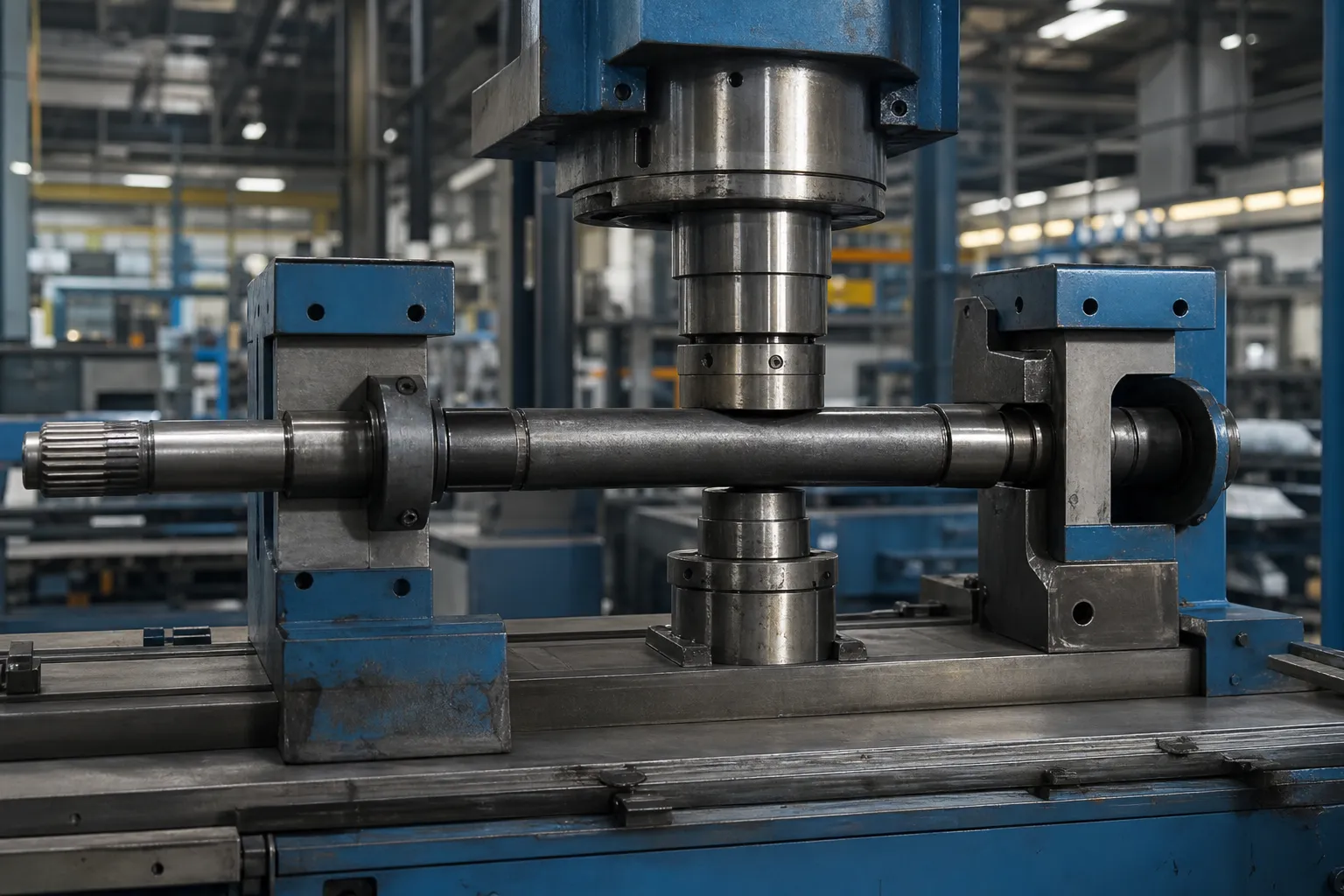
*इंजीनियरिंग अवधारणा चित्रण. यह एक विशिष्ट वर्कपीस परिवार के लिए संभावित प्रेस-सुधार संदर्भ दिखाता है, कोई सार्वभौमिक प्रक्रिया नुस्खा या सत्यापित स्थानीय क्षमता नहीं।*
परिभाषित करें कि प्रक्रिया क्या सुधार कर रही है
आवश्यक विशेषता एक अवधि में सीधापन हो सकती है, डेटम अक्ष के सापेक्ष रेडियल रनआउट, पार्श्व स्वीप, एक स्थानीय सुविधा संबंध या अन्य नियंत्रित ज्यामिति. प्रेस का चयन करने से पहले इसका नाम अवश्य दिया जाना चाहिए. एक वृत्ताकार त्रुटि, सतही रुकावट, फिक्स्चर सिग्नल या जानबूझकर ऊँट को ठीक नहीं किया जा सकता है जैसे कि यह एक ही तरह का मोड़ हो.
उपयोग शाफ़्ट सीधापन, रनआउट और टीआईआर जब भाग का घूर्णी निरीक्षण किया जाता है. नली, प्रोफ़ाइल, वसंत, रिंग और वेल्डेड वर्कपीस को अपनी स्वयं की ज्यामिति और प्रक्रिया सीमाओं की आवश्यकता होती है.
एक प्रारंभिक त्रुटि मानचित्र बनाएँ
माप योजना को अनुमोदित डेटाम की पहचान करनी चाहिए, भाग अभिविन्यास, अक्षीय स्टेशन, समर्थन की स्थिति, सेंसर विधि और दोहराव/बैठने की जाँच. एक एकल मध्यबिंदु रीडिंग में कई मोड़ छूट सकते हैं या भाग ज्यामिति के साथ गुरुत्वाकर्षण शिथिलता और स्थिरता भिन्नता को भ्रमित कर सकते हैं.

*इंजीनियरिंग अवधारणा चित्रण. यह सुधार से पहले एक माप मानचित्र दिखाता है; वास्तविक स्टेशन स्थान, जांच और डेटाम को नियंत्रित ड्राइंग से तय किया जाना चाहिए।*
| फ़्रीज़ करने के लिए इनपुट | यह जिस निर्णय का समर्थन करता है |
|---|---|
| आरेखण आँकड़े और स्वीकृति नियम | यह स्थापित करता है कि माप को क्या प्रदर्शित करना चाहिए |
| प्रारंभिक ज्यामिति मानचित्र | उम्मीदवार सुधार क्षेत्र और अंतःक्रिया जोखिम की पहचान करता है |
| स्वीकृत समर्थन और प्रतिक्रिया बिंदु | बल पथ को अनपेक्षित सिग्नल बनाने से रोकता है |
| संरक्षित सुविधाएँ और सतह सीमाएँ | निर्धारित करता है कि कहाँ संपर्क निषिद्ध है |
| सामग्री और प्रक्रिया चरण | संभावित प्रतिक्रिया को परिभाषित करता है, स्प्रिंगबैक और डाउनस्ट्रीम बाधाएँ |
The Mechanics of a Point-Press Stroke
A point-press correction is a three-point bend executed on purpose. Two supports and one press point form a loading frame: the press pushes the section toward the supports, bending moment peaks at the press point and falls toward the supports, and the outer fibers at the correction location pass yield while the core of the section stays elastic. When the force is released, the elastic core tries to spring the section back while the yielded fibers hold their new shape — the permanent set is the difference, and the art of the process is delivering just enough plastic work to land the released part inside tolerance. Three consequences follow directly from this picture. The correction is local: the plastic zone concentrates around the press point, which is why error maps guide where to press rather than intuition. The process is self-limiting only if treated incrementally: a single stroke sized optimistically cannot be un-pressed. And the section’s own geometry — its stiffness variation, its transitions, its prior deformation history — modulates everything, which is why identical stroke settings do not transfer blindly between diameters, materials or lots, and why reverse-loading effects, as described for the Bauschinger effect, change the response of a part that has already been corrected once.
Support Span Is the Primary Tuning Parameter
Operators reach for force when they should reach for geometry. Moving the supports changes the correction before any force value is touched: supports spread wide give a long, gentle bending field — the same press force produces a larger deflection spread over a longer zone, appropriate for a single broad bow; supports close in around the correction point concentrate the same energy into a short, deep correction, appropriate for a local kink but harder on the surface and the section. Span also sets the mechanical advantage of the stroke: the closer the supports, the more force the same correction demands, which is why narrowing the span on a stiff section quickly reaches the machine’s or the part’s limits. Two practical rules fall out. पहला, choose span from the error map’s wavelength — long bows get long spans, kinks get short ones — and document the choice in the setup record, because span is a process parameter like any other. दूसरा, treat support condition as part of the tooling: ज्यामिति से संपर्क करें, cleanliness and wear change the reaction path silently, और यह surface-protection tooling discipline applies to supports exactly as it does to the press nose.
समर्थन और सुधार बिंदु एक साथ चुनें
किसी प्रेस प्वाइंट को उसके समर्थन से स्वतंत्र रूप से नहीं चुना जा सकता है. समर्थन रिक्ति, अनुभाग कठोरता, बल दिशा और संपर्क ज्यामिति प्रतिक्रिया पथ बनाते हैं. गलत समर्थन स्थानीय प्रेस को प्रभावी बना सकता है जबकि त्रुटि को कहीं और स्थानांतरित कर सकता है या किसी सुविधा को नुकसान पहुंचा सकता है.
नमूना परीक्षण से पहले, दस्तावेज़:
- समर्थन और प्रतिक्रिया स्थान, जिसमें नो-कॉन्टैक्ट जोन भी शामिल हैं;
- सुधार बिंदु, बल दिशा और अनुमत अभिविन्यास;
- संपर्क सामग्री, स्वच्छता और अंकन-जोखिम नियंत्रण;
- अधिकतम वृद्धिशील सुधार और प्रयास संख्या;
- स्प्रिंगबैक/रिलीज़ माप योजना;
- कठोर अस्वीकृति और इंजीनियरिंग-समीक्षा शर्तें.
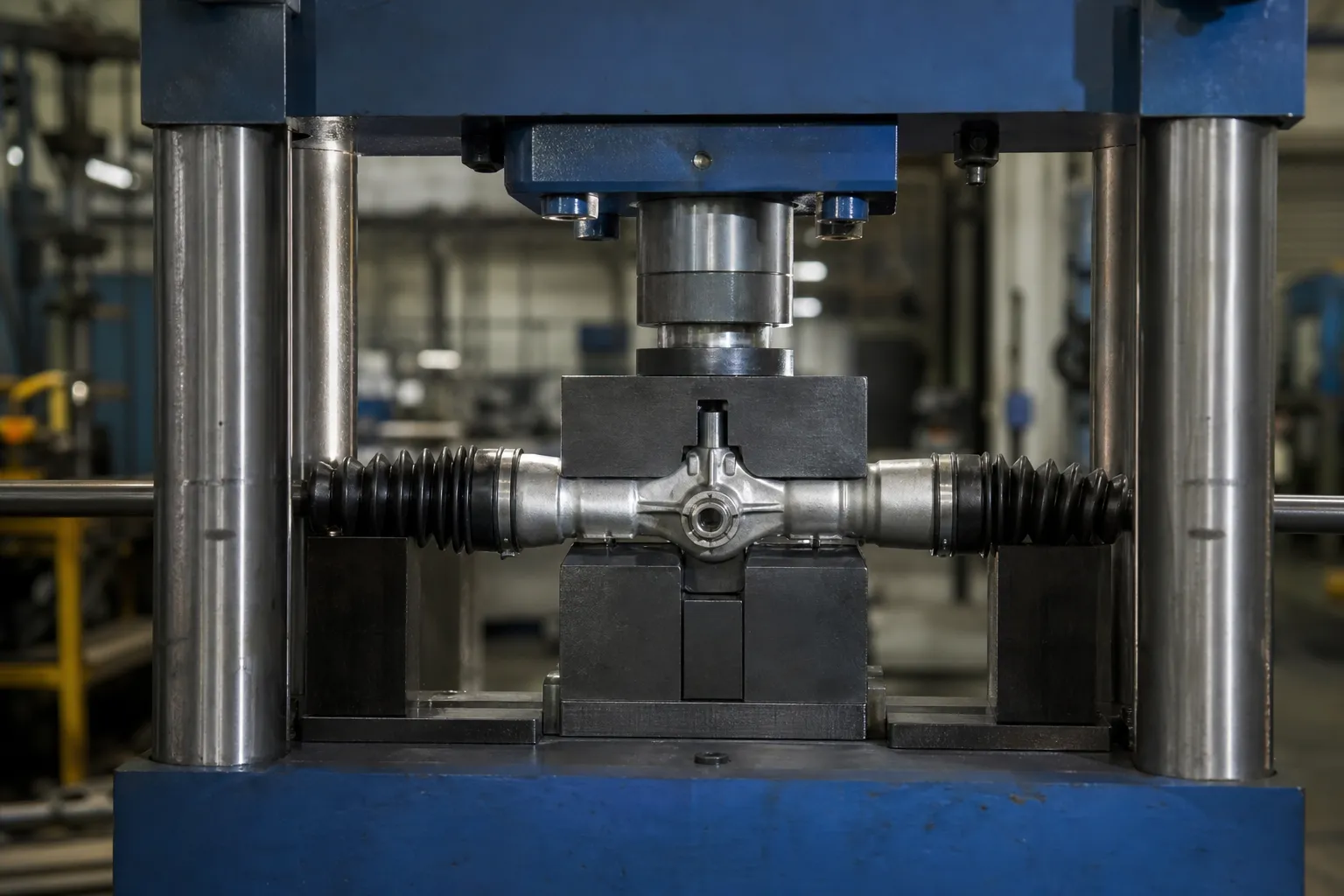
*इंजीनियरिंग अवधारणा चित्रण. यह एक वृद्धिशील सुधार अवधारणा को दर्शाता है; यह प्रेस लोड निर्धारित नहीं करता है, आघात, किसी अन्य वर्कपीस के लिए टूलींग या अनुमोदित सुधार बिंदु।*
वृद्धिशील रूप से सही करें और रिलीज़ के बाद पुनः जाँचें
बंद-लूप अनुक्रम है:
- नियंत्रित वर्कपीस परिवार और ड्राइंग संशोधन की पहचान करें;
- क्षति के लिए निरीक्षण करें, गलत भाग, निषिद्ध सतह की स्थिति या दायरे से बाहर विरूपण;
- अनुमोदित डेटाम लोड करें और बैठने की पुष्टि करें;
- प्रारंभिक ज्यामिति मानचित्र को मापें;
- अनुमत समर्थन और सुधार योजना का चयन करें;
- नमूना-परीक्षण सीमा के भीतर वृद्धिशील सुधार लागू करें;
- पूरी तरह से बल जारी करें, क्लैंप और संयम;
- सभी आवश्यक ट्रैकों को दोबारा मापें और परिणाम रिकॉर्ड करें;
- भाग को OK पर रूट करें, NOK या इंजीनियरिंग समीक्षा.
अंतिम स्वीकृति रिहाई के बाद होती है. जब भाग प्रेस बल या स्थिरता प्रतिबंध के तहत रहता है तो एक रीडिंग को अंतिम परिणाम के प्रमाण के रूप में उपयोग नहीं किया जा सकता है.
Springback as a Process Variable, Not a Constant
Because the released shape is set by the competition between yielded fibers and the elastic core, the same stroke delivers different permanent set on parts that differ in material condition, section or prior history. That is springback as a process variable, and treating it as a fixed correction factor is how lines end up oscillating around tolerance. The discipline that handles it honestly is described for शाफ्ट स्ट्रेटनिंग में स्प्रिंगबैक मुआवजा: learn the response on representative samples, correct incrementally, and re-learn when the material lot or part revision changes. A related trap deserves its own sentence: pressing a part past nominal on purpose — overshoot to pre-compensate springback — is legitimate within a validated recipe and a defined limit, but repeated overshoot-and-press-back cycles accumulate reverse-loading damage, and the correction-attempt limit exists precisely to stop that sequence before it becomes a cracking risk, प्रति the integrity-review framework.
Reading the Data Between Strokes
Each stroke in the incremental loop is also an experiment, and the data between strokes tells the operator when to continue and when to stop. A healthy convergence shows the remaining error shrinking by a decreasing amount each stroke — the response per stroke falling as the part approaches target, which is the natural signature of a stable correction. Three patterns break that signature and each demands stopping rather than pressing harder. No progress: the geometry stops responding, meaning the process is no longer engaging the error — the correction point, support condition or part state has changed under the operator. Diminishing returns with rising effort: each stroke moves the part less while the press works harder — the section is fighting back through strain hardening, and continuing trades diminishing geometry gain for accumulating material damage. Oscillation: the part crosses nominal in alternate directions stroke by stroke — the correction rule is over-reacting, often because it was calibrated on a different response, and the fix is the recipe, not the part. Building these three stop patterns into the operating procedure converts the between-stroke data from noise into the line’s earliest quality alarm.
जानें कि कब प्वाइंट दबाना सही मार्ग नहीं है
हर उत्पाद के लिए पॉइंट प्रेसिंग एक डिफ़ॉल्ट तरीका नहीं है. सतत तार, पतली दीवार वाली ट्यूब, असममित प्रोफ़ाइल, अँगूठी, वसंत, थकान-महत्वपूर्ण या वेल्ड-संवेदनशील हिस्से को एक अलग दृष्टिकोण की आवश्यकता हो सकती है, समर्पित टूलींग या एक अलग प्रक्रिया समीक्षा. देखना प्रेस बनाम रोलर स्ट्रेटनिंग विधि-चयन सीमा के लिए.
नमूना परीक्षण और स्वीकृति
नमूना योजना में सामान्य और सबसे खराब स्थिति वाले आने वाले हिस्से शामिल होने चाहिए, ज्यामिति से पहले/बाद में कच्चा, दोबारा सीट दोहराने की क्षमता, सतह निरीक्षण, आवश्यक सामग्री/सुविधा की जाँच, अधिकतम प्रयास सीमा और ग्राहक संदर्भ गेज से सहसंबंध. अगर दरारें पड़ जाएं, कठोरता, एनडीटी, पीसना या संतुलन बनाना प्रासंगिक है, वे स्वतंत्र स्वीकृति उत्तरदायित्व बने रहते हैं.
उपयोग नमूना परीक्षण और स्वीकृति को सीधा करना उत्पादन दावे या FAT/SAT निर्णय से पहले आवश्यक साक्ष्य को परिभाषित करने के लिए.
अक्सर पूछे जाने वाले प्रश्न
पॉइंट प्रेसिंग एक विशिष्ट सटीकता की गारंटी दे सकता है?
नहीं. प्राप्य परिणाम वर्कपीस पर निर्भर करता है, घटना, भौतिक अवस्था, सहायता, संपर्क क्षेत्र, नमूना प्रतिक्रिया और सहमत निरीक्षण विधि.
उच्चतम संकेतक बिंदु हमेशा सुधार बिंदु होता है?
नहीं. सुधार बिंदु को ज्यामिति मानचित्र और अनुमोदित प्रतिक्रिया पथ से चुना जाना चाहिए, किसी पृथक दृश्य या सूचक अवलोकन से नहीं.
क्या कोई प्रेस किसी दरार की मरम्मत कर सकता है या एनडीटी को बदल सकता है?
नहीं. स्ट्रेटनिंग भौतिक दोषों की मरम्मत नहीं करती है और योग्य निरीक्षण प्रक्रियाओं को प्रतिस्थापित नहीं करती है.
Why does the same press stroke move two identical-looking parts differently?
Because released geometry depends on material condition, section detail and prior deformation, not on appearance. Different lots, heat-treatment states or a previous correction cycle all change the plastic-versus-elastic balance the stroke works against. The remedy is learning the response per family on samples and re-checking it when lots change.
When should supports be moved closer together?
When the error map shows a short, local kink rather than a broad bow. A narrow span concentrates the correction where the error lives; a broad span spreads it. The span choice belongs in the documented setup, because it changes both the correction shape and the force the part must carry.
What does it mean when a part stops responding to corrections?
The process is no longer engaging the error — a no-progress condition. Causes range from a changed correction point to a setup or part-state shift, and the defined response is to stop and route the part to review, not to increase force. Continuing to press spends the part’s deformation budget on nothing.
पीसने से पहले बनाम पीसने के बाद सीधा करना
इसके लिए कोई स्वतंत्र विहित पृष्ठ नहीं रखा गया है पीसने से पहले बनाम पीसने के बाद सीधा करना क्योंकि औद्योगिक सटीक-मिलान मांग कम है. स्टेज अनुक्रमण, स्टॉक भत्ता और डेटाम ट्रांसफर जाली-बार में हैं, पॉइंट-प्रेस और मल्टी-पॉइंट प्रोसेस पेज. पुष्टि करें कि क्या पीसने से वह सामग्री निकल जाती है जो उत्पादन मार्ग को लॉक करने से पहले पहले की सीधी रीडिंग को अमान्य कर देगी.
स्ट्रेटनिंग में फोर्स का प्लेसमेंट कर्व्स
के लिए एक समर्पित पेज बल विस्थापन वक्र गाइड को सीधा करना मान्य क्वेरी मांग के बिना इसका रखरखाव नहीं किया जाता है. फोर्स की ट्रॉके व्याख्या, पॉइंट-प्रेस में सुरक्षित सीमाएँ और प्रक्रिया रोकने की स्थितियाँ समझाई गई हैं, मल्टी-पॉइंट और क्रैक-डिटेक्शन पेज. किसी भी वक्र-आधारित अलार्म को किसी अन्य सामग्री परिवार से कॉपी करने के बजाय प्रतिनिधि भागों पर मान्य किया जाना चाहिए.
Point-press work lives or dies by stroke control – read why over-correction cracks parts before you size a machine, then use the स्ट्रेटनर चयन पूर्वाभ्यास to match press concepts to your part family.