
U industriji proizvodnje zatvarača, savijanje dugim vijcima nakon termičke obrade je univerzalna bolna tačka. Tradicionalno “ručno udaranje čekićem” ne samo da je neefikasna, već i ne garantuje dosljednu preciznost. Ovaj članak dijeli specijaliziranu Automatsko rješenje za ispravljanje vijaka: demonstrating a reported client case in which automation took an 8-person manual line to one operator supervising four machines, with straightness held within 0.1 mm on the client’s acceptance records.
What is the Bolt?
Vijci su temeljni pričvršćivači za mašine, izgradnja, i automobilske industrije. Tipičan radni komad za ovo rješenje je dugi vijak visoke čvrstoće: 15mm prečnika, 340mm dužine.
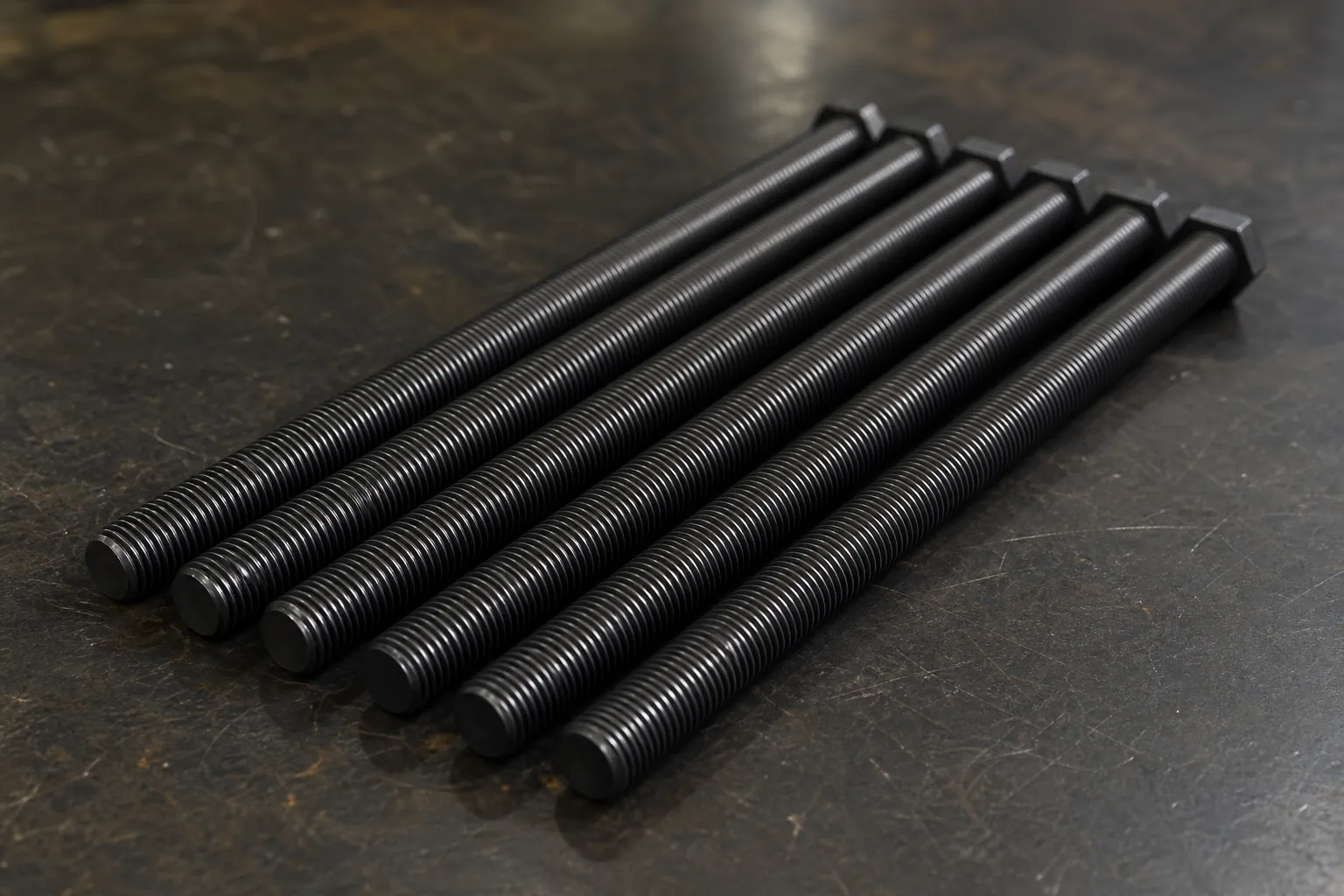
Strukturne karakteristike i izazovi
- Visok L/D omjer: Dužina od 340 mm čini vijak vrlo osjetljivim na početno savijanje od 0,5 mm – 1.5mm nakon termičke obrade.
- Zahtjevi za preciznost: The client required straightness within 0.2 mm; the case acceptance records were held under 0.1 mm.
- Zahtjevi zaštite: Proces ravnanja mora osigurati nultu štetu na preciznosti navoja i kvalitetu površine.
Why Heat Treatment Bends Long Bolts in the First Place
Understanding the distortion source is what makes a correction process defensible instead of decorative. During quenching, a long fastener cools unevenly: the section cools at different rates depending on orientation in the basket or fixture, agitation contact, and local mass differences between the plain shank, the threaded length and the head. Each cooling path wants to contract by a different amount, and the resulting locked-in stresses bend the part when it relaxes. The effect scales with length — which is why short bolts leave heat treatment usable while long ones of the same grade systematically arrive bent. Thread rolling and machining before treatment add their own stress history, and any straightening performed at the heat treater counts as prior deformation for everything done afterward.
Two practical consequences follow. Prvo, incoming inspection on long heat-treated bolts is not optional paperwork — the bend magnitude and pattern arriving at the straightening station determine both the correction plan and any supplier conversation, and the interaction of prior deformation with correction response is the reason reverse-loading behavior matters, as covered under Baušingerov efekat u ispravljanju. Drugo, process decisions upstream — how parts are racked or basketed through quench, whether stress relief is applied — change the distribution the straightening station sees, and are usually the cheapest place to reduce total correction work.
Reading the Bend Before Correcting It
Long fasteners arrive with a small vocabulary of bend patterns, and naming the pattern is the first step of an efficient correction loop. A single-arc bow — one gentle curve, maximum near the middle — is the most common heat-treatment signature and the most straightforward to correct with supports positioned around the peak. An S-shaped double bend has two opposite peaks, obično odražava dvije tačke ograničenja tokom gašenja, i zahtijeva dvije koordinisane ispravke umjesto jednog velikog pritiska na najvećem čitanju. Lokalni pregib u blizini glave ili izvlačenje navoja koncentrira izobličenje gdje se mijenja krutost presjeka, i ponaša se drugačije od distribuiranog luka. Konačno, uvrtanje oko ose povremeno prati savijanje na delovima sa asimetričnim karakteristikama. Svaki uzorak zahtijeva vlastitu kartu mjerenja i sekvencu korekcije, zbog čega automatska stanica koja skenira punu dužinu i gradi kartu prije pritiska - umjesto da juri jedno najgore očitanje - konvergira u manje poteza. Opisana je petlja za mjerenje i korekciju iza ovoga automatsko ispravljanje osovine općenito, i za porodicu dugih vijaka posebno u automatic long bolt straightening process.
Zašto se ravnanje vijaka mora udaljiti od “Manual Hammering”
Tradicionalni proces vs. Automatsko rješenje
The figures below are this client’s reported baseline and post-commissioning values, not a universal benchmark for every fastener line.
| Pain Point | Manual Hammering / Manual Press | Automatsko rješenje za ravnanje |
| Labor Requirement | 8 workers per shift (manual baseline, reported case) | 1 operator for 4 mašine (reported case) |
| Pravost | 0.2 – 0.5 mm spread (reported manual baseline) | ≤ 0,1 mm (client acceptance records) |
| Cycle Time | 120 – 180 s/kom (reported manual baseline) | 10 – 15 s/kom (reported case) |
| Ukupni trošak | High labor cost per corrected part | Manpower reduced from 8 operators to 1 supervising 4 mašine (reported case) |
Automatski tok procesa ispravljanja vijaka
Ovo rješenje pokriva potpuni automatizirani proces zatvorene petlje od hranjenja do sortiranja, osiguravajući da svaki vijak ispunjava zahtjeve visokog standarda isporuke.
Opisi osnovnih procesa
- Auto-Feeding: Savijeni vijci se automatski unose iz rezervoara u stanicu za ravnanje bez ljudske intervencije.
- Dynamic Measurement: Senzori visoke preciznosti skeniraju rotirajući radni komad u realnom vremenu, precizno hvatanje maksimalne tačke savijanja po cijeloj dužini.
- Servo Pressing: Pametni sistem automatski izračunava povratno opterećenje na osnovu materijala (ugljični čelik/legirani čelik), a servo ram primjenjuje precizan pritisak za korekciju u jednom prolazu.
- Auto-Sorting: Kvalificirani vijci prelaze na sljedeću fazu, while non-conforming parts are automatically isolated before they leave the machine.

UBJ-80 Mašina za ispravljanje vijaka
Ova ravnala je idealna za termički obrađene gotove dijelove (npr., komponente za štancanje/kancelarijske mašine, auto/moto dijelovi, alata, zavrtnji) i barovi (čelika, bakar, aluminijum, nehrđajući čelik, legura titanijuma) dužine 60-600 mm & φ3–φ25mm prečnik. Povećava i preciznost i kvalitet proizvoda.
Osnovni izazovi i rješenja za ispravljanje
Challenge 1: Manning and the Reported “1 Operater za 4 Mašine” Case
Opis problema: Manual hammering and press correction depend on operator skill, stamina and shift discipline, so manning levels stay high and results vary from operator to operator.
Rješenje:
Naše rješenje implementira potpuna automatizacija zatvorene petlje. Logika operacije je izuzetno jednostavna, sa ugrađenim receptima za različite specifikacije vijaka. Standardni radnik treba samo periodično puniti rezervoar; ostalo - merenje, ispravljanje, i inspekcija—mašina automatski upravlja. Ovo rješava nedostatak radne snage i eliminira padove preciznosti uzrokovane umorom.
Challenge 2: Garantuje konzistentnost unutar 0,1 mm preciznosti
Opis problema: Kada je vijak izložen udarima čekića, unutarnja raspodjela naprezanja postaje neravnomjerna, često dovodi do prekomjerne korekcije u lokaliziranim područjima.
Rješenje:
Rješenje koristi a potpuno parametrizirani servo kontrolni sistem. Za razliku od nejasnog ljudskog prosuđivanja, senzori detektuju aksijalnu krivu zavrtnja sa preciznošću na nivou mikrona. Kroz višestepene servo algoritme, sistem precizno savladava elastičnu oprugu od S45C ili legiranih čelika, locking final straightness within the 0.1 mm window achieved on this client’s qualified recipe.
How Thread and Head Zones Are Protected During Correction
Thread protection is a contact-zone engineering problem, and the principles are the same ones that govern surface-protection tooling across straightening applications. The correction force and the reaction forces both need somewhere to live, and on a long bolt the plain shank is the region designed to carry load, while the threaded length and the under-head fillet are the regions most easily damaged. A protection concept therefore has three parts: place supports on the shank at controlled span positions around the bend peak; direct press contact onto the shank through tooling that conforms to the section instead of touching thread crests; and keep every edge that could contact the workpiece generously radiused so load spreads instead of concentrating. Cleanliness belongs in the same sentence — debris trapped between press tooling and a thread flank is a scratch generator, and on plated or coated bolts the coating class defines how much contact the finish can tolerate at all.
The validation side is equally concrete. A thread-protection claim is proven by inspection agreed before the trial — thread gauges still running, flank condition reviewed under the method the quality function specifies — together with the released-state straightness result, on representative parts, after repeat setups. Protection and geometry are accepted together or not at all.
What an Acceptance Criteria Package Should Contain
A bolt straightening process is only as good as the acceptance definition it answers to, and a complete one answers five questions in writing. What characteristic governs — straightness of the axis, measured how: on centers, on supports, rotirajući, in what condition, since a reading under restraint is not a released result, per loaded versus released measurement practice. What the limit is, and where it applies — full length or specified spans. What else must survive the process — thread fit, završna obrada površine, premazivanje, head markings. How conformity is sampled — every part through an automatic gauge, or a sampling plan with defined reaction to a failure. And what happens to nonconforming parts — rework limits, segregation and disposition authority, following the NOK sorting and rework-limit framework. Buyers comparing straightening suppliers are well advised to ask for exactly this package; the ability to produce it says more about a supplier than any single machine specification.
Manufacturing Case: Četvrti izbor indijskog klijenta
Pozadina klijenta
Poznati indijski dobavljač zatvarača koji obezbeđuje komponente za globalne brendove građevinskih mašina.
Rezultati implementacije
- Ponovite naredbe: Na osnovu izvanrednih performansi prve tri jedinice, klijent ih je nedavno kupio 4th machine.
- Operator Consolidation: The client reported one operator managing all 4 machines after commissioning, with a substantial increase in output per operator.
- Kvaliteta: The client’s records report straightness moving from 0.2 mm down to under 0.1 mm after commissioning.
FAQs
- Q: Hoće li ram za ravnanje oštetiti navoje vijaka?
- br. Dizajnirali smo bez kontakta, jastučići za zaštitu kalupa posebno za ispravljanje vijaka. Blokovi za presovanje savršeno odgovaraju zakrivljenosti vijka, osiguravaju ravnomjernu raspodjelu sile i izbjegavaju površinska udubljenja.
- Q: Može li se oprema integrirati u MES sistem naše fabrike?
- Da. Naš kontrolni sistem ima standardne interfejse podataka za snimanje i izvoz podataka o ispravljanju u realnom vremenu za svaki vijak, ispunjavanje savremenih zahtjeva sljedivosti.
Additional Process Questions
Why do bolts from the same heat-treatment lot arrive with different bend patterns?
Because each part’s position in the basket or rack gave it a different cooling path. Quench distortion is sensitive to orientation, local mass and agitation contact, so even identical bolts leave treatment with different locked-in stress patterns. Mapping incoming parts rather than assuming a uniform error is the practical answer, and it is why scanning-based stations build a per-part correction plan.
How many correction passes does a long bolt need?
It depends on the pattern, not a fixed number. A single-arc bow typically converges in one planned press; an S-bend needs two coordinated corrections; local kinks near section changes respond differently again. The governing rule is a rework limit set before production — parts that stop responding are routed to review, not pressed repeatedly, because each additional plastic cycle consumes fatigue life and changes the material’s response.
Should straightening come before or after thread rolling?
The route belongs to the fastener process engineer, but the trade-off is explicit: correcting before thread rolling lets subsequent operations work from a straight blank, while correcting after heat treatment with finished threads demands the contact-zone protection described above. Whichever route is chosen, the acceptance package must define what state the straightness limit applies to, and the correction validation must be run on parts carrying that state.
Rezime
Za fabrike zatvarača koje teže visokoj efikasnosti i kvalitetu, an Automatsko rješenje za ispravljanje vijaka je suštinski put ka povećanju konkurentnosti. Whether the target is lower manning or 0.1 mm delivery precision, the figures in this article are one client’s reported case; your own results depend on the bolt family, incoming distortion and acceptance definition.
Moving from manual bolt correction toward automation? The ručna u odnosu na automatsku logiku odabira i ROI futrola za automatsko ispravljanje su prirodni sledeći koraci.
Ako se suočavate s problemima upravljanja radom ili preciznošću uskim grlima, slobodno Kontaktiraj nas za prilagođeni tehnički prijedlog.