
An aluminum extrusion is not a generic steel bar. Solid, hollow and semi-hollow profiles can combine thin webs, open channels, internal cavities, ribs, appearance surfaces and critical assembly interfaces. Cooling distortion, longitudinal bow, lateral sweep, twist and local section change must be separated before a straightening method is selected.
A reliable aluminum extrusion straightening solution starts with six questions:
- Which alloy, temper route, solid/hollow/semi-hollow family and length range is in scope?
- Is the part directly after extrusion and quench, after stretch straightening, after cutting, after aging or after finishing?
- Which bow, sweep, xoắn, flatness and section dimensions are controlled by the drawing?
- Can the specified temper receive secondary roller or local correction after stretching?
- Which appearance, anodizing, niêm phong, glazing or assembly surfaces may contact clamps and supports?
- How will the completely released profile be remeasured and released to the next operation?

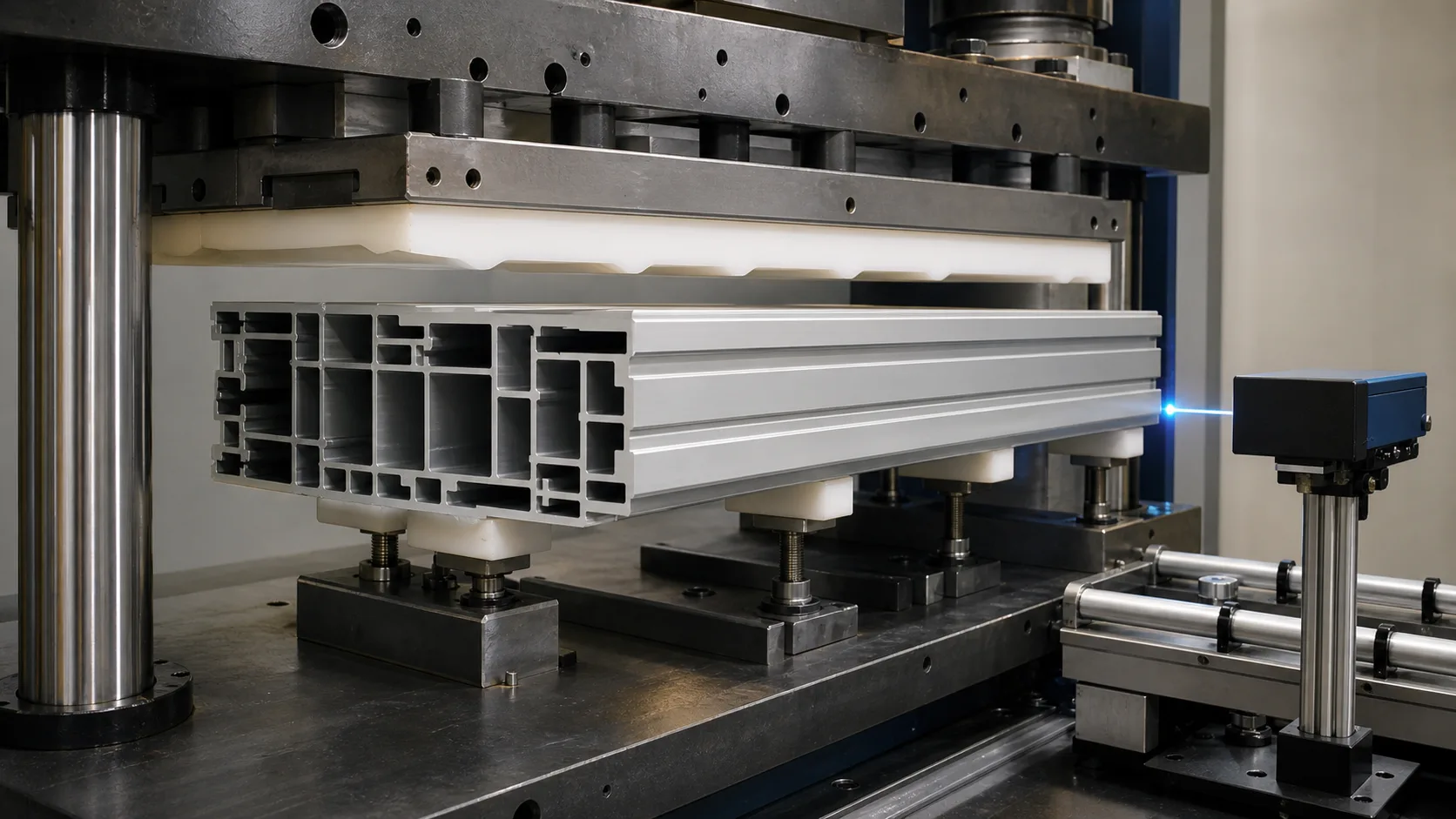
*Engineering concept illustration of a multi-cavity extrusion in a post-quench stretch-straightening cell. It is not a customer-site photograph or performance claim. Actual grip length, stretch input, ủng hộ, temperature, section response and acceptance limits require the controlled alloy, temper and profile specification.*
Define the Profile Family Before Building a Recipe
| Profile Family | Main Straightening Risk | Required Route |
|---|---|---|
| Solid symmetric profile | Bow and twist with relatively stable section | Family recipe by alloy, temper and aspect ratio |
| Hollow multi-cavity profile | Thin webs, internal voids and local wall collapse | Section-support and clamp review before loading |
| Semi-hollow or open-channel profile | Channel opening can change during stretching or pressing | Track opening and wall angle as controlled features |
| Wide thin profile | Low out-of-plane stiffness and local flatness sensitivity | Dense low-marking support and bounded correction |
| Profile with thin fins or lips | Contact marking and local yielding | Dedicated contact map and low-pressure handling |
| Anodized or appearance profile | Finished surfaces can scratch, dent or transfer contamination | Qualified soft-contact and surface-release route |
| Fabricated or welded aluminum assembly | Joint restraint and heat distortion change the load path | Use a welded-fabrication route |
| Intentionally curved extrusion | Drawing curvature is the nominal shape | Forming route; do not straighten to zero |
The Aluminum Extruders Council notes that wide thin sections can be more difficult to straighten and that thickness transitions, ribs and webs influence distortion and twist behavior. A recipe therefore starts with section mechanics, not with nominal width alone.
Freeze the Temper and Process Stage
Extrusion, Quench and Cooling
Hydro's public extrusion-process description places quenching and cooling before stretch straightening. Cooling gradients, puller alignment, runout support and section asymmetry can produce progressive bow, sweep or twist. Measurement should identify whether the apparent error is stable after the profile reaches the defined inspection condition.
Stretch Straightening
End gripping and controlled axial stretch are the normal primary route for many extrusions. The process can reduce longitudinal curvature, help relieve internal stress and prepare the profile for cutting and aging. The Aluminum Extruders Council describes stretching as widely used, but its published typical stretch range is not a universal recipe or a StraighteningTech guarantee.
The engineering proposal should define:
- approved grip or sacrificial end length;
- clamp geometry for the actual solid, hollow or open profile;
- support and transfer condition before, during and after stretch;
- temperature and time window after quench;
- bounded extension, force and stop limits;
- section-opening and appearance-surface checks;
- released bow, sweep and twist verification.
Cutting and Aging
Hydro describes a typical sequence in which straightened extrusion is cut and then naturally or oven aged before finishing or fabrication. The exact sequence belongs to the customer's alloy and temper specification. Do not assume that a correction qualified before aging remains permitted or produces the same result after aging.
Secondary Straightening
The Aluminum Association's public explanation of T_510 and T_511 is a critical gate: T_511 can allow final minor straightening to meet tolerances, while T_510 does not allow straightening after stretching. The association does not define one universal numerical meaning of “minor straightening.”
Vì thế, secondary roller or local correction is allowed only when the controlled temper route, product specification and customer process plan permit it.
Surface Finishing and Fabrication
Anodizing, lớp phủ, gia công, khoan, hàn, sealing and assembly add protected surfaces and local stiffness changes. A correction after those steps needs a separate contact, feature and inspection plan.
Separate Geometry Characteristics
The Aluminum Association's extrusion-tolerance material distinguishes straightness, twist and flatness. A single “straightness” value cannot safely replace all three.
Longitudinal Bow
Bow is curvature along the length in a defined plane. For a supported profile, the result depends on support points, định hướng, self-weight and temperature. Record vertical and lateral components separately when the drawing controls both.
Sweep
Sweep is in-plane lateral deviation relative to a selected edge, center plane or functional datum. Open profiles can roll on supports and create an apparent sweep unless orientation is controlled.
xoắn
Twist is rotation of the cross-section along the longitudinal axis. It requires angular or paired-surface measurement along the length; a single height probe cannot fully separate twist from bow or support error.
Flatness and Local Section Geometry
Local surface flatness, wall angle, channel opening, cavity spacing, lip position and other section dimensions may change even when the longitudinal centerline improves. These characteristics need drawing-specific tracks or gauges.

*Engineering concept illustration of a multi-chamber profile measured for longitudinal and section geometry. It is not a prescribed sensor layout. Actual tracks, hỗ trợ, temperature condition, feature masks and acceptance bands require the controlled drawing and customer-gauge correlation.*
Build a Datum and Support Model
The measurement plan should define:
- hợp kim, temper, profile revision and orientation;
- solid, hollow or semi-hollow classification;
- longitudinal origin, grip/end exclusion and cut condition;
- drawing-defined edge, face, center plane or functional datum;
- support number, nhịp, vật liệu, height and profile-contact land;
- vertical bow and lateral sweep tracks;
- section-angle or twist measurement stations;
- độ phẳng, opening, wall-angle and critical cavity dimensions;
- dọn dẹp, temperature and stabilization condition;
- anodized, appearance, sealing and assembly surface classes;
- repeatability after complete release and repositioning;
- correlation with the downstream fixture or final gauge.
Read shaft straightness vs runout vs TIR for the general difference between stationary geometry and rotating indication. Extrusion profiles are evaluated as supported sections, not rotating shafts.
Classify the Signal Before Correction
| Observed Signal | Possible Cause | Required Route |
|---|---|---|
| Smooth curvature after temperature stabilization | Cooling or extrusion-related bow | Candidate for approved stretch straightening |
| Lateral deviation changes when the profile is rolled on supports | Orientation or support instability | Freeze orientation and repeat measurement |
| Section angle changes along the length | xoắn | Twist-specific measurement and stretch/correction review |
| Channel opening changes while centerline improves | Section distortion under grip or load | Revise clamp/support/load path |
| Thin face is locally wavy | Local flatness or extrusion-section issue | Section inspection; do not treat as global bow alone |
| Error exists only at gripped ends | Clamp deformation or sacrificial-end effect | Define end trim/exclusion and inspect transition |
| Signal changes after aging | Temper evolution or stress redistribution | Requalify the process stage; do not reuse pre-aging recipe blindly |
| Surface line appears after handling | Roller debris, concentrated contact or transfer | Surface disposition and handling correction |
| Profile matches a designed curve | Intentional geometry | Forming route; preserve nominal curvature |
Protect Thin Walls and Appearance Surfaces
Hydro's storage guidance emphasizes separation, dry and clean handling, protection from poor stacking and contamination, and the risk of self-weight deformation. The straightening cell should apply the same discipline.
Default Protected or Review Zones
- anodized, đánh bóng, painted or specified appearance faces;
- niêm phong, glazing, mang, sliding and adhesive interfaces;
- thin unsupported webs, fins, lips and open-channel edges;
- internal cavity walls that cannot carry clamp pressure;
- lỗ, slots, cutouts, machined zones and welded attachments;
- printed, laser-marked or traceability areas;
- grip-transition and cut-end zones;
- dented, cracked, torn, corroded or overheated material pending disposition.
Potentially Approved Contact Zones
- broad unfinished lands selected by section analysis;
- sacrificial end lengths intended for later trimming;
- profiled replaceable clamp inserts matched to the extrusion;
- clean polymer or fibre supports qualified through representative trials;
- later-machined surfaces when the process plan explicitly permits contact.
“Soft” or “non-marking” tooling still needs sample verification. Surface acceptance should define scratches, vết lõm, nhặt lên, embedded debris, colour change and post-anodizing visibility where applicable.
Choose the Correction Architecture
Stretch Straightening as the Primary Route
For post-extrusion production, controlled axial stretching normally addresses continuous bow, sweep and part of the twist response while the profile is held by its ends. The solution needs synchronized handling, profile-specific jaws, bounded stretch, section monitoring and released verification.
Secondary Roller Straightening
Roller correction can suit specified profile families when the temper route permits it and contact lands can carry alternating load without local damage. The roll layout must follow the actual section stiffness, not a generic symmetric-bar arrangement.
Local Press Correction
A profile-specific press can address a discrete bend or end zone in an allowed process stage. Broad contoured pads and adjustable supports should complete a stable load path around cavities and thin webs. Local correction must not be used to force an unqualified T temper into compliance.
Torsion and Section Correction
xoắn, channel opening and local wall angle require dedicated angular/section measurement and tooling. Repeatedly pressing apparent bow can trade a centerline error for section distortion.
Read press straightening vs roller straightening before choosing a secondary correction family.
*Engineering concept illustration of broad contoured support and local correction followed by released measurement. It is not a universal machine layout. Actual force, nhịp, pad geometry, allowed process stage and surface limits require project engineering and sample trials.*
Integrate Long-Profile Handling
The cell concept should include:
- long runout and transfer tables at a controlled reference height;
- clean low-marking supports that prevent point loading and uncontrolled sag;
- profile separators that avoid metal-to-metal rubbing;
- end grippers matched to actual cavity and wall geometry;
- controlled axial alignment before stretching;
- orientation guides that do not close an open channel or crush a lip;
- temperature and recipe interlocks by alloy and temper;
- safe crane, lift or automated transfer access;
- recovery logic for an interrupted pull or local correction cycle;
- surface-cleanliness and debris-control checkpoints.
Verify the Released Profile
- Identify alloy, temper route, profile revision, process stage and traceability.
- Confirm straight nominal geometry versus intended curvature.
- Stabilize temperature and clean approved measurement/contact zones.
- Load the profile in the frozen orientation and support condition.
- Measure vertical bow, lateral sweep, twist and controlled section features separately.
- Classify global curvature, section distortion, handling error and surface defect.
- Confirm whether stretch or secondary correction is permitted at this process stage.
- Apply only the bounded correction assigned to the approved mode and zone.
- Fully release and stabilize the profile.
- Remeasure with the same datum, ủng hộ, orientation and temperature rule.
- Check grip transitions, ends, độ phẳng, opening and critical section dimensions.
- Complete appearance, coating and downstream-fixture checks.
- Store before/after profiles, công thức, process-stage identity, inspection and disposition.
Configure the Cell Around the Profile Family
| Chức năng tế bào | Aluminum-Extrusion Requirement |
|---|---|
| Nhận dạng | Alloy, temper, profile revision, chiều dài, stage and traceability |
| Xử lý | Long clean tables, separators, orientation control and profile-specific grips |
| Đo lường | Cây cung, sweep, xoắn, độ phẳng, ends and critical section dimensions |
| Classification | Cooling bow, sweep, xoắn, local section change, grip effect and setup error |
| Sửa chữa | Stretch, permitted roller, local press or torsion/section route |
| Sự bảo vệ | Appearance faces, thin webs/lips, cavities, grip zones and finished features |
| Xác minh | Fully released geometry plus section, surface and downstream-fit checks |
| dữ liệu | Temperature/stage, before/after profiles, load/extension, inspection and disposition |
Proposal Inputs We Need
Send the following before equipment selection:
- controlled cross-section and part drawings;
- hợp kim, temper designation and complete heat-treatment route;
- solid/hollow/semi-hollow family and revision list;
- chiều dài, bundle mix, takt and extrusion-line interfaces;
- quench, cooling, stretching, cutting, aging and finishing sequence;
- bow, sweep, xoắn, flatness and critical-section acceptance definitions;
- grip allowance, end trim and permitted secondary-straightening statement;
- appearance class, anodizing/coating plan and protected-contact map;
- incoming error distribution by profile family and process stage;
- thước đo khách hàng, fixture, report and traceability requirements;
- đại diện tốt, marginal and reject samples.
Sample-Test Acceptance Before Production Release
The trial should cover the alloy, temper, phần, process-stage and surface-class envelope. It should verify grip behavior, support repeatability, temperature window, bow/sweep/twist classification, section stability, surface marking, hồi xuân, released geometry and downstream fixture correlation.
Sử dụng straightening sample test and acceptance guide to freeze the test matrix and evidence package.
Engineering Boundary
Straightening can correct approved geometric error in suitable aluminum extrusion. It does not repair cracks, tears or collapsed cavities; restore a damaged anodized finish; override the alloy/temper specification; guarantee complete residual-stress removal; or prove final assembly performance without the applicable gauge and process controls.
Grip force, stretch input, roll layout, press force, khoảng hỗ trợ, sự chính xác, cycle time and secondary-correction limit are proposal outputs. They must come from the controlled profile family, temper route, bản vẽ, samples and customer gauge—not from a competitor specification table.
Request an Aluminum Extrusion Straightening Review
Send the profile-family table, cross-sections, alloy/temper route, process-stage map, controlled geometry, protected surfaces and representative samples. We will return a proposed datum and support model, primary/secondary correction architecture, grip and tooling concept, sample-test matrix and equipment configuration for review.