
A ovalidade do tubo e a retilineidade da linha central são condições geométricas diferentes. A ovalidade diz respeito à forma de uma seção transversal; a retilineidade da linha central diz respeito ao caminho do tubo ao longo de seu comprimento. Um tubo pode ter uma geometria de linha central aceitável, mas estar desalinhado em uma estação, ou pode ser redondo em cada seção medida enquanto sua linha central se curva ao longo de um longo vão. Tratar essas condições como um valor de “retidão” pode levar a uma decisão errada do processo.
Este guia é uma estrutura de medição e aceitação. Não reivindica uma linha de tubos StraighteningTech, capacidade de parede, medidor, sensor, tolerância ou processo de correção validado. Os requisitos finais devem vir do desenho controlado, método de referência e amostras representativas.

*Ilustração do conceito de engenharia. Ele descreve um contexto de processo de endireitamento de tubos, não é prova de que uma família específica de tubos ou condições de parede possam ser processadas.*
Define Each Characteristic Before Measuring Either
Ovality is a per-station property: every measured cross-section has its own value, and a tube inspected at twelve stations has twelve ovality values that can differ. Centerline straightness is a whole-length property: it is derived from the path traced by the successive centers of those cross-sections. The two characteristics do not merely describe different defects — they live at different levels of the measurement chain, and the higher level is computed from the lower one.
That dependency is the hidden coupling. A centerline is not measured directly; it is computed, station by station, from sections that are never perfectly round. Whichever rule converts a measured section into a single center point — the average of two diameters, a least-squares circle center, a minimum-zone circle center, or the center a two-point gauge happens to report — becomes part of the straightness definition. Two inspection methods can therefore disagree about the centerline of the same physical tube while each is internally consistent, because they embedded different center-finding rules.
The acceptance documents should state, for each characteristic: the formula (diameter-based ovality, radial-deviation-based ovality, or a full form tolerance), the center-finding rule feeding the centerline calculation, and the station set over which each value applies. A single “straightness OK” record that does not say which rules produced it is not transferable between supplier and customer gauges.
Meça a seção transversal e a geometria longitudinal com suportes apropriados
As posições de suporte podem afetar a linha central aparente através da flacidez; a fixação pode afetar uma seção de parede fina; o contato da sonda pode afetar a resposta da superfície ou da parede. O procedimento deve, portanto, definir as condições para cada característica e repetir/reposicionar verificações quando necessário.
| Controle de medição | Por que isso importa |
|---|---|
| Estação de seção transversal e orientação | A ovalidade pode variar ao longo do comprimento e ao redor da circunferência |
| Vão longitudinal e apoios | As leituras da linha central podem incluir efeitos de gravidade e fixação |
| Datum e condição final | Determina se o resultado está relacionado à função pretendida |
| Método de contato ou óptico | Pode introduzir superfície diferente, limites de acesso e incerteza |
| Condição liberada | Impede que a restrição temporária seja relatada como geometria final |
Support Spacing Filters the Centerline Signal
On a measured span, supports act as a mechanical filter for the centerline reading: bending content with a wavelength shorter than the support spacing is partially suppressed by the stiffened sections, while longer-wavelength bow passes into the reading. The same tube can therefore report different bow on a short fixture span than on a long one without either reading being wrong. The support span is not a setup convenience — it is part of the straightness definition, and it must match, or be explicitly correlated to, the span used by the customer gauge.
Station spacing plays the analogous role in the sampling domain. Widely spaced stations under-sample the centerline path and can miss a local kink between stations; very dense stations begin to mix surface and wall-thickness variation into the computed axis. The sampling plan should state where stations sit — not only how many — because the informative stations are the support points, the clamping points, the tube ends and the neighborhoods of expected bend peaks.
On thin-wall tubes the supports carry a second, unwanted effect: support reaction can ovalize the section locally, so the ovality measured at a support station includes a measurement-induced contribution. Comparing readings at supported stations against readings taken just outside the support influence is a cheap check for this; where the difference is significant, the ovality acceptance must be evaluated at defined free stations. For the loaded-versus-released distinction in final acceptance, ver medição de retilinidade carregada vs liberada.
Não corrija um erro e presuma que o outro foi resolvido
Um processo de correção destinado a reduzir o arco pode alterar a ovalidade ou a condição da parede. Um processo destinado a melhorar a forma da seção pode não estabelecer a retilineidade da linha central. O plano amostral deve definir qual geometria é controlada, quais características secundárias são verificadas, onde o contato é permitido e quando um processo independente é necessário.
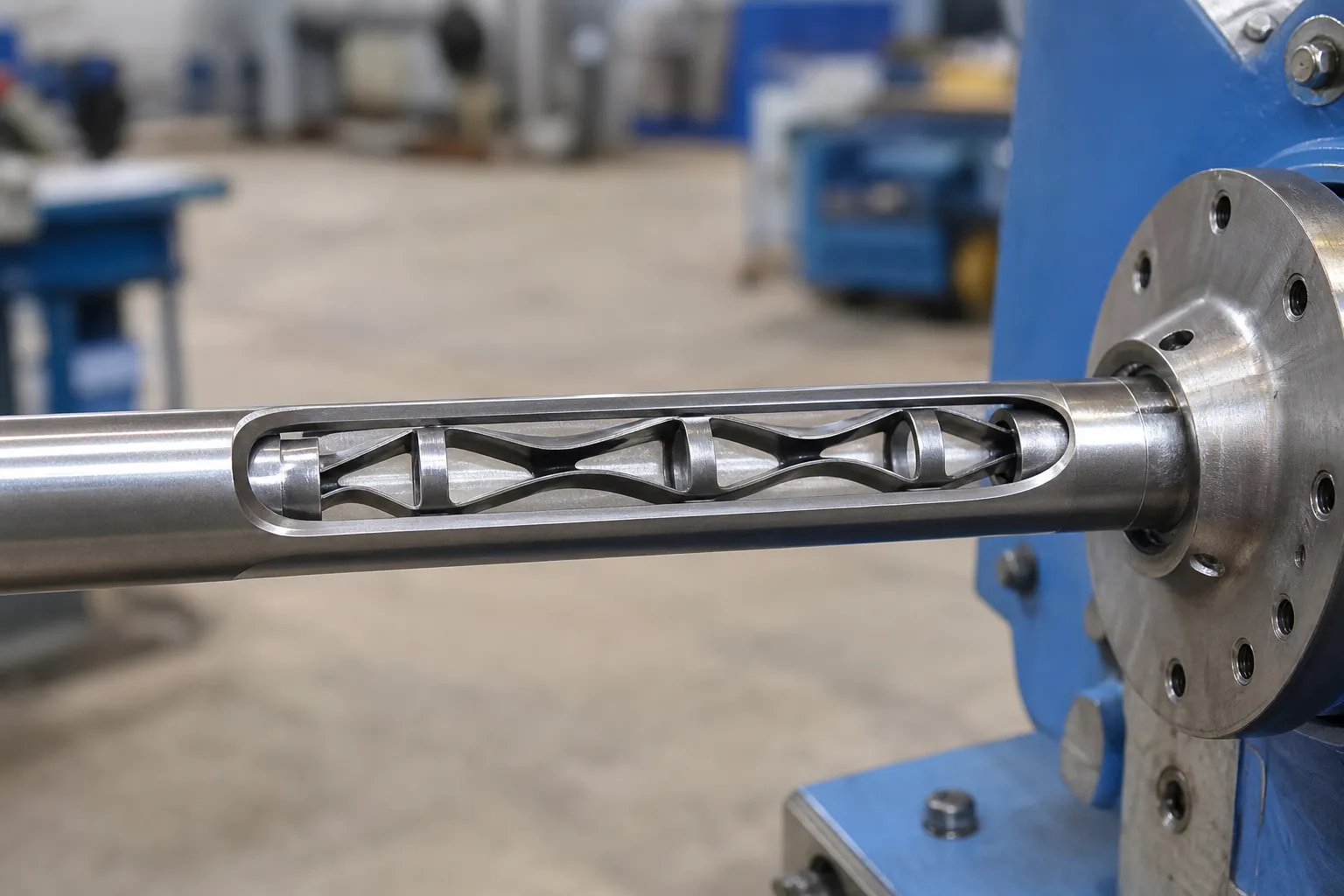
*Ilustração do conceito de engenharia. Apresenta suporte interno como uma questão candidata de engenharia; não se trata de uma afirmação de que as ferramentas internas sejam padrão ou apropriadas para cada tubo.*
Para seções ocas não redondas, see square and rectangular tube straightening. Para peças rotativas ocas, ver endireitamento de eixo oco de parede fina.
Separate the Two Signals Before Accepting Either Reading
The two characteristics contaminate each other's measurements in specific, formas diagnosticáveis. Em um traçado rotativo de sonda única em uma estação, o sinal radial contém pelo menos o erro de forma local da seção e o deslocamento do centro da seção em relação ao eixo de rotação. O erro de forma dominado pela ovalidade aparece principalmente como um segundo harmônico – o traço se repete duas vezes por revolução, com o eixo principal da ovalização definindo a fase. Um deslocamento central aparece como um primeiro harmônico – um impacto por revolução. Dentro de um único traço, os dois são separáveis em princípio, mas o primeiro harmônico em si é ambíguo: uma curvatura genuína e um deslocamento de assentamento ou mandril produzem a mesma assinatura de estação única. Os discriminadores vivem fora do traço único. Entre estações, a bend changes amplitude with longitudinal position and follows the bend plane, while a seating offset keeps a constant amplitude and a phase locked to the rotation axis. That multi-station logic, together with the harmonic fingerprints of lobing and datum effects, is developed in circularidade vs curvatura na medição rotativa.
The contamination also runs the other way. A probe scanned along the tube reads the local surface, não o eixo: a tube that is straight on its centerline but drifting in ovality orientation along its length produces a lengthwise trace that looks like bow. A practical two-scan check costs little: scan the length in one direction, then in the orthogonal direction — by rotating the tube ninety degrees against the same probe, or by using a second probe at right angles. Compare the two traces. A centerline bow decomposes into the two directions as projections of one vector: the two traces are similar in shape and same in sign, each a scaled copy of the other. Section form does the opposite: where the ovality major axis lies in the first scan direction it lies across it in the second, so a peak in one trace corresponds to a valley in the other. Traces that are same-shape-same-sign nominate a bend; traces that are opposite-sign at particular stations nominate form and wall variation. Only the first category should go to a correction decision.
Wall-thickness eccentricity adds a third layer on drawn or rolled tube: the outside surface and the bore are not concentric, so a centerline computed from outside-diameter measurements and one computed from bore measurements will not coincide. Neither is wrong; they answer different functional questions. Which one governs acceptance must follow the function of the part in its assembly — and the drawing, not whichever gauge happens to be available, defines it. Thin-wall behavior during correction has its own failure modes, coberto de endireitamento de tubo de parede fina sem colapso.
Crie um plano de correlação cliente-medidor
O ensaio deve usar tubos representativos do normal e do pior caso, leituras brutas para ambas as características, suporte acordado e condições de lançamento, repetir configuração, verificações de superfície/parede, e comparação com o medidor do cliente. O registro deve indicar se uma leitura é um valor de processo da máquina, um valor de aceitação do cliente ou um resultado correlacionado.
Usar correlação entre medidor da máquina e medidor do cliente e endireitando teste de amostra e aceitação para definir o pacote de evidências.
Run Two Separate Acceptance Chains, Not One
Because the definitions, supports and failure modes differ, ovality and centerline straightness each need their own chain from drawing language to signed record. Collapsing both into one generic “geometry OK” leaves every link below ambiguous:
| Chain link | Ovality chain | Centerline chain |
|---|---|---|
| Characteristic and formula | Which deviation rule, applied per station | Which span governs, and which center-finding rule feeds the path |
| Método de referência | Section measurement at defined stations | Lengthwise scan or rotating trace on defined supports |
| Support and release | Free stations distinguished from supported stations | Span defined; sag and clamping effects addressed or correlated |
| Sampling | Station positions fixed by the specification, não por conveniência | Station spacing short enough to resolve the shortest expected bend |
| Capacidade do medidor | Repeatability proven against within-part form variation | Repeatability proven against part-to-part and setup variation |
| Correlação | Machine gauge vs customer gauge on the same sections | Machine gauge vs customer gauge on the same span and supports |
| Registro | Per-station values with rule and station identity | Path result with support span and filtering stated |
Each link is a place the chain silently breaks. An unstated formula makes two gauges' numbers incomparable. A support condition defined at the machine but not at the customer builds a systematic offset into every correlation attempt. An unspecified station set makes the verdict depend on where the operator happened to measure. And an unproven gauge capability converts measurement noise into apparent process drift, which the correction loop then chases. Validating the measurement system before trusting any of these numbers is covered in medidor R&R para endireitar linhas.
Perguntas frequentes
Um tubo pode ser reto, mas fora de círculo??
Sim. A retilineidade e a ovalidade da linha central são condições diferentes e requerem medição separada. In practice the two belong in the same inspection record but under different characteristic numbers, each with its own formula, station set and gauge correlation.
Uma seção transversal redonda prova que o tubo está reto ao longo de seu comprimento??
Não. Um tubo pode ser redondo nas seções medidas enquanto sua linha central tem curva ou varredura. A lengthwise scan reads the surface rather than the axis, so the orthogonal two-scan comparison above is what keeps form effects out of the straightness verdict.
Um processo de correção pode garantir ambos os resultados?
Não sem validação específica da peça. O processo deve medir e verificar todas as características exigidas pelo desenho. In particular, a process validated for bow says nothing about its effect on section form at contacts, supports and free stations — those need their own before-and-after readings.
How can we tell whether a straightness reading is contaminated by ovality?
Repeat the lengthwise scan in the orthogonal direction and compare the traces. Same shape and same sign across the two scans is the signature of a centerline bow; opposite sign at particular stations points to section form or wall variation. Rotating single-station traces add a second test: a bend changes amplitude between stations, while a seating offset does not.
Does ovality need to be measured at every cross-section?
Only the specification can answer that. What the acceptance plan must guarantee is that the station set is fixed in advance — typically including supports, braçadeiras, ends and the neighborhoods of bend peaks — so the verdict does not depend on where an operator happened to check.

*Ilustração do conceito de engenharia.*