
Na indústria de fabricação de fixadores, dobrar parafusos longos após o tratamento térmico é um problema universal. Tradicional “martelo manual” não é apenas ineficiente, mas também falha em garantir uma precisão consistente. Este artigo compartilha um artigo especializado Solução automatizada de endireitamento de parafusos: demonstrating a reported client case in which automation took an 8-person manual line to one operator supervising four machines, with straightness held within 0.1 mm on the client’s acceptance records.
What is the Bolt?
Os parafusos são fixadores fundamentais para o maquinário, construção, e indústrias automotivas. A peça típica para esta solução é um parafuso longo de alta resistência: 15mm de diâmetro, 340mm comprimento.
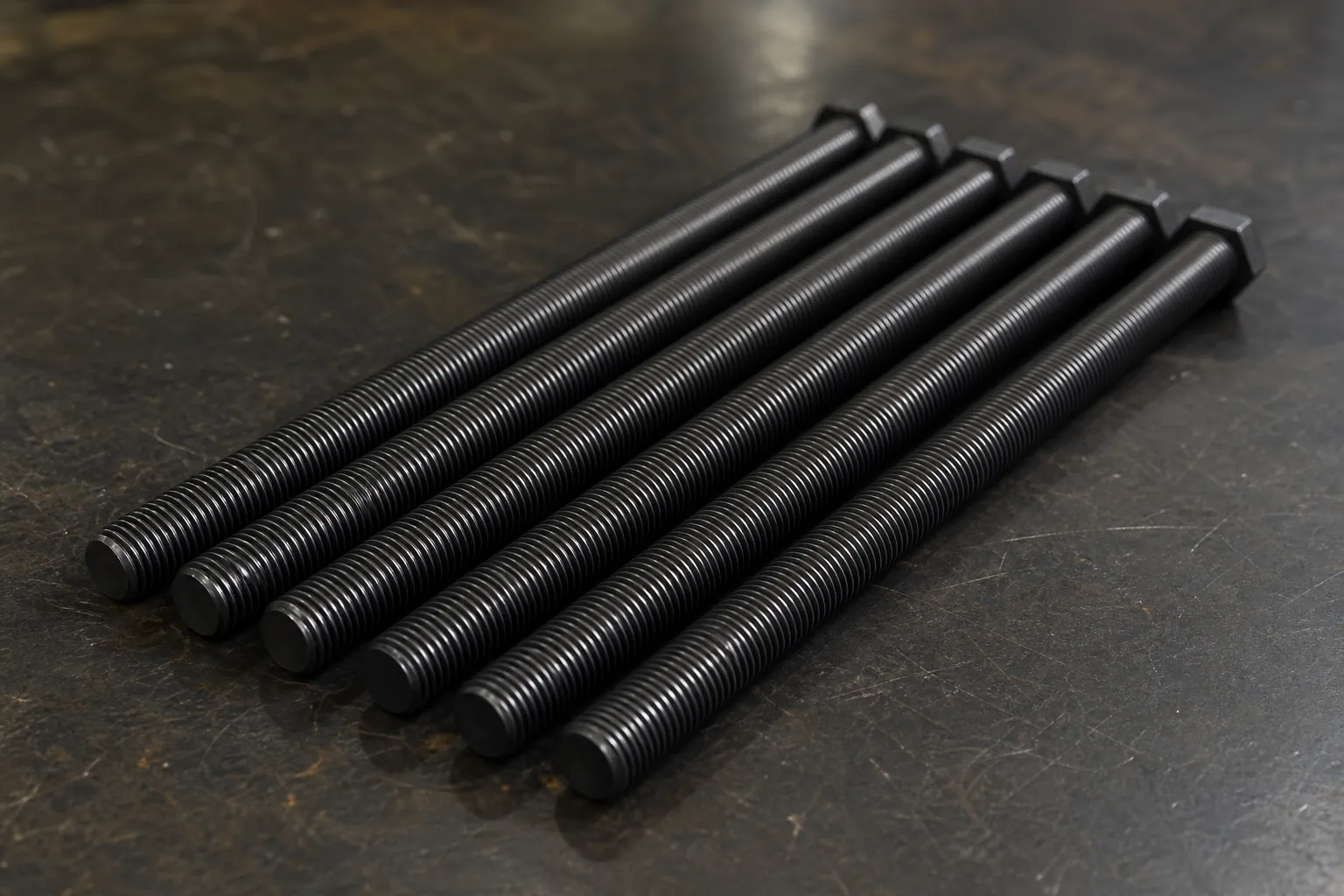
Características estruturais e desafios
- Alta relação L/D: O comprimento de 340 mm torna o parafuso altamente suscetível a uma curvatura inicial de 0,5 mm – 1.5mm após tratamento térmico.
- Requisitos de precisão: The client required straightness within 0.2 milímetros; the case acceptance records were held under 0.1 milímetros.
- Requisitos de proteção: O processo de endireitamento deve garantir zero danos à precisão da rosca e à qualidade da superfície.
Why Heat Treatment Bends Long Bolts in the First Place
Understanding the distortion source is what makes a correction process defensible instead of decorative. During quenching, a long fastener cools unevenly: the section cools at different rates depending on orientation in the basket or fixture, agitation contact, and local mass differences between the plain shank, the threaded length and the head. Each cooling path wants to contract by a different amount, and the resulting locked-in stresses bend the part when it relaxes. The effect scales with length — which is why short bolts leave heat treatment usable while long ones of the same grade systematically arrive bent. Thread rolling and machining before treatment add their own stress history, and any straightening performed at the heat treater counts as prior deformation for everything done afterward.
Two practical consequences follow. Primeiro, incoming inspection on long heat-treated bolts is not optional paperwork — the bend magnitude and pattern arriving at the straightening station determine both the correction plan and any supplier conversation, and the interaction of prior deformation with correction response is the reason reverse-loading behavior matters, as covered under o efeito Bauschinger no alisamento. Segundo, process decisions upstream — how parts are racked or basketed through quench, whether stress relief is applied — change the distribution the straightening station sees, and are usually the cheapest place to reduce total correction work.
Reading the Bend Before Correcting It
Long fasteners arrive with a small vocabulary of bend patterns, and naming the pattern is the first step of an efficient correction loop. A single-arc bow — one gentle curve, maximum near the middle — is the most common heat-treatment signature and the most straightforward to correct with supports positioned around the peak. An S-shaped double bend has two opposite peaks, usually reflecting two constraint points during quench, and demands two coordinated corrections rather than one big press at the largest reading. A local kink near the head or the thread runout concentrates distortion where section stiffness changes, and behaves differently from a distributed bow. Finalmente, twist about the axis occasionally accompanies bending on parts with asymmetric features. Each pattern requires its own measurement map and correction sequence, which is why an automatic station that scans the full length and builds the map before pressing — rather than chasing the single worst reading — converges in fewer strokes. The measuring-and-correcting loop behind this is described for automatic shaft straightening generally, and for the long-bolt family specifically in the automatic long bolt straightening process.
Por que o endireitamento de parafusos deve se afastar “Martelagem Manual”
Processo Tradicional vs.. Solução Automatizada
The figures below are this client’s reported baseline and post-commissioning values, not a universal benchmark for every fastener line.
| Ponto de dor | Martelagem Manual / Imprensa manual | Solução de alisamento automatizado |
| Requisito de mão de obra | 8 workers per shift (manual baseline, reported case) | 1 operator for 4 máquinas (reported case) |
| Retidão | 0.2 – 0.5 mm spread (reported manual baseline) | ≤ 0,1 mm (client acceptance records) |
| Tempo de ciclo | 120 – 180 s/peça (reported manual baseline) | 10 – 15 s/peça (reported case) |
| Custo geral | High labor cost per corrected part | Manpower reduced from 8 operators to 1 supervising 4 máquinas (reported case) |
Fluxo do processo de endireitamento automatizado de parafusos
Esta solução abrange um processo totalmente automatizado em circuito fechado, desde a alimentação até a classificação, garantindo que cada parafuso atenda aos requisitos de entrega de alto padrão.
Descrições do processo principal
- Alimentação automática: Os parafusos dobrados são alimentados automaticamente de uma tremonha para a estação de endireitamento sem intervenção humana.
- Medição Dinâmica: Sensores de alta precisão examinam a peça rotativa em tempo real, capturando com precisão o ponto máximo de curvatura em todo o comprimento.
- ServoPrensagem: O sistema inteligente calcula automaticamente o retorno elástico com base no material (aço carbono/liga de aço), e o servo-êmbolo aplica pressão precisa para uma correção de passagem única.
- Classificação automática: Parafusos qualificados passam para a próxima etapa, while non-conforming parts are automatically isolated before they leave the machine.

Máquina endireitadora de parafusos UBJ-80
Este alisador é ideal para peças acabadas com tratamento térmico (por exemplo, componentes de máquinas de estamparia/escritório, peças de automóveis/motocicletas, ferramentas, parafusos) e bares (aço, cobre, alumínio, aço inoxidável, Liga de titânio) de 60–600 mm de comprimento & φ3–φ25mm de diâmetro. Aumenta a precisão e a qualidade do produto.
Principais desafios e soluções de alisamento
Desafio 1: Manning and the Reported “1 Operador para 4 Máquinas” Caso
Descrição do problema: Manual hammering and press correction depend on operator skill, stamina and shift discipline, so manning levels stay high and results vary from operator to operator.
Solução:
Nossa solução implementa automação completa em circuito fechado. A lógica de operação é extremamente simples, com receitas integradas para diversas especificações de parafusos. Um trabalhador padrão só precisa reabastecer a tremonha periodicamente; o resto - medição, endireitamento, e inspeção - é realizada automaticamente pela máquina. Isso resolve a escassez de mão de obra e elimina quedas de precisão causadas por fadiga.
Desafio 2: Garantindo consistência com precisão de 0,1 mm
Descrição do problema: Quando um parafuso é submetido a golpes de martelo, a distribuição interna da tensão torna-se desigual, muitas vezes levando à correção excessiva em áreas localizadas.
Solução:
A solução utiliza um sistema de servocontrole totalmente parametrizado. Ao contrário do vago julgamento humano, sensores detectam a curva axial do parafuso com precisão de nível mícron. Através de servoalgoritmos de várias etapas, o sistema supera com precisão o retorno elástico do S45C ou aços-liga, locking final straightness within the 0.1 mm window achieved on this client’s qualified recipe.
How Thread and Head Zones Are Protected During Correction
Thread protection is a contact-zone engineering problem, and the principles are the same ones that govern surface-protection tooling across straightening applications. The correction force and the reaction forces both need somewhere to live, and on a long bolt the plain shank is the region designed to carry load, while the threaded length and the under-head fillet are the regions most easily damaged. A protection concept therefore has three parts: place supports on the shank at controlled span positions around the bend peak; direct press contact onto the shank through tooling that conforms to the section instead of touching thread crests; and keep every edge that could contact the workpiece generously radiused so load spreads instead of concentrating. Cleanliness belongs in the same sentence — debris trapped between press tooling and a thread flank is a scratch generator, and on plated or coated bolts the coating class defines how much contact the finish can tolerate at all.
The validation side is equally concrete. A thread-protection claim is proven by inspection agreed before the trial — thread gauges still running, flank condition reviewed under the method the quality function specifies — together with the released-state straightness result, on representative parts, after repeat setups. Protection and geometry are accepted together or not at all.
What an Acceptance Criteria Package Should Contain
A bolt straightening process is only as good as the acceptance definition it answers to, and a complete one answers five questions in writing. What characteristic governs — straightness of the axis, measured how: on centers, on supports, girando, in what condition, since a reading under restraint is not a released result, por loaded versus released measurement practice. What the limit is, and where it applies — full length or specified spans. What else must survive the process — thread fit, acabamento superficial, revestimento, head markings. How conformity is sampled — every part through an automatic gauge, or a sampling plan with defined reaction to a failure. And what happens to nonconforming parts — rework limits, segregation and disposition authority, following the NOK sorting and rework-limit framework. Buyers comparing straightening suppliers are well advised to ask for exactly this package; the ability to produce it says more about a supplier than any single machine specification.
Caso de fabricação: A quarta escolha do cliente indiano
Histórico do cliente
Um conhecido fornecedor indiano de fixadores que fornece componentes para marcas globais de máquinas de construção.
Resultados da implementação
- Repetir pedidos: Com base no excelente desempenho das três primeiras unidades, o cliente comprou recentemente seu 4a máquina.
- Operator Consolidation: The client reported one operator managing all 4 machines after commissioning, with a substantial increase in output per operator.
- Referência de qualidade: The client’s records report straightness moving from 0.2 mm down to under 0.1 mm after commissioning.
Perguntas frequentes
- P: O cilindro de endireitamento danificará as roscas dos parafusos?
- Não. Nós projetamos sem contato, moldes de proteção almofadados especificamente para endireitamento de parafusos. Os blocos de pressão combinam perfeitamente com a curvatura do parafuso, garantindo distribuição uniforme de força e evitando reentrâncias na superfície.
- P: O equipamento pode ser integrado ao sistema MES da nossa fábrica??
- Sim. Nosso sistema de controle apresenta interfaces de dados padrão para registrar e exportar dados de endireitamento em tempo real para cada parafuso, atendendo aos requisitos modernos de rastreabilidade.
Additional Process Questions
Why do bolts from the same heat-treatment lot arrive with different bend patterns?
Because each part’s position in the basket or rack gave it a different cooling path. Quench distortion is sensitive to orientation, local mass and agitation contact, so even identical bolts leave treatment with different locked-in stress patterns. Mapping incoming parts rather than assuming a uniform error is the practical answer, and it is why scanning-based stations build a per-part correction plan.
How many correction passes does a long bolt need?
It depends on the pattern, not a fixed number. A single-arc bow typically converges in one planned press; an S-bend needs two coordinated corrections; local kinks near section changes respond differently again. The governing rule is a rework limit set before production — parts that stop responding are routed to review, not pressed repeatedly, because each additional plastic cycle consumes fatigue life and changes the material’s response.
Should straightening come before or after thread rolling?
The route belongs to the fastener process engineer, but the trade-off is explicit: correcting before thread rolling lets subsequent operations work from a straight blank, while correcting after heat treatment with finished threads demands the contact-zone protection described above. Whichever route is chosen, the acceptance package must define what state the straightness limit applies to, and the correction validation must be run on parts carrying that state.
Resumo
Para fábricas de fixadores que buscam alta eficiência e qualidade, um Solução automatizada de endireitamento de parafusos é o caminho essencial para o aumento da competitividade. Whether the target is lower manning or 0.1 mm delivery precision, the figures in this article are one client’s reported case; your own results depend on the bolt family, incoming distortion and acceptance definition.
Moving from manual bolt correction toward automation? O manual vs automatic selection logic e o Caso ROI para endireitamento automático são os próximos passos naturais.
Se você estiver enfrentando problemas de gerenciamento de mão de obra ou gargalos de precisão, sinta-se à vontade para Contate-nos para uma proposta técnica personalizada.