
Ovality rör og miðlínuréttleiki eru mismunandi rúmfræðilegar aðstæður. Ovality varðar lögun þversniðs; miðlínuréttleiki varðar leið rörsins eftir lengdinni. Rör getur haft ásættanlega miðlínu rúmfræði en verið úr kringlótt á einni stöð, eða hún getur verið kringlótt á hverjum mældum kafla á meðan miðlína hennar hneigist yfir langa breidd. Að meðhöndla þessar aðstæður sem eitt „beinleika“ gildi getur leitt til rangrar ákvörðunar í ferlinu.
Þessi leiðarvísir er mælingar- og viðurkenningarrammi. Það gerir ekki tilkall til StraighteningTech rörasviðs, veggmöguleika, mál, skynjari, umburðarlyndi eða fullgilt leiðréttingarferli. Lokakröfur verða að koma frá stýrðri teikningu, viðmiðunaraðferð og dæmigerð sýni.

*Verkfræðihugtaksmynd. Það sýnir samhengi við túpuréttingarferli, ekki sönnun þess að hægt sé að vinna úr tiltekinni rörafjölskyldu eða veggástandi.*
Define Each Characteristic Before Measuring Either
Ovality is a per-station property: every measured cross-section has its own value, and a tube inspected at twelve stations has twelve ovality values that can differ. Centerline straightness is a whole-length property: it is derived from the path traced by the successive centers of those cross-sections. The two characteristics do not merely describe different defects — they live at different levels of the measurement chain, and the higher level is computed from the lower one.
That dependency is the hidden coupling. A centerline is not measured directly; it is computed, station by station, from sections that are never perfectly round. Whichever rule converts a measured section into a single center point — the average of two diameters, a least-squares circle center, a minimum-zone circle center, or the center a two-point gauge happens to report — becomes part of the straightness definition. Two inspection methods can therefore disagree about the centerline of the same physical tube while each is internally consistent, because they embedded different center-finding rules.
The acceptance documents should state, for each characteristic: the formula (diameter-based ovality, radial-deviation-based ovality, or a full form tolerance), the center-finding rule feeding the centerline calculation, and the station set over which each value applies. A single “straightness OK” record that does not say which rules produced it is not transferable between supplier and customer gauges.
Mældu þversnið og lengdarrúmfræði með viðeigandi stuðningi
Stuðningsstöður geta haft áhrif á sýnilega miðlínu í gegnum sig; klemmur getur haft áhrif á þunnt veggja hluta; snerting nema getur haft áhrif á yfirborðs- eða veggsvörun. Málsmeðferðin ætti því að skilgreina skilyrði fyrir hvern eiginleika og endurtaka/setja athuganir aftur þar sem þörf krefur.
| Mælingarstýring | Hvers vegna það skiptir máli |
|---|---|
| Þversniðsstöð og stefnumörkun | Ovality getur verið mismunandi eftir lengd og ummál |
| Lengdarspenna og stoðir | Miðlínumælingar geta falið í sér þyngdarafl og búnaðaráhrif |
| Dagsetning og lokaskilyrði | Ákveður hvort niðurstaðan tengist ætluðu falli |
| Snerting eða sjónræn aðferð | Getur kynnt mismunandi yfirborð, aðgangs- og óvissumörk |
| Útgefið ástand | Kemur í veg fyrir að tímabundið aðhald sé tilkynnt sem endanleg rúmfræði |
Support Spacing Filters the Centerline Signal
On a measured span, supports act as a mechanical filter for the centerline reading: bending content with a wavelength shorter than the support spacing is partially suppressed by the stiffened sections, while longer-wavelength bow passes into the reading. The same tube can therefore report different bow on a short fixture span than on a long one without either reading being wrong. The support span is not a setup convenience — it is part of the straightness definition, and it must match, or be explicitly correlated to, the span used by the customer gauge.
Station spacing plays the analogous role in the sampling domain. Widely spaced stations under-sample the centerline path and can miss a local kink between stations; very dense stations begin to mix surface and wall-thickness variation into the computed axis. The sampling plan should state where stations sit — not only how many — because the informative stations are the support points, the clamping points, the tube ends and the neighborhoods of expected bend peaks.
On thin-wall tubes the supports carry a second, unwanted effect: support reaction can ovalize the section locally, so the ovality measured at a support station includes a measurement-induced contribution. Comparing readings at supported stations against readings taken just outside the support influence is a cheap check for this; where the difference is significant, the ovality acceptance must be evaluated at defined free stations. For the loaded-versus-released distinction in final acceptance, sjáðu mæling á hlaðinni vs sleppt réttleika.
Ekki leiðrétta eina villu og gera ráð fyrir að hin sé leyst
Leiðréttingarferli sem ætlað er að draga úr boga getur breytt sporöskju eða ástandi veggja. Ferli sem ætlað er að bæta formi hluta getur ekki staðfest miðlínu beint. Sýnisáætlunin verður að skilgreina hvaða rúmfræði er stjórnað, hvaða aukaeiginleikar eru athugaðir, þar sem umgengni er leyfð og þegar þörf er á sjálfstæðu ferli.
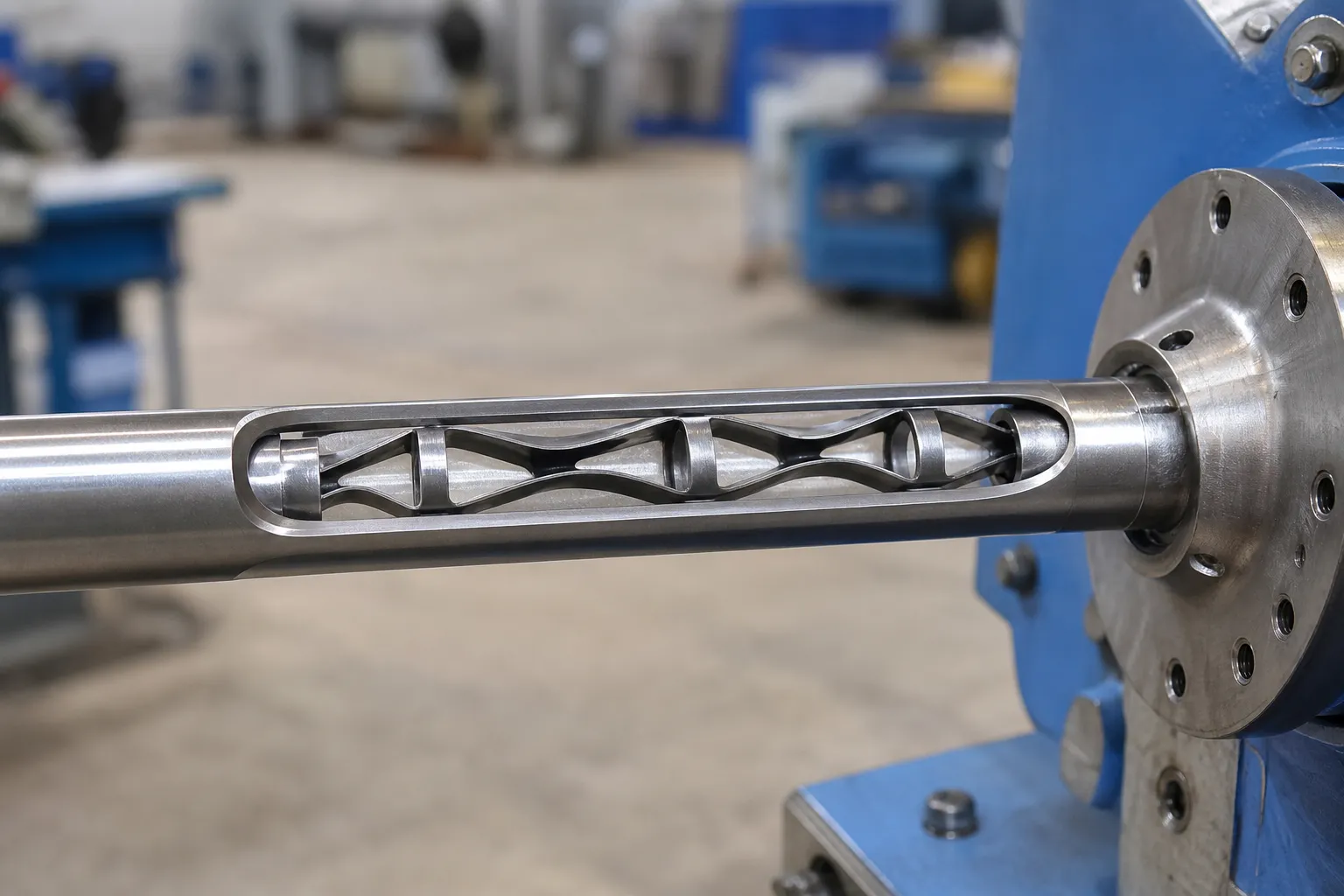
*Verkfræðihugtaksmynd. Það sýnir innri stuðning sem verkfræðilega spurningu; það er ekki fullyrt að innri verkfæri séu staðalbúnaður eða viðeigandi fyrir hvert rör.*
Fyrir óhringlaga hola hluta, see square and rectangular tube straightening. Fyrir hola snúningshluta, sjáðu þunnveggaður holur skaftréttur.
Separate the Two Signals Before Accepting Either Reading
The two characteristics contaminate each other's measurements in specific, diagnosable ways. In a rotating single-probe trace at one station, the radial signal contains at least the local form error of the section and the offset of the section center from the rotation axis. Ovality-dominated form error appears primarily as a second harmonic — the trace repeats twice per revolution, with the ovality major axis setting the phase. A center offset appears as a first harmonic — one bump per revolution. Within a single trace the two are separable in principle, but the first harmonic itself is ambiguous: a genuine bend and a seating or chucking offset produce the same single-station signature. The discriminators live outside the single trace. Across stations, a bend changes amplitude with longitudinal position and follows the bend plane, while a seating offset keeps a constant amplitude and a phase locked to the rotation axis. That multi-station logic, together with the harmonic fingerprints of lobing and datum effects, is developed in kringlótt vs beygja í snúningsmælingu.
The contamination also runs the other way. A probe scanned along the tube reads the local surface, ekki ásinn: a tube that is straight on its centerline but drifting in ovality orientation along its length produces a lengthwise trace that looks like bow. A practical two-scan check costs little: scan the length in one direction, then in the orthogonal direction — by rotating the tube ninety degrees against the same probe, or by using a second probe at right angles. Compare the two traces. A centerline bow decomposes into the two directions as projections of one vector: the two traces are similar in shape and same in sign, each a scaled copy of the other. Section form does the opposite: where the ovality major axis lies in the first scan direction it lies across it in the second, so a peak in one trace corresponds to a valley in the other. Traces that are same-shape-same-sign nominate a bend; traces that are opposite-sign at particular stations nominate form and wall variation. Only the first category should go to a correction decision.
Wall-thickness eccentricity adds a third layer on drawn or rolled tube: the outside surface and the bore are not concentric, so a centerline computed from outside-diameter measurements and one computed from bore measurements will not coincide. Neither is wrong; they answer different functional questions. Which one governs acceptance must follow the function of the part in its assembly — and the drawing, not whichever gauge happens to be available, defines it. Thin-wall behavior during correction has its own failure modes, hulið í þunnveggja rör rétta án þess að falla.
Búðu til fylgniáætlun viðskiptavinar-mælis
Prófið ætti að nota dæmigerð venjuleg og versta tilfelli slöngur, hráar lestur fyrir báða eiginleikana, samþykktum stuðnings- og losunarskilyrðum, endurtaka uppsetningu, yfirborðs-/veggskoðanir, og samanburður við mælikvarða viðskiptavina. Skráin ætti að tilgreina hvort aflestur sé vélvinnslugildi, gildi viðtöku viðskiptavina eða tengdri niðurstöðu.
Notaðu fylgni vélamælis á móti viðskiptavinamælis og réttunarsýnispróf og samþykki að skilgreina sönnunarpakkann.
Run Two Separate Acceptance Chains, Not One
Because the definitions, supports and failure modes differ, ovality and centerline straightness each need their own chain from drawing language to signed record. Collapsing both into one generic “geometry OK” leaves every link below ambiguous:
| Chain link | Ovality chain | Centerline chain |
|---|---|---|
| Characteristic and formula | Which deviation rule, applied per station | Which span governs, and which center-finding rule feeds the path |
| Tilvísunaraðferð | Section measurement at defined stations | Lengthwise scan or rotating trace on defined supports |
| Support and release | Free stations distinguished from supported stations | Span defined; sag and clamping effects addressed or correlated |
| Sampling | Station positions fixed by the specification, ekki eftir hentugleika | Station spacing short enough to resolve the shortest expected bend |
| Málgeta | Repeatability proven against within-part form variation | Repeatability proven against part-to-part and setup variation |
| Fylgni | Machine gauge vs customer gauge on the same sections | Machine gauge vs customer gauge on the same span and supports |
| Upptaka | Per-station values with rule and station identity | Path result with support span and filtering stated |
Each link is a place the chain silently breaks. An unstated formula makes two gauges' numbers incomparable. A support condition defined at the machine but not at the customer builds a systematic offset into every correlation attempt. An unspecified station set makes the verdict depend on where the operator happened to measure. And an unproven gauge capability converts measurement noise into apparent process drift, which the correction loop then chases. Validating the measurement system before trusting any of these numbers is covered in gage R&R til að rétta línur.
Algengar spurningar
Getur rör verið beint en úr kringlótt?
Já. Miðlínuréttleiki og sporöskjulaga eru mismunandi aðstæður og krefjast sérstakrar mælingar. In practice the two belong in the same inspection record but under different characteristic numbers, each with its own formula, station set and gauge correlation.
Sannar kringlótt þversnið að rörið sé beint yfir lengdina?
Nei. Rör getur verið kringlótt á mældum köflum á meðan miðlína þess hefur boga eða sópa. A lengthwise scan reads the surface rather than the axis, so the orthogonal two-scan comparison above is what keeps form effects out of the straightness verdict.
Getur leiðréttingarferli tryggt báðar niðurstöður?
Ekki án vinnustykkissértækrar staðfestingar. Ferlið verður að mæla og sannreyna alla eiginleika sem teikningin krefst. In particular, a process validated for bow says nothing about its effect on section form at contacts, supports and free stations — those need their own before-and-after readings.
How can we tell whether a straightness reading is contaminated by ovality?
Repeat the lengthwise scan in the orthogonal direction and compare the traces. Same shape and same sign across the two scans is the signature of a centerline bow; opposite sign at particular stations points to section form or wall variation. Rotating single-station traces add a second test: a bend changes amplitude between stations, while a seating offset does not.
Does ovality need to be measured at every cross-section?
Only the specification can answer that. What the acceptance plan must guarantee is that the station set is fixed in advance — typically including supports, klemmur, ends and the neighborhoods of bend peaks — so the verdict does not depend on where an operator happened to check.

*Verkfræðihugmynd.*