
Η αυτόματη ευθυγράμμιση μπορεί να δημιουργήσει σήματα διαδικασίας που αξίζουν διερεύνηση: μια απροσδόκητη απόκριση δύναμης-μετατόπισης, ένα ακουστικό γεγονός, μια ασυνήθιστη αλλαγή γεωμετρίας, επαναλαμβανόμενη αποτυχία διόρθωσης ή άλλη καθορισμένη κατάσταση. Αυτά τα σήματα μπορούν να βοηθήσουν μια γραμμή παραγωγής να σταματήσει, απομονώστε και δρομολογήστε ένα τμήμα για έλεγχο. Δεν αποτελούν αυτόματα απόδειξη ότι υπάρχει ρωγμή, και δεν αποτελούν αυτόματα υποκατάστατο μιας ειδικής μεθόδου NDT.
Αυτό το άρθρο είναι ένα πλαίσιο ελέγχου κινδύνου. Δεν ισχυρίζεται ότι η StraighteningTech παρέχει επί του παρόντος αισθητήρες ανίχνευσης ρωγμών, ανιχνεύει ένα καθορισμένο μέγεθος ρωγμής, πληροί ένα συγκεκριμένο πρότυπο ή αντικαθιστά το μαγνητικό σωματίδιο, υπερηχητικός, δινορεύματος ή άλλη επίσημη επιθεώρηση. Αυτές οι δυνατότητες απαιτούν μια ξεχωριστά επαληθευμένη μέθοδο, γνωστά δείγματα και έγκριση συστήματος ποιότητας.

*Μηχανική έννοια εικονογράφηση. Δείχνει ένα υποψήφιο πλαίσιο μέτρησης και διόρθωσης; δεν υποδεικνύει ότι έχει εγκατασταθεί αισθητήρας ρωγμών ή αλγόριθμος ανίχνευσης.*
Το σχέδιο ανάπτυξης πρέπει να χρησιμοποιεί το γνωστό κανονικό, γνωστός ύποπτος και, όπου επιτρέπεται, γνωστές συνθήκες αναφοράς για να διαπιστωθεί εάν το σήμα συσχετίζεται με την απαιτούμενη απόφαση. Δεν πρέπει να συνάγει την απόδοση ανίχνευσης από μια λίστα χαρακτηριστικών ανταγωνιστών ή από μια επιτυχημένη δοκιμή.
Why Straightening Is a Natural Integrity Checkpoint
Cracks relevant to straightening have a short list of origins: prior manufacturing wrote them in, or the correction process itself put them there. On the incoming side, quench cracks from heat treatment, seams and folds from rolling or drawing, and grinding abuse on machined surfaces all exist before the part reaches the press — and a part carrying a sharp discontinuity responds differently to plastic bending than a sound one, because the discontinuity concentrates strain locally. On the process side, aggressive correction, repeated reverse bending, and correcting a material in a brittle condition can initiate cracks that no incoming inspection would have found. The two categories demand different responses: incoming cracks are a supplier-quality problem surfaced at your station, while process-initiated cracks are a process-design problem owned inside the correction loop — the boundary worked through in υπερβολικό ίσιωμα και ράγισμα.
Either way, the straightening station sees the part in a state no inspection bench replicates: under load, in plastic deformation, with its stiffness and response visible stroke by stroke. That is why the press is a natural integrity checkpoint even though it is not an NDT instrument. The signals are there for the taking; the engineering work is making them mean something.
The Signal Families Available at the Press
Four signal families are realistically available on straightening equipment, and each has a distinct information content. Force–displacement behavior is the richest: a sound section deforms along a repeatable curve, and departures from the qualified curve shape — an early load drop, an unexpected plateau, a step in the response — indicate that the section is behaving abnormally somewhere along the load path, whether from a material discontinuity, a setup fault or a geometry outside the expected map. Acoustic events are the sharpest: a distinct release of strain energy is audible and can be sensed, though ambient noise on a production floor makes standalone acoustic detection fragile. Geometry response covers cases where the part moves less, more, or differently than the qualified correction model predicts — a crack crossing the correction zone reduces local stiffness and shows up as anomalous movement. Convergence failure — repeated correction attempts that never reach the target — is the slowest but most insidious signal, because its common causes are mundane, and the rare cause is a part that cannot be straightened because it is no longer continuous in the way the process assumes.
None of these families is specific to cracking. Each one answers “is this part behaving like the qualified population?”, δεν “does this part contain a crack of a given size?”. That gap between anomaly detection and flaw detection is the honest boundary of process monitoring, and it is exactly why the verification route — not the alarm itself — carries the quality decision. The force–stroke interpretation background sits alongside point-press process practice, where the same curves are used for correction control.
Ενσωματώστε τα στοιχεία ελέγχου κινδύνου στον βρόχο διόρθωσης
Μια ελεγχόμενη διαδρομή μπορεί να είναι:
- ταυτοποίηση μέρους/παρτίδας, αναθεώρηση σχεδίου και εγκεκριμένη συνταγή;
- πλήρης εισερχόμενη επιθεώρηση και σκληροί έλεγχοι απόρριψης;
- καθορίστε το δεδομένο και αποκτήστε βασικά δεδομένα γεωμετρίας/διεργασίας;
- εκτελέστε την εγκεκριμένη σειρά διόρθωσης;
- αξιολογήστε τα καθορισμένα σήματα διεργασίας και τη γεωμετρική απόκριση;
- απελευθερώστε και μετρήστε ξανά το εξάρτημα;
- ΠΕΡΑΣΜΑ διαδρομής, επανεπεξεργασία-κατάλληλη, κρατήστε για επαλήθευση και απορρίψτε τα αποτελέσματα χωριστά;
- διατηρούν την ιχνηλασιμότητα, αποδεικτικά στοιχεία και τη διάθεση του κριτή.
Η διαδρομή θα πρέπει να περιλαμβάνει μια συνθήκη χωρίς πρόοδο. Επανειλημμένες προσπάθειες διόρθωσης χωρίς την αναμενόμενη απόκριση μπορεί να είναι ένας λόγος για να σταματήσετε και να απομονώσετε το εξάρτημα, δεν είναι λόγος να συνεχίσουμε να εφαρμόζουμε βία.
Ορισμός απομόνωσης και επαλήθευσης NOK
Το NOK δεν είναι μια καθολική κατηγορία. Η γραμμή πρέπει να διακρίνει ένα ζήτημα μέτρησης/ρύθμισης, μια ειδοποίηση παρακολούθησης διαδικασίας, επιβεβαιωμένη μη συμμόρφωση, ένας υποψήφιος επανεπεξεργασίας και ένα εξάρτημα που απαιτεί ανεξάρτητη επιθεώρηση ή μηχανική διάθεση. Φυσικός διαχωρισμός, επισήμανση κατάστασης, πρέπει να καθοριστούν η ιχνηλασιμότητα και η αρχή για την απελευθέρωση.
*Μηχανική έννοια εικονογράφηση. Αντιπροσωπεύει αποφάσεις δρομολόγησης διαδικασιών, δεν είναι εγκατεστημένο σύστημα ανίχνευσης ρωγμών ή αυτόματης ταξινόμησης.*
| Συμβάν | Ελάχιστη απόκριση για ορισμό |
|---|---|
| Το σήμα διεργασίας υπερβαίνει το όριο | Κανόνας διακοπής/αναμονής, συλλογή δεδομένων και υπεύθυνη αναθεώρηση |
| Η γεωμετρία δεν ανταποκρίνεται όπως αναμένεται | Όριο χωρίς πρόοδο και αξιολόγηση μηχανικής |
| Απαιτείται επίσημη επιθεώρηση | Εγκεκριμένη μέθοδος, κριτήριο αποδοχής και εξουσία |
| Εξετάζεται η επανεργασία | Μέγιστες προσπάθειες, επαναμέτρηση και χωριστή έγκριση ποιότητας |
| Επιβεβαιώθηκε η απόρριψη | Απομόνωση, αρχείο ιχνηλασιμότητας και διάθεσης |
Για τα χειριστήρια ευρύτερης γραμμής, βλέπω Όρια ταξινόμησης και επεξεργασίας NOK και δοκιμή και αποδοχή δειγμάτων ευθυγράμμισης.
Όπου η απόκριση μέτρησης αποτελεί μέρος της έρευνας, machine gauge versus customer gauge correlation helps define the boundary between a line signal and the controlled customer acceptance method.
Thresholds, False Alarms and Missed Events
Any threshold drawn on a process signal trades two failure rates against each other. Set it tight, and normal part-to-part variation — different lots, temperature drift, tooling wear, honest measurement scatter — crosses it regularly, flooding the review route with good parts until operators learn to ignore alarms. Set it loose, and the abnormal parts that motivated the monitoring slip through unflagged. There is no datasheet value that resolves this trade; it is settled empirically by running the signal on a known-normal population to learn its spread, and where permitted, on known-suspect or seeded-reference parts to learn what the abnormal signature actually looks like. Only that pair of distributions justifies a threshold, and the honest summary of what was learned belongs in the validation record — including the false-alarm and missed-event behavior observed, not only the detections celebrated.
Two further rules keep thresholds honest over time. Πρώτα, drift monitoring: as tooling wears and material lots change, the normal population moves, so the threshold must be reviewed on a schedule, not set once. Δεύτερος, change control: a new part revision, a different material family, or a reworked die changes the qualified population, and the threshold work starts over. These are the same habits that keep συστήματα μέτρησης credible, applied to process signals.
Where Formal NDT Fits After an Alert
When the review route decides a part needs a definitive answer, the method must match the question and the geometry. Magnetic-particle inspection suits ferrous parts and surface-breaking discontinuities, and it is fast enough for segregation decisions in moderate volumes. Penetrant testing suits non-ferrous surfaces where coating and cleanliness permit it. Eddy-current methods respond to near-surface condition and can run in-line, with sensitivity that depends strongly on coil geometry versus part geometry. Ultrasonic methods reach internal volumes along bar and shaft axes, at the cost of coupling, calibration blocks and operator discipline. Selecting among them is a quality-engineering decision driven by the flaw orientation expected, the material, the surface state after straightening contact — witness marks and surface protection practices intersect here — and the acceptance authority. What the straightening station controls is not the NDT verdict but the integrity of the chain before it: the part is identified, isolated, protected from further correction attempts, and accompanied by its process data so the inspector knows why it was pulled.
Επικύρωση πριν από μια αξίωση ικανότητας
Ένα υπεύθυνο πακέτο επικύρωσης προσδιορίζει την οικογένεια του τεμαχίου εργασίας, κατάσταση υλικού/διεργασίας, μέθοδος ανίχνευσης/παρακολούθησης, πληθυσμό δείγματος, αναφορές γνωστών συνθηκών, κατώτατα όρια, αναμενόμενη διακύμανση, αξιολόγηση ψευδούς συναγερμού και χαμένων γεγονότων, διαδρομή επαλήθευσης, διατήρηση δεδομένων και έγκριση ποιότητας. Δηλώνει επίσης τι δεν μπορεί να αποδείξει το σύστημα.
Καμία σελίδα διεργασίας σήματος δεν πρέπει να ισχυρίζεται ότι βρίσκει όλες τις ρωγμές, αντικαθιστά το NDT ή εγγυάται την ακεραιότητα του υλικού χωρίς εγκεκριμένο, πακέτο αποδεικτικών στοιχείων για το αντικείμενο εργασίας.
FAQ
Ένας συναγερμός διαδικασίας αποδεικνύει ότι υπάρχει ρωγμή;?
Οχι. Υποδεικνύει μια κατάσταση που απαιτεί την καθορισμένη διαδρομή αναθεώρησης. Η αιτία πρέπει να αξιολογηθεί με την εγκεκριμένη μέθοδο.
Μπορεί το αυτόματο ίσιωμα να αντικαταστήσει το NDT?
Οχι. Η παρακολούθηση της διαδικασίας ευθυγράμμισης και η επίσημη NDT έχουν διαφορετικούς σκοπούς, μεθόδους και ευθύνες αποδοχής.
Μπορεί ένα εξάρτημα να επαναληφθεί επ' αόριστον μετά από ειδοποίηση?
Οχι. Η διαδικασία απαιτεί ένα μέγιστο όριο προσπάθειας διόρθωσης και μια καθορισμένη διαδρομή μηχανικής/ποιότητας.
Which signal family catches cracks best?
None of them catches cracks in the NDT sense. Force–displacement behavior, acoustic events, geometry response and convergence failure all flag parts that behave unlike the qualified population. A part flagged by any of them goes to the verification route; a part that passes all of them is not certified crack-free — it simply behaved normally. That asymmetry is the design premise of every process-monitoring scheme on straightening lines.
How are thresholds set without a standard to cite?
Empirically, on populations. Run the chosen signal across a known-normal production sample to characterize its spread, and where reference conditions are available, across known-suspect parts to characterize the abnormal signature. The threshold is then drawn against both distributions, documented with observed false-alarm and missed-event behavior, and reviewed on a schedule as tooling, lots and seasons change.
What happens to a part after an alert is cleared?
Whatever the written route says, and only that: return to the normal flow with the event recorded, proceed to rework under the attempt limit, or pass to formal inspection with disposition authority named in advance. The failure mode to design against is the quiet return of alerted parts to the good bin by operator judgment, which is why physical segregation and labeling carry as much weight as the signal itself.

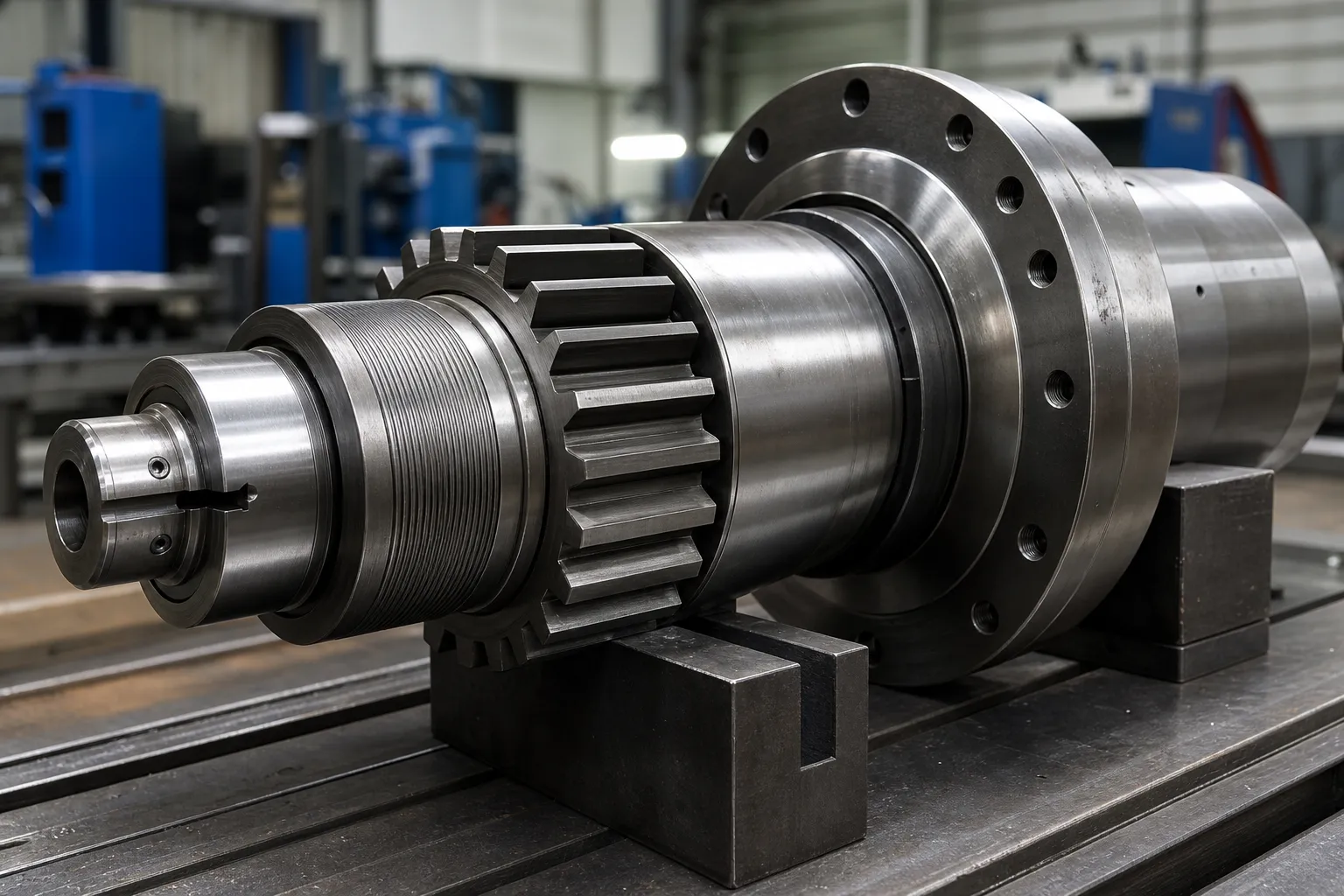
*Εικονογράφηση έννοιας μηχανικής.*
Καμπύλες μετατόπισης δύναμης στην ευθυγράμμιση
Μια ειδική σελίδα για Οδηγός καμπύλης μετατόπισης δύναμης ευθυγράμμισης δεν διατηρείται χωρίς επικυρωμένη ζήτηση ερωτήματος. Ερμηνεία της Force's Troke, Τα ασφαλή όρια και οι συνθήκες διακοπής της διαδικασίας επεξηγούνται στο point-press, σελίδες πολλαπλών σημείων και ανίχνευσης ρωγμών. Οποιοσδήποτε συναγερμός που βασίζεται σε καμπύλες πρέπει να επικυρώνεται σε αντιπροσωπευτικά μέρη αντί να αντιγράφεται από άλλη οικογένεια υλικού.