
Στη βιομηχανία κατασκευής συνδετήρων, Η κάμψη σε μακριά μπουλόνια μετά από θερμική επεξεργασία είναι ένα παγκόσμιο σημείο πόνου. Παραδοσιακός “χειροκίνητη σφυρηλάτηση” δεν είναι μόνο αναποτελεσματικό, αλλά επίσης αποτυγχάνει να εγγυηθεί σταθερή ακρίβεια. Αυτό το άρθρο μοιράζεται ένα εξειδικευμένο Λύση αυτοματοποιημένης ισιώματος μπουλονιών: demonstrating a reported client case in which automation took an 8-person manual line to one operator supervising four machines, with straightness held within 0.1 mm on the client’s acceptance records.
What is the Bolt?
Τα μπουλόνια είναι βασικοί συνδετήρες για τα μηχανήματα, κατασκευή, και αυτοκινητοβιομηχανίες. Το τυπικό τεμάχιο εργασίας για αυτή τη λύση είναι ένα μακρύ μπουλόνι υψηλής αντοχής: 15mm διάμετρος, 340μήκος mm.
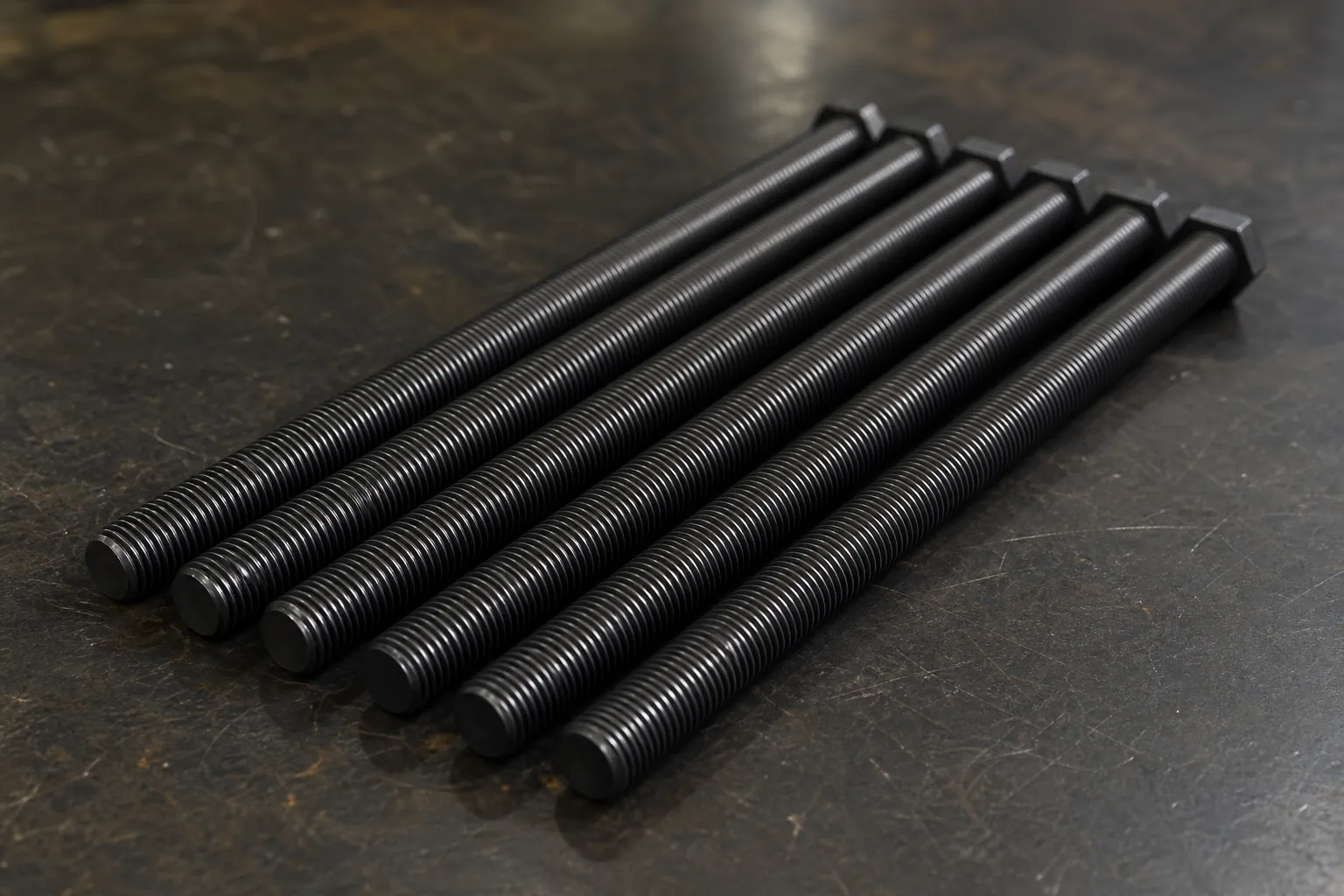
Δομικά χαρακτηριστικά και προκλήσεις
- Υψηλός λόγος L/D: Το μήκος 340 mm καθιστά το μπουλόνι ιδιαίτερα ευαίσθητο σε μια αρχική κάμψη 0,5 mm – 1.5mm μετά από θερμική επεξεργασία.
- Απαιτήσεις Ακρίβειας: The client required straightness within 0.2 mm; the case acceptance records were held under 0.1 mm.
- Απαιτήσεις Προστασίας: Η διαδικασία ισιώματος πρέπει να εξασφαλίζει μηδενική ζημιά στην ακρίβεια του νήματος και στην ποιότητα της επιφάνειας.
Why Heat Treatment Bends Long Bolts in the First Place
Understanding the distortion source is what makes a correction process defensible instead of decorative. During quenching, a long fastener cools unevenly: the section cools at different rates depending on orientation in the basket or fixture, agitation contact, and local mass differences between the plain shank, the threaded length and the head. Each cooling path wants to contract by a different amount, and the resulting locked-in stresses bend the part when it relaxes. The effect scales with length — which is why short bolts leave heat treatment usable while long ones of the same grade systematically arrive bent. Thread rolling and machining before treatment add their own stress history, and any straightening performed at the heat treater counts as prior deformation for everything done afterward.
Two practical consequences follow. Πρώτα, incoming inspection on long heat-treated bolts is not optional paperwork — the bend magnitude and pattern arriving at the straightening station determine both the correction plan and any supplier conversation, and the interaction of prior deformation with correction response is the reason reverse-loading behavior matters, as covered under το φαινόμενο Bauschinger στο ίσιωμα. Δεύτερος, process decisions upstream — how parts are racked or basketed through quench, whether stress relief is applied — change the distribution the straightening station sees, and are usually the cheapest place to reduce total correction work.
Reading the Bend Before Correcting It
Long fasteners arrive with a small vocabulary of bend patterns, and naming the pattern is the first step of an efficient correction loop. A single-arc bow — one gentle curve, maximum near the middle — is the most common heat-treatment signature and the most straightforward to correct with supports positioned around the peak. An S-shaped double bend has two opposite peaks, usually reflecting two constraint points during quench, and demands two coordinated corrections rather than one big press at the largest reading. A local kink near the head or the thread runout concentrates distortion where section stiffness changes, and behaves differently from a distributed bow. Τελικά, twist about the axis occasionally accompanies bending on parts with asymmetric features. Each pattern requires its own measurement map and correction sequence, which is why an automatic station that scans the full length and builds the map before pressing — rather than chasing the single worst reading — converges in fewer strokes. The measuring-and-correcting loop behind this is described for automatic shaft straightening generally, and for the long-bolt family specifically in the automatic long bolt straightening process.
Γιατί το ίσιωμα μπουλονιών πρέπει να απομακρυνθεί από “Χειροκίνητη σφυρηλάτηση”
Παραδοσιακή διαδικασία vs. Αυτοματοποιημένη Λύση
The figures below are this client’s reported baseline and post-commissioning values, not a universal benchmark for every fastener line.
| Σημείο πόνου | Χειροκίνητη σφυρηλάτηση / Manual Press | Λύση αυτοματοποιημένου ισιώματος |
| Απαίτηση Εργασίας | 8 workers per shift (manual baseline, reported case) | 1 χειριστή για 4 μηχανές (reported case) |
| Ευθύτητα | 0.2 – 0.5 mm spread (reported manual baseline) | ≤ 0,1 χλστ (client acceptance records) |
| Ώρα κύκλου | 120 – 180 s/τεμάχιο (reported manual baseline) | 10 – 15 s/τεμάχιο (reported case) |
| Συνολικό Κόστος | High labor cost per corrected part | Manpower reduced from 8 operators to 1 supervising 4 μηχανές (reported case) |
Ροή διαδικασίας αυτοματοποιημένης ευθυγράμμισης μπουλονιών
Αυτή η λύση καλύπτει μια πλήρη αυτοματοποιημένη διαδικασία κλειστού βρόχου από την τροφοδοσία έως την ταξινόμηση, διασφαλίζοντας ότι κάθε μπουλόνι πληροί τις απαιτήσεις παράδοσης υψηλών προδιαγραφών.
Περιγραφές βασικών διεργασιών
- Αυτόματη τροφοδοσία: Τα λυγισμένα μπουλόνια τροφοδοτούνται αυτόματα από μια χοάνη στο σταθμό ισιώματος χωρίς ανθρώπινη παρέμβαση.
- Δυναμική Μέτρηση: Αισθητήρες υψηλής ακρίβειας σαρώνουν το περιστρεφόμενο τεμάχιο εργασίας σε πραγματικό χρόνο, καταγράφοντας με ακρίβεια το μέγιστο σημείο κάμψης σε όλο το μήκος.
- Servo Pressing: Το έξυπνο σύστημα υπολογίζει αυτόματα την επιστροφή ελατηρίου με βάση το υλικό (ανθρακούχο χάλυβα/κράμα χάλυβα), και το σερβο ram εφαρμόζει ακριβή πίεση για διόρθωση μονής διέλευσης.
- Αυτόματη ταξινόμηση: Τα κατάλληλα μπουλόνια προχωρούν στο επόμενο στάδιο, while non-conforming parts are automatically isolated before they leave the machine.

UBJ-80 BOLT SHAITENIN
Αυτός ο ισιωτήρας είναι ιδανικός για τελειωμένα μέρη που έχουν υποστεί θερμική επεξεργασία (π.χ., εξαρτήματα σφράγισης/μηχανής γραφείου, ανταλλακτικά αυτοκινήτου/μοτοσικλέτας, εργαλεία, βίδες) και μπαρ (ατσάλι, χαλκός, αλουμίνιο, ανοξείδωτο ατσάλι, κράμα τιτανίου) μήκους 60–600 mm & διάμετρος φ3–φ25mm. Ενισχύει τόσο την ακρίβεια όσο και την ποιότητα του προϊόντος.
Βασικές προκλήσεις και λύσεις ευθυγράμμισης
Πρόκληση 1: Manning and the Reported “1 Χειριστής για 4 Μηχανές” Case
Περιγραφή προβλήματος: Manual hammering and press correction depend on operator skill, stamina and shift discipline, so manning levels stay high and results vary from operator to operator.
Διάλυμα:
Η λύση μας υλοποιεί πλήρης αυτοματισμός κλειστού βρόχου. Η λογική της λειτουργίας είναι εξαιρετικά απλή, με ενσωματωμένες συνταγές για διάφορες προδιαγραφές μπουλονιών. Ένας τυπικός εργάτης χρειάζεται μόνο να ξαναγεμίζει τη χοάνη περιοδικά; τα υπόλοιπα — μέτρηση, ίσιωμα, και επιθεώρηση—διαχειρίζεται αυτόματα το μηχάνημα. Αυτό επιλύει τις ελλείψεις εργατικού δυναμικού και εξαλείφει τις πτώσεις ακριβείας που προκαλούνται από την κόπωση.
Πρόκληση 2: Εγγύηση συνέπειας με ακρίβεια 0,1 mm
Περιγραφή προβλήματος: Όταν ένα μπουλόνι υποβάλλεται σε χτυπήματα σφυριού, Η εσωτερική κατανομή του στρες γίνεται άνιση, συχνά οδηγεί σε υπερβολική διόρθωση σε εντοπισμένες περιοχές.
Διάλυμα:
Η λύση χρησιμοποιεί α πλήρως παραμετροποιημένο σύστημα σερβοελέγχου. Σε αντίθεση με την αόριστη ανθρώπινη κρίση, Οι αισθητήρες ανιχνεύουν την αξονική καμπύλη του μπουλονιού με ακρίβεια σε επίπεδο micron. Μέσω σερβοαλγορίθμων πολλαπλών βημάτων, το σύστημα ξεπερνά με ακρίβεια την ελαστική πλάτη ελατηρίου S45C ή κράμα χάλυβα, locking final straightness within the 0.1 mm window achieved on this client’s qualified recipe.
How Thread and Head Zones Are Protected During Correction
Thread protection is a contact-zone engineering problem, and the principles are the same ones that govern surface-protection tooling across straightening applications. The correction force and the reaction forces both need somewhere to live, and on a long bolt the plain shank is the region designed to carry load, while the threaded length and the under-head fillet are the regions most easily damaged. A protection concept therefore has three parts: place supports on the shank at controlled span positions around the bend peak; direct press contact onto the shank through tooling that conforms to the section instead of touching thread crests; and keep every edge that could contact the workpiece generously radiused so load spreads instead of concentrating. Cleanliness belongs in the same sentence — debris trapped between press tooling and a thread flank is a scratch generator, and on plated or coated bolts the coating class defines how much contact the finish can tolerate at all.
The validation side is equally concrete. A thread-protection claim is proven by inspection agreed before the trial — thread gauges still running, flank condition reviewed under the method the quality function specifies — together with the released-state straightness result, on representative parts, after repeat setups. Protection and geometry are accepted together or not at all.
What an Acceptance Criteria Package Should Contain
A bolt straightening process is only as good as the acceptance definition it answers to, and a complete one answers five questions in writing. What characteristic governs — straightness of the axis, measured how: on centers, on supports, περιστροφικός, in what condition, since a reading under restraint is not a released result, per loaded versus released measurement practice. What the limit is, and where it applies — full length or specified spans. What else must survive the process — thread fit, φινίρισμα επιφάνειας, επένδυση, head markings. How conformity is sampled — every part through an automatic gauge, or a sampling plan with defined reaction to a failure. And what happens to nonconforming parts — rework limits, segregation and disposition authority, following the NOK sorting and rework-limit framework. Buyers comparing straightening suppliers are well advised to ask for exactly this package; the ability to produce it says more about a supplier than any single machine specification.
Υπόθεση Κατασκευής: Η τέταρτη επιλογή του Ινδού πελάτη
Υπόβαθρο πελατών
Ένας γνωστός Ινδός προμηθευτής συνδετήρων που παρέχει εξαρτήματα για παγκόσμιες μάρκες μηχανημάτων κατασκευής.
Αποτελέσματα Εφαρμογής
- Επαναλαμβανόμενες παραγγελίες: Με βάση την εξαιρετική απόδοση των τριών πρώτων μονάδων, ο πελάτης αγόρασε πρόσφατα τους 4η μηχανή.
- Operator Consolidation: The client reported one operator managing all 4 machines after commissioning, with a substantial increase in output per operator.
- Σημείο αναφοράς ποιότητας: The client’s records report straightness moving from 0.2 mm down to under 0.1 mm after commissioning.
Συχνές ερωτήσεις
- Q: Το έμβολο ανόρθωσης θα καταστρέψει τα σπειρώματα των μπουλονιών?
- Οχι. Έχουμε σχεδιάσει μη επαφή, προστατευτικά καλούπια ειδικά για το ίσιωμα των μπουλονιών. Τα μπλοκ πρέσας ταιριάζουν τέλεια με την καμπυλότητα του μπουλονιού, εξασφαλίζοντας ομοιόμορφη κατανομή δύναμης και αποφυγή εσοχών στην επιφάνεια.
- Q: Μπορεί ο εξοπλισμός να ενσωματωθεί στο σύστημα MES του εργοστασίου μας?
- Ναί. Το σύστημα ελέγχου μας διαθέτει τυπικές διεπαφές δεδομένων για την εγγραφή και εξαγωγή δεδομένων ευθυγράμμισης σε πραγματικό χρόνο για κάθε μπουλόνι, πληρούν τις σύγχρονες απαιτήσεις ιχνηλασιμότητας.
Additional Process Questions
Why do bolts from the same heat-treatment lot arrive with different bend patterns?
Because each part’s position in the basket or rack gave it a different cooling path. Quench distortion is sensitive to orientation, local mass and agitation contact, so even identical bolts leave treatment with different locked-in stress patterns. Mapping incoming parts rather than assuming a uniform error is the practical answer, and it is why scanning-based stations build a per-part correction plan.
How many correction passes does a long bolt need?
It depends on the pattern, not a fixed number. A single-arc bow typically converges in one planned press; an S-bend needs two coordinated corrections; local kinks near section changes respond differently again. The governing rule is a rework limit set before production — parts that stop responding are routed to review, not pressed repeatedly, because each additional plastic cycle consumes fatigue life and changes the material’s response.
Should straightening come before or after thread rolling?
The route belongs to the fastener process engineer, but the trade-off is explicit: correcting before thread rolling lets subsequent operations work from a straight blank, while correcting after heat treatment with finished threads demands the contact-zone protection described above. Whichever route is chosen, the acceptance package must define what state the straightness limit applies to, and the correction validation must be run on parts carrying that state.
Περίληψη
Για εργοστάσια συνδετήρων που επιδιώκουν υψηλή απόδοση και ποιότητα, ένα Λύση αυτοματοποιημένης ισιώματος μπουλονιών είναι ο ουσιαστικός δρόμος για την αύξηση της ανταγωνιστικότητας. Whether the target is lower manning or 0.1 mm delivery precision, the figures in this article are one client’s reported case; your own results depend on the bolt family, incoming distortion and acceptance definition.
Moving from manual bolt correction toward automation? ο manual vs automatic selection logic και το Θήκη ROI για αυτόματο ίσιωμα are the natural next steps.
Εάν αντιμετωπίζετε προβλήματα διαχείρισης εργασίας ή προβλήματα ακρίβειας, αισθανθείτε ελεύθερος να Επικοινωνήστε μαζί μας για μια προσαρμοσμένη τεχνική πρόταση.