
В индустрията за производство на крепежни елементи, огъването на дълги болтове след термична обработка е универсална болезнена точка. Традиционен “ръчно набиване” е не само неефективно, но и не гарантира постоянна прецизност. Тази статия споделя специализирана Автоматизирано решение за изправяне на болтове: demonstrating a reported client case in which automation took an 8-person manual line to one operator supervising four machines, with straightness held within 0.1 mm on the client’s acceptance records.
What is the Bolt?
Болтовете са основни крепежни елементи за машината, строителство, и автомобилната индустрия. Типичният детайл за това решение е дълъг болт с висока якост: 15mm диаметър, 340mm дължина.
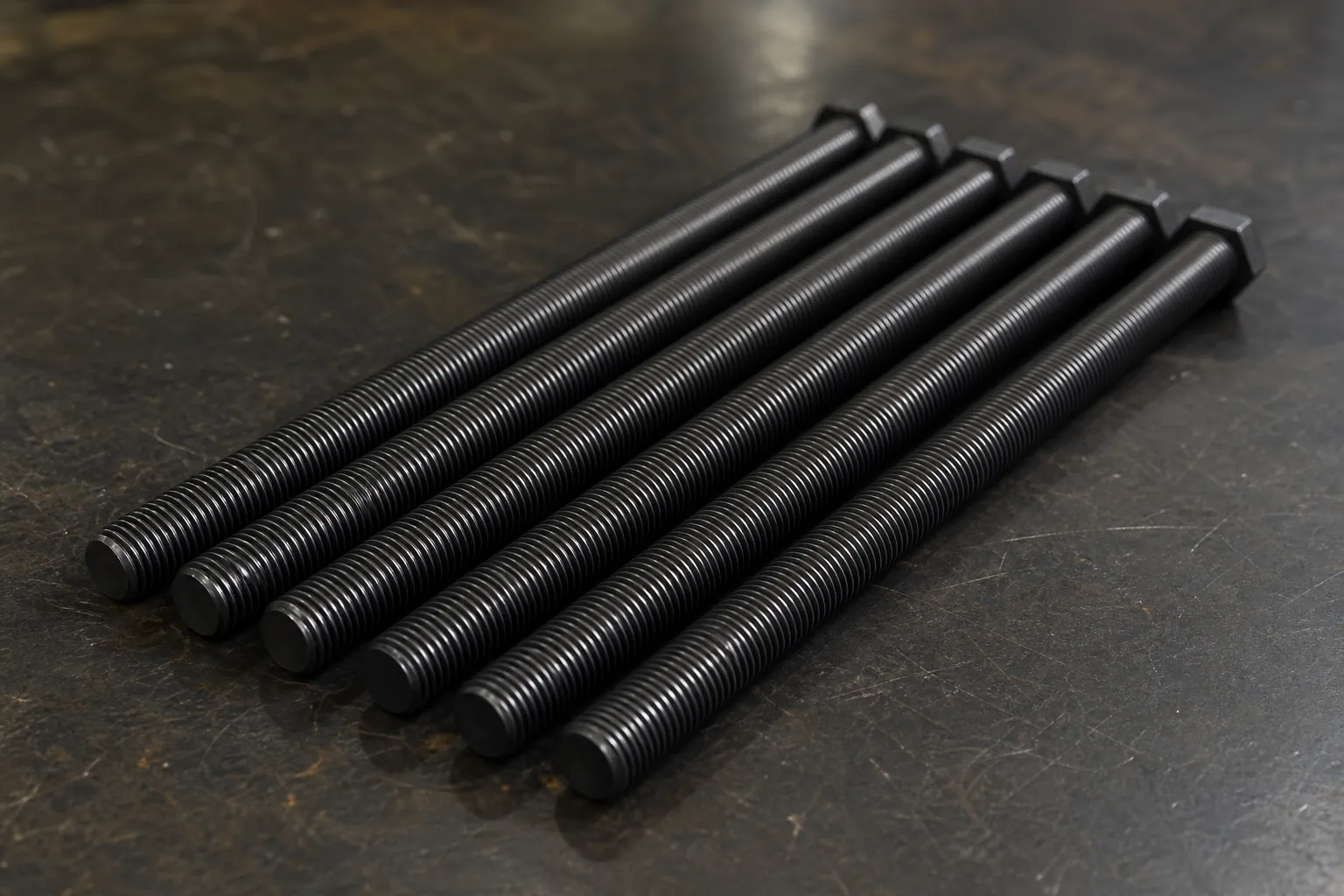
Структурни характеристики и предизвикателства
- Високо L/D съотношение: Дължината от 340 мм прави болта силно податлив на първоначално огъване от 0,5 мм – 1.5mm след топлинна обработка.
- Изисквания за точност: The client required straightness within 0.2 мм; the case acceptance records were held under 0.1 мм.
- Изисквания за защита: Процесът на изправяне трябва да гарантира нулево увреждане на прецизността на резбата и качеството на повърхността.
Why Heat Treatment Bends Long Bolts in the First Place
Understanding the distortion source is what makes a correction process defensible instead of decorative. During quenching, a long fastener cools unevenly: the section cools at different rates depending on orientation in the basket or fixture, agitation contact, and local mass differences between the plain shank, the threaded length and the head. Each cooling path wants to contract by a different amount, and the resulting locked-in stresses bend the part when it relaxes. The effect scales with length — which is why short bolts leave heat treatment usable while long ones of the same grade systematically arrive bent. Thread rolling and machining before treatment add their own stress history, and any straightening performed at the heat treater counts as prior deformation for everything done afterward.
Two practical consequences follow. Първо, incoming inspection on long heat-treated bolts is not optional paperwork — the bend magnitude and pattern arriving at the straightening station determine both the correction plan and any supplier conversation, and the interaction of prior deformation with correction response is the reason reverse-loading behavior matters, as covered under ефектът на Баушингер при изправянето. Второ, process decisions upstream — how parts are racked or basketed through quench, whether stress relief is applied — change the distribution the straightening station sees, and are usually the cheapest place to reduce total correction work.
Reading the Bend Before Correcting It
Long fasteners arrive with a small vocabulary of bend patterns, and naming the pattern is the first step of an efficient correction loop. A single-arc bow — one gentle curve, maximum near the middle — is the most common heat-treatment signature and the most straightforward to correct with supports positioned around the peak. An S-shaped double bend has two opposite peaks, usually reflecting two constraint points during quench, and demands two coordinated corrections rather than one big press at the largest reading. A local kink near the head or the thread runout concentrates distortion where section stiffness changes, and behaves differently from a distributed bow. Накрая, twist about the axis occasionally accompanies bending on parts with asymmetric features. Each pattern requires its own measurement map and correction sequence, which is why an automatic station that scans the full length and builds the map before pressing — rather than chasing the single worst reading — converges in fewer strokes. The measuring-and-correcting loop behind this is described for automatic shaft straightening generally, and for the long-bolt family specifically in the automatic long bolt straightening process.
Защо изправянето на болтовете трябва да се оттегли от “Ръчно набиване”
Традиционен процес срещу. Автоматизирано решение
The figures below are this client’s reported baseline and post-commissioning values, not a universal benchmark for every fastener line.
| Точка на болка | Ръчно набиване / Ръчна преса | Автоматизирано решение за изправяне |
| Изискване за труд | 8 workers per shift (manual baseline, reported case) | 1 оператор за 4 машини (reported case) |
| Прямост | 0.2 – 0.5 mm spread (reported manual baseline) | ≤ 0,1 мм (client acceptance records) |
| Време на цикъла | 120 – 180 с/бр (reported manual baseline) | 10 – 15 с/бр (reported case) |
| Обща цена | High labor cost per corrected part | Manpower reduced from 8 operators to 1 supervising 4 машини (reported case) |
Автоматизиран процес на изправяне на болтове
Това решение обхваща пълен автоматизиран процес със затворен цикъл от подаване до сортиране, гарантирайки, че всеки болт отговаря на изискванията за висок стандарт на доставка.
Описания на основните процеси
- Автоматично хранене: Огънатите болтове се подават автоматично от бункер в станцията за изправяне без човешка намеса.
- Динамично измерване: Високопрецизни сензори сканират въртящия се детайл в реално време, точно улавяне на максималната точка на огъване по цялата дължина.
- Серво натискане: Интелигентната система автоматично изчислява пружинирането въз основа на материала (въглеродна стомана/легирана стомана), и серво таванът прилага прецизен натиск за корекция с едно преминаване.
- Автоматично сортиране: Квалифицираните болтове преминават към следващия етап, while non-conforming parts are automatically isolated before they leave the machine.

UBJ-80 Машина за изправяне на болтове
Тази машина за изправяне е идеална за термично обработени готови части (e.g., компоненти за щамповане/офис машини, авто/мото части, инструменти, винтове) и барове (стомана, мед, алуминий, неръждаема стомана, титанова сплав) с дължина 60-600 мм & φ3–φ25mm диаметър. Той повишава както прецизността, така и качеството на продукта.
Основни предизвикателства и решения при изправянето
Предизвикателство 1: Manning and the Reported “1 Оператор за 4 Машини” Case
Описание на проблема: Manual hammering and press correction depend on operator skill, stamina and shift discipline, so manning levels stay high and results vary from operator to operator.
Решение:
Нашето решение прилага пълна автоматизация със затворен цикъл. Логиката на работа е изключително проста, с вградени рецепти за различни спецификации на болтовете. Един стандартен работник трябва само периодично да презарежда бункера; останалото — измерване, изправяне, и проверка—обработва се автоматично от машината. Това разрешава недостига на работна ръка и елиминира спадовете на точността, причинени от умора.
Предизвикателство 2: Гарантиране на консистенция с точност до 0,1 мм
Описание на проблема: Когато болтът е подложен на удари с чук, вътрешното разпределение на напрежението става неравномерно, често води до свръхкорекция в локализирани области.
Решение:
Решението използва a напълно параметризирана система за серво управление. За разлика от мъглявата човешка преценка, сензорите откриват аксиалната крива на болта с микронна точност. Чрез многостъпкови серво алгоритми, системата преодолява прецизно еластичното пружиниране на S45C или легирани стомани, locking final straightness within the 0.1 mm window achieved on this client’s qualified recipe.
How Thread and Head Zones Are Protected During Correction
Thread protection is a contact-zone engineering problem, and the principles are the same ones that govern surface-protection tooling across straightening applications. The correction force and the reaction forces both need somewhere to live, and on a long bolt the plain shank is the region designed to carry load, while the threaded length and the under-head fillet are the regions most easily damaged. A protection concept therefore has three parts: place supports on the shank at controlled span positions around the bend peak; direct press contact onto the shank through tooling that conforms to the section instead of touching thread crests; and keep every edge that could contact the workpiece generously radiused so load spreads instead of concentrating. Cleanliness belongs in the same sentence — debris trapped between press tooling and a thread flank is a scratch generator, and on plated or coated bolts the coating class defines how much contact the finish can tolerate at all.
The validation side is equally concrete. A thread-protection claim is proven by inspection agreed before the trial — thread gauges still running, flank condition reviewed under the method the quality function specifies — together with the released-state straightness result, on representative parts, after repeat setups. Protection and geometry are accepted together or not at all.
What an Acceptance Criteria Package Should Contain
A bolt straightening process is only as good as the acceptance definition it answers to, and a complete one answers five questions in writing. What characteristic governs — straightness of the axis, measured how: on centers, on supports, въртящ се, in what condition, since a reading under restraint is not a released result, пер loaded versus released measurement practice. What the limit is, and where it applies — full length or specified spans. What else must survive the process — thread fit, повърхностно покритие, покритие, head markings. How conformity is sampled — every part through an automatic gauge, or a sampling plan with defined reaction to a failure. And what happens to nonconforming parts — rework limits, segregation and disposition authority, following the NOK sorting and rework-limit framework. Buyers comparing straightening suppliers are well advised to ask for exactly this package; the ability to produce it says more about a supplier than any single machine specification.
Производство Case: Четвъртият избор на индийския клиент
Предистория на клиента
Добре известен индийски доставчик на крепежни елементи, предоставящ компоненти за световни марки строителни машини.
Резултати от изпълнението
- Повтаряне на поръчки: Въз основа на изключителното представяне на първите три единици, клиентът наскоро закупи техните 4та машина.
- Operator Consolidation: The client reported one operator managing all 4 machines after commissioning, with a substantial increase in output per operator.
- Еталон за качество: The client’s records report straightness moving from 0.2 mm down to under 0.1 mm after commissioning.
Често задавани въпроси
- Q: Изправящата шайба ще повреди ли резбата на болта?
- не. Ние сме проектирали безконтактен, омекотени защитни форми специално за изправяне на болтове. Пресовите блокове пасват идеално на кривината на болта, осигуряване на равномерно разпределение на силата и избягване на повърхностни вдлъбнатини.
- Q: Може ли оборудването да се интегрира в MES системата на нашата фабрика?
- да. Нашата система за управление включва стандартни интерфейси за данни за записване и експортиране на данни за изправяне в реално време за всеки болт, отговарящи на съвременните изисквания за проследимост.
Additional Process Questions
Why do bolts from the same heat-treatment lot arrive with different bend patterns?
Because each part’s position in the basket or rack gave it a different cooling path. Quench distortion is sensitive to orientation, local mass and agitation contact, so even identical bolts leave treatment with different locked-in stress patterns. Mapping incoming parts rather than assuming a uniform error is the practical answer, and it is why scanning-based stations build a per-part correction plan.
How many correction passes does a long bolt need?
It depends on the pattern, not a fixed number. A single-arc bow typically converges in one planned press; an S-bend needs two coordinated corrections; local kinks near section changes respond differently again. The governing rule is a rework limit set before production — parts that stop responding are routed to review, not pressed repeatedly, because each additional plastic cycle consumes fatigue life and changes the material’s response.
Should straightening come before or after thread rolling?
The route belongs to the fastener process engineer, but the trade-off is explicit: correcting before thread rolling lets subsequent operations work from a straight blank, while correcting after heat treatment with finished threads demands the contact-zone protection described above. Whichever route is chosen, the acceptance package must define what state the straightness limit applies to, and the correction validation must be run on parts carrying that state.
Резюме
За фабрики за крепежни елементи, преследващи висока ефективност и качество, ан Автоматизирано решение за изправяне на болтове е основният път към повишена конкурентоспособност. Whether the target is lower manning or 0.1 mm delivery precision, the figures in this article are one client’s reported case; your own results depend on the bolt family, incoming distortion and acceptance definition.
Moving from manual bolt correction toward automation? The ръчна срещу автоматична логика за избор и на ROI калъф за автоматично изправяне са естествените следващи стъпки.
Ако сте изправени пред проблеми с управлението на труда или прецизни тесни места, чувствайте се свободни да Свържете се с нас за индивидуално техническо предложение.