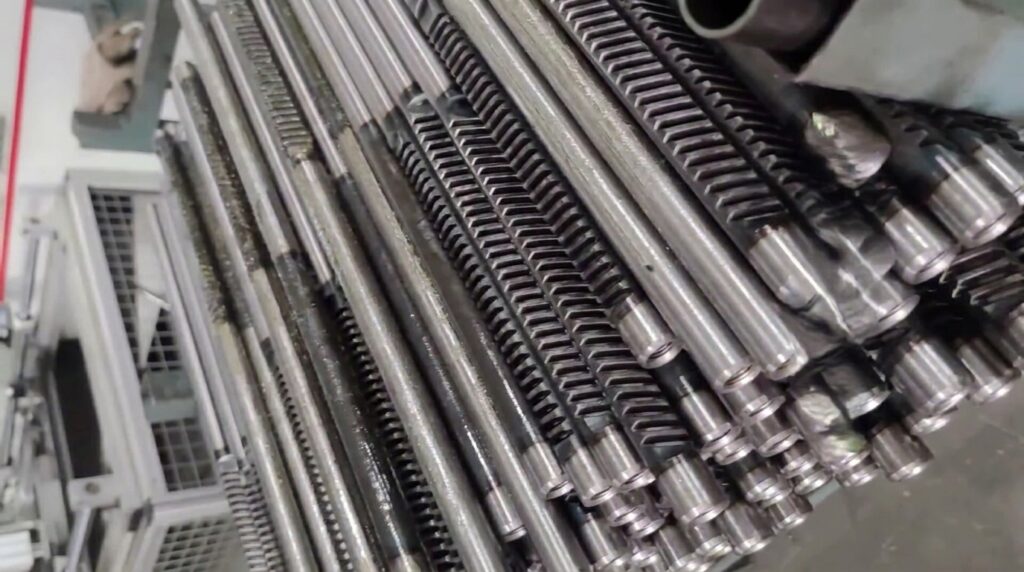
汽車轉向齒條的直線度直接決定手感, 精確, 和車輛轉向系統的噪音控制. 從技術原理出發, 本文深入解析S45C轉向齒條調直技術要點, 包括: 應對巨大的初始變形挑戰 (2.5-3毫米), 實現高精度 TIR (0.1毫米) 控制, 帶齒工件的測量困難, 和 automated straightening strategies. 透過詳細的技術數據和實際製造案例, we demonstrate the exceptional performance of the automated press straightening process, helping you solve the complex difficulties of straightening toothed shaft components.
What is an Automotive Steering Rack?
An Automotive Steering Rack is the core transmission component in a rack-and-pinion steering system, primarily used to convert the rotational motion of the steering wheel into the linear motion of the wheels. Depending on the vehicle design, common diameters range from 23mm to 30mm, and lengths range from 400mm to 750mm.


Steering Rack Application Scenarios
Steering racks are mainly used in automotive steering systems. Depending on the specific application location and functional requirements, there are differentiated requirements:
- Passenger Car Steering (EPS): Extremely high requirements for NVH (Noise, Vibration, and Harshness). The straightness TIR must be strictly controlled within 0.1mm to eliminate steering binding and abnormal noise.
- Commercial/Off-Road Vehicle Steering: Endures immense steering resistance, requiring materials (like S45C) to possess extremely high surface hardness and core toughness after high-frequency induction hardening.
All application scenarios have strict requirements for the straightness of the steering rack, because a bent rack will lead to oil seal leakage, poor gear meshing, and severe steering safety hazards.
結構特點
Automotive steering racks have the following structural features:
- Half-Tooth, Half-Shaft Structure: One end is machined with a precision tooth profile (tooth length 250mm to 300mm), while the rest is a smooth shaft.
- 材料要求: Typically made of S45C (medium carbon steel), offering excellent comprehensive mechanical properties.
- Severe Heat Treatment Distortion: After high-frequency surface hardening on the toothed section and shaft, massive stress release typically causes a huge initial bending (Input Bend) of 2.5mm to 3.0mm.
Steering Rack Key Features
主要特點:
- 高精度矯直: Supports an extremely high precision requirement of TIR ≤0.1mm.
- Massive Deformation Correction: Capable of handling massive initial bends up to 2.5mm – 3.0毫米.
- Non-Destructive to Teeth: The delicate toothed structure must be absolutely protected from damage during the entire straightening process.
Steering Rack Technical Parameters
| 物品 | 參數範圍 | 筆記 |
| Rack Diameter | Ø23mm – Ø30mm | – |
| 機架長度 | 400毫米 – 750毫米 | – |
| Tooth Length | 250毫米 – 300毫米 | Highly difficult to measure and press |
| Input Bend | 2.5毫米 – 3.0毫米 | Massive distortion post-heat treatment |
| Output Precision(TIR) | ≤0.1mm | Extreme straightness target |
| 材料 | S45C | Distinct elastic spring-back properties |
Why Automated Press Straightening is Preferred for Toothed Racks?
Conventional Process Pain Points
When steering racks undergo traditional manual or multi-roll straightening after heat treatment, they face the following challenges:
| 痛點 | 具體問題 | 影響 |
| Measurement Inaccuracy on Teeth | Standard probes jump wildly when sweeping across the 250-300mm toothed section. | Unable to determine the true bend high point; system misjudges. |
| Massive Initial Bend | High-frequency hardening causes severe bowing up to 2.5-3mm. | Manual straightening is extremely slow and prone to over-bending scrap. |
| Multi-Roll Damages Teeth | The continuous alternating stress of multi-roll systems will crush the precision gear teeth. | Ruins gear meshing, directly scrapping the expensive workpiece. |
Automated Press Straightening Advantages
解決以上痛點, 這 Automated Press Straightening Machine provides a dedicated and revolutionary solution:
| 比較維度 | 手動矯直 | Automated Press Straightening | 改進 |
| 精確 (TIR) | ~0.15毫米 | ≤0.1mm | Consistently meets tight targets |
| 效率 | 2-3 分鐘/件 | 20-30 秒/件 | Multiplied production efficiency |
| 不良率 | 5-8% (Crushed teeth) | <0.5% | Near-zero scrap |
| Operator Skill | Master Technician | Standard Operator / Unmanned | Massively reduced labor cost |
核心優勢:
- Point-to-Point Precision Pressing: Uses a precisely controlled hydraulic or servo ram to press strictly on the bend’s high points, smartly avoiding the toothed area to ensure zero tooth damage.
- Smart Filtering Algorithms: Software is equipped with exclusive algorithms to filter out noise from the tooth gaps and flat surfaces, accurately reconstructing the true central axis curve.
- S45C Spring-back Model: Built-in spring-back curves for S45C steel. Even when facing a massive 3mm bend, it instantly calculates the exact downward stroke required.
Steering Rack Straightening Process
本節概述 7 核心流程 to complete the steering rack manufacturing workflow. 這 核心流程是 05 Automated Press Straightening, which is critical for ensuring final centerless grinding quality and assembly precision.
Steering Rack Straightening Complete Process Flow
| 流程 | 行程名稱 | 裝置 | 時間 | 精確 |
| 01 | 切割 & Rough Turning | CNC Lathe | 40s | Leave finishing allowance |
| 02 | Rack Milling | Dedicated Rack Miller | 60s | Ensure pitch and profile |
| 03 | Drilling & Tapping | Machining Center | 30s | – |
| 04 | Induction Hardening | High-Frequency Heater | 20s | Generates 2.5-3mm bend |
| 05 | Automated Straightening | Press Straightener | 20-30s | TIR ≤0.1mm |
| 06 | Centerless Grinding | Centerless Grinder | 30s | Ensure OD tolerance |
| 07 | Final Inspection | CMM / Dedicated Gauge | 20s | – |
Steering Rack Straightening Process Description:
Step 5 Automated Press Straightening
Process Purpose: To precisely straighten steering racks that possess a massive 2.5mm-3.0mm induction-hardened bend down to a strict TIR of ≤0.1mm, providing a perfectly qualified blank for subsequent centerless grinding.
Process Principle: The workpiece is supported by centers or V-blocks and rotated automatically. Sensors acquire real-time runout data from the smooth shaft and the back of the rack. The control system uses proprietary algorithms to filter out data interference caused by the flat/toothed geometry, pinpointing the true high point of the axial bend. The ram then applies a precise, localized reverse press based on the spring-back properties of S45C.


Key Points:
- Handling Large Range & Micro Precision: The measurement system must simultaneously recognize a massive 3mm initial deflection and ultimately control the stroke to a micro 0.1mm tolerance.
- Smart Press Point Selection: The machine’s pressing point must strictly avoid the fragile tooth profile, typically targeting the flat/round back or the smooth shaft sections.
- Auto-Loading Integration: A solid S45C rack (Dia 30mm, Length up to 750mm) is extremely heavy. It is typically integrated with a gantry robot for fully unmanned material handling.
品質標準:
- Total Indicator Reading (TIR) ≤0.1mm across the entire length.
- Absolutely no indentations or micro-cracks on the tooth and shaft surfaces.
核心矯直挑戰與解決方案
困難 1: Massive Initial Deformation After Hardening (2.5毫米 – 3毫米)
問題描述:
- Because the rack has teeth on only one side (highly asymmetrical cross-section), the thermal stress release during high-frequency hardening is extremely uneven, inevitably causing the workpiece to warp drastically up to 3mm.
- A massive single press stroke on a traditional machine can cause over-bending or even snapping.
解決方案:
- Utilizes a Multi-Step Approximation Algorithm. Instead of attempting a “one-strike kill”, the system uses a larger stroke to quickly reduce the bend to under 0.5mm, followed by micro-strokes for ultimate precision correction.
- Incorporates a machine-learning and compensation function that automatically records the spring-back coefficient of the specific S45C batch, becoming more accurate with every piece.
困難 2: Sensor Distortion in the Toothed Zone (250-300毫米)
問題描述:
- When the measurement probe sweeps over the rotating teeth, it repeatedly falls into the gaps, creating a severe jagged, unreadable measurement curve. The machine fails to identify the true axial bend.
解決方案:
- Software upgrade introducing Envelope Filtering Technology, extracting only the runout data from the tooth crests to fit a smooth curve.
- Hardware adaptation: Strategically avoiding the teeth, sensors are directed to measure the continuous “flat/round back” of the rack, thereby acquiring true, interference-free runout data.
Straightening Case
Customer Background
A major Tier 1 automotive steering system supplier in Asia, providing EPS (Electric Power Steering) assemblies for globally renowned automotive brands.
Technical Challenges
- The client introduced a new automated steering rack production line with specifications: Diameter 23-30mm, Length 400-750mm, Tooth length 250-300mm, Material S45C.
- The post-hardening workpieces had an input bend as huge as 2.5mm to 3.0mm.
- The client strictly demanded an output straightness of TIR ≤ 0.1mm with extremely fast cycle times, which their legacy semi-automatic machines completely failed to achieve.
解決方案
| 物品 | 參數/配置 |
| Workpiece Name | Automotive Steering Rack |
| 規格 | Ø23-30mm × L400-750mm |
| 材料 | S45C (Medium Carbon Steel) |
| 核心設備 | Heavy-Duty Automated Press Straightener (with cross-section filtering algorithm) |
| Input Bend | 2.5 – 3.0 毫米 |
| 精密目標 | TIR ≤ 0.1 毫米 |
實施結果
- Precision Locked In: After commissioning, despite the extreme 3mm initial deformation, the machine stably controlled the final TIR within the strict 0.1mm red line.
- Measurement Interference Eliminated: The proprietary cross-section filtering algorithm completely solved the industry pain point of inaccurate measurements on toothed racks.
- Seamless Automation Integration: Working perfectly with the production line’s gantry robots, it achieved an unmanned material flow directly from the high-frequency hardening machine into the straightener.
客戶評價
“Your equipment’s algorithms are outstanding! In the past, our operators struggled endlessly with toothed parts bent by 3mm, suffering high scrap rates. Now, this automated straightening machine acts as if it has eyes—dodging the fragile teeth while locking the precision strictly within 0.1mm, providing the most solid guarantee for the quality of our EPS assemblies.”
Steering Rack Straightening Common Questions
Q1: The back of the steering rack often has a flat surface. How does the machine measure it accurately?
Steering racks typically have a non-standard “flat, round, and toothed” cross-section. Our straightening system has developed specific compensation algorithms for such irregular profiles. When the probe sweeps across the flat back, the system automatically subtracts the geometric height difference, extracting only the true axial deflection caused by the workpiece’s bend.
Q2: With an input bend of 3mm, will the S45C rack break during press straightening?
Although the surface of S45C (medium carbon steel) undergoes high-frequency hardening, its core retains excellent toughness. Our hydraulic/servo rams do not use destructive impact stamping; instead, they apply a speed-controlled, flexible extrusion. Because the system calculates the exact stroke matching the material’s yield point, the risk of breaking is virtually non-existent for bends within 3mm.
第三季: Why can’t multi-roll straightening machines be used for these toothed workpieces?
Multi-roll straighteners use staggered upper and lower rollers to continuously roll and bend the workpiece repeatedly. For a steering rack with a 250-300mm precision tooth profile, the immense and continuous crushing force of the rollers would directly destroy the teeth or induce micro-cracks on the crests, rendering it completely useless for gear meshing. 所以, a press-type straightener applying targeted, point-to-point pressure is the absolutely only safe choice.