
Inom fästelementstillverkningsindustrin, böjning i långa bultar efter värmebehandling är en universell smärtpunkt. Traditionell “manuell hamring” är inte bara ineffektivt utan garanterar inte heller konsekvent precision. Denna artikel delar en specialiserad Automatisk lösning för uträtning av bultar: demonstrating a reported client case in which automation took an 8-person manual line to one operator supervising four machines, with straightness held within 0.1 mm on the client’s acceptance records.
What is the Bolt?
Bultar är grundfästen för maskineriet, konstruktion, och fordonsindustrin. Det typiska arbetsstycket för denna lösning är en lång bult med hög hållfasthet: 15mm diameter, 340mm längd.
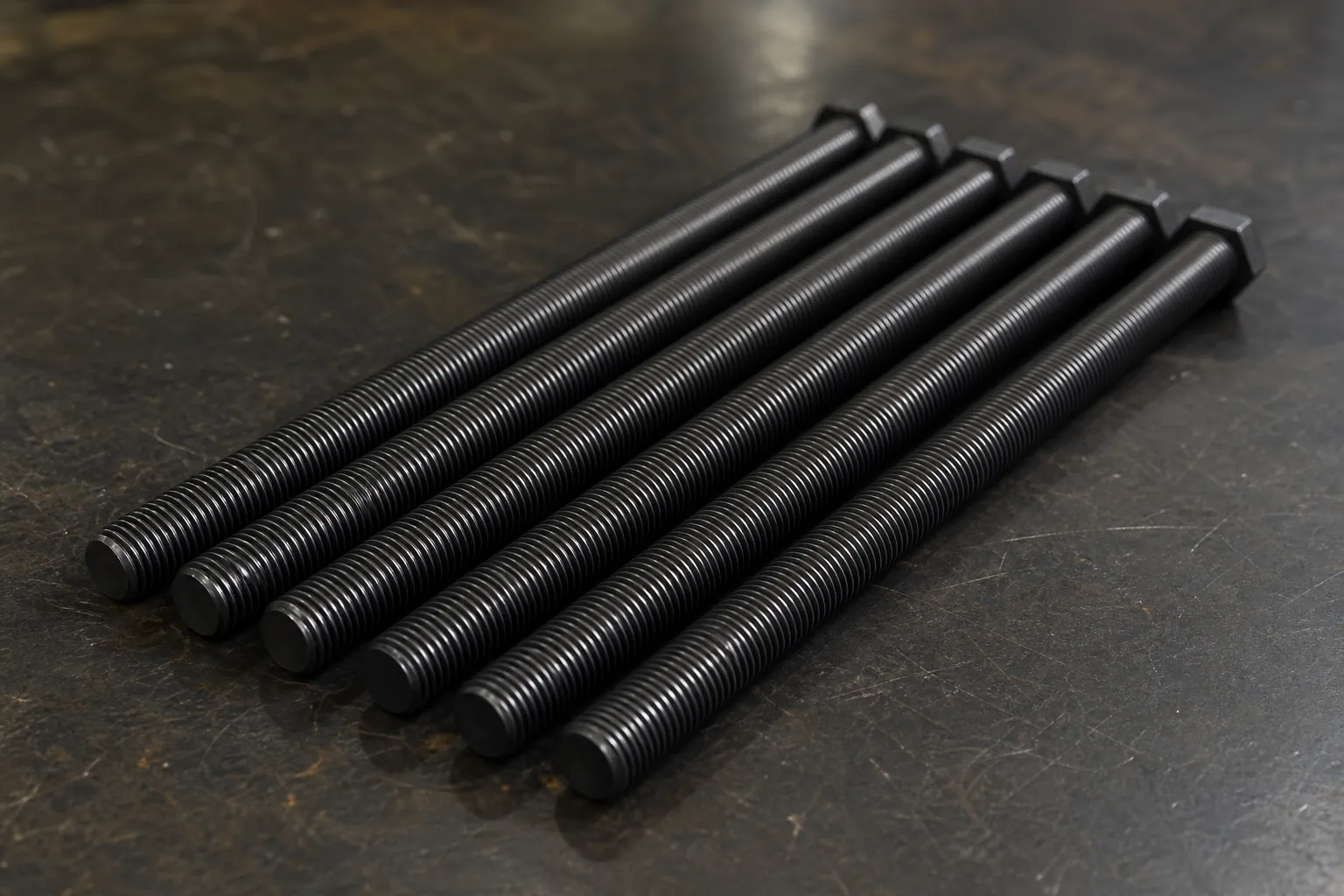
Strukturella egenskaper och utmaningar
- Högt L/D-förhållande: Längden på 340 mm gör bulten mycket känslig för en initial böjning på 0,5 mm – 1.5mm efter värmebehandling.
- Precisionskrav: The client required straightness within 0.2 mm; the case acceptance records were held under 0.1 mm.
- Skyddskrav: Rätningsprocessen måste säkerställa noll skador på gängprecision och ytkvalitet.
Why Heat Treatment Bends Long Bolts in the First Place
Understanding the distortion source is what makes a correction process defensible instead of decorative. During quenching, a long fastener cools unevenly: the section cools at different rates depending on orientation in the basket or fixture, agitation contact, and local mass differences between the plain shank, the threaded length and the head. Each cooling path wants to contract by a different amount, and the resulting locked-in stresses bend the part when it relaxes. The effect scales with length — which is why short bolts leave heat treatment usable while long ones of the same grade systematically arrive bent. Thread rolling and machining before treatment add their own stress history, and any straightening performed at the heat treater counts as prior deformation for everything done afterward.
Two practical consequences follow. Första, incoming inspection on long heat-treated bolts is not optional paperwork — the bend magnitude and pattern arriving at the straightening station determine both the correction plan and any supplier conversation, and the interaction of prior deformation with correction response is the reason reverse-loading behavior matters, as covered under Bauschingereffekten vid uträtning. Andra, process decisions upstream — how parts are racked or basketed through quench, whether stress relief is applied — change the distribution the straightening station sees, and are usually the cheapest place to reduce total correction work.
Reading the Bend Before Correcting It
Long fasteners arrive with a small vocabulary of bend patterns, and naming the pattern is the first step of an efficient correction loop. A single-arc bow — one gentle curve, maximum near the middle — is the most common heat-treatment signature and the most straightforward to correct with supports positioned around the peak. An S-shaped double bend has two opposite peaks, usually reflecting two constraint points during quench, and demands two coordinated corrections rather than one big press at the largest reading. A local kink near the head or the thread runout concentrates distortion where section stiffness changes, and behaves differently from a distributed bow. Slutligen, twist about the axis occasionally accompanies bending on parts with asymmetric features. Each pattern requires its own measurement map and correction sequence, which is why an automatic station that scans the full length and builds the map before pressing — rather than chasing the single worst reading — converges in fewer strokes. The measuring-and-correcting loop behind this is described for automatic shaft straightening generally, and for the long-bolt family specifically in the automatic long bolt straightening process.
Varför bultriktning måste flyttas bort från “Manuell hamring”
Traditionell process vs. Automatiserad lösning
The figures below are this client’s reported baseline and post-commissioning values, not a universal benchmark for every fastener line.
| Smärtpunkt | Manuell hamring / Manuell Tryck | Automatiserad riktningslösning |
| Arbetskraftskrav | 8 workers per shift (manual baseline, reported case) | 1 operatör för 4 maskiner (reported case) |
| Rakhet | 0.2 – 0.5 mm spread (reported manual baseline) | ≤ 0,1 mm (client acceptance records) |
| Cykeltid | 120 – 180 s/styck (reported manual baseline) | 10 – 15 s/styck (reported case) |
| Total kostnad | High labor cost per corrected part | Manpower reduced from 8 operators to 1 supervising 4 maskiner (reported case) |
Automatiserat bultriktningsprocessflöde
Denna lösning täcker en fullständig automatiserad process med sluten slinga från matning till sortering, säkerställer att varje bult uppfyller leveranskraven av hög standard.
Kärnprocessbeskrivningar
- Automatisk matning: Böjda bultar matas automatiskt från en behållare in i riktningsstationen utan mänsklig inblandning.
- Dynamisk mätning: Högprecisionssensorer skannar det roterande arbetsstycket i realtid, exakt fångar den maximala böjpunkten över hela längden.
- Servopressning: Det smarta systemet beräknar automatiskt återfjädring baserat på materialet (kolstål/legerat stål), och servokolven applicerar exakt tryck för en engångskorrigering.
- Automatisk sortering: Kvalificerade bultar fortsätter till nästa steg, while non-conforming parts are automatically isolated before they leave the machine.

UBJ-80 Boltriktningsmaskin
Denna plattång är idealisk för värmebehandlade färdiga delar (till exempel, stämpling/kontorsmaskinkomponenter, bildelar/motorcykeldelar, verktyg, skruvar) och barer (stål, koppar, aluminium, rostfritt stål, titanlegering) längd 60–600 mm & φ3–φ25mm diameter. Det ökar både precision och produktkvalitet.
Kärnriktade utmaningar och lösningar
Utmaning 1: Manning and the Reported “1 Operatör för 4 Maskiner” Case
Problembeskrivning: Manual hammering and press correction depend on operator skill, stamina and shift discipline, so manning levels stay high and results vary from operator to operator.
Lösning:
Vår lösning implementerar full automatisering med sluten slinga. Operationslogiken är extremt enkel, med inbyggda recept för olika bultspecifikationer. En standardarbetare behöver bara fylla på behållaren med jämna mellanrum; resten — mätning, uträtning, och inspektion – hanteras automatiskt av maskinen. Detta löser brist på arbetskraft och eliminerar precisionsfall orsakade av trötthet.
Utmaning 2: Garanterar konsistens inom 0,1 mm precision
Problembeskrivning: När en bult utsätts för hammarslag, inre spänningsfördelning blir ojämn, leder ofta till överkorrigering i lokala områden.
Lösning:
Lösningen använder en helt parametriserat servokontrollsystem. Till skillnad från vagt mänskligt omdöme, sensorer upptäcker bultens axiella kurva med noggrannhet på mikronnivå. Genom flerstegs servoalgoritmer, systemet övervinner exakt den elastiska återfjädringen av S45C eller legerat stål, locking final straightness within the 0.1 mm window achieved on this client’s qualified recipe.
How Thread and Head Zones Are Protected During Correction
Thread protection is a contact-zone engineering problem, and the principles are the same ones that govern surface-protection tooling across straightening applications. The correction force and the reaction forces both need somewhere to live, and on a long bolt the plain shank is the region designed to carry load, while the threaded length and the under-head fillet are the regions most easily damaged. A protection concept therefore has three parts: place supports on the shank at controlled span positions around the bend peak; direct press contact onto the shank through tooling that conforms to the section instead of touching thread crests; and keep every edge that could contact the workpiece generously radiused so load spreads instead of concentrating. Cleanliness belongs in the same sentence — debris trapped between press tooling and a thread flank is a scratch generator, and on plated or coated bolts the coating class defines how much contact the finish can tolerate at all.
The validation side is equally concrete. A thread-protection claim is proven by inspection agreed before the trial — thread gauges still running, flank condition reviewed under the method the quality function specifies — together with the released-state straightness result, on representative parts, after repeat setups. Protection and geometry are accepted together or not at all.
What an Acceptance Criteria Package Should Contain
A bolt straightening process is only as good as the acceptance definition it answers to, and a complete one answers five questions in writing. What characteristic governs — straightness of the axis, measured how: on centers, on supports, roterande, in what condition, since a reading under restraint is not a released result, per loaded versus released measurement practice. What the limit is, and where it applies — full length or specified spans. What else must survive the process — thread fit, ytfinish, beläggning, head markings. How conformity is sampled — every part through an automatic gauge, or a sampling plan with defined reaction to a failure. And what happens to nonconforming parts — rework limits, segregation and disposition authority, following the NOK sorting and rework-limit framework. Buyers comparing straightening suppliers are well advised to ask for exactly this package; the ability to produce it says more about a supplier than any single machine specification.
Tillverkningsväska: Den indiska kundens fjärde val
Kundens bakgrund
En välkänd indisk leverantör av fästelement som tillhandahåller komponenter till globala anläggningsmaskiners varumärken.
Implementeringsresultat
- Upprepa order: Baserat på de första tre enheternas enastående prestanda, kunden köpte nyligen sina 4e maskinen.
- Operator Consolidation: The client reported one operator managing all 4 machines after commissioning, with a substantial increase in output per operator.
- Kvalitetsriktmärke: The client’s records report straightness moving from 0.2 mm down to under 0.1 mm after commissioning.
Vanliga frågor
- Q: Kommer riktningskolven att skada bultgängorna?
- Inga. Vi har designat icke-kontakt, dämpade skyddsformar speciellt för bultriktning. Pressblocken matchar bultens krökning perfekt, säkerställer jämn kraftfördelning och undviker ytfördjupningar.
- Q: Kan utrustningen integreras i vår fabriks MES-system?
- Ja. Vårt kontrollsystem har standarddatagränssnitt för att registrera och exportera riktningsdata i realtid för varje bult, uppfylla moderna spårbarhetskrav.
Additional Process Questions
Why do bolts from the same heat-treatment lot arrive with different bend patterns?
Because each part’s position in the basket or rack gave it a different cooling path. Quench distortion is sensitive to orientation, local mass and agitation contact, so even identical bolts leave treatment with different locked-in stress patterns. Mapping incoming parts rather than assuming a uniform error is the practical answer, and it is why scanning-based stations build a per-part correction plan.
How many correction passes does a long bolt need?
It depends on the pattern, not a fixed number. A single-arc bow typically converges in one planned press; an S-bend needs two coordinated corrections; local kinks near section changes respond differently again. The governing rule is a rework limit set before production — parts that stop responding are routed to review, not pressed repeatedly, because each additional plastic cycle consumes fatigue life and changes the material’s response.
Should straightening come before or after thread rolling?
The route belongs to the fastener process engineer, but the trade-off is explicit: correcting before thread rolling lets subsequent operations work from a straight blank, while correcting after heat treatment with finished threads demands the contact-zone protection described above. Whichever route is chosen, the acceptance package must define what state the straightness limit applies to, and the correction validation must be run on parts carrying that state.
Sammanfattning
För fästelementsfabriker som strävar efter hög effektivitet och kvalitet, en Automatisk lösning för uträtning av bultar är den väsentliga vägen till ökad konkurrenskraft. Whether the target is lower manning or 0.1 mm delivery precision, the figures in this article are one client’s reported case; your own results depend on the bolt family, incoming distortion and acceptance definition.
Moving from manual bolt correction toward automation? De manual vs automatic selection logic och den ROI-fodral för automatisk rätning är de naturliga nästa stegen.
Om du står inför arbetsledningsproblem eller precisionsflaskhalsar, gärna Kontakta oss för ett skräddarsytt tekniskt förslag.