
В сфере производства крепежных изделий, изгиб длинных болтов после термообработки — универсальная болевая точка. Традиционный “ручная ковка” не только неэффективно, но и не может гарантировать постоянную точность. В этой статье рассказывается о специализированном Автоматизированное решение для выпрямления болтов: demonstrating a reported client case in which automation took an 8-person manual line to one operator supervising four machines, with straightness held within 0.1 mm on the client’s acceptance records.
What is the Bolt?
Болты являются основным крепежом машин., строительство, и автомобильная промышленность. Типичная заготовка для этого решения — высокопрочный длинный болт.: 15диаметр мм, 340длина мм.
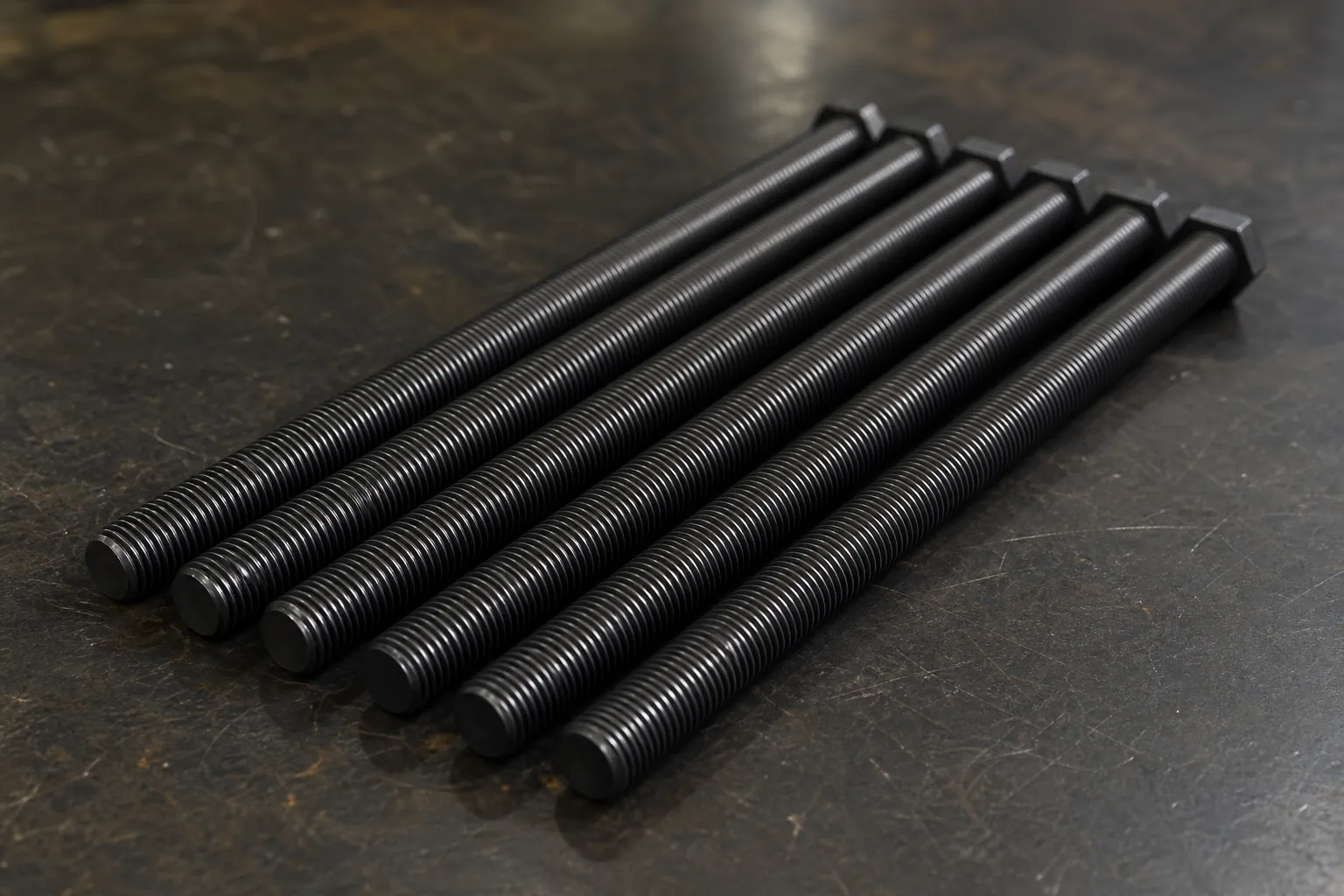
Структурные особенности и проблемы
- Высокое соотношение L/D: Длина 340 мм делает болт очень чувствительным к первоначальному изгибу на 0,5 мм. – 1.5мм после термообработки.
- Требования к точности: The client required straightness within 0.2 мм; the case acceptance records were held under 0.1 мм.
- Требования защиты: Процесс правки должен гарантировать нулевое повреждение точности резьбы и качества поверхности..
Why Heat Treatment Bends Long Bolts in the First Place
Understanding the distortion source is what makes a correction process defensible instead of decorative. During quenching, a long fastener cools unevenly: the section cools at different rates depending on orientation in the basket or fixture, agitation contact, and local mass differences between the plain shank, длина резьбы и головка. Каждый путь охлаждения хочет сжиматься на разную величину., и возникающие в результате фиксированные напряжения сгибают деталь, когда она расслабляется.. Эффект масштабируется с длиной — именно поэтому короткие болты допускают термообработку, в то время как длинные болты того же класса систематически поступают изогнутыми.. Накатка резьбы и механическая обработка перед обработкой добавляют свою собственную историю напряжений., и любое выпрямление, выполненное на термообработке, считается предварительной деформацией для всего, что делается после этого..
Из этого следуют два практических следствия.. Первый, Входной контроль длинных термообработанных болтов не является обязательным документальным оформлением — величина и рисунок изгиба, поступающие на станцию правки, определяют как план коррекции, так и любой разговор с поставщиком., and the interaction of prior deformation with correction response is the reason reverse-loading behavior matters, as covered under эффект Баушингера при выпрямлении. Второй, process decisions upstream — how parts are racked or basketed through quench, whether stress relief is applied — change the distribution the straightening station sees, and are usually the cheapest place to reduce total correction work.
Reading the Bend Before Correcting It
Long fasteners arrive with a small vocabulary of bend patterns, and naming the pattern is the first step of an efficient correction loop. A single-arc bow — one gentle curve, maximum near the middle — is the most common heat-treatment signature and the most straightforward to correct with supports positioned around the peak. An S-shaped double bend has two opposite peaks, usually reflecting two constraint points during quench, and demands two coordinated corrections rather than one big press at the largest reading. A local kink near the head or the thread runout concentrates distortion where section stiffness changes, and behaves differently from a distributed bow. Окончательно, twist about the axis occasionally accompanies bending on parts with asymmetric features. Each pattern requires its own measurement map and correction sequence, which is why an automatic station that scans the full length and builds the map before pressing — rather than chasing the single worst reading — converges in fewer strokes. The measuring-and-correcting loop behind this is described for automatic shaft straightening generally, and for the long-bolt family specifically in the automatic long bolt straightening process.
Почему выпрямление болтов должно отойти от “Ручная ковка”
Традиционный процесс против. Автоматизированное решение
The figures below are this client’s reported baseline and post-commissioning values, not a universal benchmark for every fastener line.
| Болевая точка | Ручная ковка / Ручной пресс | Автоматизированное решение для выпрямления |
| Требование к рабочей силе | 8 workers per shift (manual baseline, reported case) | 1 operator for 4 машины (reported case) |
| Прямолинейность | 0.2 – 0.5 mm spread (reported manual baseline) | ≤ 0,1 мм (client acceptance records) |
| Время цикла | 120 – 180 с/шт. (reported manual baseline) | 10 – 15 с/шт. (reported case) |
| Общая стоимость | High labor cost per corrected part | Manpower reduced from 8 operators to 1 supervising 4 машины (reported case) |
Автоматизированная последовательность операций по выпрямлению болтов
Это решение охватывает полностью автоматизированный процесс замкнутого цикла от подачи до сортировки., обеспечение соответствия каждого болта высоким стандартам доставки.
Описание основных процессов
- Автоподача: Согнутые болты автоматически подаются из бункера на станцию правки без участия человека..
- Динамическое измерение: Высокоточные датчики сканируют вращающуюся заготовку в режиме реального времени., точно фиксируя точку максимального изгиба по всей длине.
- Сервопрессование: Интеллектуальная система автоматически рассчитывает упругость в зависимости от материала. (углеродистая сталь/легированная сталь), а сервоцилиндр оказывает точное давление для однопроходной коррекции..
- Автосортировка: Квалифицированные болты переходят к следующему этапу, while non-conforming parts are automatically isolated before they leave the machine.

Машина выпрямляющей болта UBJ-80
Этот выпрямитель идеально подходит для термообработанных готовых деталей. (например, компоненты штамповочных/офисных машин, авто/мотозапчасти, инструменты, винты) и бары (сталь, медь, алюминий, нержавеющая сталь, титановый сплав) длиной 60–600 мм & Диаметр φ3–φ25 мм. Это повышает точность и качество продукции..
Основные проблемы и решения выпрямления
Испытание 1: Manning and the Reported “1 Оператор по 4 Машины” Case
Описание проблемы: Manual hammering and press correction depend on operator skill, stamina and shift discipline, so manning levels stay high and results vary from operator to operator.
Решение:
Наше решение реализует полная автоматизация с обратной связью. Логика работы предельно проста, со встроенными рецептами для различных характеристик болтов. Обычному работнику необходимо лишь периодически пополнять бункер.; остальное-измерение, выпрямление, и осмотр — выполняются машиной автоматически. Это решает проблему нехватки рабочей силы и устраняет падение точности, вызванное усталостью..
Испытание 2: Гарантия постоянства с точностью до 0,1 мм
Описание проблемы: Когда болт подвергается ударам молотка, распределение внутренних напряжений становится неравномерным, часто приводит к чрезмерной коррекции в локализованных областях.
Решение:
В решении используется полностью параметризованная система сервоуправления. В отличие от расплывчатого человеческого суждения, датчики определяют осевую кривую болта с точностью до микрона. Благодаря многошаговым сервоалгоритмам, система точно преодолевает упругое пружинение S45C или легированных сталей, locking final straightness within the 0.1 mm window achieved on this client’s qualified recipe.
How Thread and Head Zones Are Protected During Correction
Thread protection is a contact-zone engineering problem, and the principles are the same ones that govern surface-protection tooling across straightening applications. The correction force and the reaction forces both need somewhere to live, and on a long bolt the plain shank is the region designed to carry load, while the threaded length and the under-head fillet are the regions most easily damaged. A protection concept therefore has three parts: place supports on the shank at controlled span positions around the bend peak; direct press contact onto the shank through tooling that conforms to the section instead of touching thread crests; and keep every edge that could contact the workpiece generously radiused so load spreads instead of concentrating. Cleanliness belongs in the same sentence — debris trapped between press tooling and a thread flank is a scratch generator, and on plated or coated bolts the coating class defines how much contact the finish can tolerate at all.
The validation side is equally concrete. A thread-protection claim is proven by inspection agreed before the trial — thread gauges still running, flank condition reviewed under the method the quality function specifies — together with the released-state straightness result, on representative parts, after repeat setups. Protection and geometry are accepted together or not at all.
What an Acceptance Criteria Package Should Contain
A bolt straightening process is only as good as the acceptance definition it answers to, and a complete one answers five questions in writing. What characteristic governs — straightness of the axis, measured how: on centers, on supports, вращающийся, in what condition, since a reading under restraint is not a released result, за loaded versus released measurement practice. What the limit is, and where it applies — full length or specified spans. What else must survive the process — thread fit, обработка поверхности, покрытие, head markings. How conformity is sampled — every part through an automatic gauge, or a sampling plan with defined reaction to a failure. And what happens to nonconforming parts — rework limits, segregation and disposition authority, following the NOK sorting and rework-limit framework. Buyers comparing straightening suppliers are well advised to ask for exactly this package; the ability to produce it says more about a supplier than any single machine specification.
Производственный корпус: Четвертый выбор индийского клиента
Информация о клиенте
Известный индийский поставщик крепежных изделий, поставляющий компоненты для мировых брендов строительной техники..
Результаты внедрения
- Повторные заказы: На основе выдающихся показателей первых трех агрегатов, клиент недавно приобрел их 4эта машина.
- Operator Consolidation: The client reported one operator managing all 4 machines after commissioning, with a substantial increase in output per operator.
- Эталон качества: The client’s records report straightness moving from 0.2 mm down to under 0.1 mm after commissioning.
Часто задаваемые вопросы
- вопрос: Не повредит ли выпрямляющий плунжер резьбу болтов??
- Нет. Мы разработали бесконтактный, мягкие защитные формы специально для выпрямления болтов. Пресс-блоки идеально соответствуют кривизне болта., обеспечение равномерного распределения силы и отсутствие вмятин на поверхности.
- вопрос: Может ли оборудование интегрироваться в MES-систему нашего завода??
- Да. Наша система управления оснащена стандартными интерфейсами данных для записи и экспорта данных правки в реальном времени для каждого болта., соответствие современным требованиям прослеживаемости.
Additional Process Questions
Why do bolts from the same heat-treatment lot arrive with different bend patterns?
Because each part’s position in the basket or rack gave it a different cooling path. Quench distortion is sensitive to orientation, local mass and agitation contact, so even identical bolts leave treatment with different locked-in stress patterns. Mapping incoming parts rather than assuming a uniform error is the practical answer, and it is why scanning-based stations build a per-part correction plan.
How many correction passes does a long bolt need?
It depends on the pattern, not a fixed number. A single-arc bow typically converges in one planned press; an S-bend needs two coordinated corrections; local kinks near section changes respond differently again. The governing rule is a rework limit set before production — parts that stop responding are routed to review, not pressed repeatedly, because each additional plastic cycle consumes fatigue life and changes the material’s response.
Should straightening come before or after thread rolling?
The route belongs to the fastener process engineer, but the trade-off is explicit: correcting before thread rolling lets subsequent operations work from a straight blank, while correcting after heat treatment with finished threads demands the contact-zone protection described above. Whichever route is chosen, the acceptance package must define what state the straightness limit applies to, and the correction validation must be run on parts carrying that state.
Краткое содержание
Для заводов по производству крепежных изделий, стремящихся к высокой эффективности и качеству, а Автоматизированное решение для выпрямления болтов является важным путем к повышению конкурентоспособности. Whether the target is lower manning or 0.1 mm delivery precision, the figures in this article are one client’s reported case; your own results depend on the bolt family, incoming distortion and acceptance definition.
Moving from manual bolt correction toward automation? The manual vs automatic selection logic и ROI-кейс для автоматического выпрямления являются естественными следующими шагами.
Если вы столкнулись с проблемами управления трудовыми ресурсами или узкими местами в точности, не стесняйтесь Связаться с нами для индивидуального технического предложения.