
Penyemperitan aluminium bukan bar keluli generik. Padat, profil berongga dan separa berongga boleh menggabungkan jaringan nipis, saluran terbuka, rongga dalaman, tulang rusuk, permukaan rupa dan antara muka pemasangan kritikal. Herotan penyejukan, busur membujur, sapuan sisi, twist dan perubahan bahagian setempat mesti diasingkan sebelum kaedah meluruskan dipilih.
Penyelesaian meluruskan penyemperitan aluminium yang boleh dipercayai bermula dengan enam soalan:
- Aloi yang mana, laluan marah, keluarga pepejal/berongga/separa berongga dan julat panjang adalah dalam skop?
- Adalah bahagian secara langsung selepas penyemperitan dan pelindapkejutan, selepas meluruskan regangan, selepas dipotong, selepas penuaan atau selepas selesai?
- busur yang mana, menyapu, putar belit, kerataan dan dimensi bahagian dikawal oleh lukisan?
- Bolehkah marah yang ditentukan menerima roller sekunder atau pembetulan tempatan selepas regangan?
- Penampilan yang mana, anodizing, pengedap, kaca atau permukaan pemasangan boleh menyentuh pengapit dan penyokong?
- Bagaimanakah profil yang dikeluarkan sepenuhnya akan diukur semula dan dikeluarkan untuk operasi seterusnya?

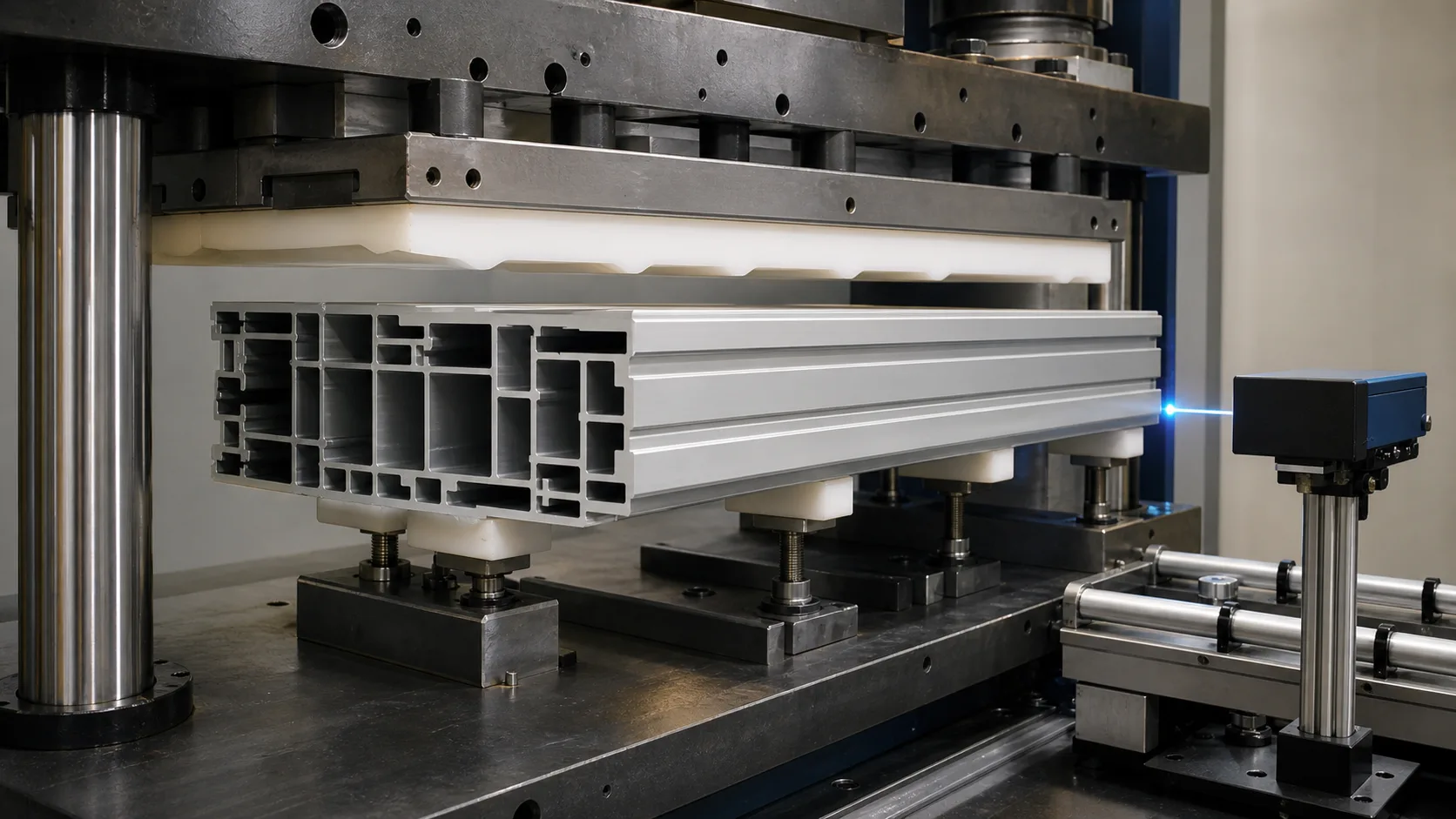
*Ilustrasi konsep kejuruteraan penyemperitan berbilang rongga dalam sel pelurus regangan selepas pelindapkejutan. Ia bukan gambar tapak pelanggan atau tuntutan prestasi. Panjang cengkaman sebenar, input regangan, sokongan, suhu, tindak balas bahagian dan had penerimaan memerlukan aloi terkawal, perangai dan spesifikasi profil.*
Tentukan Keluarga Profil Sebelum Membina Resipi
| Keluarga Profil | Risiko Meluruskan Utama | Laluan yang Diperlukan |
|---|---|---|
| Profil simetri pepejal | Tunduk dan putar dengan bahagian yang agak stabil | Resipi keluarga oleh aloi, perangai dan nisbah aspek |
| Profil berbilang rongga berongga | Jaring nipis, lompang dalaman dan keruntuhan dinding tempatan | Semakan sokongan bahagian dan pengapit sebelum dimuatkan |
| Profil separa berongga atau saluran terbuka | Pembukaan saluran boleh berubah semasa regangan atau menekan | Jejaki sudut bukaan dan dinding sebagai ciri terkawal |
| Profil nipis lebar | Kekakuan luar satah yang rendah dan sensitiviti kerataan setempat | Sokongan penanda rendah padat dan pembetulan terhad |
| Profil dengan sirip atau bibir nipis | Penandaan kenalan dan hasil tempatan | Peta hubungan khusus dan pengendalian tekanan rendah |
| Anodized atau profil penampilan | Permukaan siap boleh tercalar, kekotoran atau pemindahan pencemaran | Laluan sentuhan lembut dan pelepasan permukaan yang layak |
| Pemasangan aluminium yang direka atau dikimpal | Sekatan sendi dan herotan haba mengubah laluan beban | Gunakan laluan fabrikasi yang dikimpal |
| Penyemperitan melengkung dengan sengaja | Kelengkungan lukisan ialah bentuk nominal | Membentuk laluan; jangan luruskan kepada sifar |
Majlis Penyemperit Aluminium menyatakan bahawa bahagian nipis yang lebar boleh menjadi lebih sukar untuk diluruskan dan perubahan ketebalan, rusuk dan web mempengaruhi tingkah laku herotan dan twist. Oleh itu, resipi bermula dengan mekanik bahagian, bukan dengan lebar nominal sahaja.
Membekukan Tahap Temper dan Proses
Penyemperitan, Pelindapkejutan dan Penyejukan
Hydro's public extrusion-process description places quenching and cooling before stretch straightening. Kecerunan penyejukan, penjajaran penarik, sokongan larian dan bahagian asimetri boleh menghasilkan haluan progresif, menyapu atau memutar. Pengukuran harus mengenal pasti sama ada ralat ketara adalah stabil selepas profil mencapai keadaan pemeriksaan yang ditetapkan.
Meregangkan Regangan
Cengkaman akhir dan regangan paksi terkawal adalah laluan utama biasa untuk banyak penyemperitan. Proses ini boleh mengurangkan kelengkungan membujur, membantu melegakan tekanan dalaman dan menyediakan profil untuk pemotongan dan penuaan. Majlis Penyemperit Aluminium menerangkan regangan sebagai digunakan secara meluas, tetapi julat regangan tipikalnya yang diterbitkan bukanlah resipi universal atau jaminan StraighteningTech.
Cadangan kejuruteraan harus ditakrifkan:
- cengkaman yang diluluskan atau panjang hujung pengorbanan;
- pengapit geometri untuk pepejal sebenar, profil kosong atau terbuka;
- sokongan dan keadaan pemindahan sebelum ini, semasa dan selepas regangan;
- suhu dan tetingkap masa selepas pelindapkejutan;
- lanjutan bersempadan, daya dan had henti;
- pemeriksaan pembukaan bahagian dan penampilan permukaan;
- busur yang dilepaskan, pengesahan sweep and twist.
Pemotongan dan Penuaan
Hidro menerangkan urutan tipikal di mana penyemperitan yang diluruskan dipotong dan kemudian secara semula jadi atau oven berumur sebelum penamat atau fabrikasi. The exact sequence belongs to the customer's alloy and temper specification. Jangan menganggap bahawa pembetulan yang layak sebelum penuaan kekal dibenarkan atau menghasilkan keputusan yang sama selepas penuaan.
Meluruskan Sekunder
The Aluminum Association's public explanation of T_510 and T_511 is a critical gate: T_511 boleh membenarkan pelurus kecil terakhir untuk memenuhi toleransi, manakala T_510 tidak membenarkan meluruskan selepas regangan. Perkaitan itu tidak mentakrifkan satu makna berangka universal bagi "meluruskan kecil."
Oleh itu, roller sekunder atau pembetulan tempatan dibenarkan hanya apabila laluan temper terkawal, spesifikasi produk dan pelan proses pelanggan membenarkannya.
Kemasan Permukaan dan Fabrikasi
Anodizing, salutan, pemesinan, menggerudi, mengimpal, pengedap dan pemasangan menambah permukaan yang dilindungi dan perubahan kekakuan setempat. Pembetulan selepas langkah tersebut memerlukan kenalan yang berasingan, ciri dan rancangan pemeriksaan.
Ciri-ciri Geometri Berasingan
The Aluminum Association's extrusion-tolerance material distinguishes straightness, twist dan kerataan. Satu nilai "kelurusan" tidak boleh menggantikan ketiga-tiganya dengan selamat.
Busur Membujur
Tunduk ialah kelengkungan sepanjang panjang dalam satah tertentu. Untuk profil yang disokong, keputusan bergantung pada mata sokongan, orientasi, berat diri dan suhu. Rekod komponen menegak dan sisi secara berasingan apabila lukisan mengawal kedua-duanya.
sapu
Sapuan ialah sisihan sisi dalam satah berbanding tepi yang dipilih, satah tengah atau datum berfungsi. Profil terbuka boleh melancarkan sokongan dan mencipta sapuan yang jelas melainkan orientasi dikawal.
Pusing
Twist ialah putaran keratan rentas sepanjang paksi membujur. Ia memerlukan ukuran sudut atau permukaan berpasangan sepanjang panjang; probe ketinggian tunggal tidak dapat memisahkan sepenuhnya twist daripada bow atau ralat sokongan.
Kerataan dan Geometri Bahagian Setempat
Kerataan permukaan tempatan, sudut dinding, pembukaan saluran, jarak rongga, kedudukan bibir dan dimensi bahagian lain mungkin berubah walaupun garis tengah membujur bertambah baik. Ciri-ciri ini memerlukan trek atau tolok khusus lukisan.

*Ilustrasi konsep kejuruteraan bagi profil berbilang ruang yang diukur untuk geometri membujur dan keratan. Ia bukan susun atur sensor yang ditetapkan. Jejak sebenar, menyokong, keadaan suhu, topeng ciri dan jalur penerimaan memerlukan lukisan terkawal dan korelasi tolok pelanggan.*
Bina Model Datum dan Sokongan
Pelan pengukuran harus ditentukan:
- aloi, perangai, semakan dan orientasi profil;
- padu, klasifikasi berongga atau separa berongga;
- asal membujur, genggaman/penghujung pengecualian dan keadaan potong;
- tepi ditakrifkan lukisan, muka, satah tengah atau datum berfungsi;
- nombor sokongan, rentang, bahan, ketinggian dan tanah kenalan profil;
- haluan menegak dan trek sapu sisi;
- stesen pengukuran sudut keratan atau pintal;
- kerataan, pembukaan, sudut dinding dan dimensi rongga kritikal;
- pembersihan, suhu dan keadaan penstabilan;
- anodized, penampilan, kelas permukaan pengedap dan pemasangan;
- kebolehulangan selepas pelepasan lengkap dan kedudukan semula;
- korelasi dengan lekapan hiliran atau tolok akhir.
Baca kelurusan aci lwn runout lwn TIR untuk perbezaan umum antara geometri pegun dan petunjuk berputar. Profil penyemperitan dinilai sebagai bahagian yang disokong, tidak berputar aci.
Kelaskan Isyarat Sebelum Pembetulan
| Isyarat Diperhati | Kemungkinan Punca | Laluan yang Diperlukan |
|---|---|---|
| Kelengkungan licin selepas penstabilan suhu | Penyejukan atau haluan berkaitan penyemperitan | Calon untuk meluruskan regangan yang diluluskan |
| Sisihan sisi berubah apabila profil digulung pada sokongan | Orientasi atau ketidakstabilan sokongan | Orientasi beku dan ulangi pengukuran |
| Sudut bahagian berubah sepanjang panjang | Pusing | Pengukuran khusus lilitan dan semakan regangan/pembetulan |
| Pembukaan saluran berubah manakala garis tengah bertambah baik | Herotan bahagian di bawah cengkaman atau beban | Semak semula laluan pengapit/sokongan/beban |
| Muka nipis beralun secara tempatan | Isu kerataan atau bahagian penyemperitan setempat | Pemeriksaan bahagian; jangan anggap sebagai busur global sahaja |
| Ralat wujud hanya pada hujung yang dicengkam | Ubah bentuk pengapit atau kesan pengorbanan | Tentukan pemangkasan/pengecualian akhir dan periksa peralihan |
| Perubahan isyarat selepas penuaan | Evolusi temper atau pengagihan semula tekanan | Layakkan semula peringkat proses; jangan gunakan semula resipi pra-penuaan secara membuta tuli |
| Garis permukaan muncul selepas pengendalian | Serpihan penggelek, hubungan atau pemindahan tertumpu | Pembetulan pelupusan permukaan dan pengendalian |
| Profil sepadan dengan lengkung yang direka bentuk | Geometri yang disengajakan | Membentuk laluan; mengekalkan kelengkungan nominal |
Lindungi Dinding Nipis dan Rupa Permukaan
Hydro's storage guidance emphasizes separation, pengendalian yang kering dan bersih, perlindungan daripada susunan dan pencemaran yang buruk, dan risiko ubah bentuk berat badan sendiri. Sel pelurus harus menggunakan disiplin yang sama.
Zon Dilindungi atau Semakan Lalai
- anodized, digilap, wajah rupa yang dilukis atau dinyatakan;
- pengedap, kaca, galas, antara muka gelongsor dan pelekat;
- jaringan nipis yang tidak disokong, sirip, bibir dan tepi saluran terbuka;
- dinding rongga dalaman yang tidak boleh membawa tekanan pengapit;
- lubang-lubang, slot, potongan, zon mesin dan lampiran yang dikimpal;
- dicetak, kawasan bertanda laser atau kebolehkesanan;
- zon cengkaman-peralihan dan potong-hujung;
- kemek, retak, koyak, bahan terhakis atau terlalu panas menunggu pelupusan.
Zon Hubungan Berpotensi Diluluskan
- tanah luas yang belum siap dipilih oleh analisis bahagian;
- panjang pengorbanan yang bertujuan untuk pemangkasan kemudian;
- sisipan pengapit boleh diganti berprofil dipadankan dengan penyemperitan;
- polimer bersih atau sokongan gentian yang layak melalui ujian perwakilan;
- permukaan yang dimesin kemudian apabila pelan proses secara eksplisit membenarkan sentuhan.
Alatan "lembut" atau "tidak menandai" masih memerlukan pengesahan sampel. Penerimaan permukaan harus menentukan calar, kemek, pickup, serpihan tertanam, perubahan warna dan keterlihatan selepas anodisasi jika berkenaan.
Pilih Seni Bina Pembetulan
Regangan Lurus sebagai Laluan Utama
Untuk pengeluaran selepas penyemperitan, regangan paksi terkawal biasanya menangani haluan berterusan, sapuan dan sebahagian daripada tindak balas twist semasa profil dipegang pada hujungnya. Penyelesaiannya memerlukan pengendalian yang disegerakkan, rahang khusus profil, regangan bersempadan, pemantauan bahagian dan pengesahan yang dikeluarkan.
Meluruskan Roller Sekunder
Pembetulan roller boleh sesuai dengan keluarga profil tertentu apabila laluan marah membenarkannya dan tanah sentuhan boleh membawa beban berselang-seli tanpa kerosakan setempat. Susun atur gulungan mesti mengikut kekakuan bahagian sebenar, bukan susunan bar simetri generik.
Pembetulan Akhbar Tempatan
Akhbar khusus profil boleh menangani selekoh diskret atau zon akhir dalam peringkat proses yang dibenarkan. Pad berkontur lebar dan sokongan boleh laras harus melengkapkan laluan beban yang stabil di sekeliling rongga dan sarang nipis. Pembetulan tempatan tidak boleh digunakan untuk memaksa perangai T yang tidak memenuhi syarat kepada pematuhan.
Kilasan dan Pembetulan Bahagian
Pusing, pembukaan saluran dan sudut dinding setempat memerlukan ukuran sudut/bahagian khusus dan perkakas. Menekan haluan jelas berulang kali boleh menukar ralat garis tengah untuk herotan bahagian.
Baca tekan straightening vs roller straightening sebelum memilih keluarga pembetulan sekunder.
*Ilustrasi konsep kejuruteraan sokongan berkontur luas dan pembetulan setempat diikuti dengan ukuran yang dikeluarkan. Ia bukan susun atur mesin universal. Kekuatan sebenar, rentang, geometri pad, peringkat proses dan had permukaan yang dibenarkan memerlukan kejuruteraan projek dan ujian sampel.*
Sepadukan Pengendalian Berprofil Panjang
Konsep sel hendaklah termasuk:
- habis panjang dan jadual pemindahan pada ketinggian rujukan terkawal;
- sokongan penanda rendah bersih yang menghalang pemuatan titik dan kendur yang tidak terkawal;
- pemisah profil yang mengelakkan gosokan logam ke logam;
- penggenggam hujung dipadankan dengan rongga sebenar dan geometri dinding;
- penjajaran paksi terkawal sebelum regangan;
- panduan orientasi yang tidak menutup saluran terbuka atau menghancurkan bibir;
- suhu dan resipi saling berkait dengan aloi dan temper;
- kren selamat, akses lif atau pemindahan automatik;
- logik pemulihan untuk tarikan terputus atau kitaran pembetulan setempat;
- pusat pemeriksaan kebersihan permukaan dan kawalan sampah.
Sahkan Profil Dikeluarkan
- Kenal pasti aloi, laluan marah, semakan profil, peringkat proses dan kebolehkesanan.
- Sahkan geometri nominal lurus berbanding kelengkungan yang dimaksudkan.
- Menstabilkan suhu dan membersihkan zon pengukuran/sentuhan yang diluluskan.
- Muatkan profil dalam orientasi beku dan keadaan sokongan.
- Ukur busur menegak, sapuan sisi, ciri bahagian twist dan terkawal secara berasingan.
- Kelaskan kelengkungan global, herotan bahagian, ralat pengendalian dan kecacatan permukaan.
- Sahkan sama ada regangan atau pembetulan sekunder dibenarkan pada peringkat proses ini.
- Gunakan hanya pembetulan terhad yang diberikan kepada mod dan zon yang diluluskan.
- Lepaskan dan stabilkan profil sepenuhnya.
- Ukur semula dengan datum yang sama, sokongan, peraturan orientasi dan suhu.
- Periksa peralihan cengkaman, berakhir, kerataan, dimensi bukaan dan bahagian kritikal.
- Penampilan lengkap, salutan dan pemeriksaan lekapan hiliran.
- Simpan profil sebelum/selepas, resepi, identiti peringkat proses, pemeriksaan dan pelupusan.
Konfigurasikan Sel Sekitar Keluarga Profil
| Fungsi Sel | Keperluan Aluminium-Penyemperitan |
|---|---|
| Pengenalan | Aloi, perangai, semakan profil, panjang, peringkat dan kebolehkesanan |
| Pengendalian | Meja panjang bersih, pemisah, kawalan orientasi dan genggaman khusus profil |
| Pengukuran | Tunduk, menyapu, putar belit, kerataan, hujung dan dimensi bahagian kritikal |
| Pengelasan | Tunduk penyejukan, menyapu, putar belit, perubahan bahagian tempatan, kesan cengkaman dan ralat persediaan |
| Pembetulan | Regangan, roller yang dibenarkan, akhbar tempatan atau laluan kilasan/bahagian |
| Perlindungan | Penampilan muka, sarang/bibir nipis, rongga, zon cengkaman dan ciri siap |
| Pengesahan | Bahagian tambah geometri yang dikeluarkan sepenuhnya, pemeriksaan kesesuaian permukaan dan hiliran |
| Data | Suhu/peringkat, profil sebelum/selepas, beban/lanjutan, pemeriksaan dan pelupusan |
Input Cadangan Yang Kami Perlukan
Hantar perkara berikut sebelum pemilihan peralatan:
- lukisan keratan rentas dan bahagian terkawal;
- aloi, penetapan temperamen dan laluan rawatan haba yang lengkap;
- keluarga pepejal/berongga/separa berongga dan senarai semakan;
- panjang, campuran berkas, takt dan antara muka talian penyemperitan;
- memadamkan, penyejukan, regangan, memotong, urutan penuaan dan penamat;
- tunduk, menyapu, putar belit, takrifan kerataan dan penerimaan bahagian kritikal;
- elaun cengkaman, trim akhir dan pernyataan meluruskan sekunder yang dibenarkan;
- kelas penampilan, pelan anodisasi/penyalut dan peta hubungan terlindung;
- pengedaran ralat masuk mengikut keluarga profil dan peringkat proses;
- tolok pelanggan, lekapan, keperluan laporan dan kebolehkesanan;
- perwakilan yang baik, sampel marginal dan menolak.
Sampel-Ujian Penerimaan Sebelum Keluaran Pengeluaran
Percubaan harus meliputi aloi, perangai, bahagian, peringkat proses dan sampul kelas permukaan. Ia harus mengesahkan tingkah laku cengkaman, menyokong kebolehulangan, tingkap suhu, klasifikasi busur/sapu/pusing, kestabilan bahagian, penandaan permukaan, springback, geometri yang dikeluarkan dan korelasi lekapan hiliran.
Gunakan ujian sampel meluruskan dan panduan penerimaan untuk membekukan matriks ujian dan pakej bukti.
Sempadan Kejuruteraan
Meluruskan boleh membetulkan ralat geometri yang diluluskan dalam penyemperitan aluminium yang sesuai. Ia tidak membaiki keretakan, koyak atau rongga yang runtuh; memulihkan kemasan anodized yang rosak; mengatasi spesifikasi aloi/temper; menjamin penyingkiran tekanan sisa yang lengkap; atau membuktikan prestasi pemasangan akhir tanpa tolok dan kawalan proses yang berkenaan.
Daya cengkaman, input regangan, susun atur gulung, kuasa akhbar, rentang sokongan, ketepatan, masa kitaran dan had pembetulan sekunder adalah output cadangan. Mereka mesti datang daripada keluarga profil terkawal, laluan marah, lukisan, sampel dan tolok pelanggan—bukan daripada jadual spesifikasi pesaing.
Minta Semakan Meluruskan Penyemperitan Aluminium
Hantar jadual keluarga-profil, keratan rentas, laluan aloi/temper, peta peringkat proses, geometri terkawal, permukaan terlindung dan sampel yang mewakili. Kami akan mengembalikan model datum dan sokongan yang dicadangkan, seni bina pembetulan primer/sekunder, konsep cengkaman dan alatan, matriks ujian sampel dan konfigurasi peralatan untuk semakan.