
Í festingariðnaðinum, beygja í löngum boltum eftir hitameðferð er alhliða sársaukapunktur. Hefðbundið “handvirkt hamrað” er ekki aðeins óhagkvæm heldur nær ekki að tryggja stöðuga nákvæmni. Þessi grein deilir sérhæfðum Sjálfvirk lausn fyrir boltaréttingu: demonstrating a reported client case in which automation took an 8-person manual line to one operator supervising four machines, with straightness held within 0.1 mm on the client’s acceptance records.
What is the Bolt?
Boltar eru grunnfestingar fyrir vélina, byggingu, og bílaiðnaður. Dæmigerð vinnuhlutur fyrir þessa lausn er hárstyrkur langur bolti: 15mm diameter, 340mm length.
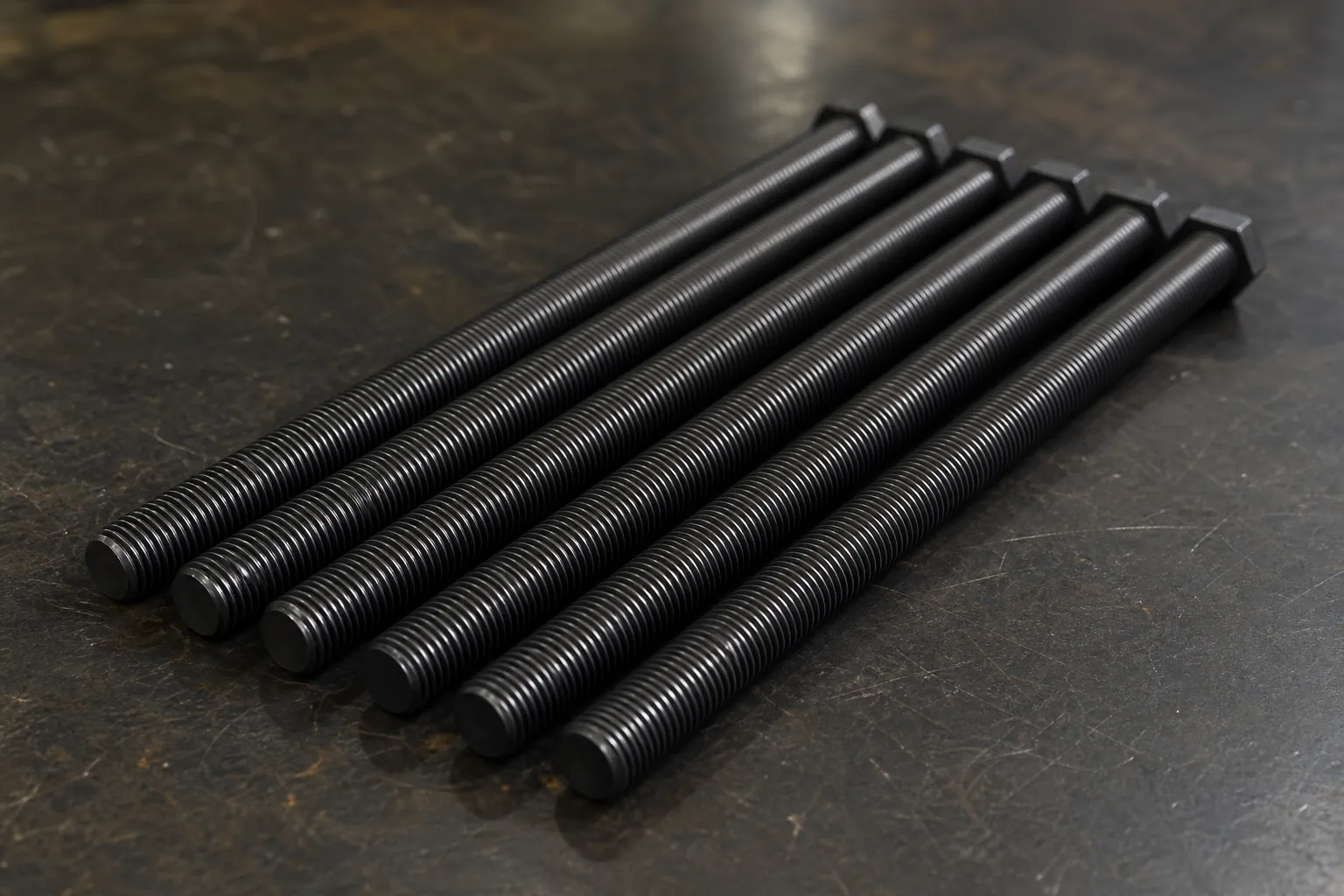
Byggingareiginleikar og áskoranir
- Hátt L/D hlutfall: 340 mm lengdin gerir boltann mjög viðkvæman fyrir fyrstu beygju upp á 0,5 mm – 1.5mm eftir hitameðferð.
- Nákvæmni kröfur: The client required straightness within 0.2 mm; the case acceptance records were held under 0.1 mm.
- Verndarkröfur: Réttarferlið verður að tryggja núll skemmdir á nákvæmni þráðar og yfirborðsgæði.
Why Heat Treatment Bends Long Bolts in the First Place
Understanding the distortion source is what makes a correction process defensible instead of decorative. During quenching, a long fastener cools unevenly: the section cools at different rates depending on orientation in the basket or fixture, agitation contact, and local mass differences between the plain shank, the threaded length and the head. Each cooling path wants to contract by a different amount, and the resulting locked-in stresses bend the part when it relaxes. The effect scales with length — which is why short bolts leave heat treatment usable while long ones of the same grade systematically arrive bent. Thread rolling and machining before treatment add their own stress history, and any straightening performed at the heat treater counts as prior deformation for everything done afterward.
Two practical consequences follow. Fyrst, incoming inspection on long heat-treated bolts is not optional paperwork — the bend magnitude and pattern arriving at the straightening station determine both the correction plan and any supplier conversation, and the interaction of prior deformation with correction response is the reason reverse-loading behavior matters, as covered under the Bauschinger effect in straightening. Í öðru lagi, process decisions upstream — how parts are racked or basketed through quench, whether stress relief is applied — change the distribution the straightening station sees, and are usually the cheapest place to reduce total correction work.
Reading the Bend Before Correcting It
Long fasteners arrive with a small vocabulary of bend patterns, and naming the pattern is the first step of an efficient correction loop. A single-arc bow — one gentle curve, maximum near the middle — is the most common heat-treatment signature and the most straightforward to correct with supports positioned around the peak. An S-shaped double bend has two opposite peaks, usually reflecting two constraint points during quench, and demands two coordinated corrections rather than one big press at the largest reading. A local kink near the head or the thread runout concentrates distortion where section stiffness changes, and behaves differently from a distributed bow. Loksins, twist about the axis occasionally accompanies bending on parts with asymmetric features. Each pattern requires its own measurement map and correction sequence, which is why an automatic station that scans the full length and builds the map before pressing — rather than chasing the single worst reading — converges in fewer strokes. The measuring-and-correcting loop behind this is described for automatic shaft straightening generally, and for the long-bolt family specifically in the automatic long bolt straightening process.
Af hverju verður að fjarlægja boltaréttingu “Handvirkt hamrað”
Hefðbundið ferli vs. Sjálfvirk lausn
The figures below are this client’s reported baseline and post-commissioning values, not a universal benchmark for every fastener line.
| Sársaukapunktur | Handvirkt hamrað / Manual Press | Sjálfvirk sléttunarlausn |
| Vinnuskilyrði | 8 workers per shift (manual baseline, reported case) | 1 operator for 4 vélar (reported case) |
| Réttleiki | 0.2 – 0.5 mm spread (reported manual baseline) | ≤ 0,1 mm (client acceptance records) |
| Cycle Time | 120 – 180 s/stk (reported manual baseline) | 10 – 15 s/stk (reported case) |
| Heildarkostnaður | High labor cost per corrected part | Manpower reduced from 8 operators to 1 supervising 4 vélar (reported case) |
Sjálfvirkt boltaréttingarferli
Þessi lausn nær yfir fullkomið sjálfvirkt ferli með lokuðum lykkjum frá fóðrun til flokkunar, tryggja að hver bolti uppfylli hágæða afhendingarkröfur.
Kjarnaferlislýsingar
- Sjálfvirk fóðrun: Beygðir boltar eru sjálfkrafa færðir úr hellu inn í réttunarstöðina án mannlegrar íhlutunar.
- Dýnamísk mæling: Hánákvæmir skynjarar skanna vinnustykkið sem snýst í rauntíma, ná nákvæmlega hámarks beygjupunkti yfir alla lengdina.
- Servó pressa: Snjallkerfið reiknar sjálfkrafa til baka út frá efninu (kolefnisstál/álblendi), og servóhrúturinn beitir nákvæmum þrýstingi fyrir leiðréttingu með einni umferð.
- Sjálfvirk flokkun: Hæfir boltar halda áfram á næsta stig, while non-conforming parts are automatically isolated before they leave the machine.

UBJ-80 Boltréttingarvél
Þessi slétta er tilvalin fyrir hitameðhöndlaða fullbúna hluta (e.g., stimplun/skrifstofuvélahluti, bíla/mótorhjólahlutir, verkfæri, skrúfur) og börum (stáli, kopar, áli, Ryðfrítt stál, títan ál) 60–600 mm að lengd & φ3–φ25mm þvermál. Það eykur bæði nákvæmni og vörugæði.
Kjarna viðleitni áskoranir og lausnir
Áskorun 1: Manning and the Reported “1 Rekstraraðili fyrir 4 Vélar” Case
Lýsing á vandamálum: Manual hammering and press correction depend on operator skill, stamina and shift discipline, so manning levels stay high and results vary from operator to operator.
Lausn:
Lausnin okkar útfærir full sjálfvirkni með lokaðri lykkju. Aðgerðarrökfræðin er afar einföld, með innbyggðum uppskriftum fyrir ýmsar boltaforskriftir. Venjulegur starfsmaður þarf aðeins að fylla á tankinn reglulega; restin — mæling, rétting, og skoðun - er meðhöndluð sjálfkrafa af vélinni. Þetta leysir skort á vinnuafli og útilokar nákvæmnisfall af völdum þreytu.
Áskorun 2: Tryggir samkvæmni innan 0,1 mm nákvæmni
Lýsing á vandamálum: Þegar bolti verður fyrir hamarshöggum, innri streitudreifing verður ójöfn, leiðir oft til ofleiðréttingar á staðbundnum svæðum.
Lausn:
Lausnin notar a fullkomlega stillt servóstýrikerfi. Ólíkt óljósum mannlegum dómi, skynjarar greina axial feril boltans með míkron-stigi nákvæmni. Í gegnum fjölþrepa servó reiknirit, kerfið sigrar nákvæmlega teygjanlegt afturfjöðrun S45C eða álblendis, locking final straightness within the 0.1 mm window achieved on this client’s qualified recipe.
How Thread and Head Zones Are Protected During Correction
Thread protection is a contact-zone engineering problem, and the principles are the same ones that govern surface-protection tooling across straightening applications. The correction force and the reaction forces both need somewhere to live, and on a long bolt the plain shank is the region designed to carry load, while the threaded length and the under-head fillet are the regions most easily damaged. A protection concept therefore has three parts: place supports on the shank at controlled span positions around the bend peak; direct press contact onto the shank through tooling that conforms to the section instead of touching thread crests; and keep every edge that could contact the workpiece generously radiused so load spreads instead of concentrating. Cleanliness belongs in the same sentence — debris trapped between press tooling and a thread flank is a scratch generator, and on plated or coated bolts the coating class defines how much contact the finish can tolerate at all.
The validation side is equally concrete. A thread-protection claim is proven by inspection agreed before the trial — thread gauges still running, flank condition reviewed under the method the quality function specifies — together with the released-state straightness result, on representative parts, after repeat setups. Protection and geometry are accepted together or not at all.
What an Acceptance Criteria Package Should Contain
A bolt straightening process is only as good as the acceptance definition it answers to, and a complete one answers five questions in writing. What characteristic governs — straightness of the axis, measured how: on centers, on supports, snúast, in what condition, since a reading under restraint is not a released result, per loaded versus released measurement practice. What the limit is, and where it applies — full length or specified spans. What else must survive the process — thread fit, yfirborðsfrágangur, húðun, head markings. How conformity is sampled — every part through an automatic gauge, or a sampling plan with defined reaction to a failure. And what happens to nonconforming parts — rework limits, segregation and disposition authority, following the NOK sorting and rework-limit framework. Buyers comparing straightening suppliers are well advised to ask for exactly this package; the ability to produce it says more about a supplier than any single machine specification.
Framleiðsluhylki: Fjórði val indverska viðskiptavinarins
Bakgrunnur viðskiptavina
Vel þekktur indverskur festingabirgir sem útvegar íhluti fyrir alþjóðleg vörumerki byggingarvéla.
Framkvæmd Niðurstöður
- Endurteknar pantanir: Byggt á framúrskarandi frammistöðu fyrstu þriggja eininganna, viðskiptavinurinn keypti nýlega sína 4th vél.
- Operator Consolidation: The client reported one operator managing all 4 machines after commissioning, with a substantial increase in output per operator.
- Gæðaviðmið: The client’s records report straightness moving from 0.2 mm down to under 0.1 mm after commissioning.
Algengar spurningar
- Q: Mun sléttunarhrúturinn skemma boltaþræðina?
- Nei. Við höfum hannað án snertingar, dempuð hlífðarmót sérstaklega fyrir boltaréttingu. Pressukubbarnir passa fullkomlega við sveigju boltans, tryggir jafna kraftdreifingu og forðast innskot á yfirborði.
- Q: Getur búnaðurinn fellt inn í MES kerfi verksmiðjunnar okkar?
- Já. Stýrikerfið okkar er með staðlað gagnaviðmót til að skrá og flytja út rauntíma réttunargögn fyrir hverja bolta, uppfylla nútíma kröfur um rekjanleika.
Additional Process Questions
Why do bolts from the same heat-treatment lot arrive with different bend patterns?
Because each part’s position in the basket or rack gave it a different cooling path. Quench distortion is sensitive to orientation, local mass and agitation contact, so even identical bolts leave treatment with different locked-in stress patterns. Mapping incoming parts rather than assuming a uniform error is the practical answer, and it is why scanning-based stations build a per-part correction plan.
How many correction passes does a long bolt need?
It depends on the pattern, not a fixed number. A single-arc bow typically converges in one planned press; an S-bend needs two coordinated corrections; local kinks near section changes respond differently again. The governing rule is a rework limit set before production — parts that stop responding are routed to review, not pressed repeatedly, because each additional plastic cycle consumes fatigue life and changes the material’s response.
Should straightening come before or after thread rolling?
The route belongs to the fastener process engineer, but the trade-off is explicit: correcting before thread rolling lets subsequent operations work from a straight blank, while correcting after heat treatment with finished threads demands the contact-zone protection described above. Whichever route is chosen, the acceptance package must define what state the straightness limit applies to, and the correction validation must be run on parts carrying that state.
Samantekt
Fyrir festingarverksmiðjur sem sækjast eftir mikilli skilvirkni og gæðum, an Sjálfvirk lausn fyrir boltaréttingu er nauðsynleg leið til aukinnar samkeppnishæfni. Whether the target is lower manning or 0.1 mm delivery precision, the figures in this article are one client’s reported case; your own results depend on the bolt family, incoming distortion and acceptance definition.
Ef þú stendur frammi fyrir vinnustjórnunarvandamálum eða nákvæmni flöskuhálsum, ekki hika við Hafðu samband fyrir sérsniðna tæknitillögu.