
Η ωογένεια του σωλήνα και η ευθύτητα της κεντρικής γραμμής είναι διαφορετικές γεωμετρικές συνθήκες. Η οβάλια αφορά το σχήμα μιας διατομής; η ευθύτητα της κεντρικής γραμμής αφορά τη διαδρομή του σωλήνα κατά μήκος του. Ένας σωλήνας μπορεί να έχει αποδεκτή γεωμετρία κεντρικής γραμμής αλλά να μην είναι στρογγυλός σε έναν σταθμό, ή μπορεί να είναι στρογγυλό σε κάθε μετρημένο τμήμα, ενώ η κεντρική του γραμμή πλέκεται σε μεγάλο άνοιγμα. Η αντιμετώπιση αυτών των συνθηκών ως μία τιμή «ευθύτητας» μπορεί να οδηγήσει σε λανθασμένη απόφαση διαδικασίας.
Αυτός ο οδηγός είναι ένα πλαίσιο μέτρησης και αποδοχής. Δεν διεκδικεί σειρά σωλήνων StraighteningTech, ικανότητα τοίχου, μετρητής, αισθητήρας, ανοχής ή επικυρωμένης διόρθωσης. Οι τελικές απαιτήσεις πρέπει να προέρχονται από το ελεγχόμενο σχέδιο, μέθοδος αναφοράς και αντιπροσωπευτικά δείγματα.

*Μηχανική έννοια εικονογράφηση. Απεικονίζει ένα πλαίσιο διαδικασίας ισιώματος σωλήνα, δεν αποτελεί απόδειξη ότι μια συγκεκριμένη οικογένεια σωλήνων ή κατάσταση τοιχώματος μπορεί να υποστεί επεξεργασία.*
Define Each Characteristic Before Measuring Either
Ovality is a per-station property: every measured cross-section has its own value, and a tube inspected at twelve stations has twelve ovality values that can differ. Centerline straightness is a whole-length property: it is derived from the path traced by the successive centers of those cross-sections. The two characteristics do not merely describe different defects — they live at different levels of the measurement chain, and the higher level is computed from the lower one.
That dependency is the hidden coupling. A centerline is not measured directly; it is computed, station by station, from sections that are never perfectly round. Whichever rule converts a measured section into a single center point — the average of two diameters, a least-squares circle center, a minimum-zone circle center, or the center a two-point gauge happens to report — becomes part of the straightness definition. Two inspection methods can therefore disagree about the centerline of the same physical tube while each is internally consistent, because they embedded different center-finding rules.
The acceptance documents should state, for each characteristic: the formula (diameter-based ovality, radial-deviation-based ovality, or a full form tolerance), the center-finding rule feeding the centerline calculation, and the station set over which each value applies. A single “straightness OK” record that does not say which rules produced it is not transferable between supplier and customer gauges.
Μετρήστε τη διατομή και τη γεωμετρία κατά μήκος με τα κατάλληλα στηρίγματα
Οι θέσεις στήριξης μπορούν να επηρεάσουν την εμφανή κεντρική γραμμή μέσω της πτώσης; Η σύσφιξη μπορεί να επηρεάσει ένα τμήμα λεπτού τοιχώματος; Η επαφή του ανιχνευτή μπορεί να επηρεάσει την απόκριση της επιφάνειας ή του τοίχου. Ως εκ τούτου, η διαδικασία θα πρέπει να ορίζει τις προϋποθέσεις για κάθε χαρακτηριστικό και να επαναλαμβάνει/επαναφέρει τους ελέγχους όπου χρειάζεται.
| Έλεγχος μέτρησης | Γιατί έχει σημασία |
|---|---|
| Σταθμός διατομής και προσανατολισμός | Το οβάλ μπορεί να ποικίλλει κατά μήκος και γύρω από την περιφέρεια |
| Διαμήκη άνοιγμα και στηρίγματα | Οι μετρήσεις κεντρικής γραμμής μπορούν να περιλαμβάνουν εφέ βαρύτητας και προσαρτήματος |
| Σημείο αναφοράς και τελική κατάσταση | Καθορίζει εάν το αποτέλεσμα σχετίζεται με την προβλεπόμενη λειτουργία |
| Επαφή ή οπτική μέθοδος | Μπορεί να εισάγει διαφορετική επιφάνεια, όρια πρόσβασης και αβεβαιότητας |
| Κατάσταση απελευθέρωσης | Αποτρέπει την αναφορά του προσωρινού περιορισμού ως τελικής γεωμετρίας |
Support Spacing Filters the Centerline Signal
On a measured span, supports act as a mechanical filter for the centerline reading: bending content with a wavelength shorter than the support spacing is partially suppressed by the stiffened sections, while longer-wavelength bow passes into the reading. The same tube can therefore report different bow on a short fixture span than on a long one without either reading being wrong. The support span is not a setup convenience — it is part of the straightness definition, and it must match, or be explicitly correlated to, the span used by the customer gauge.
Station spacing plays the analogous role in the sampling domain. Widely spaced stations under-sample the centerline path and can miss a local kink between stations; very dense stations begin to mix surface and wall-thickness variation into the computed axis. The sampling plan should state where stations sit — not only how many — because the informative stations are the support points, the clamping points, the tube ends and the neighborhoods of expected bend peaks.
On thin-wall tubes the supports carry a second, unwanted effect: support reaction can ovalize the section locally, so the ovality measured at a support station includes a measurement-induced contribution. Comparing readings at supported stations against readings taken just outside the support influence is a cheap check for this; where the difference is significant, the ovality acceptance must be evaluated at defined free stations. For the loaded-versus-released distinction in final acceptance, βλέπω μέτρηση ευθύτητας φορτωμένης έναντι απελευθέρωσης.
Μην διορθώσετε το ένα λάθος και υποθέστε ότι το άλλο έχει λυθεί
Μια διαδικασία διόρθωσης που αποσκοπεί στη μείωση του τόξου μπορεί να αλλάξει την κατάσταση του ωοειδούς ή του τοίχου. Μια διαδικασία που αποσκοπεί στη βελτίωση της φόρμας ενότητας ενδέχεται να μην καθιερώνει ευθύτητα κεντρικής γραμμής. Το σχέδιο δείγματος πρέπει να ορίζει ποια γεωμετρία ελέγχεται, ποια δευτερεύοντα χαρακτηριστικά ελέγχονται, όπου επιτρέπεται η επαφή και όταν απαιτείται ανεξάρτητη διαδικασία.
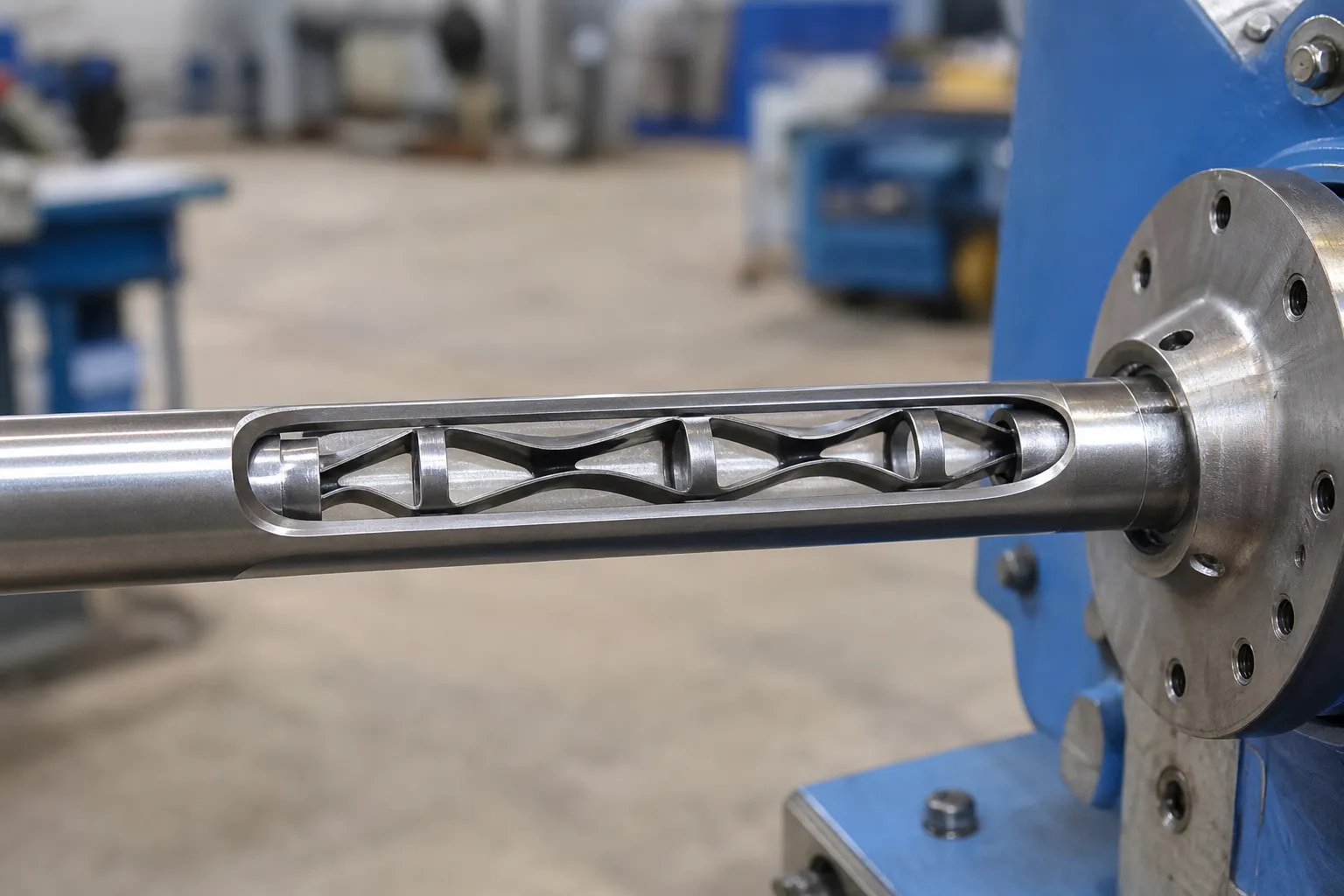
*Μηχανική έννοια εικονογράφηση. Παρουσιάζει εσωτερική υποστήριξη ως υποψήφια ερώτηση μηχανικής; Δεν είναι ισχυρισμός ότι τα εσωτερικά εργαλεία είναι στάνταρ ή κατάλληλα για κάθε σωλήνα.*
Για μη στρογγυλά κοίλα τμήματα, see square and rectangular tube straightening. Για κοίλα περιστρεφόμενα μέρη, βλέπω ίσιωμα κοίλου άξονα με λεπτό τοίχωμα.
Separate the Two Signals Before Accepting Either Reading
The two characteristics contaminate each other's measurements in specific, diagnosable ways. In a rotating single-probe trace at one station, the radial signal contains at least the local form error of the section and the offset of the section center from the rotation axis. Ovality-dominated form error appears primarily as a second harmonic — the trace repeats twice per revolution, with the ovality major axis setting the phase. A center offset appears as a first harmonic — one bump per revolution. Within a single trace the two are separable in principle, but the first harmonic itself is ambiguous: a genuine bend and a seating or chucking offset produce the same single-station signature. The discriminators live outside the single trace. Across stations, a bend changes amplitude with longitudinal position and follows the bend plane, while a seating offset keeps a constant amplitude and a phase locked to the rotation axis. That multi-station logic, together with the harmonic fingerprints of lobing and datum effects, is developed in στρογγυλότητα vs κάμψη στην περιστρεφόμενη μέτρηση.
The contamination also runs the other way. A probe scanned along the tube reads the local surface, όχι ο άξονας: a tube that is straight on its centerline but drifting in ovality orientation along its length produces a lengthwise trace that looks like bow. A practical two-scan check costs little: scan the length in one direction, then in the orthogonal direction — by rotating the tube ninety degrees against the same probe, or by using a second probe at right angles. Compare the two traces. A centerline bow decomposes into the two directions as projections of one vector: the two traces are similar in shape and same in sign, each a scaled copy of the other. Section form does the opposite: where the ovality major axis lies in the first scan direction it lies across it in the second, so a peak in one trace corresponds to a valley in the other. Traces that are same-shape-same-sign nominate a bend; traces that are opposite-sign at particular stations nominate form and wall variation. Only the first category should go to a correction decision.
Wall-thickness eccentricity adds a third layer on drawn or rolled tube: the outside surface and the bore are not concentric, so a centerline computed from outside-diameter measurements and one computed from bore measurements will not coincide. Neither is wrong; they answer different functional questions. Which one governs acceptance must follow the function of the part in its assembly — and the drawing, not whichever gauge happens to be available, defines it. Thin-wall behavior during correction has its own failure modes, covered in ίσιωμα σωλήνα λεπτού τοιχώματος χωρίς κατάρρευση.
Δημιουργήστε ένα σχέδιο συσχέτισης μετρητών πελατών
Η δοκιμή θα πρέπει να χρησιμοποιεί αντιπροσωπευτικά κανονικά και χειρότερα σωληνάρια, ακατέργαστες αναγνώσεις και για τα δύο χαρακτηριστικά, συμφωνημένες συνθήκες υποστήριξης και έκδοσης, επαναλάβετε τη ρύθμιση, έλεγχοι επιφανειών/τοίχων, και σύγκριση με το μετρητή πελάτη. Η εγγραφή πρέπει να αναφέρει εάν μια ένδειξη είναι τιμή διαδικασίας μηχανής, μια αξία αποδοχής από τον πελάτη ή ένα συσχετισμένο αποτέλεσμα.
Χρήση μετρητής μηχανής έναντι συσχέτισης μετρητή πελάτη και δοκιμή και αποδοχή δειγμάτων ευθυγράμμισης για τον καθορισμό του πακέτου αποδεικτικών στοιχείων.
Run Two Separate Acceptance Chains, Not One
Because the definitions, supports and failure modes differ, ovality and centerline straightness each need their own chain from drawing language to signed record. Collapsing both into one generic “geometry OK” leaves every link below ambiguous:
| Chain link | Ovality chain | Centerline chain |
|---|---|---|
| Characteristic and formula | Which deviation rule, applied per station | Which span governs, and which center-finding rule feeds the path |
| Μέθοδος αναφοράς | Section measurement at defined stations | Lengthwise scan or rotating trace on defined supports |
| Support and release | Free stations distinguished from supported stations | Span defined; sag and clamping effects addressed or correlated |
| Sampling | Station positions fixed by the specification, όχι από ευκολία | Station spacing short enough to resolve the shortest expected bend |
| Δυνατότητα μετρητή | Repeatability proven against within-part form variation | Repeatability proven against part-to-part and setup variation |
| Συσχέτιση | Machine gauge vs customer gauge on the same sections | Machine gauge vs customer gauge on the same span and supports |
| Ρεκόρ | Per-station values with rule and station identity | Path result with support span and filtering stated |
Each link is a place the chain silently breaks. An unstated formula makes two gauges' numbers incomparable. A support condition defined at the machine but not at the customer builds a systematic offset into every correlation attempt. An unspecified station set makes the verdict depend on where the operator happened to measure. And an unproven gauge capability converts measurement noise into apparent process drift, which the correction loop then chases. Validating the measurement system before trusting any of these numbers is covered in gage R&R για ίσιωμα γραμμών.
FAQ
Μπορεί ένας σωλήνας να είναι ίσιος αλλά όχι στρογγυλός?
Ναί. Η ευθύτητα της κεντρικής γραμμής και η οβάλ είναι διαφορετικές συνθήκες και απαιτούν ξεχωριστή μέτρηση. In practice the two belong in the same inspection record but under different characteristic numbers, each with its own formula, station set and gauge correlation.
Μια στρογγυλή διατομή αποδεικνύει ότι ο σωλήνας είναι ευθύς κατά το μήκος του;?
Οχι. Ένας σωλήνας μπορεί να είναι στρογγυλός στα μετρημένα τμήματα ενώ η κεντρική του γραμμή έχει τόξο ή σκούπισμα. A lengthwise scan reads the surface rather than the axis, so the orthogonal two-scan comparison above is what keeps form effects out of the straightness verdict.
Μπορεί μια διαδικασία διόρθωσης να εγγυηθεί και τα δύο αποτελέσματα?
Όχι χωρίς επικύρωση για το τεμάχιο εργασίας. Η διαδικασία πρέπει να μετρά και να επαληθεύει κάθε χαρακτηριστικό που απαιτείται από το σχέδιο. In particular, a process validated for bow says nothing about its effect on section form at contacts, supports and free stations — those need their own before-and-after readings.
How can we tell whether a straightness reading is contaminated by ovality?
Repeat the lengthwise scan in the orthogonal direction and compare the traces. Same shape and same sign across the two scans is the signature of a centerline bow; opposite sign at particular stations points to section form or wall variation. Rotating single-station traces add a second test: a bend changes amplitude between stations, while a seating offset does not.
Does ovality need to be measured at every cross-section?
Only the specification can answer that. What the acceptance plan must guarantee is that the station set is fixed in advance — typically including supports, σφιγκτήρες, ends and the neighborhoods of bend peaks — so the verdict does not depend on where an operator happened to check.
*Εικονογράφηση έννοιας μηχανικής.*